Skip to content
DevMeme
3855 of 7435
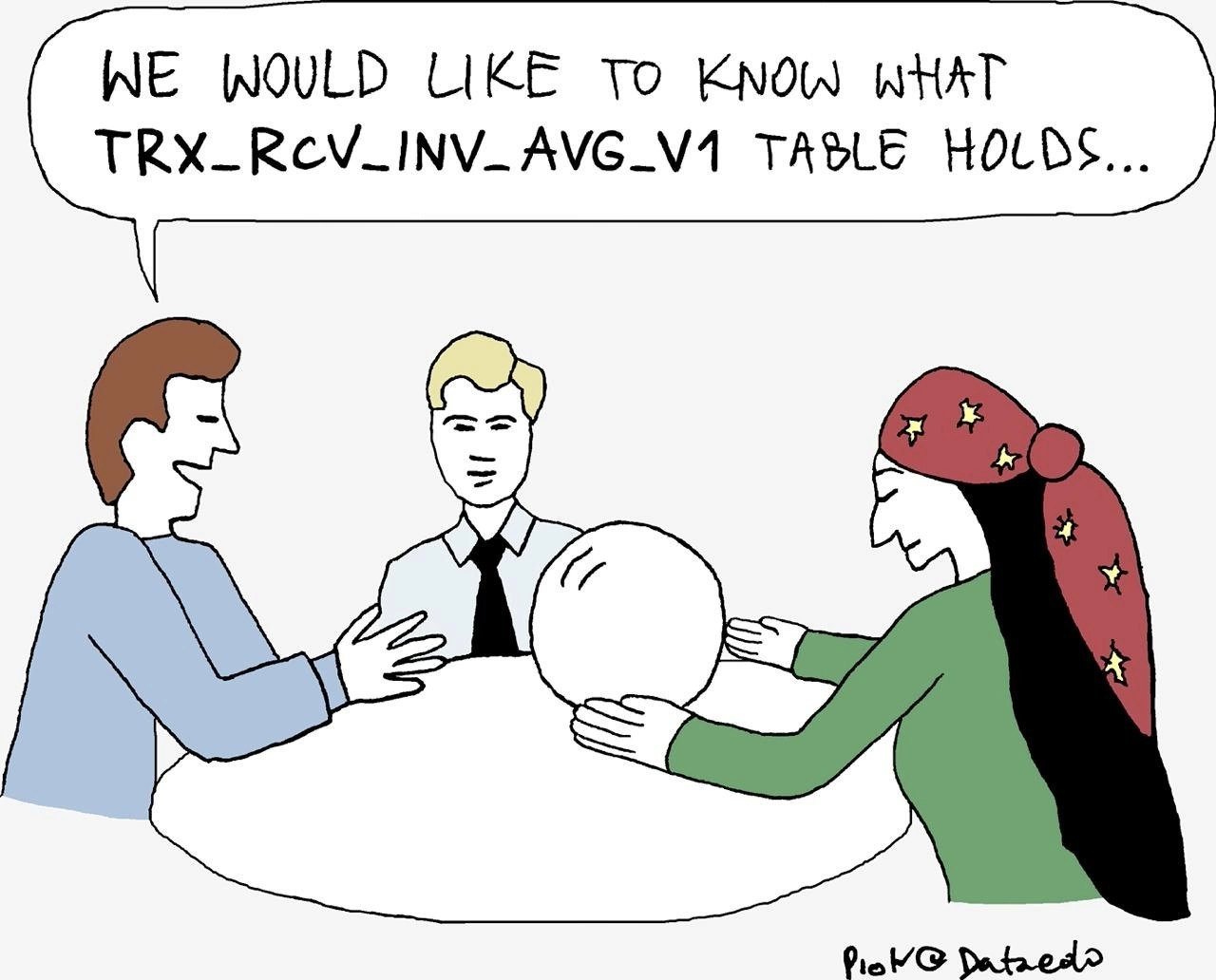
Consulting a fortune teller to decipher cryptic TRX_RCV_INV_AVG_V1 database table
Databases Post #4198, on Feb 11, 2022 in TG

Consulting a fortune teller to decipher cryptic TRX_RCV_INV_AVG_V1 database table

Why is this Databases meme funny?

Level 1: No Label, No Clue

Imagine you find a big box in the attic with a weird code like "XJ_12_RB" written on it, and no one knows what's inside. You try shaking it and listening for clues, but you still have no idea. You might even joke, "Maybe we need a wizard or a fortune teller to figure out what's in this box!" Sounds silly, right? But that's exactly what's happening in this picture: the people at the table have a mystery box in their computer world (a piece of data with a confusing name) and no label or note to tell them what it is. They're so stuck that they're play-acting like they need magic to peek inside. The funny part is seeing normally logical, tech-savvy people throw up their hands and say, "Well, maybe magic will help!" – it shows just how lost they feel when something important isn’t labeled or explained.

Level 2: Naming Things Is Hard

In this cartoon, a programmer and his manager are literally asking a fortune teller for help with a database question. The question: "What does the TRX_RCV_INV_AVG_V1 table hold?" The joke is that the table’s name is so cryptic and there's zero documentation, the team might as well use supernatural means to find out. Normally, if you want to know what data a table contains, you would check the documentation or at least look at the code that writes to that table. But if none of that exists, you're stuck guessing. It can honestly feel like you need a crystal ball to figure out something that should be simple!

Let's unpack that scary-looking name. TRX_RCV_INV_AVG_V1 is written in all caps with underscores, which usually means it's made of abbreviations (very common in old enterprise databases). We can try to decode it part by part:

Part of Name Possible Meaning
TRX probably Transaxtion (transaction)
RCV maybe Receive or Received
INV could mean Invoice or Inventory
AVG most likely Avg (Average)
V1 probably Version 1 (first version)

So one educated guess is this table holds something like "transaction receive invoice averages". It’s not immediately clear – is it averaging invoices received? Or average values of inventory transactions? We’d need more context to be sure. And that's the big problem: without any documentation or comments, the developers can only guess the purpose of this table.

In a well-run project, you'd have a data dictionary or at least some notes that say, "Table TRX_RCV_INV_AVG_V1 stores the average of X for Y" (whatever X and Y actually are). A data dictionary is basically a reference guide for all the tables and columns in the database, explaining what they are and how they're used. Many large companies with complex systems (especially older ERP systems – big business software for things like finance and inventory) try to maintain these guides. But over time, such documentation can get lost or outdated, especially if the system is very old and nobody kept it up.

Let's go over a few relevant terms from this scenario:

  • Database table: A structured collection of data in a database, kind of like a spreadsheet with rows and columns. Each table has a name and stores a specific type of information. For example, a table named Customers would hold customer details. Here, our table’s name isn’t straightforward like that; it's a bunch of abbreviations strung together, which makes it hard to tell what’s inside.
  • Naming convention: A set of rules or patterns for naming things (like tables or variables) so that names are consistent and meaningful. For instance, a naming convention might say "use full words in English for table names" or "use three-letter abbreviations for module names". Maybe whoever named TRX_RCV_INV_AVG_V1 was following a convention that made sense to them at the time (like prefixing with TRX for any transaction-related tables). But if you're not familiar with that pattern, the name looks like gibberish.
  • Documentation gap: This refers to information that is missing or not documented where it should be. In our case, the gap is that the table name alone isn't enough to tell us its purpose, and there's no additional document or comment explaining it. It's like receiving a jar with a code on it but no label – you know something is inside, but you have no official clue what it is.
  • Legacy system: A polite term for an old system or software that’s still in use. Legacy systems have often been maintained by different people over many years, and they carry a lot of historical baggage. Things might not be well-documented because the folks who originally built it have moved on, and their knowledge left with them. This table is likely part of a legacy system – it's been around forever, doing its job in the background, and now no one currently working on the project fully remembers its story.
  • Technical debt: When shortcuts or quick-and-dirty solutions in the past force you to do extra work in the future, that's technical debt. Not having clear names or documentation is a classic example. The "debt" here is the extra time and effort the current developers must spend to understand or fix things because earlier, someone didn't invest the time to do it right. Over the years, this debt "accrues interest" – meaning the problems get worse or harder to tackle. In our scenario, all those unclear names and missing docs are finally demanding payment: the team has to waste time sleuthing or, humorously, consulting a faux fortune teller to bridge the knowledge gap.

So in the cartoon, instead of a quick answer, the team is basically stuck doing a detective mission to learn what should have been obvious. The fortune teller is a humorous exaggeration: since they can't find the answer by normal, logical means, they joke that maybe some magic will do the trick. It highlights just how helpless one can feel when dealing with a black-box mystery in an old system. It’s funny because it mixes the world of programming (which relies on logic and evidence) with the idea of supernatural help. In reality, no one is going to literally hire a psychic for a database problem, but the joke nails the emotion — "I have no idea what's going on here, and I'm so desperate I'd try anything, even wizardry!" Every developer who has inherited a poorly documented legacy system chuckles (and maybe cringes) at that feeling.

Level 3: Schema Séance

"We would like to know what TRX_RCV_INV_AVG_V1 table holds..."

That single plea from the developer in the cartoon sets the stage for an almost ritualistic quest to find meaning in a cryptic database schema. In this scene, the engineers have literally brought in a fortune teller, crystal ball and all, to divine the purpose of a table named TRX_RCV_INV_AVG_V1. It's an absurdist twist on a situation that's all too familiar in enterprise IT: when your legacy system is so under-documented and arcane that you might as well be conducting a séance to contact the spirit of the original developer.

This table name reads like a license plate in a code cryptogram. Is it Transaction Received Invoice Average, Version 1? Or maybe Transaction Records: Inventory Averages, v1? The name is a jumbled acronym soup, the kind that arises from long-forgotten naming conventions or brutal 30-character identifier limits from the '90s. In many legacy systems, older database tables carry such cryptic abbreviations because either someone was trying to save space or follow an internal shorthand. Over years, that shorthand becomes lost to time. A name like TRX_RCV_INV_AVG_V1 might have made sense to one programmer a decade ago (probably documented only in their head or a long-gone email), but today it's just indecipherable noise to everyone else.

When faced with a mysterious table like this, veteran developers go through a coping ritual before resorting to mystical solutions:

  • Denial: "Surely there must be documentation or a data dictionary for this." (Spoiler: there isn’t.)
  • Anger: "Who on earth named this table?!" (Usually followed by some unpublishable expletives.)
  • Bargaining: Scour the entire codebase with search tools, hoping to find a query or comment that explains it. Maybe an ancient commit message holds a clue (e.g., "Added TRX_RCV_INV_AVG_V1 for new req" helpful).
  • Depression: Realize even the old-timers have no clue. The last person who understood this table left the company years ago. You open the table and stare at the data itself, trying to read patterns like tea leaves in the hope of gleaning its purpose.
  • Acceptance (Séance time): "Alright, time to break out the crystal ball." In other words, jokingly concede that you might need to summon the spirit of the ex-DBA to figure this out.

By the time you're metaphorically (or literally, as the meme exaggerates) consulting a fortune teller, you’ve hit peak technical debt. This is the kind of debt that accumulates when nobody bothers to maintain documentation or clean up ugly old code. Each quick fix and poorly named table is a debt that future developers must pay off with interest – that interest being hours of frustration and guesswork. The documentation gap here is so wide that engineers feel like archaeologists deciphering hieroglyphs or cryptographers cracking a code. The fortune teller gag is funny because it rings true: when logic, code, and queries fail to answer "What does this do?", bringing in a mystical advisor starts to feel like the next best option.

On a serious note, this meme is a cautionary tale about why clear naming and docs matter. Naming things in programming is deceptively hard – a table name like Transactions_Received_Invoices_Average would have been long but at least somewhat descriptive. Instead, we got TRX_RCV_INV_AVG_V1, which only the original author (and their crystal ball) could fully decode without help. A proper database schema documentation (or even just a comment in the code) could have saved the team from this occult exercise. In real life, the "fortune teller" would be replaced by digging through old design documents or Slack messages to someone who might remember. But if those don’t exist, you really do end up relying on intuition and piecing together clues.

The humor hits home for developers because it's a shared experience across the industry. Whether it’s a bizarre table name, a weirdly named function, or a config flag called ENABLE_XYZ_V2_LEGACY_MODE with no explanation, we've all been there. It's equal parts frustrating and darkly comic. So the team in the comic turning to a crystal ball is a tongue-in-cheek way of saying: "We’re completely in the dark here – might as well ask the universe for help!" As a grizzled veteran might quip: Any sufficiently advanced legacy system is indistinguishable from magic. In other words, when a system becomes so old and poorly documented, figuring it out feels less like engineering and more like sorcery.

Description

Cartoon-style drawing of three people around a round table. On the left a brown-haired man in a blue shirt speaks; in the middle a blond office worker in shirt and tie looks on; on the right a fortune-teller with a red star-patterned headscarf and green blouse holds a crystal ball. A speech bubble from the man reads, “WE WOULD LIKE TO KNOW WHAT TRX_RCV_INV_AVG_V1 TABLE HOLDS…”. The scene parodies developers turning to mysticism because a table with an impenetrable name lacks documentation. The joke highlights real-world pain points around poor database naming conventions, missing data dictionaries, and accumulated technical debt that forces engineers to guess a schema’s intent like clairvoyants

Comments

11
Anonymous ★ Top Pick SELECT * FROM crystal_ball WHERE table_name = 'TRX_RCV_INV_AVG_V1';  -  the sanctioned workflow after the last DBA with context took early retirement
  1. Anonymous ★ Top Pick

    SELECT * FROM crystal_ball WHERE table_name = 'TRX_RCV_INV_AVG_V1';  -  the sanctioned workflow after the last DBA with context took early retirement

  2. Anonymous

    After 20 years in enterprise software, I've learned that TRX_RCV_INV_AVG_V1 is actually the optimistic version - wait until you discover TRX_RCV_INV_AVG_V1_FINAL_FINAL_USE_THIS_ONE_2023_BACKUP

  3. Anonymous

    The séance failed - the original DBA's spirit refused to testify without the V0 table, which was dropped in 2009 along with the only documentation

  4. Anonymous

    After 15 years in enterprise software, you realize the real 'magic' isn't in the algorithms - it's convincing yourself that TRX_RCV_INV_AVG_V1 was a reasonable name when someone created it in 2003, and that the one person who knew what it meant retired in 2011 without writing a single comment. The crystal ball is honestly more reliable than grep-ing through stored procedures written in PL/SQL by contractors who were paid by the line

  5. Anonymous

    If your data model needs a seance to decode TRX_RCV_INV_AVG_V1, that’s not governance; that’s distributed folklore

  6. Anonymous

    Team policy: if you can infer what TRX_RCV_INV_AVG_V1 does without a séance, you’re the table owner and get to maintain its lineage graph

  7. Anonymous

    When the DBA who named it retires, TRX_RCV_INVL_AVG_V1's purpose retires too - time for schema séances

  8. @RiedleroD 4y

    I would like to know why my dad thinks he knows more about Rust than me when he's never ever used Rust.

  9. @dsmagikswsa 4y

    TRX = transaction RCV = receive INV = invoice avg = average v1 = version1 V could be view But I use vw_ in the beginning

  10. @tyranron 4y

    When nominal typing fails and structural typing shines.

  11. @SamsonovAnton 4y

    Is this how databases are restored now, instead of classic backups?

Use J and K for navigation