The Anatomy of a 'Quick' Production Fix
Why is this OnCall ProductionIssues meme funny?
Level 1: Tiny Fix, Big Mess
Imagine you’re playing with a big tower of blocks. You see one little block that’s slightly out of place, and you think, “I’ll just fix that real quick.” You carefully pull it out to straighten it… and suddenly CRASH! – the whole tower comes tumbling down. What was supposed to be a quick, tiny fix turned into a big mess.
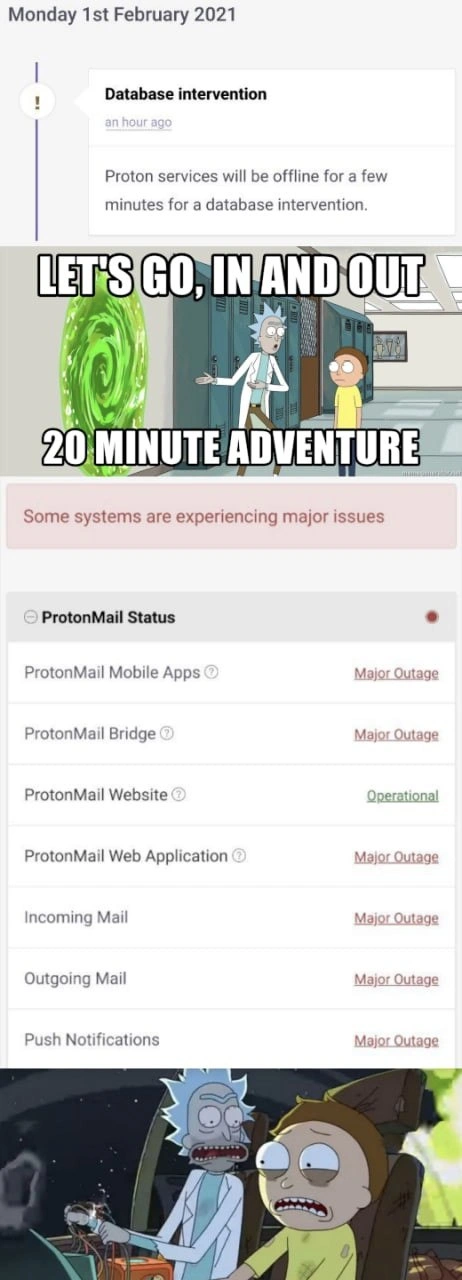
This meme is joking about that exact feeling, but with computers. The “tower of blocks” here is a big email service (ProtonMail). The engineers thought they were doing something small and fast (like taking the database down for just a moment to tweak it – kind of like adjusting that one block). They even said it would only take a few minutes, like saying “I’ll be done before you know it!” But just like the tower collapsing, their small change accidentally broke everything for a while. The picture from the cartoon show Rick and Morty with the characters looking panicked is like the face you make when you realize, “Uh-oh, I messed up big time.” It’s funny in the way that sometimes you have to laugh about a big oopsie once it’s over and everything is okay again.
So, in super simple terms: they tried to fix one little thing, and it caused a giant problem. Everyone who has ever tried to quickly fix something – whether it’s a toy, a game, or a computer – and had it go terribly wrong can chuckle at this. It’s a funny reminder that sometimes a “quick fix” can become an adventure you didn’t plan for!
Level 2: What Could Possibly Go Wrong?
Let’s break down the meme in simpler terms. It highlights a common DevOps/SRE nightmare: a small planned change causing a big unplanned problem. Here’s what’s happening step by step:
Database intervention: ProtonMail planned a maintenance task for their database. A database is like the central data storage for all ProtonMail services (user accounts, emails, etc.). When they say “offline for a few minutes,” they intended to take the database down briefly to make a change (like fixing something or improving performance). This planned downtime is often scheduled during a maintenance_window – a time when fewer users are online – to minimize disruption.
“In and out, 20 minute adventure”: This quote comes from Rick and Morty, a popular sci-fi cartoon. In the show, Rick tells Morty a task will be quick and easy, which of course goes horribly wrong. In the meme, it represents the team’s optimistic attitude: they truly thought the database update would only take 5-20 minutes. In other words, “It’s just a small change, what could go wrong?”
Status page red alert: ProtonMail, like many companies, has a status_page (a website where they post the status of their services). Initially it likely showed a notice about the maintenance. But then things went awry. The meme shows a red banner: “Some systems are experiencing major issues.” That’s a polite way of saying “uh-oh, stuff is down.” Below it, the ProtonMail Status list shows multiple components with Major Outage in red. This means those parts of ProtonMail are not working at all. For example:
- ProtonMail Mobile Apps – Major Outage: The phone apps couldn’t connect to the service.
- ProtonMail Bridge – Major Outage: ProtonMail Bridge (a desktop app to integrate ProtonMail with other email clients) wasn’t working either.
- ProtonMail Web Application – Major Outage: This is the main webmail interface. “Major Outage” means users couldn’t log in or read/send emails via the web.
- Incoming Mail – Major Outage / Outgoing Mail – Major Outage: No emails coming in, no emails going out. Essentially, the email delivery system was down.
- ProtonMail Website – Operational: Interestingly, this one was still green (operational). That’s just the basic website (informational pages). So the homepage was up, but the actual mail services were down.
In short, almost everything that makes ProtonMail a mail service was broken during this incident.
Why did a tiny change break everything? Think of the database as the heart of ProtonMail’s operations. All these services (web app, mobile app, mail delivery, etc.) feed into or from that heart. The team likely performed a change like updating the database structure or settings. If the database is offline or unresponsive even for a bit longer than expected, all the other parts that rely on it can’t do their job. For example, if the database was taken down to add more storage or alter a table, the email services would be unable to fetch or store messages during that time. They probably expected a brief pause. But if the “pause” extends or something goes wrong (say the change is taking too long, or caused an error), those dependent services start failing. It’s a chain reaction: one failure causes another in a Production environment if you haven’t isolated each part. This is why we suddenly see major_outage for multiple systems.
On-call firefighters: In the world of OnCall and ProductionIncidents, when something like this happens, engineers (Site Reliability Engineers or DevOps engineers) get paged immediately. Their phone or pager will buzz to alert them that services are down. They have to jump in to fix the issue ASAP. You can imagine the team at ProtonMail rushing to the computers, much like Rick and Morty panicking in that last image. The term incident_escalation means the problem got serious enough that more people/levels of support had to get involved. A “five-minute tweak” became an all-hands emergency.
The meme’s punchline: The last panel from Rick and Morty shows Rick driving frantically and Morty looking utterly shocked, which is exactly how a team feels after fighting to get the system back online. The reason developers find this funny is because it’s a little too relatable – many of us have confidently said “Oh, this update is simple, it’ll be quick,” only to end up sweating as everything crashes. It’s a form of OnCallHumor: laughing at the absurdity of how wrong things can go, after the fact. At the time it’s stressful, but later on, you joke about it to cope.
In summary, ProtonMail’s “quick database maintenance” didn’t go as planned. The whole platform (except the static website) went down for a while, all because of that one change. The meme uses a pop culture reference (Rick and Morty’s 20-minute adventure gone wrong) to make light of a situation that every developer or SRE dreads. If you’re new to IT, the lesson is: even a small change to a critical system can have huge consequences. Always have a backup plan and never underestimate a seemingly simple fix!
Level 3: Scheduled Downtime, Unscheduled Chaos
ProtonMail’s status page on February 1, 2021 began with reassuring words:
Proton services will be offline for a few minutes for a database intervention.
Famous last words in the ops world. What was supposed to be a routine maintenance_window – a quick tweak to the production database – turned into a full-blown ProductionOutage spanning multiple services. The meme brilliantly captures this with a scene from Rick and Morty: Rick opens a portal confidently declaring “Let’s go, in and out, 20 minute adventure,” implying the maintenance will be trivial. But by the next panel, a red banner quietly admits “Some systems are experiencing major issues.” Below that, the ProtonMail status board lights up like a Christmas tree of failure: ProtonMail Mobile Apps – Major Outage, ProtonMail Bridge – Major Outage, ProtonMail Web Application – Major Outage, Incoming Mail – Major Outage, Outgoing Mail – Major Outage. (At least the static ProtonMail Website stayed Operational, so the status page itself didn’t go down – small comfort!). In the final frame, a frazzled Rick drives with a shell-shocked Morty, perfectly illustrating the incident_escalation aftermath: the team that went in cocky is now coming out traumatized.
So how does a “five-minute” database intervention nuke an entire platform? In complex production systems, databases are often a central single point of failure – the one component every service relies on. A “quick” change can create a cascade failure if that database becomes locked or unavailable even briefly. Perhaps the DBA applied an innocuous-sounding schema update or index to improve query performance. In a small test environment it ran in seconds, but in production with millions of records it might lock critical tables and grind transactions to a halt. For example, running something like this without careful planning can be catastrophic:
-- The "quick fix" that wasn't:
CREATE INDEX idx_sent_date ON Messages(sent_date);
-- This builds an index on the Messages table and can block writes/reads until it's done
While this index is building, the Messages table (which could store emails or metadata) might be locked or under heavy load. Suddenly, all components that need to read or write email data are stuck waiting. Incoming Mail can’t be saved to the database (so new emails queue up or bounce), Outgoing Mail can’t be fetched or sent, and the Web Application and mobile apps can’t load your mailbox (triggering errors for users). What was meant to be a few minutes hours of planned downtime for a small part of the system turns into Major Outage across the board. It’s the domino effect of tightly-coupled systems: one piece falters and everything else tumbles after it. In reliability engineering, this is well-known as a cascading failure.
Even if ProtonMail’s infrastructure is distributed and uses redundancy, a database intervention often requires choosing consistency over availability for a moment. They likely took the primary database node offline to apply the change. If a failover to a replica didn’t happen smoothly (or if replicas also needed the same change), the maintenance could stall. In the worst case, the cluster might have hit a hiccup (e.g., replication lag, a sync error, or nodes disagreeing on state). For instance, if a replication lagged behind, promoting a secondary could result in missing data or a split-brain scenario, so the team might have halted everything to avoid inconsistency. That guarantees correctness (no emails lost or out-of-sync), but at the cost of downtime for every service depending on that database. DevOps/SRE teams are painfully familiar with this trade-off – it's the essence of the CAP theorem in action (Consistency vs. Availability). Here, consistency won and availability dropped to zero during the “intervention.”
The humor (and horror) of this meme resonates with any seasoned engineer who has been on OnCall duty. It’s practically an Ops proverb that “a quick fix in prod will snowball into an all-nighter.” In theory, a maintenance like this should have been a non-event: perform the change during off-peak hours, maybe run it through a staging environment first, and have a rollback plan. In practice, even a scripted, well-planned database_intervention can go sideways due to unknown unknowns – maybe the script hit a rare bug, or the maintenance window wasn’t long enough, or an unrelated system (like a caching layer or a queue) started misbehaving under the unexpected conditions. There’s a Murphy’s Law for deployments: anything that can go wrong will go wrong, especially when you’ve announced it’ll only take a few minutes.
This meme also pokes fun at the optimistic communication vs. the grim reality. The initial status update said “offline for a few minutes,” which is hilariously understated in hindsight. (We can imagine the SRE team frantically updating the status later to “Major Outage” with gritted teeth.) The Rick and Morty quote “20 minute adventure” is exactly that kind of overconfidence. Every experienced dev has done something thinking “It’ll be fine, just a tiny change!” only to trigger a massive ProductionIncident. The contrast between Rick’s swagger at the start and Morty’s thousand-yard stare at the end is basically the before-and-after of an incident responder on a “routine” deployment gone awry. OnCallHumor often includes dark jokes like “What’s the difference between a 5-minute fix and a 5-hour outage? – 5 minutes.” It’s funny because it’s true (in a painful way).
In the ProtonMail incident, all those Major Outage entries on the status page imply the team had to scramble to get each component working again. Maybe they had to rollback the DB change entirely, or restore from backup, or bring up a fresh replica – none of which are truly “five-minute” tasks. Users were likely flooding support and social media with “Is ProtonMail down?!” messages. Meanwhile, the on-call engineers are furiously digging through logs and running recovery scripts while managers are asking for updates every 5 minutes. It’s a nightmare scenario, but not an uncommon one in the world of Production operations.
The reason this meme draws laughter (and groans) from developers is because it encapsulates a shared experience: the DeploymentFailure or maintenance fiasco that escalates into a fire-fight. It’s DevOps dark humor. We laugh seeing Morty’s horrified face because we’ve been Morty – deploying what we thought was a trivial update, then watching in dread as monitoring dashboards flash red and pager alarms start ringing. And we’ve seen Ricks too: those confident team leads who say “It’ll be quick, trust me” and later are just as shaken by the result. In hindsight, once the system is back online, the team will likely have a postmortem meeting to discuss what went wrong (maybe even a blameless one – after all, the goal is to learn, not blame Rick for being overconfident). They’ll dissect whether the procedure was faulty, if automation could catch the issue, or if the status_page comms should be more cautious next time (“offline for a few minutes” might become “planned maintenance, expect possible extended downtime just in case”).
Ultimately, this meme is a hilarious (and cathartic) reminder that in software operations, no change is truly “minor.” The simplest tweaks often hide nasty surprises. As any battle-hardened SRE will tell you with a rueful grin: “Quick 5-minute adventure? That’s how you end up on a 5-hour epic quest in PROD.”
Description
A four-panel meme that tells a story of a system maintenance gone wrong. The first panel shows a service announcement for Proton dated 'Monday 1st February 2021', stating 'Proton services will be offline for a few minutes for a database intervention.' The second panel features Rick from 'Rick and Morty' confidently declaring, 'LET'S GO, IN AND OUT 20 MINUTE ADVENTURE.' The third panel abruptly shifts tone, displaying a ProtonMail Status page with a red banner warning 'Some systems are experiencing major issues,' followed by a list of services like 'ProtonMail Mobile Apps,' 'Incoming Mail,' and 'Push Notifications' all marked with 'Major Outage.' The final panel shows Rick and Morty looking exhausted and traumatized after their supposed 20-minute adventure. This meme perfectly illustrates the classic operations nightmare where a simple, planned maintenance task unexpectedly spirals into a catastrophic, system-wide failure, a deeply relatable scenario for SREs, DevOps professionals, and anyone who has been on-call
Comments
10Comment deleted
The delta between 'a few minutes of downtime' and 'major outage' is directly proportional to the confidence of the engineer before hitting enter on the migration script
Every time someone schedules a “five-minute ALTER TABLE” during business hours, our status page pre-warm cache hits 99.9% - the only 9s we can actually guarantee
The only database intervention that takes "a few minutes" is the one where you accidentally drop the wrong table and spend the next 6 hours explaining to the board why "quick schema optimization" means all customer data is now quantum entangled across parallel universes
Every senior engineer knows the universal constant: multiply any database maintenance estimate by at least 10x, add two hours for rollback planning, and schedule it when you're already on-call. 'A few minutes' in production time operates on the same physics as Narnia - you go in thinking it's a quick trip, emerge three seasons later with PTSD, and the status page looks like a Christmas tree decorated entirely in red. The only thing operational being the website is the infrastructure equivalent of 'well, at least the Titanic's lights still work.' Pro tip: when the DBA says 'quick intervention,' start brewing coffee and cancel your evening plans
Quick DB restart? More like firing the portal gun into prod - five minutes in, eternity of cascading outages out
“Just a quick database intervention - 20 minutes tops.” Translation: we ALTERed a hot table without CONCURRENTLY, replicas drowning in WAL, and the only green check left is the static status page
If your “few‑minutes database intervention” grabs a write lock on the primary, you didn’t plan maintenance - you scheduled a blameless postmortem and an accelerated SLO burn
Fake account? Bot? Comment deleted
It's a bot Comment deleted
Report spam Comment deleted