The Database Access Trolley Problem: A Loop of Bureaucracy
Why is this Databases meme funny?
Level 1: Can’t Please Everyone
Imagine you’re in charge of a big cookie jar in a classroom. There are a bunch of kids who really want cookies – they’re like the developers who want easy access to data. But there’s also a strict teacher who wants the cookies locked up so no one eats too many and gets a stomachache – that teacher is like the security engineer who wants to protect the data. Now, you, as the cookie monitor (the DBA), have a tough choice.
If you give cookies freely to all the kids, the kids are super happy because they get what they want right away (just like developers would be happy getting quick access to whatever data/code they need). But the strict teacher will be upset, because now there’s a risk: the kids might spoil their dinner or someone might eat too much and feel sick (that’s like security problems or data getting messed up). You kind of “ran over” the teacher’s rules by handing out all the cookies.
On the other hand, if you listen to the teacher and lock up the cookie jar tight, the teacher is pleased because no one’s at risk of overindulging (the data is safe and sound). But now all the kids are sad and grumpy because they can’t have any cookies at all, or they have to wait a long time for you to hand out just one each (this is like developers being frustrated that they have to ask permission and wait to get data or do their work). In this case, you “ran over” the kids’ happiness.
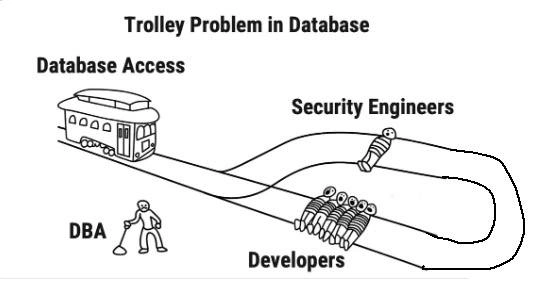
Either way, someone is upset. You can’t make everyone happy with just one simple choice. It’s an impossible choice, kind of like picking between two friends. If you side with one friend, the other friend feels hurt, and vice versa. The cartoon shows this by having a little train (the decision) and two paths: one where a lot of developers (the kids wanting cookies) get hurt, and another where one security person (the strict teacher) gets hurt. It’s using a tricky situation to make us laugh, because the database admin person has to decide who to disappoint.
The heart of the joke is that the database admin’s job can be like being stuck between parents and kids: one side always wants more freedom and fun, and the other side always wants more safety and rules. Too much freedom, and things can get chaotic; too many rules, and nobody can get anything done. The cartoon is saying “Look, no matter what the poor DBA does, it feels wrong.” It’s funny in a kind of “oh no, I recognize that situation!” way.
So, imagine having to choose between letting everyone play outside in the mud (and risk a mess) or making everyone stay inside quietly (and dealing with a bunch of bored, unhappy kids). That’s how the DBA feels about letting developers into the database versus keeping it secure. There’s no perfect answer – and that’s why this dilemma is shown as a trolley problem. It’s a way to laugh at a tough situation where you just can’t win, no matter which way you go.
Level 2: Permission Predicament
Let’s break down the scenario in simpler terms. We have three key players: developers, security engineers, and a DBA (Database Administrator). The developers are the people writing code and building features. To do their job, they often need to work with the company’s database – for example, to fetch data, test changes, or fix bugs that involve data. The security engineers are the folks responsible for protecting that data and making sure the company’s systems are safe from breaches or accidents. And the DBA is like the gatekeeper or caretaker of the database, managing how the data is stored and who is allowed to do what with it.
Now, the cartoon uses the famous “trolley problem” setup to joke about the DBA’s tough choice. The trolley problem is a classic thought experiment: there’s a runaway trolley on a track heading towards five people, and you can pull a lever to divert it to a different track where only one person is tied up. It’s a moral dilemma – do you do nothing and let the five get hit, or pull the lever and cause the one person to get hit instead? In this database humor version, the trolley represents a decision about database access privileges. The DBA (the person at the lever) has to choose which track the “Database Access” trolley goes down. One track has five Developers tied up – this symbolizes the scenario where the DBA’s decision ends up hurting the developers’ work. The other track has one Security Engineer tied up – symbolizing a decision that upsets the security side. It’s a silly drawing, but it maps to a real access control dilemma: any choice will upset one side or the other.
Here’s what the two tracks mean in real life:
Track 1 – Hit the developers: This would mean the DBA keeps the database very locked down (strict permissions). Maybe developers are not given direct access to production data, or they can only run certain approved queries. This makes the Security team happy because it follows the “least privilege” principle – nobody has more access than absolutely necessary, so the risk of someone messing up the data or leaking information is low. However, the consequence is the developers’ jobs get harder. If they need something from the database, they have to go through a lot of hoops (like writing requests, waiting for the DBA’s approval, or working with sanitized copies of data that might not be up-to-date). This can slow down development significantly. Imagine a junior dev who finds a bug that only shows up with real data on the live system – they might want to check the production database to diagnose it, but all they get is “ACCESS DENIED.” They then have to ask the DBA or file a ticket and wait, which is frustrating when an outage or a deadline is looming. In the cartoon, keeping the trolley on this track “runs over” the developers figuratively – meaning their work is harmed. They’re the five tied-up figures because usually there are more developers affected by such a decision.
Track 2 – Hit the security engineer: This implies the DBA decides to give the developers broader access to the database to keep them happy and productive. For example, the DBA might give developers a login to the production database with fairly high privileges (so they can read and write lots of data freely), or share credentials that normally would be closely guarded. The developers in this case are untied – they can move freely and do what they need in the database without waiting for approval. That sounds great for productivity: fixes and features roll out faster, and the devs are smiling. But this decision effectively “runs over” the security engineer’s concerns. Why? Because from a security standpoint, this is risky. If every developer can directly touch live data, the chance of a mistake or misuse goes way up. Even well-intentioned developers might accidentally run a bad command. For instance, a dev could think they’re on the test database and type
DROP TABLE users;(which deletes a table), but oops – they were actually connected to the production database. That could be a catastrophic mistake, deleting real customer data. Or consider security breaches: the more people who have broad access to sensitive data, the higher the chance that one of their accounts gets compromised or one person mishandles the data. Security engineers recall famous incidents where too much access led to leaks. So, giving devs free rein makes the infosec folks very unhappy (the lone security engineer in the cartoon is the one who gets “hit” in this scenario).
So the "permission predicament" here is that the DBA must choose between usability and safety. On one hand, there’s the Security vs Usability conflict: stronger security (safety) usually means more rules and restricted access, which hurts usability (convenience for developers). On the other hand, making things very usable and convenient (just let everyone access everything) hurts security. This is often summarized as security vs. convenience: you rarely can have 100% of both. The cartoon dramatizes that by equating it to a life-and-death trolley choice, which is an exaggeration for comedic effect. But in a tech company, it does feel high-stakes: if you displease the developers too much, the product might suffer or you might get complaints to your boss; if you displease security, you might fail an audit or, worst-case, experience a breach on your watch.
For someone new to these concepts, let’s define a couple of terms being joked about:
DBA (Database Administrator): This is the person or team in charge of maintaining the databases. They handle things like performance tuning, backups, and importantly here, user access and permissions. If you want permission to read or modify certain data, the DBA is usually the one who sets that up via proper commands or tools. They often set policies on who can do what in the database. Think of them like librarians of a big library – they organize the books (data) and also control who is allowed into the rare-books section or who can check out certain materials.
Least Privilege Principle: This is a security guideline that says each user (or program) should have the minimum access rights they need to do their job, and nothing more. For a database, that could mean if you only need to read data from a table, you should be given just SELECT permissions on that table, not write or delete permissions, and certainly not access to other unrelated databases. It’s like in a company badge system – if your job is in the mailroom, your badge might only open the mailroom and common areas, not the CEO’s office. In theory, least privilege limits damage if an account is misused or a mistake is made.
Access Control Mechanisms: These are the methods and tools by which access is granted or restricted. In databases, common mechanisms include user accounts with passwords, roles (a set of permissions that can be assigned to users), and explicit permission grants or revokes (like “User X can read table Y” or “User Z cannot delete from table W”). The DBA manages these via SQL commands (
GRANT,REVOKE) or through a management interface. It’s analogous to setting up who has keys to which rooms in a building.Security vs. Usability (SecurityVsUsability): This tag and concept refer to the constant balance between making a system secure and making it user-friendly or efficient to use. More security often means more steps or restrictions (think two-factor authentication – it’s safer but takes more effort each login). More usability often means fewer barriers (like staying logged in or having broad access), which can expose you to risks. This meme encapsulates that tug-of-war: the DBA can tilt toward security (with strict controls) or usability (with open access), but tilting to one side inherently takes away from the other.
In many tech organizations, especially ones dealing with sensitive data (like finance, healthcare, etc.), new developers are sometimes surprised at how little access they have to production systems. They might say, “Hey, I need to run this query on prod data to debug an issue,” and the response is “Sorry, you don’t have permission – file a request.” This can be a learning moment: the company isn’t trying to make your life hard for no reason, it’s following best practices to protect data. Conversely, in very early-stage startups or small teams, a junior dev might be shocked at how much access everyone has (“Wow, I just joined and I already have the admin password to the customer database!”). That might feel empowering until something goes wrong. Over time, one learns the reason behind these permission policies – probably after hearing a scary story or two about when things went wrong because someone had too much freedom.
The trolley dilemma cartoon is a funny way to show that the DBA’s role involves making tough calls that ideally avoid disasters. It’s a bit exaggerated – of course, in reality granting permissions isn’t as immediate or visual as a speeding trolley – but emotionally it can feel that way. The DBA knows if they make a mistake in judgement (too lenient or too strict), there will be consequences: upset coworkers, or security incidents. They’re damned if they do, damned if they don’t.
One more angle: The meme also gently pokes at how each side (developers vs. security) tends to think their priority is the most important. Developers often argue from a productivity standpoint: “If we can’t move fast and ship features, the business suffers.” Security folks argue from a risk standpoint: “If we don’t protect our data and systems, a breach or failure could tank the business.” Both are right in their own way, which is why the decision is hard! The DBA (and management above) has to weigh immediate needs vs. long-term safety. For a junior developer, it’s useful to understand both perspectives: yes, those permission hurdles can be annoying, but they exist due to real dangers; and yes, sometimes security has to be balanced with practical needs. The best is when both teams talk and find a solution (like tools or processes that allow safe but efficient access – for example, temporary access that is monitored, or creating non-production datasets that are safe to play with). This meme is basically joking, “Look, our poor DBA is stuck in the middle of this classic conflict.”
In short, the cartoon simplifies a very real scenario: the DBA’s impossible choice. If they lean towards helping developers by loosening access, they might compromise security. If they lean towards ironclad security, they might hinder or anger developers. The visual of a trolley about to run someone over comically dramatizes how any decision feels like hurting one group or the other. It’s a lighthearted take on a serious balancing act.
Level 3: The Path of Least Privilege
In practice, this meme hits home for any seasoned engineer who’s dealt with Database Access Control. The stick-figure DBA (Database Administrator) standing by the track switch represents the poor human who has to decide between two unpleasant options on a daily basis: make developers happy or make security happy. The tracks are labeled “Database Access” for a reason – it’s about how freely people can get into the database and what they can do there. On one track lie five tied-up Developers, helplessly bound by red tape (imagine them stuck waiting for permissions or data). On the other track lies a single Security Engineer, representing the infosec team’s strict policies. The trolley represents the consequences of a decision about database permissions speeding toward one of these groups. This image parodies the classic trolley problem ethical dilemma (sacrifice one to save five or vice versa) – except now it’s permissions and productivity that are on the line. The DBA is essentially thinking: “Do I grant broader database access and run over security’s protocols, or do I lock things down and run over the dev team’s timeline?”
Why is this funny (and painful) to experienced devs and DBAs? Because it’s too real. In many organizations, DBAs constantly get caught between developers who need quick, convenient access to data and security teams who demand strict controls (often guided by principles like least privilege, compliance requirements, or fear of breaches). It’s an everyday access control tradeoff:
If the DBA favors developers (stays on the straight track): Developers get generous privileges or maybe even direct prod DB logins. Now they can query any table, deploy new SQL changes faster, and fix issues at 2 AM without waiting. Productivity soars – the devs are saved from being “run over” by delays. But this choice “runs over” the security engineer’s peace of mind. With looser permissions, the risk of something going wrong goes way up. One overzealous developer might accidentally execute a destructive query (
DELETE * FROM important_table;– oops) or exfiltrate sensitive data. The infosec folks will be fuming about policy violations and potential breaches. In real life, there have been horror stories of an intern with too much access dropping a production database or a disgruntled dev copying customer data. The DBA who allowed broad access will have to answer some uncomfortable questions in the postmortem meeting (if not polish up their résumé).If the DBA sides with security (pulls the lever to divert): The database stays locked down tight. Every query and change is strictly regulated – maybe developers can only access production data through read-only views or have to file a ticket for the DBA to run queries for them. The security engineer is safe on this path: they’re happy because the chance of an unauthorized action is near zero. But this means the trolley hits the five developers’ productivity. They’re tied up waiting for approvals and might miss deadlines. Imagine a dev urgently needs to look at a production dataset to debug a critical issue, and they get “ACCESS DENIED” – now they’re effectively run over by bureaucracy. In practice, this can frustrate engineers to no end. It’s not just theoretical: overly strict permissions can slow down incident response (think delays in fixing a live outage because nobody can query the live DB for clues) and breed resentment between teams. A common refrain in such orgs: “security is holding us back.” Plus, when devs feel too restricted, they often find shadowy workarounds (like exporting a production dump to analyze on their laptop – ironically creating more security risk, just outside official channels).
This dynamic is a classic security vs. usability tug-of-war in tech, and every experienced developer or sysadmin has witnessed it. The humor here is that the DBA’s decision is portrayed as an impossible moral choice – the cartoon exaggerates it as life-and-death on the tracks, which is how it feels when both sides pressure you. The DBA knows whichever way the lever is pulled, someone will scream. It’s a lose-lose scenario, or as developers often say, a “no-win situation”.
Notably, the meme labels the security side as plural “Security Engineers” (even though only one figure is drawn) and developers as a group of five. This mirrors reality: usually the development team is larger and louder in demanding access (“we need it to do our jobs!”), whereas the security team might be a smaller, singular voice insisting on caution (“one breach can ruin us!”). It’s also a cheeky nod to the traditional trolley problem framing: sacrificing one versus five. The implication is that sacrificing the one security person’s demands (by opening access) might seem the utilitarian choice – make five people productive at the cost of one person’s upset. But in tech, things aren’t so clear-cut morally: that “one” security engineer might represent protecting millions of users’ data. So the meme cleverly captures the ethical flavor of the decision in a tech context.
We can practically hear the DBA’s internal monologue:
“Give developers the
sudo-equivalent on the database? They’ll deploy faster, sure… and maybe fast-track me to an early grave when something breaks or we get hacked. Keep things ultra-locked-down? Fewer sleepless nights about breaches, but I’ll be hated for every slow deployment and bug I block. Great.”
Every senior dev knows that glare the DBA gives when you ask for elevated rights in production – it’s the look of someone standing at the trolley lever, weighing consequences. We also know the look of relief (or despair) on the security analyst’s face reading the latest permissions report. The shared trauma this meme taps into is the endless meeting or email thread where devs argue for more freedom (“we can’t get anything done!”) and security counters with worst-case scenarios (“one mistake and we’re on the news!”). The DBA is stuck mediating this shouting match, often at odd hours, and often blamed by both sides.
To balance things out, many organizations attempt a compromise. For example, a DBA might set up read replicas of the production database: developers get freer access to those copies (so they can run heavy queries or experiments without harming real data), while production stays safe. Or teams implement fine-grained roles – e.g., devs get read-only access to most tables and write access only to what they truly need. There are also modern DevOps/DevSecOps practices: automating access provisioning so that developers can request temporary elevated rights that auto-expire, with all actions logged for audit. These are like trying to steer the trolley down the middle, avoiding hitting anyone – a noble idea, but it requires a lot of careful setup (and it’s never foolproof).
The truth is, even with such measures, the fundamental tension remains. When something’s on fire in production, speed often wins out and rules get bent – the DBA might pull an emergency lever granting broader access (and feel the wheels of the trolley nudge toward the security track). Other times, after a scare or a security audit, the pendulum swings back and things lock down again (now the trolley inches toward the dev track). It’s a constant back-and-forth adjustment, and seasoned engineers have learned to appreciate why this is hard. The meme nails this predicament with a simple stark image that any on-call dev, DBA, or security analyst can relate to: sometimes you just can’t save everyone, and you have to decide who gets “run over” in the short term. It’s dark humor with a wink – we laugh, because otherwise we’d cry.
To illustrate the extremes of this dilemma in actual database terms, consider the SQL commands a DBA could run:
-- Developers' dream scenario: full access to everything (dangerous in practice)
GRANT ALL PRIVILEGES ON *.* TO 'dev_team'@'%';
-- Security's ideal scenario: revoke all direct access (impractical for work)
REVOKE ALL PRIVILEGES ON *.* FROM 'dev_team'@'%';
-- A careful compromise: grant only specific rights on needed data
GRANT SELECT, INSERT ON production.orders TO 'dev_team'@'appserver';
In the first case, GRANT ALL PRIVILEGES is like sending the trolley straight over the Security Engineers — it’s a big no-no from their perspective (“You gave them root access to the entire database?!”). The second line, REVOKE ALL PRIVILEGES, is the equivalent of tying up the Developers and letting them get hit — it makes Security happy but means the dev team can’t do anything useful in the database until privileges are given back one ticket at a time. The last example is the DBA trying to thread the needle: only let the dev team read and insert into the orders table from a specific application server, nothing more. This satisfies least privilege on paper, but if the devs later need to update a record or query another table, we’re back to square one (another ticket, another meeting, and likely some grumpy faces).
In summary, the meme humorously spotlights an unavoidable reality in database management: every decision to loosen or tighten access has consequences. Senior folks chuckle (or groan) at this cartoon because they’ve lived it. They know that feeling when your Slack has simultaneous pings from the dev lead (“any update on those permissions?”) and the security lead (“we noticed some dev accounts with excessive rights…”). It’s a damned-if-you-do, damned-if-you-don’t situation — the quintessential DBA dilemma. And the only solace is that at least we can joke about it with cartoons like this, sharing a laugh over the proverbial trolley we’ve all had to drive.
Level 4: The Privilege Paradox
At the core of this meme lies a security vs. usability paradox that software engineering has wrestled with for decades. In formal terms, giving every user exactly the access they need and not a shred more is known as the principle of least privilege (first articulated by Saltzer and Schroeder in 1975). It’s a foundational security principle: each person or program should operate using the least set of permissions necessary to complete their job. The paradox? Determining that “least set” in a dynamic development environment is extraordinarily complex – often combinatorially hard. In fact, figuring out the optimal minimal privileges for each of dozens of developers and hundreds of database tables can resemble an NP-hard problem (similar to solving a complex puzzle where each permission is a piece). The more you try to mathematically minimize risk, the more you realize you’re dealing with a multi-variable optimization that has no perfect answer.
This dilemma in the meme is essentially a multi-objective optimization problem with conflicting goals: maximize developer productivity (availability and speed) while maximizing security (confidentiality and integrity). In information security theory, it’s like balancing two corners of the CIA triad: Confidentiality (protect data from unauthorized access – the security engineers’ demand) vs. Availability (ensure people who need data can get it quickly – the developers’ need). Perfect confidentiality often means zero availability (locking data so tightly nobody can use it), and perfect availability means giving everyone open access (terrible for confidentiality). There’s no free lunch – tightening one screw inevitably loosens another.
Computer science and security research have introduced models like RBAC (Role-Based Access Control) and its more granular cousin ABAC (Attribute-Based Access Control) to navigate this minefield. RBAC lets a DBA assign sets of permissions to roles (like “read-only user” or “data engineer”) rather than individuals, seeking a balance between too broad (“everyone is an admin”) and too narrow (“create a unique rule for every single query”). Even so, defining roles that are both secure and let every developer do their job without frustration is notoriously tricky. Role design can fall prey to the subset-sum problem in disguise – add one permission to help one developer and suddenly you’ve over-privileged another. Academic papers and security frameworks have grappled with algorithms for “role mining” – deriving optimal roles from usage patterns – which underscores how non-trivial this is.
Deep down, this is a socio-technical paradox: humans vs. rules, or in this case, developer agility vs. strict security policy. There’s an old security quip that applies here: the only truly secure database is one that no one can access. From a theoretical standpoint, you could imagine a provably secure system that mathematically guarantees no unauthorized data access – but that system would be practically unusable for day-to-day work. Conversely, a system that’s wide open for convenience might as well have no security model. The meme’s dark humor is highlighting this unsolvable equation. The DBA’s trolley problem is an embodiment of Gödel’s incompleteness in policy form – any consistent set of simple rules for permissions either ends up incomplete (doesn’t let devs do something they eventually need) or inconsistent (introduces a security hole). It’s a privilege paradox: you can’t fully satisfy both sides with one elegant formula; every choice is a compromise that leaves some risk on the table.
Description
This image presents a clever adaptation of the classic 'Trolley Problem' ethical dilemma to a common scenario in a tech organization. Titled 'Trolley Problem in Database', the line-drawing illustration depicts a trolley labeled 'Database Access' heading down a track. A person labeled 'DBA' (Database Administrator) stands at a lever, controlling a switch in the track. The trolley's default path leads to a group of five people tied to the track, labeled 'Developers'. The alternate path, selectable via the lever, leads to a single person labeled 'Security Engineers'. The crucial, humorous twist is that the alternate track is a short loop that merges back into the main track just before the developers. This implies that pulling the lever to 'save' the developers by sacrificing the security engineer is a futile gesture; the trolley will run over the security engineer and then proceed to run over the developers anyway. The meme satirizes corporate processes where security reviews are treated as a bureaucratic checkbox - a mandatory but ultimately ineffective step - before access is granted to developers regardless
Comments
12Comment deleted
The DBA knows the real choice isn't who gets run over, but whether the 'Database Access' ticket needs to link to a 'Security Approval' ticket that everyone knows will be rubber-stamped after a two-day SLA
I solved the DBA trolley problem by adding a read-only replica in a quarantined VPC - now the devs can SELECT, the security team can audit, and the only thing tied to the tracks is my pager
The real trolley problem is explaining to the C-suite why the junior dev who needed 'just read access for debugging' accidentally dropped the production users table because someone forgot that stored procedures inherit execution context
The DBA stands at the lever, knowing full well that no matter which track they choose, they'll be the one getting run over in the post-incident review. Pull it toward security, and you're blocking the entire sprint with a 47-step approval process for a read-only SELECT. Leave it toward the developers, and you're explaining to the CISO why production customer data ended up in someone's local Postgres instance named 'test_db_final_v3_actually_final'. The real trolley problem? Both tracks loop back to your on-call pager at 3 AM
DBA at the switch: Left for compliance bliss, right for commit velocity - either way, pick your poison outage
Prod DB access is a trolley problem: give it to devs and security gets flattened; lock it down and a “temporary” break‑glass admin service loops the trolley back over everyone at 2 a.m
Our RBAC implementation: whichever way the DBA flips the lever, the CAB/SOX loop routes the trolley back over developer velocity - least privilege achieved, least productivity guaranteed
what is the difference? Comment deleted
The loop Comment deleted
Lower quality Comment deleted
😭😭😭 Comment deleted
Old Internet is leaking Comment deleted