Skip to content
DevMeme
5770 of 7435
Amazon's Hybrid Work Policy as an Extended Workday
RemoteWork Post #6326, on Oct 12, 2024 in TG

Amazon's Hybrid Work Policy as an Extended Workday

Why is this RemoteWork meme funny?

Level 1: The “Fair” Choice That Isn’t

Imagine your parents tell you that you have a “new, flexible playtime policy.” That sounds great — maybe you can sometimes play at home and sometimes at the park. But then they explain the details: you’re allowed to play at home only early in the morning before school and late at night before bed, and all the rest of the day you must be at school doing homework. That would be pretty unfair, right? They’re calling it a “flexible” plan, but in reality you spend almost all your time doing the usual thing (homework at school) and hardly any time with the fun option (playing at home). This meme is joking about the same kind of situation, but for grown-ups at work. The company said workers could have a mix of working from home and working in the office (which sounds flexible), but really they meant people have to be in the office the whole workday and can only be at home when it’s normally time off. It’s funny in a kind of “that’s ridiculous!” way, because calling that mix hybrid is like calling our pretend plan flexible playtime — the nice name doesn’t match the reality at all.

Level 2: Office vs. Home, Explained

Let’s break down the hybrid work policy meme in simpler terms. Hybrid work usually means a mix of WFH (Work From Home) and in-office work. In an ideal hybrid setup, you might spend a few days working remotely (from your home or anywhere outside the office) and the rest of the days working onsite at the company’s office. It’s supposed to combine the best of both worlds: the comfort and focus of home with the face-to-face collaboration of the office. Many tech companies adopted hybrid policies after the pandemic, trying to balance employees’ newfound remote-work preferences with managers’ desire to see people back at their desks.

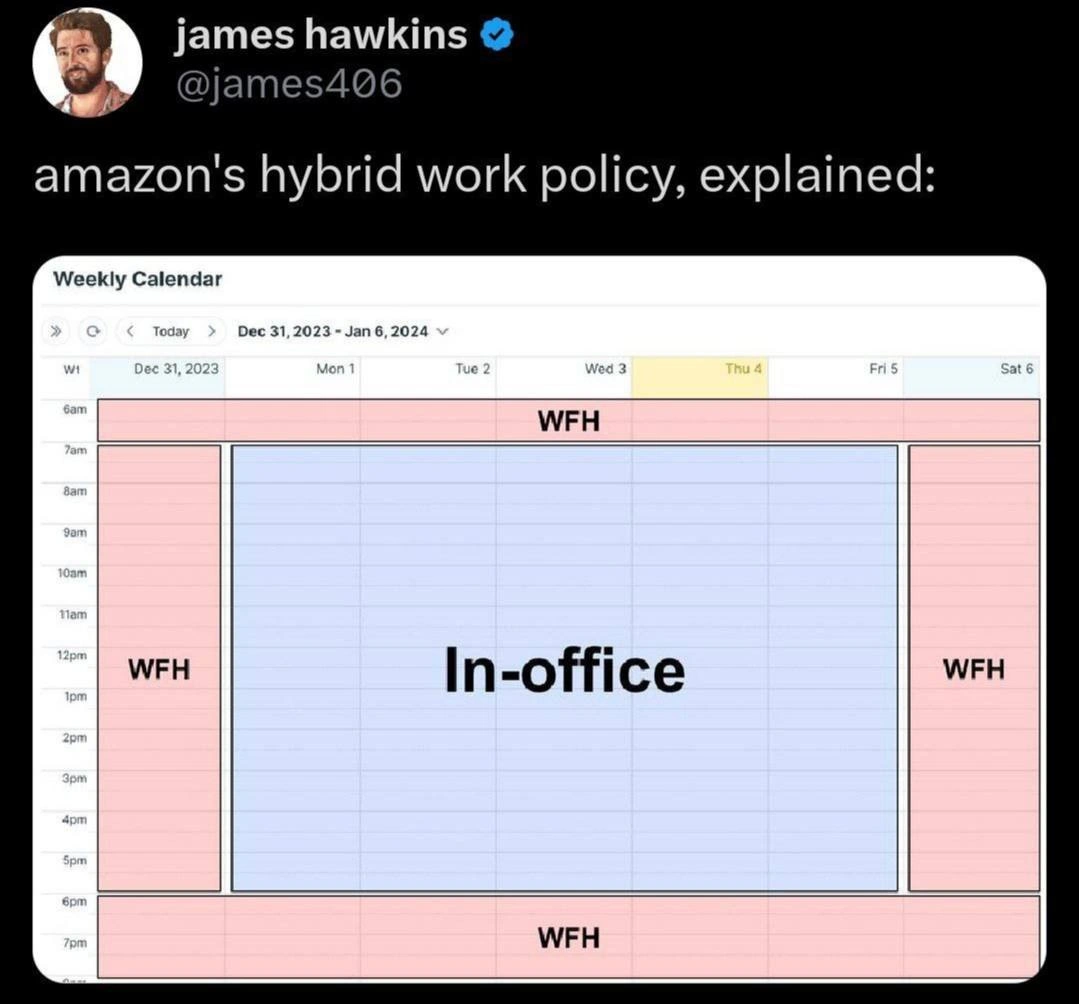
Now, the meme jokes that Amazon’s idea of “hybrid” is a little one-sided. The image is a fake calendar (like a Google Calendar screenshot) for a week. The pink areas labeled “WFH” appear at the very top, bottom, and sides of the week – basically covering Sunday and Saturday, plus very early mornings and late evenings on weekdays. Those are times when, realistically, most people aren’t working (either it’s the weekend or outside normal work hours). The huge blue block in the middle labeled “In-office” covers the entire workday (approximately 6am to 6pm) from Monday through Friday. In other words, if you read the calendar like a schedule, it’s telling you: every single work hour, you have to be in the office. You can “WFH” only during times you’d typically have off anyway (or possibly the fringes of the day when you might not have meetings).

The tweet text above the image says, “amazon’s hybrid work policy, explained:” which sets a sarcastic tone. Essentially, the meme is saying: Amazon calls this a hybrid policy, but look — it’s basically just an office policy. RemoteWork is technically allowed, but only in name or in useless time slots. For context, around 2023-2024, Amazon (like several other big companies) started requiring employees to return to the office most of the week. Many Amazon employees had been working from home effectively for over a year, so being told to come back in-person felt like a big change. Management pitched it as a “hybrid work” policy (perhaps allowing one or two days remote), but a lot of workers felt it wasn’t much flexibility at all. This meme captures that feeling in a single image: the core of the week is still in-office, and WFH is squeezed to the edges.

For a junior developer or someone new to the workplace, a few definitions might help: WFH stands for Work From Home, meaning you do your job from home using your computer, internet, etc., instead of going to the office. In-office means you are physically present at the company’s office building, working on-site. A hybrid policy is supposed to let you do both, for example, “3 days in-office, 2 days WFH” in a week. The joke here is that Amazon’s version basically ends up being “5 days in-office, 0 days WFH,” if you count real working hours. Developers often color-code their calendars — maybe marking WFH days or blocking out time for “focused work.” In the image, pink is used to denote WFH times and blue for in-office times. The layout is tongue-in-cheek: it looks like a legitimate weekly schedule, but the way it’s colored makes it obvious that WFH got the short end of the stick.

This is WorkplaceHumor and RelatableHumor for anyone in tech (or other industries) dealing with similar policies. The meme isn’t attacking the concept of hybrid work itself; it’s poking fun at how some companies (here, Amazon) might say “hybrid” but actually mean “mostly on-site.” For a junior employee, it’s a reminder to always read the fine print of policy announcements. If your boss says, “Sure, you can work from home... on weekends,” that’s not much of a perk! The joke lands because it’s a bit of truth exaggerated: many people feel that “hybrid” can sometimes be a buzzword to make a strict return-to-office plan sound flexible and employee-friendly. And there’s a generational aspect too — younger developers who started their careers working remotely might be surprised or frustrated to find companies pushing them back into office chairs despite all the modern tech that makes remote collaboration possible. This meme is a lighthearted way of venting about that situation.

In summary, the calendar graphic simplifies the whole issue: WFH is confined to the borders (literally the outer border of the calendar, where non-work time lives), and in-office time fills the center (the actual workdays). It’s saying, “This is what Amazon’s hybrid policy really looks like.” Anyone who’s experienced a bait-and-switch like that can relate to the humor. Even if you haven’t, it’s easy to see the unfairness — it’s like being told you have freedom to choose, then being given only one real choice. The meme uses a familiar office tool (a weekly planner) and a straightforward visual trick to convey all that in an instant. It’s a bit snarky, a bit insightful, and very much in line with the kind of DeveloperHumor that thrives in online tech communities.

Level 3: Hybrid in Name Only

The meme delivers a sarcastic sucker-punch to corporate culture around RemoteWork. At first glance, it’s a weekly calendar screenshot with an enormous blue rectangle labeled “In-office” consuming every normal work hour (6am–6pm, Mon–Fri). Surrounding it, a thin pink border labeled “WFH” wraps the edges: early mornings, evenings, and the weekend. In other words, Amazon’s so-called hybrid_work_policy reserves all meaningful hours for mandatory office presence, leaving WFH (Work From Home) only to times when you wouldn’t be working anyway. This visual gag lands because it exploits a tool developers know well — the overloaded calendar — to expose the workplace irony of a “hybrid” policy that’s hybrid in name only. It’s a classic bit of TechSatire skewering management’s doublespeak: the company promises flexibility, but the schedule screams “butts-in-seats, 9 to 5.”

Seasoned developers immediately recognize the pattern. We’ve seen grand corporate edicts before: the post-pandemic pivot where C-suites trumpet “flexible hybrid arrangements” while quietly herding everyone back into the office. The humor here comes from that shared experience — many of us enjoyed a taste of true RemoteWork during 2020-2021, only to have the rug pulled out. The meme specifically calls out Amazon, where leadership’s back-to-office mandate in 2023 was met with employee grumbles and dark humor just like this. The blue In-office block dominating the calendar is the visual equivalent of a manager cheerfully saying, “We offer work-life balance — you can Work From Home anytime outside of work!” 🙄 Developers who’ve been through these policy flip-flops nod knowingly. We recognize the subtle betrayal: after proving we can deploy, debug, and deliver from our home offices (often with higher productivity), being corralled back under fluorescent lights feels like an anti-pattern from the pre-pandemic playbook.

Why is this so relatable (and bitingly funny) in tech circles? Because it highlights the disconnect between WorkplaceCulture reality and corporate rhetoric. Big tech firms often speak of “trusting employees” and “autonomy”, yet moves like this hybrid policy hint at a lack of trust — a belief that real work only happens under the watchful eye of management at HQ. The meme resonates as WorkplaceHumor precisely because it rings true: it’s the IYKYK wink of engineers who’ve seen HR’s glossy “flexibility” brochure turn into a pumpkin once the clock strikes 9 AM Monday. There’s a dose of ManagementHumor too, in that the image literally draws the line around leadership’s unwritten rules. The calendar_meme format is perfect here: developers practically live in calendars filled with stand-ups, sprint demos, and planning meetings, so we instantly get the joke. The empty pink WFH blocks look just like those trivial slivers of “free time” you see when you’re fully booked — except in this case, it’s an entire pseudo-“flexible” work arrangement that’s been reduced to a decorative border. It’s a satirical visualization of what many suspect: the only thing hybrid about some policies is the term itself.

This comedic call-out also masks a real frustration in the tech community. Behind the laughs is the memory of rushed RemoteWork transitions that actually went well — developers thrived coding in pajama pants, meetings moved to Slack and Zoom, deployments kept shipping. But now, many companies (Amazon just being a high-profile example) are snapping back to old norms, citing vague benefits of “in-person collaboration” and “serendipitous hallway conversations.” Senior engineers have heard this refrain before and often view it with skepticism. Sure, whiteboard discussions are great, but do they outweigh the 2-hour commute and constant office interruptions? The meme’s tone hints at a collective eye-roll. It’s the Cynical Veteran outlook: “We debug distributed systems from our couches just fine, but okay, let’s burn gas to sit in an open-plan zoo because someone upstairs has a nostalgia for face-to-face.” The image’s border of WFH time (at the literal margins) versus the solid center of in-office time captures that power imbalance. RelatableHumor often stems from pain, and here the pain point is feeling that our hard-won remote flexibility is being squeezed out, with a smile.

In true sarcastic fashion, the meme also jabs at the euphemistic language corporations use. Calling something hybrid usually implies a roughly even mix of remote and office days (say 2-3 days WFH a week). But Amazon’s interpretation, as the meme implies, is more like “Hybrid, but make it 95% office.” It’s reminiscent of other corporate bait-and-switch tactics engineers groan about, like “unlimited vacation” policies that result in no one taking vacation. The veteran perspective here is battle-scarred: we’ve learned to read between the lines. If a policy needs a slick PR label (“flexible hybrid!”), it often means the reality is unpalatably rigid. So when developers see that big blue In-office monolith on the calendar surrounded by a token pink fringe of WFH, it elicits a chuckle followed by a knowing headshake. We laugh so we don’t cry, bonding over this shared satire of tech workplace ironies.

To put it in pseudo-code, the “algorithm” for this hybrid schedule is brutally straightforward:

for hour in week.hours():  # iterate through each hour of the week
    if hour.is_workday() and hour.between(6, 18):
        schedule[hour] = "In-office"  # mandatory presence during core work hours
    else:
        schedule[hour] = "WFH"        # WFH allowed only on off-hours and weekends

In plain English, if it’s a normal working hour, you’re at the office; otherwise, sure, do whatever, call it WFH. This little snippet effectively spells out the joke in code form. It’s absurd, and that absurdity is exactly the point. The senior devs reading this might smirk because it’s a bit too real — we’ve all encountered policies that felt like if (working_hours) { office = true; }. The code comment “WFH allowed only on off-hours” is essentially the meme’s caption translated into a logic rule. The humor lives in that stark simplicity: something as nuanced and human as work arrangements reduced to an if-statement that’s all condition and no compromise.

So, at Level 3 analysis, this meme is a savvy piece of TechSatire blending visual humor with biting commentary. It thrives on the collective memory of developers who navigated the remote-work revolution only to see old WorkplaceCulture habits reassert themselves. It’s funny because it’s true: a hybrid_work_policy that’s a thinly veiled in-office mandate is the tech world’s version of a cruel joke. And as any cynical veteran will tell you with a shrug, jokes like this circulate because they validate what the troops on the ground feel. In the end, the calendar’s pink WFH border versus blue office core encapsulates a frustration many developers share — the feeling that promises of flexibility were just wallpaper over the same old office walls.

Description

This image is a screenshot of a tweet from user James Hawkins (@james406), which reads, 'amazon's hybrid work policy, explained:'. Below the text is a visual representation of a weekly calendar. The calendar displays a large, solid blue block labeled 'In-office' that covers the core working hours of the day (approximately 7 AM to 7 PM). This central block is completely surrounded by smaller, pink-colored blocks labeled 'WFH' (Work From Home) that fill the time slots early in the morning, during the lunch hour, and late into the evening. The joke satirizes the implementation of hybrid work policies at companies like Amazon, suggesting that instead of offering flexibility, the policy effectively creates an 'always-on' culture. The time that would have been spent commuting or on breaks is now framed as additional 'Work From Home' time, sandwiching the mandatory in-office hours and leading to a longer, more demanding workday

Comments

11
Anonymous ★ Top Pick Amazon's hybrid policy is just EC2 with extra steps: you provision your own desk at home for the morning, burst into the office VPC for 8 hours, then handle the egress traffic back home while still being on the clock
  1. Anonymous ★ Top Pick

    Amazon's hybrid policy is just EC2 with extra steps: you provision your own desk at home for the morning, burst into the office VPC for 8 hours, then handle the egress traffic back home while still being on the clock

  2. Anonymous

    Turns out their “hybrid” schedule is just like our architecture: a wafer-thin layer of edge services called WFH wrapped around the same old 9-to-5 on-prem monolith

  3. Anonymous

    Amazon's 'hybrid' work policy is like claiming your microservice architecture is loosely coupled when every service still needs to hit the same monolithic database during business hours - technically distributed, practically centralized, and everyone knows the real bottleneck is the commute latency

  4. Anonymous

    This calendar perfectly captures the distributed systems approach to hybrid work: the 'In-office' block is the critical path with the smallest time slice, while WFH handles all the async operations. It's like Amazon's leadership principles met CAP theorem and chose Availability and Partition tolerance over Consistency - employees are highly available from home, partitioned from the office, but consistently productive. The real joke? Calling this 'hybrid' is like calling a microservice with 95% of its logic in one service 'distributed architecture.'

  5. Anonymous

    Amazon's hybrid policy: a sparse matrix of in-office requirements amid dense WFH bliss - perfect for optimizing commute latency

  6. Anonymous

    Amazon’s “hybrid” policy is basically active‑passive: the office is the primary region with strong consistency 9 - 5, and WFH is the DR site that only gets traffic nights and weekends - aka a misconfigured load balancer dressed up as culture

  7. Anonymous

    Their “hybrid” is implemented like a routing table: 0.0.0.0/0 → in‑office; WFH only routes to the nights/weekends subnet

  8. @seyfer 1y

    What the Wfh mean?

  9. @victoriaSome 1y

    Work from home

    1. @SamsonovAnton 1y

      Well, "In-office" then does not say a word about working, so...

      1. @M4lenov 1y

        HRs are INFURIATED by this simple hack...

Use J and K for navigation