
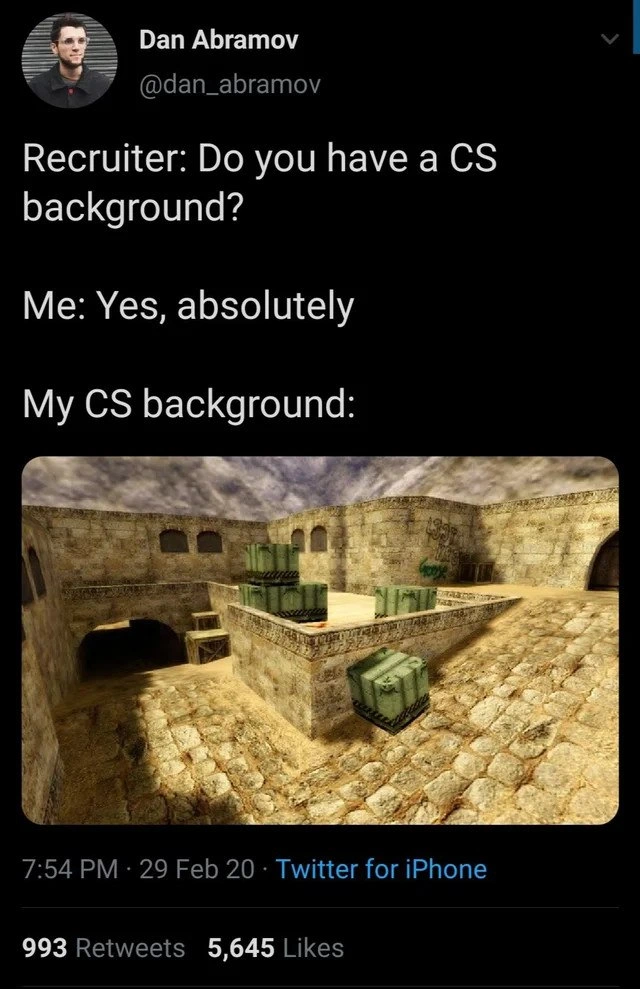
The 'CS' Background Recruiters Don't Expect
Description
This image is a screenshot of a tweet from well-known developer Dan Abramov (@dan_abramov). The tweet's text creates a dialogue: 'Recruiter: Do you have a CS background?', followed by 'Me: Yes, absolutely', and then 'My CS background:'. Below this text is an image from the classic first-person shooter video game Counter-Strike, showing the 'A' bombsite area of the iconic map 'de_dust2'. The scene is a desert-themed environment with stone walls, archways, and stacked green crates. The humor is a pun, playing on the abbreviation 'CS' which stands for both 'Computer Science' and 'Counter-Strike'. For many developers, especially those in the millennial generation, Counter-Strike was a formative part of their youth, and this joke resonates by humorously suggesting that the skills and time invested in the game are equivalent to a formal computer science education

Comments
7Comment deleted
My Counter-Strike background is my real qualification for SRE. I have 20 years of experience defusing bombs in production with seconds to spare, all while being yelled at by teenagers
My CS degree is 10k hours on Dust2 - keeping five flaky nodes synchronized around a single state transition (plant/defuse) while dodging random latency spikes. Basically Paxos with headshots
The irony is that Dan Abramov, who co-created Redux and works on React, probably has more practical impact on modern web architecture than most CS PhDs - yet his 'background' in de_dust2 likely taught him more about state management and event loops than any algorithms course ever could
When the recruiter asks about your CS background and you start explaining your AWP positioning strategy on long A, they probably meant the other kind of algorithms. Though honestly, predicting enemy rotations in Counter-Strike might be better preparation for distributed systems design than most bootcamps - both involve latency compensation, state synchronization, and dealing with unpredictable Byzantine actors who definitely aren't following the protocol
Formal CS grads prove P=NP; crate-stackers partition sites with CAP-defying availability - recruiters hire the latter for prod resilience
Counter‑Strike taught me distributed systems: five unreliable nodes, jittery network, a hard real‑time deadline (40s bomb timer), and if rush B fails we execute an immediate rollback
CS background? Dust2 - tickrate, interpolation, client/server reconciliation, and the realization that “eventual consistency” is just your headshot arriving after the killcam