The Professional Paranoia of a Cybersecurity Engineer
Why is this Security meme funny?
Level 1: Haunted Appliances
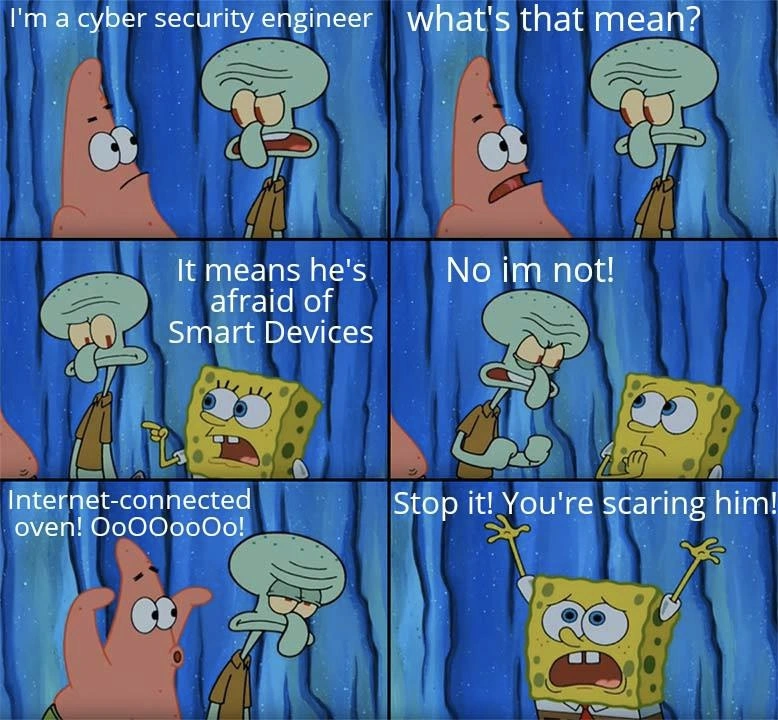
Imagine your friend is really scared of something that everyone else thinks is normal. For example, say you have a buddy who watched a scary movie about clowns, and now even a friendly clown at a birthday party makes them jump. This meme is kind of like that, but with smart gadgets. Here, a cybersecurity engineer (someone who normally loves computers and technology) is depicted as being scared of a new internet-connected oven, almost like it’s a ghost or a monster. His friend teases him by saying “Internet-connected oven! OoOOoooOo!” in a spooky voice, the same way you might say “Boo!” to scare someone. And another friend yells, “Stop it! You’re scaring him!” as if the idea of a high-tech oven is as frightening as a ghost story.
Why is this funny? It’s an exaggeration that shows how knowing too much can make you afraid. The engineer knows that a smart oven, which connects to the internet, might have hidden dangers (kind of like an appliance with a sneaky ghost inside). Most people just see a cool oven that can turn on with a phone. But he sees an oven that could be controlled by bad guys on the internet – and that thought spooks him. It’s like he believes the oven could be “haunted” or possessed because it’s online. The humor comes from treating a regular object (an oven) like a scary monster under the bed, all because it’s hooked up to the web. In simple terms: sometimes the people who understand something the best (like technology) are the ones who get scared of it the most, just like how knowing all the ghost stories can make you scared of the dark. So, the meme is funny and cute because it’s as if a grown-up tech expert is hiding under the covers from a creepy smart oven, and his friends have to remind others not to spook him with tech talk. It’s a playful way to say “even the bravest tech geeks can get scared... if you show them a haunted toaster!”
Level 2: Smart Devices, Real Risks
This meme uses SpongeBob characters to illustrate a tech joke. Patrick (the pink starfish) is teasing Squidward (the grumpy octopus) about something that actually hits close to home for IT folks. When Squidward says “It means he’s afraid of Smart Devices,” he’s talking about how a cybersecurity engineer might react to modern gadgets. Let’s break that down in simpler terms:
Smart devices are everyday appliances or objects – like ovens, fridges, thermostats, even light bulbs – that are connected to the internet. This whole category of technology is called the Internet of Things (IoT). If you have a watch that connects to Wi-Fi, or a doorbell with a camera you can view from your phone, you own an IoT device. They’re “smart” because they can do cool things like remote control or collecting data. An internet_connected_oven, for example, might let you start preheating it via an app while you’re driving home. Sounds convenient, right?
Now, a cybersecurity engineer is someone whose job is to protect computers, networks, and devices from hackers and malware (bad software). These are the folks who think about worst-case scenarios so that the rest of us can use tech safely. To them, each smart device is not just a fun gadget – it’s also a new door into the network that bad actors might try to sneak through. In tech terms, more devices online means a larger attack surface (more points an attacker could target).
In the meme, Patrick playfully goes “Internet-connected oven! OoOOoooOo!” like he’s saying “boo!” to scare someone. SpongeBob even yells, “Stop it! You’re scaring him!” as if an internet-enabled oven is the new boogeyman. Why would a normally cool and tech-savvy person be scared of a smart oven? The joke is referencing real security risks that come with these devices. Here are some reasons an IoT oven might worry a security-conscious person:
Weak passwords or no passwords: Many IoT gadgets come with default logins (like user: admin, password: admin) or no real lock at all. If you don’t change it, literally anyone who knows that common default could access it. A cybersecurity engineer knows these default settings are a big no-no, and they cringe if they find out a device is still using them.
Lack of updates: Traditional computers (your phone, your PC) get regular software updates, including security patches. But have you ever updated your fridge’s software? Many smart appliances don’t get frequent updates, or the owner might not know how to update them. Over time, hackers find flaws in the software. If those flaws aren’t fixed by an update, the device stays vulnerable. A security person might imagine an internet-connected oven that hasn’t been updated in years – that’s scary to them because who knows what vulnerabilities are lurking?
Privacy concerns: Some smart devices have cameras or microphones (like smart assistants or fridges with inside cameras). Even something like an oven might collect usage data or have a sensor. A paranoid (or let’s say cautious) engineer will worry about where that data goes. Is someone collecting info on when you’re home cooking? Could someone hacking it figure out your schedule? These ideas might sound far-fetched, but thinking about them is literally the job of security experts.
Physical safety: Unlike hacking a computer, hacking a device with physical functions (like an oven or a thermostat) can have real-world consequences. Imagine an oven being turned on remotely to a high temperature without you knowing – that’s a potential fire hazard. Or a smart lock on your door being unlocked by a hacker. These scenarios are rare, but they’re not impossible. A cybersecurity engineer’s mind will jump to those “what if” cases, which makes them wary of putting something like an oven online without strong safeguards.
For a junior developer or someone new to IT, this meme might also be a humorous lesson in SecurityAwareness. You might remember the first time you set up a gadget and discovered it was openly accessible. For instance, maybe you bought a smart security camera to tinker with. You plug it in, and before you even change the default password, you realize anyone on the internet could potentially connect to it. 😨 That light-bulb moment (pun intended) is when you gain “trust issues” with tech. It’s not that all tech is evil; it’s that tech often ships insecure out-of-the-box. New developers learn pretty quickly that you can’t assume a device is safe — you have to check things like passwords, network settings, and encryption.
The SpongeBob scene is a lighthearted way to show how a knowledgeable person can overreact to what seems mundane. Patrick (the naive friend) represents the average user who just sees the cool factor: “Wow, an oven I can control from my phone!” Squidward (the security engineer) is the one immediately thinking: “Oh no, that oven is on Wi-Fi; what if someone hacks it?” And SpongeBob is like the friend who understands the engineer’s fears and is saying “Don’t even joke about that, he’s genuinely scared.” It’s a comical exaggeration, of course. Security experts don’t actually run away screaming when they see an IoT device, but some do get a bit uneasy and might say, “Hmm, I’m not sure I trust that thing.”
As a junior tech worker, you might even encounter this in a company. Imagine you excitedly bring a new smart speaker to your office desk to play music. A senior IT person might rush over to unplug it from the company network, warning you about potential eavesdropping or malware. It feels overcautious, but it comes from real incidents where innocuous devices became backdoors. In other words, this meme also gently encourages SecurityAwareness: it reminds us that even the “fun” devices can introduce risks. It’s poking fun at the paranoia, but also saying that a healthy dose of skepticism about IoT isn’t completely unwarranted.
In summary, at this level we understand that: IoT (smart_devices) are amazing and handy, but they often lack strong security, which keeps cybersecurity folks up at night. The meme exaggerates it to the point of being afraid of an “internet-connected oven,” but that exaggeration is grounded in real technical concerns. A cybersecurity engineer knows every new smart gadget is potentially a tiny Trojan horse rolling into your home network. So Patrick’s “OoOOoooOo!” is funny because it’s exactly how security nerds feel when another appliance says “Now with Wi-Fi!”. The meme resonates with junior devs and anyone starting to learn about security, because it’s both humorous and a cautionary tale: treat new tech like that weird noise in the basement – probably nothing… but maybe something.
Level 3: The Insecurity of Things
If you've hung around a veteran cybersecurity engineer, you'll notice they eye new gadgets with suspicion rather than excitement. This SpongeBob meme nails that dynamic: it’s funny because it’s true. A bright-eyed friend (Patrick) hears “I’m a cyber security engineer” and asks “what’s that mean?” Squidward dryly answers, “It means he’s afraid of Smart Devices.” That punchline lands because in real life, security pros really do view smart devices with dread. Every new IoT gizmo (Internet of Things device) is basically another computer with an antenna, and that means another potential attack surface. The more things we connect to the internet, the more ways things can go terribly wrong — a fact that haunts experienced engineers.
Why exactly is an InternetOfThings oven scary? Seasoned devs remember real horror stories. We joke that the “S” in IoT stands for Security (because it’s usually missing). For example, the infamous Mirai botnet in 2016 turned thousands of innocent security cameras and DVRs into a zombie army that took down major websites. How did it happen? Those gadgets shipped with hard-coded logins like admin:admin – basically an open invitation to hackers. It was a wake-up call: even a baby monitor or a CCTV camera can become a cyber weapon if left insecure. So when Patrick teases “Internet-connected oven! OoOOoooOo!” like he’s telling a ghost story, experienced folks smirk; they’ve seen enough to know that an internet-connected oven could be a real nightmare (remote oven fire sale, anyone?).
This meme brilliantly satirizes SecurityAwareness and TrustIssuesInTech. The security engineer (Squidward) insists “No I’m not!” afraid, but everyone knows he is. It’s a classic case of whistling past the graveyard. We’ve all met that team member who pretends to be calm yet flinches at the mention of a new smart_device on the network. Why? Because they’ve cleaned up the mess when a “harmless” gadget went rogue. Maybe it was a smart thermostat used as a gateway into the office LAN, or a seemingly benign smart fish tank thermometer that hackers exploited to access a casino’s database (yes, that actually happened). Each new IoT doodad – whether it’s an internet-connected oven, fridge, or toaster – is seen as one more door for attackers to sneak in.
The humor here comes from role reversal: usually tech enthusiasts love new gadgets, but the cybersecurity engineer is acting like a jumpy cat in a room full of rocking chairs. It’s relatable to senior developers because we’ve been there – excited about innovation, then burned by its dark side. The industry keeps churning out “smart” appliances faster than they can secure them. Best practices (like strong passwords, encrypted connections, timely firmware updates) are often an afterthought. Companies race to market, slapping Wi-Fi onto a toaster, and the poor security team is left thinking “Great, another device I have to distrust by default.” It’s a shared anxiety: every DevOps veteran knows the pain of juggling cool new tech with the nagging voice saying “Did anyone change the default creds on that thing?”
In real-world scenarios, the mere mention of a smart_devices can cause a small panic in IT departments. I’ve seen coworkers physically unplug a “smart” coffee machine that management bought for the break room, because IoT_security folks don’t want a milk frother with an open port on the corporate network. It sounds over-the-top, but these are coping mechanisms born from experience. When Squidward hears “Internet-connected oven,” he isn’t imagining convenient remote baking – he’s picturing some hacker on the other side of the world scanning for that oven’s IP address on Shodan (the search engine for Internet-connected things), and then maybe exploiting a buffer overflow to turn the heat up to 500°F at 3 AM. Paranoia_about_IoT? Sure, but as the saying goes: “Just because you’re paranoid doesn’t mean they aren’t out to get your oven.”
The meme’s final line, “Stop it! You’re scaring him!” is SpongeBob panicking on Squidward’s behalf – a perfect comedic exaggeration of how jumpy security folks can get. Within tech circles, it highlights the truth that those who understand tech the most often trust it the least. The laughter is a bit cathartic: we’re essentially saying, “Haha, yeah, I do freak out about those ‘smart’ lightbulbs,” and we laugh off the very real stress. We know that feeling of telling coworkers “Don’t connect that thing here, you’ll give me a heart attack,” only half joking. This mix of humor and anxiety resonates strongly with anyone who’s battled unruly networks or spent late nights patching servers. It’s funny and a little sad: the industry keeps repeating mistakes (default passwords, unpatched firmware), and the weary security engineers are left forever jumpy. In short, the meme captures a core truth: Smart Devices bring great convenience and great insecurity, and those charged with defending systems can’t help but be a little spooked by each new “smart” thing that comes along.
To put it another way, here’s how perspectives differ on IoT gadgets:
| Gadget | Average Person Sees | Security Engineer Sees |
|---|---|---|
| Smart Light Bulb | “Cool, I can use Alexa to dim it!” | “It’s on my Wi-Fi? Could be a hidden microphone or a botnet node.” |
| Smart Oven | “I can preheat dinner from my phone.” | “Who else can turn it on remotely? Is it patched?!” |
| Smart Fridge | “It tracks groceries and streams recipes.” | “Untended Linux box with old SSL libraries… hope it doesn’t leak my Wi-Fi password.” |
| Smart Camera | “I can check my home from work.” | “An attacker could check my home from anywhere. Change that default login NOW.” |
Every row in that table is the reason this meme exists. Security engineers have basically seen everyday appliances turn into mini-computers that need securing, and it’s a nightmare trying to secure something as trivial as a light bulb. So, when a friend jokingly whispers about an “internet-connected oven” as if it’s a ghost under the bed, the cybersecurity guy’s fear is played for laughs – because all the technical folks reading this know it’s a little too accurate. This mix of absurdity and truth is what makes the meme pure gold for anyone in CyberSecurityMemes culture. We chuckle, then nervously double-check if our own smart TV is still running that 5-year-old firmware. In the end, the best defense is to laugh and update your devices – and maybe keep that oven offline unless you really need to tweet your baking.
Description
A six-panel comic strip using a scene from the cartoon Spongebob Squarepants to illustrate a cybersecurity professional's worldview. In the first two panels, Squidward introduces himself to Patrick as a 'cyber security engineer,' and Patrick asks for a definition. In the third panel, Spongebob explains, 'It means he's afraid of Smart Devices,' which Squidward angrily denies in the fourth. The punchline unfolds in the last two panels: Patrick taunts Squidward by shouting, 'Internet-connected oven! OoOOooOo!', causing Squidward to cower in fear. Spongebob then yells, 'Stop it! You're scaring him!'. The meme humorously captures the core truth that cybersecurity experts, being deeply aware of the pervasive vulnerabilities in IoT devices, are often seen as paranoid. Their 'fear' is a rational response to the poor security standards common in the smart device industry

Comments
18Comment deleted
The difference between a normal person and a security engineer is that the normal person worries about their smart oven burning their food, while the security engineer worries about it joining a botnet to mine crypto
House rule from our security architect: every “smart” appliance gets its own VLAN named guest-probably-botnet until it survives a pen-test longer than the warranty
The real horror isn't the internet-connected oven - it's explaining to the C-suite why their smart fish tank just became the entry point for a data breach that cost $4.2M, right after you warned them about IoT security in last quarter's risk assessment that nobody read
Security engineers don't fear the smart oven because it might burn dinner - they fear it because it shipped with telnet open and a firmware update policy of 'never'
Every cybersecurity engineer's nightmare: explaining to family why their new smart toaster needs to be on a separate VLAN with egress filtering, while they just want to know if it can brown bread evenly. The attack surface of modern IoT devices is so vast that even a connected oven becomes a potential pivot point for lateral movement - because nothing says 'defense in depth' like your kitchen appliances participating in a DDoS botnet while you're trying to bake cookies
IoT security: where 'plug and pray' replaces 'plug and play' because every firmware update is a potential rootkit
Internet-connected oven? That’s RCE with preheat - the only CVE that ships with a smoke alarm
It’s not fear of smart devices - it’s a threat model where the oven ships with telnet, opens UPnP, and requires a cloud account to preheat; that’s a lateral‑movement appliance, not a kitchen upgrade
Why does he says 'no i am not' He should be scared Comment deleted
There are no internet-connected devices in his and this house so he's calm, but he doesn't want other people to know he's afraid Comment deleted
+ Comment deleted
Not without reason Comment deleted
IoT oven is scary as fuck - could literally put your house on fire during the night Comment deleted
tech enthusiasts: my entire house is smart. tech workers: the only piece of technology in my house is a printer and i keep a gun next to it so i can shoot it if it makes a noise i don't recognize. Comment deleted
And I rember that you should put pistol in another room, not giving the printer a chance Comment deleted
not for that that gun is for printer if tech worker makes noise printer cant recognise Comment deleted
Why would a printer recognize sounds in the first place .. Comment deleted
to activate self-destruction if it hears "FBI OPEN UP" Comment deleted