The Pristine Academic vs. The Battle-Hardened Industry Coder
Why is this Learning meme funny?
Level 1: Cookbook vs Kitchen
Imagine you want to learn how to bake a cake. You have two teachers. One teacher is like someone who read all the recipe books and cooking theory but hasn’t actually baked a cake themselves in a long time. In their class, they wear a nice clean chef’s outfit and keep everything super tidy. They’ll calmly tell you, “According to the recipe, you mix these ingredients and a perfect cake comes out.” But they won’t actually crack an egg or turn on an oven in front of you. Everything sounds perfect when they explain it, and they never make a mess because it’s all talk — like just reading from the cookbook.
The other teacher is like a real chef who worked in a busy restaurant kitchen. They come to class maybe with a bit of flour on their apron and a burn mark or two from last week’s cooking – a little messy, a little tired. In their class, they say, “Let’s actually bake this cake right now together!” They start mixing ingredients in front of you. Sometimes an eggshell falls in or they spill a bit of milk, and at one point the oven alarm might go off because the cake baked a minute too long. They laugh it off and show you how to fix things (“no worries, we’ll just scrape off that burnt edge, it’ll still taste great”). By the end of the class, the kitchen counter is a bit messy, and the teacher might have some smudges on their face, but you’ve seen exactly how to bake that cake from start to finish — mistakes and all.
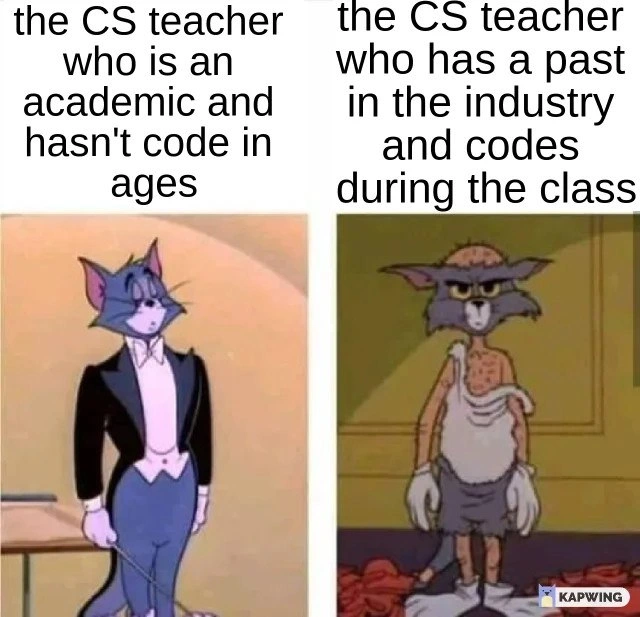
This meme is just like that. The first teacher is the neat, textbook-style computer science teacher (all theory, no mess). The second teacher is the hands-on coder teacher (real coding, real mistakes). It’s funny because the picture shows the neat teacher as a clean, fancy cat and the hands-on teacher as a roughed-up, tired cat. In simple terms, it’s saying: some teachers teach by the book, and some teach by doing it live. And just like cooking, the one who shows you how to do it (and maybe goofs up a bit) gives you a taste of the real thing, even if it’s a bit chaotic, while the one who sticks to the book keeps everything perfect but only in theory. That’s why the meme makes people smile – it’s a truth wrapped in a joke that even someone learning to ride a bike or cook a meal can understand: learning by watching real action is totally different from learning by just hearing instructions. The fancy cat vs. messy cat is a playful way to show that difference.
Level 2: Textbook vs Terminal
Now let’s break this down in simpler terms. This meme compares two types of computer science teachers using a funny cartoon. On the left, we have a teacher who is primarily an academic. The caption says “the CS teacher who is an academic and hasn’t code in ages” – grammatically it means “hasn’t coded in ages,” implying it’s been a long time since this teacher wrote actual code. This kind of teacher might teach straight from a textbook or slides. They’ll talk about concepts, mathematics, and step-by-step algorithms, but often they won’t actually open up a code editor during class. Picture a professor drawing diagrams on the board or showing pseudocode (fake code used to illustrate an algorithm) on a slide. They explain how things should work in theory. The Tom cat in a tuxedo represents this teacher visually. He looks perfect and clean because, metaphorically, this teacher doesn’t get their hands dirty with live coding. Nothing unpredictable happens in their lectures – no code crashes, no typos – so they (like Tom in a suit) stay neat and composed. This reflects an academic-only approach: very strong on CS fundamentals and theory, but not so focused on demonstrating actual coding in real time. If you’re a student in such a class, you might get a solid foundation in concepts, but you might not see those concepts turned into a running program during the lecture.
On the right side, we have the opposite: a teacher who comes from industry (meaning they used to work as a software developer or engineer in a company) and who codes during the class. This caption reads “the CS teacher who has a past in the industry and codes during the class.” This type of teacher will actually write code in front of students to show how a concept is implemented. For example, if the lesson is about sorting algorithms, instead of just talking about it, they might open an IDE or a terminal and start coding a quick sort or merge sort in Python or Java live, explaining as they go. Because they’re doing it live, there’s a chance they’ll run into small issues (maybe a syntax error if they mistype something, or an unexpected output that needs debugging). This is normal in real coding, and the class gets to see how to handle it. The Tom on the right is all ragged, bandaged, and tired – this is a funny exaggeration, implying that writing code (especially live or in the real world) can be a battle. When you code for real, you often encounter errors or bugs, and you have to troubleshoot them. That’s like getting a little banged up in the process, just as Tom looks banged up after presumably chasing Jerry through some catastrophe. The teacher with industry experience might come into class casually dressed and perhaps looking a little tired (maybe they were up late finishing a project or preparing code examples). They bring war stories from real projects and show practical techniques. In class, they might say, “Alright, let’s write a quick program to demonstrate this concept,” and then proceed to code (possibly even asking students for input or ideas). If something goes wrong, they’ll say, “Oops, minor bug, let’s fix that – this is a good learning moment!” That spontaneity is both exciting and a bit chaotic.
For a student or junior developer, the difference feels huge. The academic lecturer (textbook style) provides structured knowledge: you learn definitions, formulas, why algorithms are correct, perhaps with no mistakes happening during the lecture. It’s comfortable and clear-cut, but sometimes it’s dry. You might not see how to convert that theory into a full program until you try it yourself later. On the other hand, the industry veteran teacher (terminal style) gives you a taste of how coding actually happens. They might type out code for a data structure, run it, and let you watch the process. This can be super informative because you’re seeing the exact syntax, the tools (maybe a specific code editor or how to run a program), and the problem-solving in action. However, it can also be a bit overwhelming: if the teacher writes fast or if the code breaks, you have to follow along with their thought process as they fix it. It’s messier than the slide approach, but also more real.
The meme uses Tom & Jerry cartoon imagery to drive the point home in a humorous way. Both images are of Tom the cat, but in very different states:
Left image (Academic teacher): Tom is in a fancy black tuxedo with a tidy appearance. This correlates with the prim-and-proper academic teacher. The background is a plain, neat wall (beige) which could symbolize the orderly classroom lecture style. The text explicitly says this teacher “hasn’t coded in ages,” implying they might be relying on memory or theory rather than recent hands-on coding. They might talk about computing in abstract terms (like explaining what a data structure is or tracing an algorithm on paper) but won't typically open up, say, Visual Studio Code to live demo it.
Right image (Industry teacher): Tom looks completely beaten up – fur ruffled, clothes torn, with bandages on him. The background has a bit of a chaotic color (greenish wall, maybe representing a more hectic environment). This corresponds to the teacher who has been through the coding grind. “Has a past in the industry” means he used to work in actual software development, so he’s been through real-world challenges (tight deadlines, debugging sessions, maybe even production issues). “Codes during the class” means he actively writes code as part of his teaching. That’s like doing a live performance – and the wear and tear on Tom suggests it takes a toll! It’s a tongue-in-cheek way to say: coding live or working in industry can be rough, so the teacher who does that shows the battle scars (like Tom’s tired eyes and bandages).
In simpler terms, the meme is a joke about Academic vs. Industry teaching styles in computer science. It’s common in ComputerScienceEducation discussions: should teachers stick to theory or always demonstrate with real code? Students often find the industry approach more relatable and engaging because it feels like what they imagine actual programming work to be. However, it can also be less polished. The academic-only approach ensures students get the classical knowledge, but sometimes it feels disconnected from what people in the industry actually do day-to-day. This meme clearly sides with the idea that the industry veteran (even though he looks worn out like Tom on the right) might be preferable or at least more authentic. It’s using humor to highlight the learning curve: if you only learn theory, you might have a steeper learning curve later when you write real code. The battered Tom suggests that the teacher has been through that curve and is taking the students along for the ride during class. The well-dressed Tom suggests a smooth road, but maybe that road didn’t actually go through any mud (read: actual coding pitfalls).
Anyone who’s a student or new developer can chuckle at this because they might have seen these teacher types. For example, you could have a programming course where the professor just lectures and maybe writes some pseudo-code on the board – you understand it in class, but when you try to code it at home, you hit all sorts of errors he never talked about. Then you might have another class where the instructor opens Eclipse or PyCharm in class and starts coding a project from scratch – it’s exciting, you see how he thinks and you also see him make mistakes and correct them, which teaches you how to debug. The trade-off is the second class can feel like watching a live sport: a bit unpredictable, sometimes messy, but very engaging. The meme simply encapsulates that contrast in one visual: fancy vs. ragged, theory vs. practice, academic lectures vs. live coding demos. It’s a relatable academic humor that pretty much any CS student or teacher can appreciate (and maybe playfully argue about!).
Level 3: Ivory Tower vs The Trenches
On the surface, this meme sets up a stark contrast between two kinds of computer science instructors. In the left panel, a perfectly groomed Tom (from Tom & Jerry) stands in a tuxedo, representing the Ivory Tower academic. This CS professor hasn’t coded in ages, so he remains unruffled by the messy realities of software development. In the right panel, a battered, exhausted Tom in torn clothes depicts the battle-scarred industry veteran who live-codes in class. The humor hits home for seasoned developers and students alike: it’s poking fun at the gap between theoretical knowledge and practical experience in teaching style.
From a senior developer’s perspective, the joke resonates because we've seen how differently theory and practice can manifest in the classroom. The academic lecturer often lives in a world of pristine pseudocode and polished slides, confidently lecturing about algorithms and CS fundamentals from first principles. You might hear them extolling the elegance of a breadth-first search or the mathematics of a sorting algorithm on a whiteboard. They’re like Tom in a tuxedo – presenting concepts with formal correctness and not a hair (or line of code) out of place. But ask them to live-code a complex system on the spot, and you might get a polite deferral or a carefully scripted demo at best. Their code examples (if any) tend to be pre-written or straight from the textbook, so nothing ever goes wrong during class. In industry terms, this teacher hasn’t been in the debugging trenches for a long time, so they bear none of the scars of fighting real compiler errors at 2 AM. AcademicHumor in the meme exaggerates this as Tom’s spotless attire — he hasn't wrestled with a wild pointer or a race condition lately, so of course he looks fancy and composed.
Contrast that with the instructor who has been there and done that in the software industry. This is the professor who can whip out a text editor or IDE in front of the class and start coding a solution in real-time. They treat a lecture like a live demo, perhaps building a small app or implementing an algorithm on the fly. Inevitably, something unexpected happens: a typo triggers a syntax error, a demo gods gremlin causes the program to crash, or an edge case blows up the output. This teacher is unfazed by those hiccups — in fact, they half-expect them. You’ll see them pause to debug, maybe crack a joke like “time to sacrifice a semicolon to appease the compiler,” demonstrating practical problem-solving in real time. Tom’s disheveled, bandaged look in the right panel hilariously symbolizes this: the industry instructor might walk into class looking a bit tired (perhaps from a late-night coding session or grading actual code projects), and after an hour of live-coding (complete with troubleshooting), they’ve metaphorically been through a war with the code. The torn outfit and weary expression mirror the war stories they share and the on-the-spot adjustments they make when code doesn’t run as expected. It’s a classic case of AcademicVsIndustry satire that’s all too relatable in ComputerScienceEducation circles.
Why is this so funny (and insightful) to those in the know? Because it captures an open secret in tech education: some professors teach Computer Science fundamentals abstractly (focus on theory, proofs, concept-heavy lectures), while others bring in PracticalSkills (current tools, live coding, real-world anecdotes). There’s often a trade-off. The academic purist can drill a class on Turing machines or Big-O complexity with flawless theoretical depth, but might still be teaching in Python 2 or using overhead slides from 2005. Meanwhile, the industry veteran might introduce the class to Git version control, live-debug a web app, or show how a concept applies in a real codebase, but perhaps gloss over a formal proof or two. Students sense this difference. You’ll hear comments like “Prof. X knows his stuff but his code never leaves the slide – does it even compile?” versus “Dr. Y’s class was chaotic but I learned how to actually fix bugs and deploy a script!”. The meme brilliantly exaggerates these archetypes with Tom’s visuals: AcademicVsPracticalSkills personified.
Let’s break down the differences side-by-side, from a seasoned viewpoint:
| Textbook-Only Academic 📚 | Live-Coding Industry Vet 💻 |
|---|---|
| Teaches from carefully prepared slides or textbooks. Code is often pseudocode or theoretical. | Writes actual code in front of students, often improvising examples on the projector. |
| Has deep knowledge of theory: can prove algorithm correctness or recite the $\displaystyle O(n \log n)$ runtime of QuickSort in their sleep. | Has deep knowledge of practice: can refactor a messy function on the fly or explain how to avoid a NullPointerException from experience. |
| Presents idealized scenarios. Everything on the slide “works” because it’s curated, and there are no live errors. | Embraces Murphy’s Law 😅. Typos, compiler errors, or environment issues might occur during demos, providing teachable moments in debugging. |
| Often uses older or academic-only languages (teaching in pseudocode, Java, C from K&R textbook, maybe even Scheme). Latest frameworks or tools may not feature prominently. | Likely uses modern, widely-used languages or tools (Python, JavaScript, real frameworks). Keeps content up-to-date with industry trends and Stack Overflow wisdom. |
| Maintains a polished, authoritative demeanor. Class flow is orderly and by the book. Ends on time having covered all planned slides. | Shows a candid, realistic demeanor. Might veer off-plan to troubleshoot code or answer “real-world” questions. Sometimes runs a bit over time when the code needs fixing or an impromptu example grabs attention. |
| Students learn solid foundations but might wonder “How does this apply when I actually code?” | Students see how concepts translate into working code, but occasionally witness the messy reality of development (and learn from those hiccups). |
In essence, the meme’s humor lies in relatable humor for anyone who’s sat through a CS course. It exaggerates reality just enough: not every academic is out-of-touch, and not every industry-savvy teacher is literally coming to class with bandages 😄. But the core truth is widely recognized in the tech world. Academia can sometimes drift into an “ivory tower,” focusing on pristine theory disconnected from practice. Industry folks come from the “trenches,” full of battle scars from real projects, and they carry that practical mentality everywhere – even into how they teach sorting algorithms or web development 101. The Tom & Jerry images drive the point home visually. The left image (tuxedo Tom) is clean and refined, much like a lecture that’s all theory and no live demo – no surprises, but perhaps no visceral excitement either. The right image (wrecked Tom) is messy but authentic, like a live coding session where things go wrong and you solve them on the fly – chaotic, engaging, and closer to real developer life. It’s IndustrySatire meeting AcademicHumor: two extremes of teaching style, captured in one meme that developers and students share with a knowing laugh.
Description
This is a two-panel comparison meme using the character Tom from the cartoon 'Tom and Jerry' to contrast two types of computer science teachers. The left panel is captioned, 'the CS teacher who is an academic and hasn't code in ages'. Below the text, Tom is depicted looking dapper and pristine in a tuxedo, confidently holding a conductor's baton. The right panel is captioned, 'the CS teacher who has a past in the industry and codes during the class'. This version of Tom is completely disheveled, wearing tattered rags, with messy fur and an exhausted, battle-weary expression. The meme humorously portrays the difference between theoretical knowledge and practical application. The academic is clean and detached, while the teacher with industry experience is worn down by the messy reality of actual coding. For senior developers, this is a relatable trope that validates the idea that real-world experience, with all its struggles and imperfections, is more authentic and valuable than polished, sterile theory
Comments
23Comment deleted
An academic CS teacher's code compiles on the first try because it's three lines of pseudocode. An industry vet's code compiles on the tenth try after discovering the legacy API they're using only accepts XML comments in wingdings
Academic Tom calmly proves the lock-free queue terminates; battle-scarred Tom live-codes it, triggers a kernel panic, and mutters, “Proofs don’t page you at 3 a.m.”
The industry veteran teacher's IDE has more breakpoints than their lesson plan, and their git history shows commits at 3 AM with messages like 'fixed the thing that shouldn't have broken but did because JavaScript' - meanwhile, the academic is still explaining why O(n log n) is theoretically optimal while their last production code was written when CVS was cutting-edge
The academic teaches you that quicksort is O(n log n); the industry veteran teaches you why it was reimplemented in a stored procedure in 2009 and who to never ask about it
The academic CS professor explains Big O notation with mathematical rigor and proves correctness on the whiteboard. The industry veteran opens their IDE, mutters 'let me show you why this actually matters when your API times out at 3am,' live-codes a solution with three Stack Overflow tabs open, hits a segfault, debugs it in real-time while explaining their thought process, and somehow makes the entire class understand complexity theory better in 10 minutes than a semester of proofs ever could. One teaches computer science; the other teaches survival
One proves correctness with Hoare triples; the other demonstrates reality when npm install pulls 1,400 packages, four CVEs, and the projector kernel-panics
CS prof who hasn’t coded in years: proves liveness on the whiteboard; ex‑industry prof who codes in class: reproduces a deadlock on the projector and the lecture turns into a live postmortem
Academic: CS is math. Industry: CS is war stories with timestamps
One of them stays true to the craft and the lifestyle Comment deleted
True Comment deleted
> all theory, no practice > learned coding in 2 weeks, doesn't know about anything more complicated than OOP Comment deleted
> The only OOP he ever touched was in C++ Comment deleted
no, java, I guarantee you. Comment deleted
Well, my OOP course in uni was in C++ and the guy knew more about the compiler than how to write polymorphic functions Comment deleted
damn, I only got teachers that are the exact opposite. Either shitton of formal education with no real world experience (see fig. 1) or crackhead programmers that only code with technology that's been released before 2010. Comment deleted
I've studied (not really, did my exam in the very first day) the course above in 2010 :) Comment deleted
huh, well. I'm still studying (though sometimes I feel like I know more than the teachers themselves :/ ) Comment deleted
I took some MITx CS500 for fun to learn Python and was surprised by the professors who had both formal and real-world experience. Comment deleted
damn, I really need teachers like that. Comment deleted
Just apply for MIT Kappa Comment deleted
In my advanced programming course (a good load was on OOP), the professor basically lived his life in java. Taught C++ tho Comment deleted
i see myself in this picture and i dont like that Comment deleted
Fax Comment deleted