Skip to content
DevMeme
3934 of 7435
The Mechanical Keyboard Rabbit Hole
Hardware Post #4283, on Mar 19, 2022 in TG

The Mechanical Keyboard Rabbit Hole

Why is this Hardware meme funny?

Level 1: Sports Car Window Shopping

Imagine your friend buys a super fancy sports car – like a shiny red Ferrari. It’s incredibly fast and cost a fortune. You’d think they’d be out racing it or at least driving it around for fun, right? But instead, picture that friend only using the Ferrari to drive slowly around town visiting car dealerships, just so they can look at even more expensive cars in the showroom windows. Pretty silly, huh? They have this amazing car, but they’re basically using it just to window-shop for an even cooler car.

That’s exactly the joke this meme is making, but with a keyboard instead of a car. A developer got a really expensive, high-quality keyboard (imagine a super cool keyboard that lights up and feels great to type on). Then someone asks, “What do you actually do with that fancy keyboard?” And the answer is, “I use it to look at pictures and websites of even fancier keyboards!” It’s funny because the person already has something great, but they’re not satisfied and are already dreaming about the next upgrade. It’s a gentle poke at how people (especially techy folks like developers) sometimes never stop wanting the next new thing, even when they have something really nice right in front of them. Everyone can laugh because we all know the feeling of wanting more toys even while playing with the ones we have.

Level 2: Mechanical Keyboard Mania

Let’s break down what’s happening here in simpler terms. Mechanical keyboards are those high-quality keyboards that many programmers and PC enthusiasts rave about. Unlike a typical cheap office keyboard that uses a rubber membrane under the keys, a mechanical keyboard has individual mechanical switches under each keycap. When you press a key, you can feel and often hear a satisfying click or bump. For a developer who spends all day typing, this kind of keyboard can make typing feel better and more precise. It’s a big part of DeveloperErgonomics – keeping your hands comfortable and your typing accurate when you’re coding for hours. Think of it as the difference between writing with a flimsy ballpoint pen versus a sturdy, smooth fountain pen; the fountain pen doesn’t suddenly improve your writing skills, but it feels so much nicer to use.

Now, mechanical keyboards are expensive peripherals. A “peripheral” means an external device you plug into your computer, like keyboards, mice, or monitors. A basic keyboard might cost $20, but a fancy mechanical keyboard can easily cost $150, $250, or even more, especially if it’s a custom build with premium materials. Developers often justify this cost because the keyboard is one of their primary developer tools – it’s how we actually get code and commands into the computer. If you’re typing thousands of lines of code, you want a reliable and comfortable tool. Companies and individuals today recognize DeveloperExperience_DX as important: a happy, comfortable developer can be more productive. So spending a bit more on a quality keyboard, mouse, or chair is seen as investing in productivity and health (like avoiding wrist strain).

However, this meme highlights a fun and slightly absurd side of that passion. In the meme scenario, Spider-Man asks Nick Fury about the fancy keyboard and what he actually does with it. Fury’s answer: he uses it to browse for even more expensive keyboards. In other words, instead of using that top-tier keyboard mainly for coding up the next big app or writing serious code, he’s mostly using it to scroll through keyboard shopping websites and forums, looking at other keyboards. It’s a joke about falling into the mechanical_keyboard_enthusiast lifestyle. Once you buy one nice keyboard, you start eyeing the next nicer one.

This is an example of an endless_upgrade_cycle. That term refers to when you never stop upgrading — you get a great device, but then you see a greater one and want that too, and on and on. It happens with phones, computers, even programming gear. Here it’s about keyboards: maybe you start with a basic mechanical keyboard and love it. Then you hear about a cooler one with RGB lights and custom keycaps. So you get that. Then you discover an even more exclusive limited-edition keyboard with a unique design or a different type of keyboard switch that everyone on the forums says feels amazing. Suddenly, you’re saving up for that one. There’s always a “next” keyboard to desire.

Tech consumerism is at play: developers are consumers too, and many love gadgets. Entire online communities (like discussion boards and subreddits dedicated to keebs, which is a fun slang for keyboards) are full of people sharing photos of their latest builds and reviewing new switch types. For instance, one switch might be clicky and loud (like the Cherry MX Blue switch that makes a click with each press), while another switch might be silent and smooth (like Cherry MX Red or the countless other brands and variants). There are even custom switches with whimsical names and particular feels. People get into details like spring weight (how hard you need to press) and actuation point (when the key press actually registers). It’s like car enthusiasts talking about engines and suspension – a whole micro-technology hobby.

Now, the HardwareTradeoffs or the practicality: Do you need a $300 keyboard to write good code? Not really. A $30 keyboard types the same letters. But the fancy keyboard might be more durable, more comfortable, and more fun to use. It’s a luxury/enthusiast item. The meme is funny because Nick Fury’s character is essentially admitting that his high-end keyboard’s main use isn’t something serious – it’s feeding his own enthusiasm for higher-end gear. It’s a bit like a chef buying a premium knife but mostly using it to open packages of even more expensive knives. It shows how the hobby can become a loop.

The mention of Spider-Man and Nick Fury isn’t random either – it’s a popular meme template. In many memes, Spider-Man represents the innocent or curious person, and Nick Fury (who is a tough, no-nonsense character in Marvel movies) represents the experienced, somewhat cynical person. By using this format, the meme taps into a common comedic setup: the newbie asks a genuine question, the veteran gives a blunt answer that reveals an unexpected truth. Even if you haven’t seen the exact Spider-Man–Fury scene, the format is clear and the roles make sense. This is part of MemeCulture where we remix scenes from movies or pop culture with new captions to communicate a joke that lots of people can relate to.

So, in summary, as a junior or someone new to this: the meme is pointing out the humorous fact that developers sometimes spend a lot on their gear (like a super nice keyboard) and then use that gear in pursuit of even more gear. It’s poking fun at how we humans can turn tools into collectibles. If you’ve ever known someone who had to get the latest iPhone, and then once they have it they just watch videos about the next iPhone – that’s the kind of irony we’re dealing with here, but in the context of a developer and their keyboard. It’s funny to developers because it’s a little self-deprecating: we know it’s a bit silly, but it’s also kind of true for many of us who love tech gadgets.

Level 3: Infinite Upgrade Loop

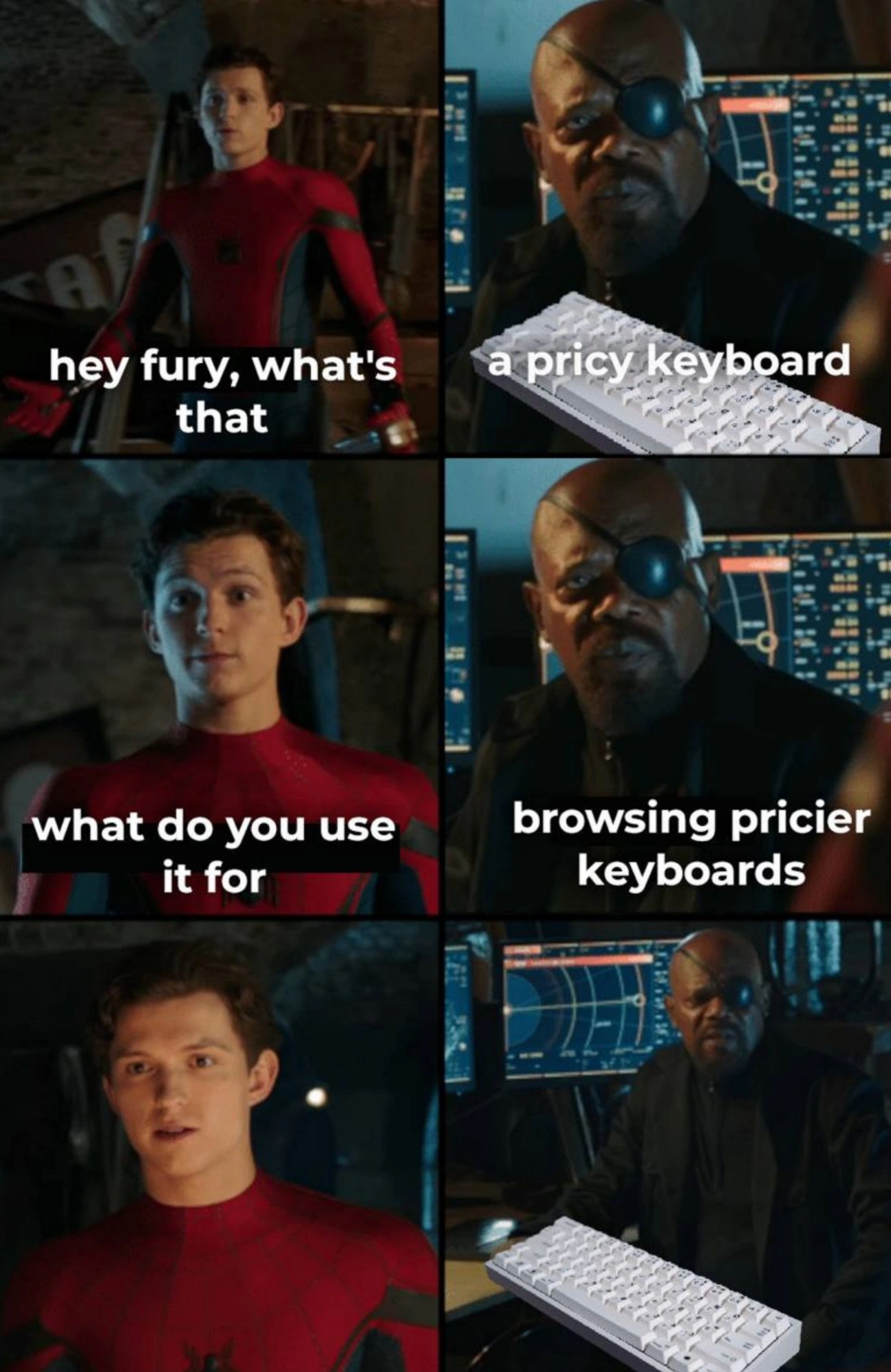
Spider-Man: "hey fury, what's that"
Nick Fury: "a pricy keyboard"
Spider-Man: "what do you use it for"
Nick Fury: "browsing pricier keyboards"

This meme is a playful jab at developer culture and the endless upgrade cycle of hobbyist hardware. In the scene, Spider-Man (playing the curious junior dev) is amazed at Nick Fury’s fancy mechanical keyboard. Fury – the battle-hardened senior engineer figure – reveals that this expensive peripheral’s main purpose is ironically to browse for even pricier keyboards. It’s a classic tech irony: using a high-end tool for a self-referential, almost trivial purpose. The humor hits home for a lot of experienced devs who have fallen into this exact loop. We justify buying top-of-the-line gear for productivity or better Developer Experience (DX), and then find ourselves treating it like a collectable hobby rather than just a tool.

Mechanical keyboards are a prime example of this phenomenon. In developer circles, these keyboards are legendary for their tactile feedback and customizability. Each key has its own mechanical switch, giving a satisfying click or thock sound and a distinct feel. Enthusiasts (often proudly calling themselves mechanical_keyboard_enthusiasts) will gush about keyboard switches like Cherry MX, Gateron, or Kailh the way a sommelier talks about wine notes. They’ll swap out springs, lube switches, and hunt for the perfect keycap set. The developer ergonomics angle is real – a good keyboard can reduce fatigue during marathon coding sessions – but past a point it becomes a passionate hobby and status symbol. There’s always a more exotic switch or a limited-edition custom board to covet.

The meme nails this with Fury’s deadpan line: he bought a pricey keyboard only to use it for “browsing pricier keyboards.” It’s an exaggeration that feels true. Many of us have caught ourselves doing something similar: using our current setup to research the next upgrade. This “just one more” mindset is essentially an infinite loop of tech consumerism. From a coding perspective, it’s like a program that never breaks out because there’s always a new condition triggering it. In pseudo-code, the hobby might look like:

// Pseudocode illustrating the endless keyboard upgrade loop
let keyboard = buy("Fancy Mechanical Keyboard");  
while (true) {  
  browse("online keyboard forums");  
  let next = find("even pricier keyboard model");  
  if (next.price > keyboard.price) {  
    keyboard = buy(next);  // upgrade to the pricier one  
  }  
  // Loop continues as there's always an even pricier keyboard out there  
}

Notice the while(true) – it never ends! There’s even a running joke in enthusiast communities about finding your “endgame” keyboard (the one to end all upgrades), but that endgame keeps getting pushed further away with each new discovery. The tag endless_upgrade_cycle is on point: no matter how advanced your current gear is, something shinier emerges.

Another layer of humor here is the use of the Spider-Man & Nick Fury meme format, a staple of modern MemeCulture. It’s a scene from the Marvel movies repurposed to lampoon tech habits. Spider-Man’s naive question and Fury’s blunt answer heighten the comedic effect: it’s like a junior dev asking an earnest question and a senior dev responding with a world-weary truth. The contrast between a superhero context and a nerdy keyboard obsession makes it even funnier. It echoes the dynamic in many dev teams: newcomer is curious about a fancy tool; veteran reveals the tool’s ironically mundane or indulgent actual use.

The broader commentary is about tech consumerism among developers. We often pour time and money into developer tools and gadgets, convincing ourselves it’s all in service of coding better or faster. A high-end keyboard, a 4K monitor, the latest framework – these are supposed to boost productivity. And they can, to an extent. But as this meme jokes, it’s easy to slip into using the tool as an end in itself. The expensive keyboard isn’t writing code by magic; it’s being used to scroll through forums and shop for more gear. It’s a tongue-in-cheek reminder that even the most high-tech hardware can become a toy rather than a tool if you’re not careful.

Any seasoned programmer can chuckle at this because they’ve either experienced it or seen it: colleagues who boast about their $400 custom keyboard with rainbow LED backlights (because of course it has RGB) and ultra-rare keycaps, yet spend more time talking about it (or browsing for upgrades) than the actual code they’re supposed to write. It’s a shared joke of the developer experience: we love our toys, sometimes to absurd lengths. The meme’s punchline lands so well because it’s almost absurd, but not quite – it rings true enough to make us laugh and cringe at ourselves simultaneously.

Description

A six-panel meme featuring a conversation between Spider-Man (Tom Holland) and Nick Fury (Samuel L. Jackson) from a Marvel movie. In the first panel, Spider-Man asks, 'hey fury, what's that'. The second panel shows Nick Fury in a high-tech control room with a custom white mechanical keyboard digitally edited in, accompanied by the text 'a pricy keyboard'. In the third panel, Spider-Man follows up, 'what do you use it for'. Fury's deadpan response in the fourth panel is, 'browsing pricier keyboards'. The final two panels show Spider-Man's bewildered reaction and Fury stoically sitting with his keyboard, emphasizing the punchline. This meme humorously captures the recursive and often expensive nature of niche hobbies popular within the tech community, like building custom mechanical keyboards. The joke is that acquiring one expensive item only serves to fuel the desire for even more expensive and specialized versions, a cycle many senior engineers with disposable income can relate to

Comments

9
Anonymous ★ Top Pick The ultimate developer setup: a $400 ergonomic keyboard to prevent carpal tunnel from writing YAML, and a $1200 standing desk to make pacing during endless builds feel more productive
  1. Anonymous ★ Top Pick

    The ultimate developer setup: a $400 ergonomic keyboard to prevent carpal tunnel from writing YAML, and a $1200 standing desk to make pacing during endless builds feel more productive

  2. Anonymous

    Our infra budget funds 50 Kubernetes nodes and a $600 gasket-mount keeb whose primary workload is ⌘-T followed by “next group-buy” - it’s basically CI/CD for buyer’s remorse

  3. Anonymous

    It's the same recursive optimization problem as our microservices architecture - we keep decomposing the solution into smaller, more expensive pieces that each require their own specialized maintenance contract

  4. Anonymous

    Mechanical keyboards are the only dependency where each upgrade resolves to a strictly more expensive version - npm audit would flag your wallet as critical

  5. Anonymous

    The mechanical keyboard community has achieved perfect recursion: O(n²) complexity where n is the number of keyboards you own, and each keyboard's primary function is researching its successor. It's the only hardware investment where the ROI is measured in artisan keycaps per dollar rather than productivity gains - a true implementation of the 'expensive_noop()' function that senior engineers recognize as the most honest form of technical debt

  6. Anonymous

    Mechanical keyboard economics: buy K0 so you can type faster while opening tabs for K1 where price(K1) > price(K0); the ‘endgame’ condition never halts

  7. Anonymous

    Upgrading keyboards like refactoring a monolith: start simple, end up chasing the perfect switch in an infinite hotswap loop

  8. Anonymous

    I call it continuous improvement: buy a $300 keyboard to cut p99 actuation by 2 ms, then use it exclusively to browse $500 keyboards

  9. @misesOnWheels 4y

    it does these really loud clicking sounds

Use J and K for navigation