Skip to content
DevMeme
3025 of 7435
The Brutal Reality of a Computer Science Degree
CS Fundamentals Post #3340, on Jun 26, 2021 in TG

The Brutal Reality of a Computer Science Degree

Why is this CS Fundamentals meme funny?

Level 1: Vegetables Before Dessert

Imagine you really love desserts – say you got into cooking because you enjoy baking cookies and eating ice cream. You sign up for a cooking class expecting to make chocolate cakes and yummy treats. But on the first day, the instructors stand over you with strict faces and say, “Before any cupcakes, you must learn about broccoli, boiling potatoes, and the chemistry of bread.” They make you chop vegetables and study why dough rises. Suddenly, all the fun stuff you looked forward to is nowhere in sight, and you’re stuck with the boring, tough stuff first! You feel disappointed and a bit scared – this isn’t what you thought you signed up for. In the end, though, just like eating your vegetables before dessert, those boring lessons are like the healthy greens that will make you a stronger cook. The meme is funny because the person just wanted the sweet fun of coding, but got a plate full of tough veggies (hard courses) instead, and they’re on the floor crying about it. It’s showing in a silly way how we often have to do the hard, important stuff before we can enjoy the easy fun stuff – even if we might sulk like a kid with broccoli in the meantime.

Level 2: Meet the Gatekeepers

For newcomers or junior CS students, let’s demystify what these scary-sounding courses are, and why they’re there. The meme highlights three subjects in a CS curriculum that often catch students off guard. Think of them as the “gatekeepers” to the upper levels of computer science – tough courses that ensure you learn the fundamentals, not just how to code in a high-level language. Here’s what each of those terms means in plain language:

  • Microprocessors (Computer Architecture) – This is basically learning how the computer’s hardware works. Imagine opening up a computer and zooming into the tiny chip (the CPU) that executes instructions. In a microprocessors course, you study how that chip is designed and how it runs your programs. You’ll encounter things like logic gates (the electronic switches that perform basic logical operations like AND, OR, NOT), and see how combining thousands or millions of those creates components like adders and multipliers. You learn about the CPU’s structure: units that fetch instructions, decode them, perform arithmetic, and access memory. A big part of this class is often writing in assembly language, which is a very low-level way of programming the CPU directly. For example, instead of writing a nice high-level line like total = a + b, you might write a couple of assembly instructions to move numbers into registers and add them. It looks more like MOV AX, [a] / ADD AX, [b] / MOV [total], AX. That can be jarring! Many students who are comfortable writing code in Python or Java get a shock when they see how primitive and intricate coding at the hardware level is. But this course teaches you what’s really happening when your code runs – it’s like lifting the hood of a car engine and understanding how each part moves. It can actually be pretty cool to realize that, say, memory cache exists and why reading sequentially from an array is faster than jumping around (because of how the CPU fetches memory in chunks). Still, it’s a lot of detail and new concepts, which is why it feels like a big, demanding gatekeeper.

  • Automata Theory (Theory of Computation) – This one is all about the mathematical side of computing. It’s less about the physical computer and more about the logic and possibilities of computation itself. In an Automata Theory class, you won’t be building programs to run on a computer; instead, you’ll study abstract “machines” that help us understand what computers can and cannot do. For example, you start with finite automata, which are like simple robots with a limited memory that can recognize patterns in input (think of a vending machine that reads coins – it’s a real-life example of a finite automaton, because it has a few states and changes state when you insert coins). You learn about formal languages, which aren’t spoken languages, but sets of strings (like sentences made of symbols) that these machines can process. This ties directly into how programming languages are designed – the rules that determine if your code’s syntax is correct come from this theory. As the course goes on, you meet more powerful theoretical machines: pushdown automata (which can use a stack memory, good for understanding things like parentheses matching) and finally Turing machines, which are a model of a computer with unlimited memory. A Turing machine is a bit like a super-simplified computer that reads and writes symbols on an infinite tape according to some rules; it’s a fundamental model that captures what “computing” means. Why does a coding enthusiast have to deal with all this theory? Well, Automata Theory also covers important concepts like computational complexity (how hard problems are to solve) and decidability (whether a problem can be solved at all by any computer). For instance, you learn there are some problems no program can ever solve (like the Halting Problem, which proves there’s no general way to know if any given program will finish running or loop forever). For a student expecting to just make apps or games, this class can feel like a curveball – suddenly there’s a lot of proofs, Greek letters, and not a single actual coding project! It’s very abstract. But it’s in the curriculum to train your brain to think about problems rigorously and understand the limits of computing. It’s like the “grammar and vocabulary” of the computing world – not as exciting as writing a story (program) directly, but it ensures you know the rules.

  • Engineering Physics – This one might seem the furthest from programming. Why is a wannabe coder sitting in a physics classroom learning about motion, electricity, or optics? In many universities, computer science programs require basic engineering physics because computers run on physical principles. An Engineering Physics course usually covers fundamental physics topics that every engineer should know: classical mechanics (how objects move under forces), electromagnetism (how electric currents and magnetic fields work), maybe some thermodynamics (heat and energy) or material science. For computer engineering specifically, the electromagnetism part is very relevant – it leads into understanding circuits, signals, and semiconductor physics (how chips are made and how electrons move in silicon). You might do labs where you build simple electrical circuits with resistors and capacitors, or experiments measuring gravitational acceleration, depending on the syllabus. To a student eager to code, this can feel completely unrelated. Solving Newton’s second law problems or calculating the frequency of a pendulum doesn’t obviously help you center a div in CSS or fix a bug in your Java code. But this class is there to give you a grounding in the scientific method and the real-world constraints of technology. After all, the smartphone or laptop you’re coding on is a physical device – it has a battery, it obeys physics. Knowing a bit about how energy, signal voltage, and even basic mechanics work makes you a more well-rounded technologist. And if you ever wonder “why can’t they just make computers faster?”, physics has the answers (like heat dissipation and quantum limits). Still, as a freshman, you mostly think, “Ugh, I have to pass physics while all I want is to code.” It’s definitely a hurdle if science and math aren’t your strongest suits.

Now imagine facing all three of these in your early semesters! It’s a lot. Each demands a different way of thinking and studying: one minute you’re memorizing physics formulas, the next you’re drawing state diagrams for an automaton, then you’re debugging an assembly language loop. No direct coding of cool apps in sight. That’s exactly why the meme depicts these courses as a formidable gang and the student as a crying Pepe. CS curriculum shock is real: you go in expecting to craft software and end up wrestling with abstract math proofs and hardware details. Many junior students feel a bit of “regret” or at least surprise, like “Did I choose the wrong major? I just wanted to program, why am I doing all this?”

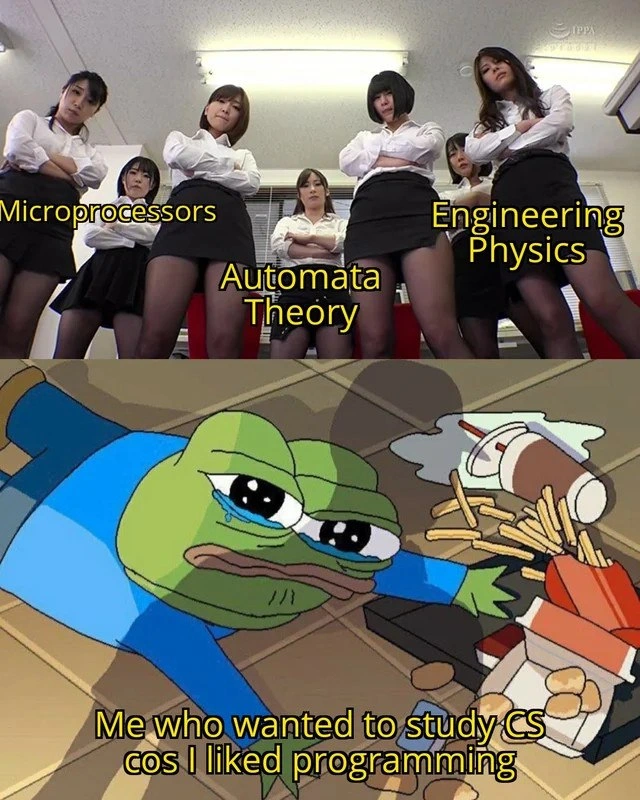
The humor here also comes from how the meme uses visual labels: The top image literally shows people standing over you, labeled as those tough subjects. It’s like the personification of each course. And indeed, these classes can feel like personal antagonists during your degree. The bottom image being Pepe the Frog crying on the floor perfectly sums up the emotional state: overwhelmed and defeated. Pepe’s fast food (fries and soda) could symbolize attempted comfort or just the classic student diet during long study sessions, now lying wasted – much like the student’s energy. It’s a funny way to say, “I’m done; these subjects broke me.”

For someone early in their CS learning journey, the key takeaway is: computer science isn’t just coding. A CS degree aims to teach you the science and engineering behind computers, not just how to use a programming language. That’s why it throws these “gatekeeper” fundamental courses at you. It can be a tough pill to swallow (not unlike eating your veggies before you get to dessert), but it builds a foundation that makes you a stronger developer down the road. The meme’s joke is that this reality often hits students by surprise, with a bit of dark comedy in how brutally it’s portrayed. If you’re a junior dev or student seeing this, know that you’re not alone—pretty much everyone has felt like that Pepe at some point, crying out “I just wanted to code, why am I learning this?!” The good news is, once you get through it, you gain superpowers: you’ll not only write code but also understand what’s happening under the hood and why things work the way they do. That’s what those intimidating core courses are really for.

Level 3: Trial by Curriculum

Now, why is this meme so painfully spot-on for anyone who’s been through a Computer Science program? It captures that classic expectations vs. reality moment. A lot of us signed up for CS because we loved coding – building websites, making simple games, or automating tasks gave us a thrill. We thought university would be more of that on a grander scale. Instead, the first years hit us with a barrage of theoretical and low-level courses that felt, at times, only tangentially related to writing cool software. The meme nails this feeling by portraying those core subjects as a posse of intimidating bullies. It’s academic humor born from collective student trauma: everyone remembers their curriculum shock when theory vs. programming wasn’t just a phrase but their daily struggle.

The top panel’s imagery is perfect. A low-angle shot of a group of people with arms crossed, staring down – it’s the universal visual language of intimidation. By labeling these stoic figures as “Microprocessors”, “Automata Theory”, and “Engineering Physics”, the meme creator turns abstract classes into characters, almost like boss fights in a video game or the “gatekeepers” of the CS degree. It’s as if these subjects formed a gang in the hallways of university, waiting to rough up unsuspecting newbies. The low camera angle (looking up at them) exaggerates their dominance – exactly how a struggling student perceives these courses: towering, unapproachable, and a bit menacing. There’s a dash of dark humor in that framing, because to a 19-year-old who just wants to code a cool app, something like Automata Theory can indeed feel like a big scary person looming over, demanding respect or else.

Meanwhile, the bottom panel gives us the defeated student avatar: the crying Pepe the Frog sprawled on the floor. Pepe is a well-known internet meme character often used to represent feelings of sadness, overwhelm, or self-pity in a tongue-in-cheek way. Here Pepe is in full meltdown mode: tears streaming, lying next to spilled french fries, a toppled soda, and a fallen burger. This absurdly tragic fast-food scene amplifies the comedy. It’s like our poor student tried to comfort themselves with a meal (perhaps a late-night junk food session after a brutal study attempt), only to be knocked flat by these subjects. The spilled fries and drink are cartoonish shorthand for “utter defeat” – we’ve all had that moment where you just facepalm and knock your drink over in despair. Using Pepe, a cartoon frog, also contrasts with the real-life photo above; it conveys “this is me, a pathetic mess, in contrast to the stern professors (or courses) above.” The contrast between the real intimidating figures and the cartoon crying frog is intentionally ridiculous and relatable at the same time, a hallmark of academic humor memes.

For seasoned developers or graduates looking at this, there’s a lot of knowing laughter and maybe a bit of a wince. We’ve been there. Those of us who survived these courses can attest that they often felt like a rite of passage (some might say a hazing ritual) in becoming a computer scientist. The meme resonates because it’s common to hear things like, “I just wanted to make software, but suddenly I’m proving the pumping lemma or calculating capacitor charge – what gives?” University curricula, especially in classical computer science programs, are heavy on theory and low-level fundamentals. They are sometimes jokingly described as “teaching you everything but coding.” There’s truth in that humor: you might spend more time doing math proofs and debugging circuit diagrams than building real applications in those early semesters.

Why do these subjects “tower over” the love of coding? Partly, it’s intentional: these core courses are often used as weed-out classes – they’re tough by design to ensure students are serious and to build rigorous thinking. They forge you in fire: after you’ve survived designing a finite automaton that recognizes palindromes or writing an assembler for a made-up CPU, you can probably handle the logic of complex software. But in the moment, it absolutely feels like trial by ordeal. Many junior students hit a wall here and some even question continuing in CS – the meme’s crying figure embodies that “What have I gotten myself into?!” crisis. It’s a shared experience; even senior engineers remember cramming for a microarchitecture exam at 3 AM or struggling with physics problem sets, fueled by fast food and sheer desperation. This meme is basically school-life PTSD packaged in two images.

From a senior perspective, we can now chuckle at how overdramatic it all felt. Sure, at the time Automata Theory made us cry (or at least grab an extra soda from stress), but later on, we might find ourselves unexpectedly using that knowledge. Maybe you’re optimizing a regex engine and suddenly those finite state machine lessons click. Or memory alignment issues crop up in your high-performance C code and you recall something from your microprocessor class about word boundaries and the cache lines. Even if you don’t use the physics formulas directly, the analytical problem-solving skills carry over. In hindsight, you see the wisdom of it, though back then it just felt like academic sadism. The academic vs practical skills debate is long-running: “Why do I need to know theoretical O(N log N) when I can just Google a sorting function?” – but when a real-world problem doesn’t fit the textbook scenarios, those fundamentals become your unsung toolkit.

The meme exaggerates to hit that humorous nerve, but it’s rooted in truth. ComputerScienceEducation often emphasizes breadth and theory, whereas the average student expectation is more narrow and practical. The result? A lot of stunned undergrads. It’s funny to seasoned devs because we recognize our younger selves in Pepe. We remember that naive enthusiasm for coding colliding with the brick wall of formal languages and hardware design. “It’s not all writing cool code, kiddo,” the curriculum effectively tells you, “there’s a whole universe under the hood.” The top panel’s crossed arms and stern looks say “we’re not impressed by your enthusiasm alone.” You have to earn your stripes by grappling with the tough stuff. In meme terms, CS fundamentals are the mini-bosses you must defeat to get to the treasure (the degree, the cool projects, the bragging rights). And once you do, it’s oddly satisfying – though at the time you’re just a frog on the floor crying over spilled fries.

Level 4: From NAND to Turing

At the most foundational levels of computer science, these intimidating courses represent the pillars of computation from hardware physics up to abstract theory. The meme labels each stern-faced figure with a core subject—Microprocessors, Automata Theory, and Engineering Physics—which correspond to different layers of how computers work. This is essentially the entire stack of computing laid bare: from electrons flowing through circuits, to bits flipping in a CPU, all the way to the mathematical limits of what can be computed. No wonder a student who "just likes programming" might feel overwhelmed; they're being shown the full iceberg beneath the tip of coding.

Let's break down these towers of theory and tech: Automata Theory dives into the mathematical models of computation. It’s where you meet things like finite state machines, pushdown automata, and the legendary Turing machine. These aren’t sci-fi robots, but abstract machines that help us understand what logic can be automated. In Automata Theory class, you’ll prove things like which problems are decidable (can be solved by an algorithm) and explore the hierarchy of formal languages (thanks to Noam Chomsky’s work on grammars). It’s heady stuff: one day you're coding a fun game, next day you’re pondering the Halting Problem or using the pumping lemma to show a language isn’t regular. This theory is crucial for designing compilers, interpreters, and understanding why some problems are impossible to compute at all. It’s deep computer science: Alan Turing back in 1936 imagined an infinite-tape machine (the Turing machine) to define computing itself, and that legacy lives on in this course. For a student, though, being asked to construct a formal proof about an automaton can feel like being dropped into an alternate universe of symbols and Greek letters, far from the straightforward joy of writing code that “does something cool”.

Meanwhile, Microprocessors (often encompassing computer architecture or digital logic design) yank you down from the clouds of theory into the gritty reality inside a computer’s brain. This is about how the CPU — the chip at the heart of every computer — actually works. It starts with basic electronic logic: you learn how to build circuits out of logic gates like NAND and NOR, which are the simplest building blocks that realize Boolean algebra (the true/false logic underlying all computing). There’s a beautiful historical symmetry here: in 1937, Claude Shannon showed how to implement Boolean logic with electrical circuits, laying groundwork for digital computers. Fast forward, and in a microprocessors course you might literally design a simplified CPU in a simulator or wire up an ALU (Arithmetic Logic Unit) with those gates. You delve into the Von Neumann architecture – the design where programs and data reside in memory and a processor fetches and executes instructions sequentially. The class might force you to write low-level assembly code (e.g., doing MOV AX, BX to move data between CPU registers, or using bitwise operations) which is a shock if you’ve only used Python or Java before. You confront concepts like registers, cache memory, pipelines, and clock cycles – the machinery that makes your code run millions (or billions) of operations per second. It’s fascinating, because you realize that your high-level program ultimately becomes sequences of machine instructions toggling tiny transistors. But it’s also exceedingly detail-oriented: one misplaced bit in an assembly instruction and nothing works. The abstraction barrier is stripped away – for a student who just wants to build apps, being asked to understand two’s complement arithmetic or how a branch predictor works can feel like being spoken to in another language (quite literally, the language of the machine).

Now, Engineering Physics swoops even further down to the bedrock. This course (or series of courses) is often about applying physics principles in an engineering context – it might include electricity and magnetism, waves, thermodynamics, even quantum basics – all of which are indirectly crucial for computing hardware. This is where you learn that behind every bit of digital data is an analog world: currents, voltages, magnetic fields, and silicon materials obeying Maxwell’s equations and quantum mechanics. In a computing degree, Physics class might mean understanding how a transistor actually switches on and off (spoiler: it’s quantum tunneling and semiconductor physics making those 0s and 1s possible). You might find yourself calculating the capacitance of a circuit, or how fast an electrical signal can propagate on a wire, or analyzing forces in mechanical systems if it’s a general engineering requirement. It’s rigorous science and math, often with lab experiments – a far cry from making a colorful website. The link to coding is indirect but fundamental: without physics, there would be no electronics, and without electronics, no computers. Engineering Physics reminds us there are physical limits to computing power (like heat dissipation or the speed of light delay in signals). It’s the universe saying “there are rules to what you can build,” even as Automata Theory is the universe saying “there are rules to what you can solve logically.” Together, these courses frame the ultimate laws of computing, both physical and theoretical.

In essence, a traditional CS curriculum is ensuring you see the entire elephant, not just the tail. Programming – the act of writing code – is just one part of a much larger picture. The meme humorously personifies those other parts (the hardware, the theory, the science) as a gang of intimidating figures. And honestly, from a scholarly perspective, they are formidable: each of these subjects is complex enough to spawn entire specialist careers. But they’re in the curriculum because everything in computing connects: The code you love to write is executed on a microprocessor (built using physics) and is constrained by the theories of computation. Your nifty program works only because a long chain of fundamental principles makes it possible. It’s both humbling and awe-inspiring – but when you’re a student facing them all at once, it mostly just feels terrifying!

Description

This is a two-panel meme contrasting the expectation of studying computer science with its challenging reality. The top panel features a low-angle shot of several women in office attire looking down with intimidating expressions, with text labels superimposed on them reading 'Microprocessors', 'Automata Theory', and 'Engineering Physics'. This image format is often used to represent overwhelming or dominant forces. The bottom panel shows a popular internet character, Pepe the Frog, depicted as sad and crying on the floor after spilling his fast food. The text over this panel reads, 'Me who wanted to study CS cos I liked programming'. The meme humorously captures the shock and despair many students experience when their simple passion for programming collides with the intense, theoretical, and often abstract curriculum of a formal Computer Science degree. For seasoned developers, it's a nostalgic nod to the academic gauntlet they survived, which involved far more than just writing code


Comments

18
Anonymous ★ Top Pick I walked into my CS degree excited to build apps. I walked out with PTSD from finite automata and a deep-seated fear of physics
  1. Anonymous ★ Top Pick

    I walked into my CS degree excited to build apps. I walked out with PTSD from finite automata and a deep-seated fear of physics

  2. Anonymous

    I just wanted to ship features - now Microprocessors pages me with cache-miss flame graphs, Automata Theory opens sev-1s on runaway regex backtracking, and Engineering Physics keeps reminding me the speed of light isn’t on the sprint board

  3. Anonymous

    Twenty years later, you realize those automata theory courses were the only thing that prepared you for debugging regex in production at 3 AM while your microservices are having an existential crisis about state management

  4. Anonymous

    The classic CS degree bait-and-switch: you come for the joy of making computers do your bidding, but first you must prove you can hand-trace a Turing machine through a non-deterministic finite automaton while calculating the propagation delay of a CMOS inverter. By the time you're deriving the Chomsky hierarchy for the third time, you start to wonder if 'self-taught developer' wasn't the more direct path to actually writing code

  5. Anonymous

    Thought CS was just coding; Automata, Microprocessors, and Physics jumped me - then prod taught me it’s all three: a nondeterministic state machine on a lossy network riding a leaky CPU cache

  6. Anonymous

    Signed up for CS to sling code, ended up proving P vs NP over cafeteria fries - now every prod regex feels like a personal vendetta

  7. Anonymous

    CS degrees are monorepos where ‘Intro to Programming’ transitively depends on DFA closure proofs, CMOS timing diagrams, and a midterm in Lagrangian mechanics

  8. @sylfn 5y

    Translation: FULL Remember, this is an English-only chat. If you wanna talk any other language, please add a translation of your message. This rule also applies to all media you send. Это -- англоязычный чат, поэтому, если вам захотелось выразить свои мысли на любом другом языке, то необходимо добавить их перевод на английский. Правило применяется не только к тексту, но и к любым медиаыайлам и стикерам, которые вы отсвлаете.

    1. @UQuark 5y

      Fuck you, it's a sticker

  9. @Chess_player_1224 5y

    Full

  10. @wtf_is_telegram 5y

    Nah Me, who wanted to study CS in uni: can't wait to get deeper into computers to become a better programmer Fucking MS Access courses for 3 years: I'm about to ruin this man's whole career

  11. @sylfn 5y

    warning 1/3 for @Artem_High_five Reason: Ignoring English only rule (по-русски) Предупреждение 1 из 3 для @Artem_High_five Причина: игнорирование правила только английский язык --- About non-existing rule. It exists and you can see it: 1. in chat description 2. when you join this chat one of mods send you a copy of them 3. from comments on tdesktop in right panel I don't know how to see rules from comments in mobile version, so we need something here. (по-русски) Насчет несуществующего правила. Оно существует, его можно увидеть: 1. в описании чата 2. когда заходишь в чат, тебе его отправляет один из модераторов 3. в десктопной версии в панели справа в комментариях Я не нашел способа открыть из комментариев на мобильной версии описание чата, поэтому тут надо что-то придумать.

  12. @sylfn 5y

    I agree with you - there should be some rules (maybe a link to them) in main channel's description. But the main thing is - everything can be talked about. That's why you don't get immediately banned after violating a rule, but just get a warning.

  13. @mityabb 5y

    Come on guys, MPs are fun. Studying them in University gave me childhood lego vibes

  14. @mityabb 5y

    100 times tougher thou

  15. @ZgGPuo8dZef58K6hxxGVj3Z2 5y

    🤦‍♂️

  16. @RiedleroD 5y

    there are already enough russian meme channels

    1. @p4vook 5y

      but not enough

Use J and K for navigation