Creative Reuse of Obsolete Networking Hardware
Why is this Hardware meme funny?
Level 1: Keys on a Wire
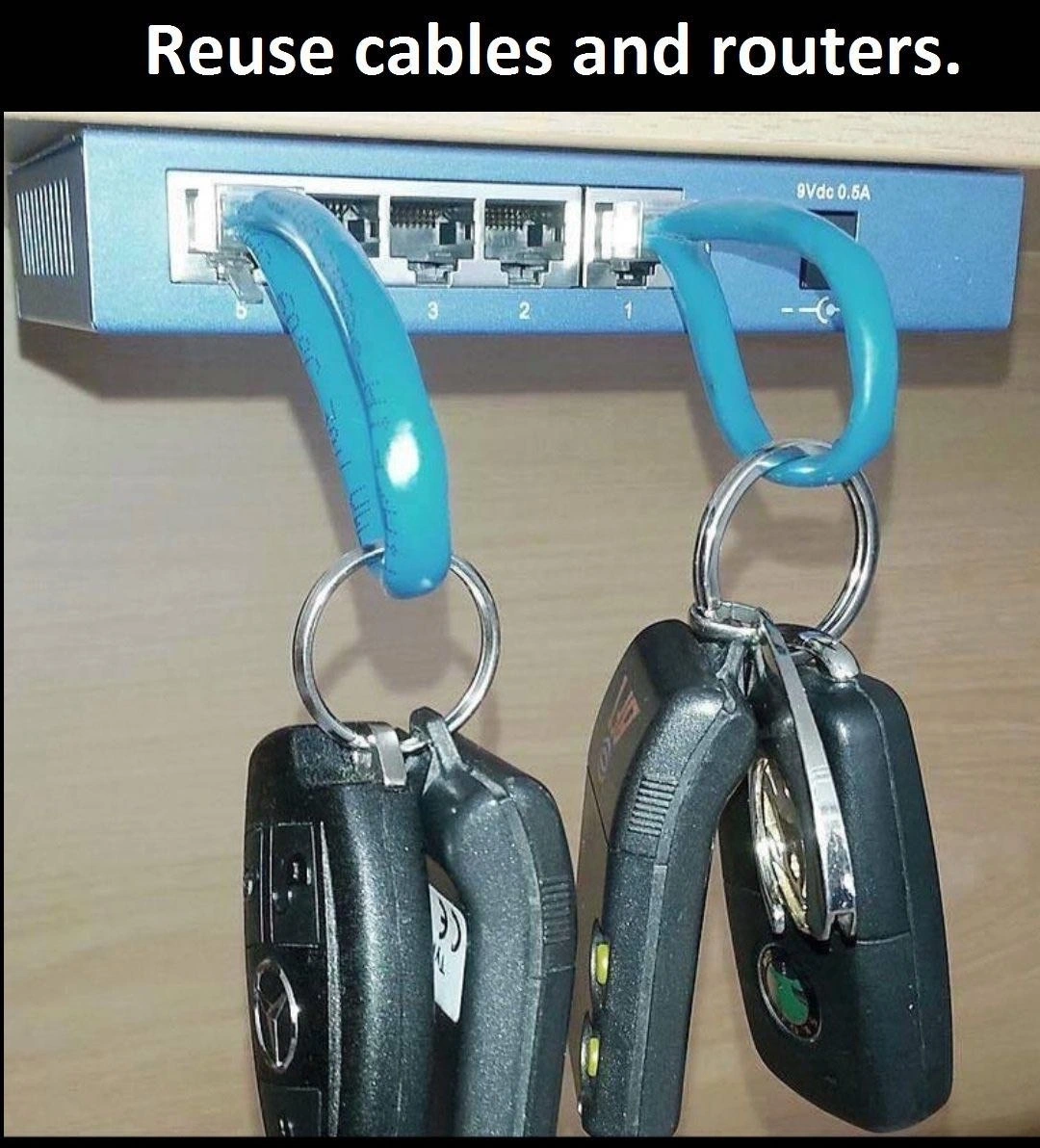
Imagine you have a toy or gadget that you don’t use anymore. Instead of throwing it away, you decide to do something funny with it. For example, let’s say you have an old plastic box with holes (kind of like a little toolbox). You flip it upside down and stick it under a shelf. Then you take a couple of old wires, plug them into the holes, and bend the ends of the wires into hooks. Now you can hang your keys on those wire hooks! It sounds silly, right? That’s exactly what’s happening in the picture: a router (an old internet box that used to connect computers) has been turned into a place to hang keys. The cables (wires) that normally would connect computers are used like hooks to hold the keys. It’s funny because people don’t usually use tech gadgets as furniture or storage, so it’s very unexpected. It’s like using a fork as a hair comb – a goofy, creative idea that actually kind of works. The reason it makes us smile is because someone found a clever way to recycle something old and solve a simple problem (where to put the keys) at the same time. Even if you’re not a tech expert, you can laugh at how resourceful and absurd it is to see car keys dangling from an internet router.
Level 2: Old Router, New Tricks
Let’s break down what’s going on in simpler terms. We have an old router (technically, it could be a small network switch – a box that usually connects multiple computers together with Ethernet cables). It’s that rectangular blue device in the picture. Normally, you’d plug computers or other network devices into its Ethernet ports (those square holes with metal contacts) using Ethernet cables to share an internet connection or local network. These Ethernet cables, often blue like the ones shown, are also called Cat5 or Cat6 cables (short for Category 5/6, indicating how much data they can carry). Each cable has an RJ45 connector at the end – that’s the plastic clip that clicks into the port to lock the cable in place.
In the meme, however, nobody is using this router for networking anymore. It’s been flipped upside-down and mounted under a wooden shelf. Two short patch cables (small Ethernet cables used for connecting devices in tight spaces) are plugged into the router’s ports number 5 and 1. But here’s the wild part: instead of running those cables to a computer or another network device, the other ends of the cables have been stripped and bent into loops! The plastic outer coating of the cable has been cut away at the tip, exposing the internal wires just enough so the cable can be curved back into a U-shape. This makes each cable end look like a little blue hook coming out of the router. And dangling from each of those cable hooks are metal key rings loaded with keys (car key fobs, specifically). Essentially, the cables have been turned into makeshift hooks, and the router has become a funky wall-mounted key holder.
Why is this funny or noteworthy? For one, it’s a very non-standard use of tech equipment. Routers and switches are meant to transmit data, not hold household items. Seeing keys hanging from network ports is unexpected – it’s like seeing a computer mouse used as a doorstop or a keyboard as a hammer. It makes you do a double-take. People who work in IT or tech (like system administrators or network engineers) find it funny because they’re used to dealing with this gear in a serious way (configuring networks, managing cables properly) and here it’s just being used as a cheap tool in the office. It’s a bit of HardwareHumor and CableManagement irony – usually those cables are carefully routed in server racks, but now they’re literally hanging out with keys on them.
This image also speaks to the idea of upcycling or reusing old stuff. In many offices, especially in IT departments, you accumulate a lot of old hardware over time: outdated routers, switches, cables, and other gizmos that are no longer needed for the network. Often these gadgets sit in a closet as spares or awaiting proper recycling. Someone clearly had the clever idea, “Hey, instead of throwing away this old router, let’s give it a new purpose!” By turning it into a key-holder, they solved a practical problem (where to hang the office or car keys) at no extra cost. It’s a very DIY (do it yourself) kind of fix – no need to buy a new key rack when you can make one from tech junk. That kind of resourcefulness is sometimes jokingly called an “office MacGyver” move, referencing MacGyver, a TV character famous for inventive solutions with common objects. Tech folks pride themselves on these clever hacks, so it’s both a joke and a humblebrag: look what we managed to do with an Ethernet cable!
Let’s clarify a few terms and why they’re mentioned:
- Router/Switch: a box that directs network traffic. A router usually connects different networks (like your home network to the internet), and a switch connects devices within one network. The device in the photo has multiple ports like a switch, but people often call any networking box a “router” loosely. In either case, it’s old hardware not being used for its original network purpose.
- Ethernet Cable: the cord that connects computers to network devices. It has 8 tiny copper wires inside (in twisted pairs) and typically an RJ45 connector on the end. In the meme, the connectors on two cables were removed and the cable ends were bent into hooks.
- RJ45 Port: the jack on the router/switch where you plug the Ethernet cable. It usually holds the cable firmly (with a little spring latch). Here, those ports are anchoring the bent cables. Interestingly, RJ45 ports and connectors are designed to withstand plugging and unplugging, and apparently they can also hold the weight of a few keys without breaking!
- Cable Management: normally refers to organizing cables so they’re not a messy tangle. For example, using Velcro straps or cable ties to bundle excess length, labeling cables, etc. It’s an important part of keeping a server room or desk setup neat and functional. In this joke, “cable management” is cheekily reinterpreted as using cables to manage something else (the keys). It’s like a word play: instead of managing cables, the cables are managing keys.
- Systems Administrator (Sysadmin): an IT professional who manages and supports computer systems and networks. They often have to be very practical and handy. If something breaks, they fix it. If they need a tool and don’t have it, they improvise. This meme is exactly the kind of solution a crafty sysadmin might come up with. It’s both a bit of humor and a badge of honor in that community: finding the simplest, cheapest fix that works, even if it’s a bit unorthodox.
For a newcomer or junior developer, the meme is illustrating how informal and creative IT office culture can be. It’s okay if you didn’t immediately recognize the device or the cables — what matters is understanding that an object that used to do high-tech work (sending data) is now doing a low-tech job (holding keys). The cleverness is what makes it funny. And if you’ve ever worked around tech hardware, you’ll start seeing why this is relatable: eventually, you’ll come across old gadgets lying around and you might be tempted to turn them into something fun or useful too.
Level 3: Reduce, Reuse, Router
This meme hits on the SysAdminHumor nerve by showing an absurdly practical hack: an old network router (or 5-port Ethernet switch) literally repurposed as a key rack. In the IT world, we jokingly live by “reduce, reuse, recycle” – or in this case, reduce, reuse, router. Here a decommissioned piece of Networking hardware finds a second life bolted under a shelf, with two blue Cat5 Ethernet cables forming hooks for car keys. It’s a perfect example of improvised_hardware_reuse in low_budget_it_solutions: when management won’t approve $5 for a key holder, the IT staff digs into the old equipment pile and says “challenge accepted.” 😏
From a seasoned systems administrator’s perspective, the humor works on multiple levels (no pun intended, OSI model folks). Normally, that blue box’s RJ45 ports would be busy forwarding packets, linking computers, and blinking away with network traffic. It might have been a modest 100 Mbps switch from years ago – practically ancient history in networking terms. But once it’s obsolete (too slow for modern networks or replaced by an upgraded unit), it becomes just another hardware relic gathering dust in the server closet. Networking gear often has a long afterlife of being shuffled around: first it’s the core switch, then a test lab device, and eventually it’s E-waste waiting for disposal. This meme jokes that before tossing it out, why not give it one last mission? Hence the office MacGyver moment: using the router’s sturdy metal case and cable ports as an office_macgyver solution for key organization.
There’s also an ironic twist on cable_management. In IT, “good cable management” means neatly routing and securing cords so nothing tangles or sags – making things easy to maintain. But in this scene, someone took Ethernet patch cables and literally managed them into U-shaped hooks. The blue cables have been stripped of their plugs and bent back into loops emerging from port 5 and port 1. Those improvised ethernet_cable_hooks are now supporting hefty key fobs. It’s both hilarious and actually pretty clever. Ethernet cables contain twisted copper pairs with decent stiffness, especially with the jacket (outer insulation) intact. Bend one just right and it’ll hold its shape — strong enough to suspend a few keys without unbending. The RJ45 jacks on the router chassis provide a ready-made anchor for the cable ends, almost as if the device was always meant to double as a mini coat rack. (Who knew that the Layer 1 physical layer could handle car keys as well as signals?)
This scenario satirizes the resourcefulness (and desperation) of SystemsAdministration teams. It’s common in understaffed IT departments or scrappy startups that every piece of gear is precious. Old equipment isn’t tossed if it might be useful someday. And sometimes that usefulness turns out to be totally unrelated to its original purpose. HardwareHumor often shows servers used as doorstops, dead hard drives turned into coffee coasters, or in this case, a router as the “cheapest key-holder solution.” It’s funny because it’s true: many senior IT folks have seen or done similarly janky fixes. When budgets are tight or time is short, you solve problems with whatever is on hand. Why buy a fancy key cabinet when a defunct router plus some spare cables and screws will do? This is office upcycling at its finest.
The meme also pokes fun at corporate Networking culture. A veteran network engineer might joke, “Finally found a use for that old 5-port switch that won’t handle Gigabit speeds – it’s holding the keys to the server room.” There’s subtext about legacy hardware hanging around. Maybe the team upgraded to a modern Gigabit switch, and this little blue box was left over. Rather than throw it away, the engineers mounted it under a shelf. That’s a wink to how IT people often operate: pragmatic, a bit sarcastic, and always ready to jury-rig a solution. It’s a bonding moment of NetworkHumor – anyone who’s crawled under a desk to plug in cables or rummaged through boxes of old parts can appreciate the absurd efficiency of this hack. The phrase “Reuse cables and routers” in the meme header sounds almost like an official best practice, which makes it doubly sarcastic. (In real best practices, you do reuse cables/routers for networking, not for hanging keys! 😂)
In essence, this is a senior engineer’s inside joke about upcycled_network_gear. It highlights a mix of frugality, creativity, and a little bit of I-can’t-believe-they-did-that shock value. The humor lands because it’s simultaneously silly and relatable. We’re laughing at the absurdity, but also nodding because, honestly, IT folks would do this. After all, when life hands you old routers, you make… key holders.
Description
The image displays a humorous 'life hack' for reusing old technology. A small, blue network switch or router is mounted on a wooden surface. Two short, bright blue Ethernet cables are plugged into the ports, with the other end of each cable also plugged into the switch, creating loops. These loops are being used as key holders, with two sets of car keys hanging from them. The text 'Reuse cables and routers.' is written in a bold, white font at the top of the image. The humor comes from the literal and unexpected repurposing of IT equipment, appealing to tech professionals who often have spare or obsolete hardware lying around. It's a clever visual pun on the concept of recycling in a tech context
Comments
22Comment deleted
This is the physical manifestation of technical debt. It's not the intended use case, it looks questionable, but it's now a production-critical system for leaving the house
When finance said the 5-port switch still had four years of depreciation left, ops turned it into a key-value store - complete with dangling references on every port
After 20 years in the industry, I've finally discovered the true purpose of CAT5e: Centralized Attachment Technology for 5 electronic devices. Who needs PoE when you have Physics over Ethernet?
When the PM asks you to 'maximize hardware utilization' and 'reduce e-waste' in the same sprint, but the budget for new infrastructure is still stuck in approval. At least this router finally achieved 100% uptime - it's been hanging around doing absolutely nothing for years, just like in production
The only reuse that survives longer than your COBOL mainframe - straight to keychain without breaking changes
Decommissioned Layer-2 repurposed as a key-value store: excellent port density, negligible throughput, and PoE now means 'Place on Entry'
Post-cloud repurpose: the decommissioned router is now a key-value store - O(1) lookups by port, Layer-2 retrieval, and vendor lock-in finally means actual locks
Tfb this is fucking hilarious Comment deleted
This is genius Comment deleted
how long until this thingy from connector will fall off? 10 times of use at its best Comment deleted
thats a switch ;-; Comment deleted
Thank you for saying that I came here here to say it if no one else did Comment deleted
(nitpicking, yes) Comment deleted
what if it's a hub Comment deleted
caption says router, so it'd still be wrong :p nonetheless: hubs usually had one port dedicated as an "upstream"; no such thing here Comment deleted
oh hi domi since when are you here Comment deleted
not 100% a given, but i have reasons to believe it's a switch Comment deleted
This is perfect explanation to localhost Comment deleted
Or loopback Comment deleted
Idk Comment deleted
Some double penetration happening in these connectors Comment deleted
two car keys, and… what are those other things? garage door remotes? Comment deleted