Skip to content
DevMeme
1140 of 7435
The Hackathon We Want vs. The COBOL We Need
LegacySystems Post #1271, on Apr 6, 2020 in TG

The Hackathon We Want vs. The COBOL We Need

Why is this LegacySystems meme funny?

Level 1: We Need a Plumber

Imagine a bunch of excited kids who want to help out during a big problem by building a fancy new treehouse for the neighborhood. They’re full of ideas about making it super cool with lights and gadgets. But then, suddenly, the town has an emergency: the main water pipe in the town is very old and just burst, and now everyone’s basement is flooding. The mayor comes and says, “We really need someone who knows how to fix old water pipes right now!” The kids all look at each other and go, “Oh… we didn’t mean that kind of help.” They were hoping to do something fun and inventive, not get their hands dirty repairing a rusty old pipe from 50 years ago.

In this simple story, the fancy treehouse project is like the hackathon where coders wanted to create something new and exciting to help with COVID-19. The burst water pipe is like the broken unemployment computer system – it’s an urgent, messy problem in something old. And the call for someone to fix the old pipe is just like asking for COBOL programmers to fix that old system. The kids feeling disappointed is the same as modern programmers saying “not like that” – they realized the help needed isn’t glamorous at all. It’s a funny comparison because it shows how sometimes the hero we really need is the plumber who can fix the old pipe (or the COBOL coder who can patch the old system), not the person with the shiny new idea. That twist – expecting a cool project but being asked to do maintenance on something ancient – is exactly why the meme makes people smirk. It’s like a reality check wrapped in a joke: sometimes helping out isn’t about doing something new and exciting, it’s about fixing the boring old things that are already here.

Level 2: COBOL? Seriously?

Let’s break down why this meme is funny and what’s going on, in case you’re newer to these concepts. First off, a hackathon is basically a coding marathon. Picture a bunch of programmers staying up all night in a friendly competition to build a prototype or cool app in a short time (often 24-48 hours). It’s a staple of modern NerdCulture – people get together (in person or online) fueled by coffee and innovation fever, hoping to create the next big thing or at least something nifty to help a cause. In early 2020 when COVID-19 hit, there were lots of hackathons where developers said, “Hey, let’s build projects to help fight the pandemic!” This could mean anything from making websites to track the virus, to apps that help organize community aid. It’s all very new, exciting, and on the cutting edge of technology.

Now enter the NJ Gov (Governor of New Jersey) in the meme. He basically says: our unemployment system is crashing and needs help. What is that system? It’s the computer system that handles unemployment benefit claims – i.e., when people lose jobs (as happened massively during the pandemic), they file for payments to get by. These systems are run by state governments, and many of them were originally built decades ago on old computers. New Jersey’s system, like many others, runs on a mainframe using software written in COBOL.

Here’s where the "COBOL? Seriously?" disbelief comes in. COBOL (which stands for COmmon Business Oriented Language) is a programming language from way back – we’re talking late 1950s and 1960s. It was super popular for business and government applications in the 70s and 80s. Think of COBOL as the language your grandparents might have used if they were programmers. It’s very different from modern languages like Python or JavaScript; COBOL looks almost like plain English and was designed to run on huge old computers (mainframes). A mainframe is a giant, powerful computer system – not a personal laptop or a little server, but a beast that can handle thousands of transactions, often used by banks or governments. Back in the day, one mainframe was as big as a refrigerator (or a room), and it was the central brain that many people connected to via terminals. They’re legendary for being reliable and processing a lot of data (like all the paychecks or all the tax forms for a state), but they’re also considered old school and not very flexible by today’s standards.

So when the NJ Governor says the unemployment system is falling over, he means it’s overwhelmed and crashing because of the sudden flood of claims. Imagine tens of thousands of people all filing unemployment forms at once online – the poor system just couldn’t handle that volume because it was designed decades ago for a smaller load. It’s like expecting a 40-year-old car to win a highway drag race; it’s reliable for an older era, but suddenly it’s asked to perform way beyond its limits. To fix or update that system, the state needed programmers who know COBOL (since that’s the only language that system “speaks”). But here’s the catch: COBOL isn’t commonly taught anymore. Most new programmers have probably never written a single line of COBOL in their life. Universities teach Java, Python, C++, JavaScript… not usually COBOL, because those old systems are considered “legacy.” Legacy code is a term for old software that’s still in use. It often runs critical things (like banks processing transactions, airlines scheduling flights, or governments sending out benefits), but it was written so long ago that many of the original developers have retired or moved on. Maintaining it can be tricky because you need specialized knowledge and the code might not be well documented by today’s standards.

Now picture those “Nerds” at the start of the meme – likely younger programmers or just folks who are into the latest tech. They enthusiastically say “let’s do a hackathon to help fight COVID-19!” meaning they want to volunteer their coding skills. They’re probably thinking of using the tools they know and love – maybe building a new website or mobile app in a modern language, something cool and visible that directly helps people (like an app to find nearby testing sites or coordinate volunteers). That’s the kind of project that gets media attention and feels exciting.

Then the NJ Gov effectively responds, “Actually, we need COBOL programmers to fix our crashing unemployment system.” This is a totally different direction. It’s not a new app; it’s troubleshooting and improving an existing system that’s really old. For a lot of those excited hackathon coders, this is a bit of a letdown or a shock. “COBOL? Seriously?” – that might be what some of them exclaim in real life. They might be thinking: I don’t even know COBOL, and even if I did, working on that sounds tedious. It’s not what they pictured as “programmers fighting COVID-19.” They likely imagined doing something cutting-edge, not diving into code from the 1980s running on a terminal window with black-and-green text.

So the final line, “Nerds: not like that,” captures that disappointment and irony. The developers are essentially saying, “Uh, that’s not how we wanted to help.” It’s a bit like offering to cook a fancy dinner to help your community, and then being asked if you could instead repair the old oven that’s broken at the soup kitchen. Not as glamorous, right? The meme is poking fun at that exact scenario. The truth is, fixing that COBOL-based system is incredibly important — arguably more immediately important to people’s lives than any brand-new app idea — but it’s just not attractive to most programmers. There’s a shortage of COBOL-skilled folks for this reason: most people moved on to newer languages and never looked back.

To give more context, around April 2020, the need was so dire that states like New Jersey literally pleaded publicly for cobol_volunteers_request to come out of the woodwork. They had systems crashing and nobody on staff who knew how to fix them quickly enough. This was front-page tech news at the time and became a bit of an infamous moment in the programming world. It suddenly reminded everyone that hey, a lot of our critical infrastructure is actually running on really old code. Many banks, insurance companies, and government agencies still use COBOL systems because they work and have been reliable for decades. The downside is, when you need to change something, you have to find someone with the right knowledge (imagine having to find a mechanic for a very old model of car – fewer people know how to service it nowadays).

For a junior developer or someone new to the industry, the meme highlights a key point: there’s often a gap between the cool, fun stuff you get excited about and the old, important stuff that actually keeps things running. Hackathons produce a lot of prototypes and new ideas, but big organizations rely on code written long before many of us were born. That code is not easy to replace overnight. In fact, one reason these state systems still run on COBOL is because rewriting them entirely into a modern language would be a huge, risky project — one that could take years and many millions of dollars, with no guarantee of success (and governments tend to be risk-averse about systems that handle money for citizens, for good reason). There have been attempts to modernize these systems, but many projects either failed or weren’t completed, so the legacy code stays in place.

The humor, then, is a bit self-deprecating for the tech community. It’s saying, “We techies always want to charge in on a white horse with our new tools, but sometimes the real help needed is something very unheroic like debugging old COBOL code. And we’re kind of caught off guard by that.” Even if you’re new to programming, you likely understand the vibe: imagine you just learned all the latest and greatest tech, and then someone asks you to work with something from the computing Stone Age – it would feel bizarre and probably not what you were hoping for.

Let’s recap the key elements in simple terms:

  • Hackathon: An event where programmers quickly build new projects or demos, usually with modern tech, hoping to create innovative solutions. It’s exciting, fast-paced, and creative.
  • COVID-19 context: Early in the pandemic, lots of people in tech wanted to help by writing software – it felt like a global problem where coding skills could be useful.
  • Unemployment system: A critical government system that suddenly had way more users (filing claims) than ever before, due to pandemic job losses. Many of these systems are old in terms of software.
  • COBOL: The old programming language those systems were written in. Not many people know it today because it’s from another era of computing.
  • NJ Governor’s request: A real-world plea for programmers with a niche skill (COBOL) to volunteer and help stabilize an urgent problem.
  • Punchline – “not like that”: The reaction of today’s programmers, highlighting that this request is the opposite of the cool, modern projects they wanted. It’s both funny and a little eye-opening: help was needed, just not in the way the “nerds” expected.

In essence, the meme is a humorous lesson in LegacySystemsAndModernization for newcomers: Don’t underestimate those old systems. They may not be fun or trendy, but when they break, everything comes to a standstill and suddenly they become the center of attention. And sometimes, being a developer means you’re required to dive into code that’s older than you, because that’s where you’re truly needed. It’s a slice of tech reality served with a side of irony – which is why developers find it both funny and painfully relatable.

Level 3: COBOL Strikes Back

The meme lands like a punch to any seasoned engineer’s gut, highlighting the chasm between fashionable tech hype and LegacySystems reality. On one side, you have eager developers suggesting a hackathon to "fight COVID-19" – conjuring images of shiny new apps built with the latest JavaScript frameworks, IoT devices tracking symptoms, or machine learning models predicting outbreaks. It’s that typical IndustryTrends_Hype where every NerdCulture coder wants to be a hero with clever code. On the other side, you have the New Jersey Governor bluntly pleading, “our unemployment system is crashing, we desperately need COBOL programmers.” In early 2020, as the pandemic hit, New Jersey’s decades-old unemployment benefits system (running on a mainframe from the COBOL-era) was falling over under a record surge of claims. The state literally put out a call for volunteer COBOL developers because so much of their critical infrastructure was still written in a 60-year-old language that most modern devs have only heard jokes about. Talk about IndustryIrony – the real coding heroes turned out to be the retirees who still remembered how to debug a PERFORM VARYING loop in some dusty batch program.

This contrast is hilarious and painfully true for senior engineers. We’ve seen it again and again: the youthful enthusiasm to build something new runs smack into the ugly truth that real-world problems often live in old, unglamorous code. The “Nerds: not like that” punchline drips with sarcasm. The devs wanted to help save the world with cool new tech at a hackathon, not spend their weekend spelunking into a 35-year-old mainframe payroll processing algorithm. But guess what? That boring, legacy code running on an IBM mainframe in Trenton is what keeps thousands of people fed during a crisis. It’s the kind of core system that a hackathon quick-fix can’t replace on a whim. The humor here is a knowing laugh – every experienced developer recognizes the scenario where management or society suddenly realizes their mission-critical system is a prehistoric LegacySystemsAndModernization nightmare, and they go scrambling for anyone who speaks the old tongue of COBOL.

Let’s be clear: COBOL is a programming language from 1959 (yes, older than even some grandparents of today’s coders) used heavily on aging_mainframe_infrastructure in government and finance. These mainframes are proverbial tanks: extremely reliable and fast for certain tasks, but not exactly flexible or cloud-scalable. Normally, nobody talks about them – they’re hidden in basement data centers quietly processing payrolls and benefit checks. Then a crisis hits (like a pandemic with millions suddenly filing unemployment claims), and that old system starts to buckle under the load. It needs updates – maybe to add new emergency relief rules, or just to handle unprecedented traffic – and those updates must be written in COBOL running on a big iron IBM System/390 or similar. Now you’ve got a pandemic_it_challenges situation: the world’s on fire, and the only firefighters who know how to use the hose (COBOL code) are either retired, hard to find, or not exactly the ones attending hackathons at 2 AM on Zoom.

The meme’s conversation format nails this absurd mismatch in tone:

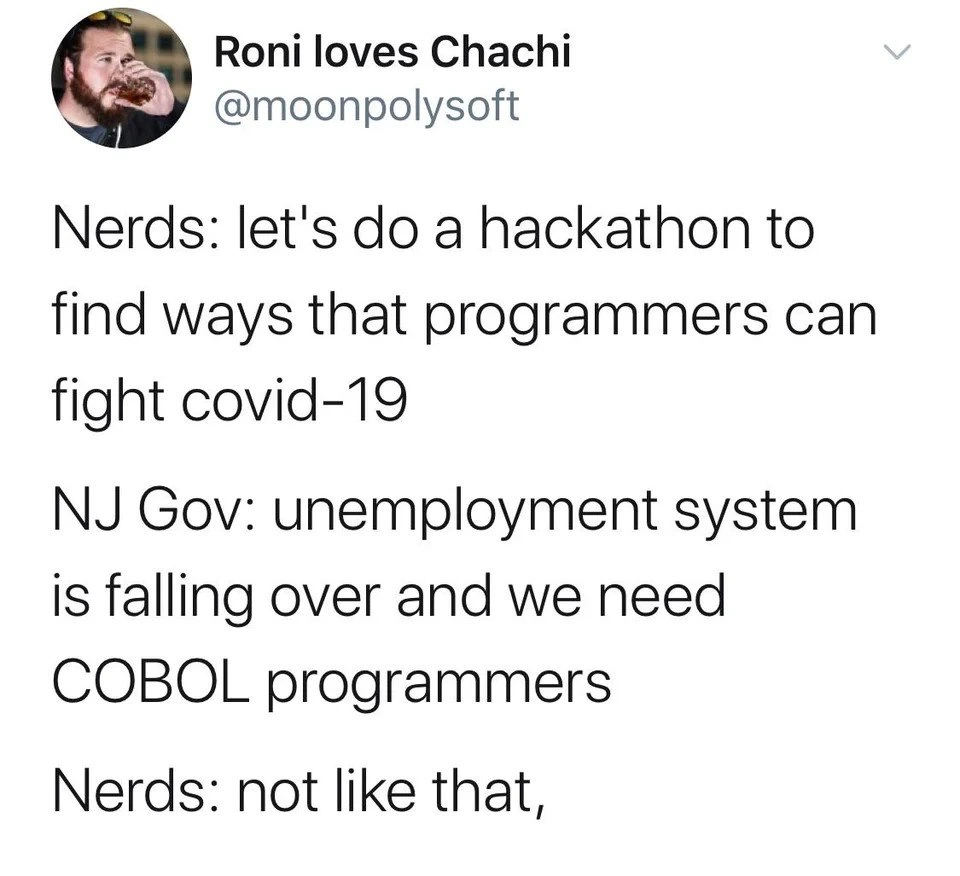
  • Nerds: “Let’s do a hackathon to find ways programmers can fight COVID-19!”
    Translation: “We want to write brand-new code in trendy languages, maybe make a flashy open-source project or a mobile app. We crave an innovation spotlight, something we can demo on GitHub next week.”

  • NJ Gov: “Our unemployment system is crashing; we need COBOL programmers.”
    Translation: “We don’t need another slick app. We need people to maintain and patch a LegacySystem written in a language most of you have never worked with, on hardware you’ve only seen in textbooks. Real lives (and payments) depend on this creaky system staying alive.”

  • Nerds: “Not like that,.”
    Translation: “Oh… that’s not the kind of coding we had in mind. Fixing decades-old code? Using COBOL, of all things? That’s so not sexy or fun. Can’t someone else do that while we build something cooler?”

The comedy cuts deep because it’s DeveloperHumor drawn from truth: modern devs often idolize greenfield projects and hackathon-style problem solving, but the world runs on a lot of LegacyCode that isn’t glamorous. There’s almost a collective eye-roll from veteran engineers here: Of course we ended up needing COBOL people. In times of crisis, it’s not the next JavaScript framework that saves the day – it’s that forgotten LegacySystemsAndModernization project you’ve been kicking down the road for years. New Jersey wasn’t alone; other states and agencies also had similar COBOL SOS calls. It’s a classic case of tech debt coming due at the worst possible time. Those mainframes chugging along since the 70s were suddenly front-page news, and a generation of hackathon coders got a wake-up call that sometimes innovation means fixing what you’ve already got.

To those of us who’ve lived through production nightmares, the meme also whispers a darkly comic lesson: “You can’t code yourself out of a crisis with cool demos if the real bottleneck is an ancient system no one bothered to modernize.” The tweet-style format delivers that message with stinging brevity. It’s both funny and frustrating because it rings true — the DeveloperMemes community loves this kind of punchline precisely because it’s an exaggerated mirror of reality. We laugh, then we wince a little, recalling all the times a critical system ran on outdated tech that the “cool kids” didn’t want to touch. It’s a reminder that in tech, hype doesn’t solve legacy problems magically. Sometimes the hero we need is the one who remembers how to write a COBOL IF statement, not the one live-streaming their hackathon project on Twitch.

In summary, the meme’s humor comes from this stark hype-versus-reality juxtaposition. Hackathons are the symbol of modern, idealistic problem-solving – fast, furious, and flashy. But a statewide unemployment system meltdown is the ultimate reality check: slow, crusty, and crying out for boring, thankless maintenance work. That gap between what excites developers and what society actually needs from them at that moment is pure comedic gold (with an aftertaste of truth). It’s the same energy as a startup promising AI-driven solutions to world hunger, while the local food bank’s database is down because nobody updated the server. Cue the CynicalVeteran smirk. 😏 We’re laughing, but we’ve been there. The code that matters most isn’t always glamorous, and as this meme highlights, sometimes the call of duty sounds like a COBOL compiler warning in a forgotten terminal window rather than applause at a hackathon demo night.

Hackathon Dreams Legacy Needs
Build a sleek new COVID-tracking web app 🌐 Patch a 45-year-old COBOL program so checks go out 💾
Invent an AI to “solve” the pandemic 🤖 Debug an overloaded mainframe batch job from 1985 🖨️
Use the latest cloud tech to scale effortlessly ☁️ Figure out why the old database commits are locking up 🔒

This table above pretty much sums it up. The left column is what those starry-eyed hackathon nerds imagine doing to save the world. The right column is what the NJ Gov actually needed done ASAP. The stark difference is both funny and a bit sobering. Seasoned devs chuckle because they know which column actually pays the bills (and which one gets the retweets). In true meme fashion, “not like that” is the perfect kicker – the nerds balk when reality asks them to roll up their sleeves for a task that’s decidedly uncool. It’s a form of gentle self-deprecation within the developer community: we all love to chase the next big thing, but we’re reminded not to ignore the boring systems that actually keep society running. COBOL may not win any popularity contests at meetups, but when the system is on the brink, that ancient code just might be the hero of the day.

Description

A screenshot of a tweet from the user 'Roni loves Chachi' (@moonpolysoft). The profile picture shows a bearded man drinking from a glass. The tweet presents a three-part narrative: First, 'Nerds: let's do a hackathon to find ways that programmers can fight covid-19'. Second, 'NJ Gov: unemployment system is falling over and we need COBOL programmers'. Third, the punchline, 'Nerds: not like that,'. The meme humorously captures the disconnect between the desire of modern developers to work on trendy, high-impact projects (like a COVID-19 hackathon) and the harsh reality that critical, real-world infrastructure often relies on ancient, unglamorous technologies like COBOL. It highlights a recurring theme in the industry: the most vital work is often maintaining legacy systems, a task few engineers find exciting but is essential for societal functions, as was exposed during the pandemic
Comments

7
Anonymous ★ Top Pick Everyone wants to build the next microservice mesh in Rust until the real world reminds them that the global financial system is one COBOL programmer's retirement away from collapsing
  1. Anonymous ★ Top Pick

    Everyone wants to build the next microservice mesh in Rust until the real world reminds them that the global financial system is one COBOL programmer's retirement away from collapsing

  2. Anonymous

    Funny how 500 devs will spin up a Kubernetes-powered “AI pandemic dashboard” overnight, but change one PERFORM loop in a 1970s COBOL batch job and everyone suddenly has “strategic backlog grooming” on their calendar

  3. Anonymous

    We'll build a Kubernetes cluster to orchestrate your COBOL batch jobs, but first let me explain why the real problem is you're not using event sourcing with your mainframe

  4. Anonymous

    Ah yes, the classic developer fantasy: 'Let's solve global problems with a weekend hackathon using our favorite modern stack!' Reality: 'Actually, we need someone who remembers COBOL and can navigate a 40-year-old mainframe codebase with zero documentation while the entire state's unemployment system is on fire.' Turns out saving the world sometimes means debugging PICTURE clauses and PERFORM statements, not shipping a React app. The real pandemic was the legacy systems we inherited along the way

  5. Anonymous

    Nerds Dockerizing COVID cures while COBOL boomers scale monoliths to pandemic loads - now that's real devops

  6. Anonymous

    Funny how "hack to fight COVID" turned into bumping CICS MAXTASK and recutting the JCL - flattening the curve was easier than flattening the nightly batch window

  7. Anonymous

    2020 hackathons pitched blockchain; the state needed someone to shave three hours off a COBOL batch so the nightly window didn’t slip - turns out resilience was spelled JCL

Use J and K for navigation