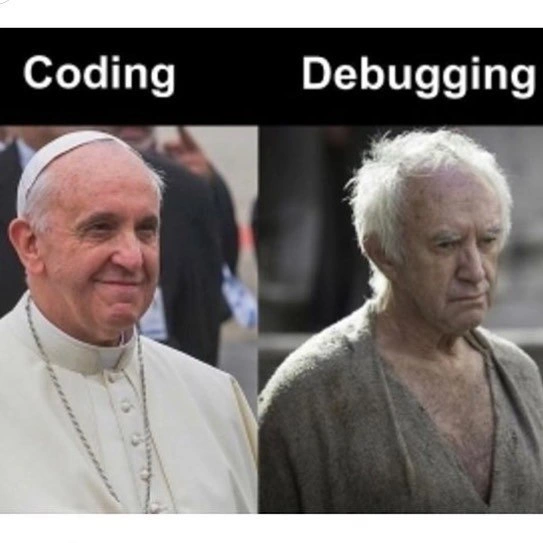
Why is this developer meme funny?
Level 1: Party vs Cleanup
Imagine you spent an afternoon building the coolest LEGO castle ever. While you’re building it, you’re having a great time – you feel proud and happy because everything is going well. 😄 That’s like coding: you’re creating something new and it’s fun, and you feel like the smart, awesome person in the first picture. Now, imagine later you accidentally knock over the castle. It breaks into a bunch of pieces all over the floor. 😢 Now you have to clean up the mess and try to fix the castle. You’re on your hands and knees, picking up tiny LEGO bricks, maybe feeling upset or tired because this isn’t fun at all. That’s like debugging: something went wrong with your creation, and now you have to figure out how to put it right. The second picture in the meme – the tired-looking old man – is how that fixing process feels: exhausting and frustrating. The meme is funny because it shows two opposite feelings side by side. On the left, it’s the happy time when everything is working (making the castle), and on the right, it’s the unhappy time when you’re struggling to fix problems (cleaning up the broken castle). Anyone who’s made something and then had to fix it later can understand those two feelings. It’s a big contrast, and that contrast is exactly what makes the joke so relatable and amusing!
Level 2: Bug Hunt Basics
Let’s break down what’s happening in this meme for a newer developer (or someone just learning to code). On the left side, labeled “Coding,” you have a person looking confident, clean, and happy. On the right side, labeled “Debugging,” there’s an exhausted, messy looking person. This is a joke about how writing code versus fixing code errors can feel like two totally different experiences.
Coding is the part where you write new code to add a feature or solve a problem. It’s the creative and fun side of programming – you’re basically telling the computer what to do, and when it works, you feel great. Think of coding as designing and building something from scratch. In the meme, that’s represented by the dignified figure in white robes (even with a serene smile). It’s like saying “when I’m writing new code, I feel as pleased and put-together as this guy.” Often during coding, if you have a clear plan, you can get into a flow: a state of focus where you’re making steady progress. Everything is new and you’re not dealing with big problems yet. If you’ve ever sat down and started writing a program and a couple of hours passed in what felt like minutes because you were so into it – that’s the coding flow state. It feels almost effortless and rewarding.
Debugging, on the other hand, is what you do when your code isn’t working correctly – when there are bugs. A “bug” is just programmer slang for an error or defect in the code that causes it to behave in an unintended way. Debugging is the process of finding why that bug is happening and fixing it. This part can be much less fun. The meme’s “Debugging” picture – the slouching older man in tattered clothing – represents how debugging makes many developers feel: drained, frustrated, and disorganized. Instead of creating something new, you’re dealing with a problem that might not have an obvious solution. Especially for newcomers, it can be surprising how a tiny mistake can cause a program to crash or give wrong results, and finding that tiny mistake can take a lot of effort.
When you debug, you often have to do a lot of detective work. For example, imagine you wrote a program and it’s giving you incorrect output or throwing an error message you don’t understand. You might start by reading the error message carefully, or adding some print statements (like console.log in JavaScript, or printf in C, etc.) to see which parts of your code are executing and what the values of certain variables are. You might use a debugger tool to pause the program at a certain line (this is called setting a breakpoint) and then run the program step by step to watch what it’s doing. All of this is to pinpoint where things go wrong. This process can feel slow and tedious: you try one thing, run the program, it fails; you try another thing, run it again, still fails; maybe you consult Google or Stack Overflow for similar issues; you check your assumptions... it can go on for a while. This is what we mean by debugging being a time sink – it can swallow up hours before you know it. In contrast, writing the code in the first place might have been pretty quick!
The meme also hints at cognitive load and context switching. These are slightly fancy terms, but easy to explain:
- Cognitive load is the mental effort required to do something. When debugging, the cognitive load is high because you’re juggling a lot of information in your head: what you intended the code to do, what it’s actually doing, what you’ve tried so far, and what each part of the code is responsible for. It’s like trying to remember and solve multiple puzzles at once. This can make your brain tired. When coding new features, you also think hard, but you’re usually focused on one forward task (building the feature) rather than scattered backwards-looking tasks (finding an unknown problem).
- Context switching in a developer’s day means changing focus from one task to another. Say you’re happily working on Feature A (you’re “coding”), and then a bug is reported in Feature B, so you have to pause Feature A and go debug Feature B. That switch is jarring. You have to load all the knowledge about Feature B into your brain now, and forget about Feature A for a while. It’s like if you were reading a story and suddenly someone asks you to solve a math problem – your mind has to stop and shift gears. Too much context switching, like going back and forth between coding and debugging frequently, can make anyone feel exhausted. In the scenario of the meme, the left image could be you in the morning focusing on new code, and the right image is you in the afternoon after being interrupted by a tricky bug in old code. You can almost see the mental exhaustion on the “Debugging” side.
Most developers, even beginners, quickly learn that debugging is a huge part of programming. There’s a common, humorous understanding that when you start a career in software, you might imagine yourself just building cool apps and systems (the “coding” dream). In reality, a big chunk of your time is spent finding out why those cool apps aren’t working right and fixing them (the “debugging” reality). The reason the meme is so relatable (and funny) is because it exaggerates this difference in feeling. We often joke about “coding vs. debugging” like it’s Jekyll and Hyde: one moment you’re Dr. Jekyll writing nice code, and later you’re Mr. Hyde smashing keys trying to slay an evil bug. It resonates especially with anyone who has spent a late night fighting with a stubborn error – by the end of it, you might literally feel like the person on the right: your hair a mess, eyes bleary, maybe wrapped in a blanket, muttering “why won't this work?!”. Debugging frustration is very real!
There’s even a phrase “debugging hell” that developers use half-jokingly to describe being stuck in an endless cycle of trying to fix one problem. If you hear a programmer say “I’m in debugging hell,” it means they’ve been troubleshooting a nasty bug for so long that they’re starting to feel a bit hopeless or burnt out. Developer burnout is a serious topic – it’s when prolonged stress and frustration (from things like constant debugging or pressure at work) make a developer feel exhausted, cynical, or detached. The meme’s scruffy “Debugging” character visually represents that kind of burnout in an exaggerated way (don’t worry, real-life debugging usually doesn’t make you that gray and ragged, at least not all at once!). Still, the feeling of being utterly spent after solving a hard bug is captured perfectly by that image.
The bottom line: coding is the enjoyable, creative part of making software – it’s when you feel in control and everything is fresh. Debugging is the challenging, often frustrating part – it’s when things go wrong and you have to play detective to set them right. Every developer experiences both states, and the contrast can be pretty comical (in hindsight). That’s why this meme draws nods and laughs – we’ve all been the confident “coder” on Monday and the exhausted “debugger” by Friday. It’s a bit of tech humor that perfectly captures a day in the life of a programmer.
Level 3: Flow vs Firefighting
At the coding stage, a developer often enters a flow state – that almost meditative zone where ideas stream smoothly into code. The meme’s left image (a dignified figure in immaculate white robes, reminiscent of the Pope) perfectly captures that feeling: everything seems orderly, almost divine. In those moments you're confident, maybe even a bit holy in your coding prowess – the code is clean, your mind is clear, and you feel on top of the world. But then comes debugging, and the contrast couldn’t be sharper. The right image – a slumped, disheveled elder in tattered robes – is basically every developer at 3 AM hunting a critical bug. Debugging turns that divine calm into a frantic firefight. Instead of creating something new, you’re desperately trying to keep the system from burning down. The humor here is how extreme this before-and-after is, yet every seasoned engineer knows it’s hilariously accurate. One minute you’re a programming saint, the next you’re a bug exorcist fighting off demons in the code.
Why does this transformation happen? It comes down to the cognitive load and context switch involved in debugging. Writing fresh code is a forward-moving, creative process – you have a plan, you implement features step by step. It’s challenging, but it’s a structured challenge. In contrast, debugging is pure troubleshooting: something went wrong, and often you have only cryptic errors or weird symptoms to start with. Suddenly, you must juggle multiple contexts in your head: the intended behavior, the actual behavior, and all the code paths that could connect the two. This heavy mental juggling is what we mean by high cognitive load. Tracking down a bug might require understanding parts of the system you haven’t looked at in ages (or ever), reading obscure log messages, recalling odd language quirks, and considering hardware, OS, and network layers – all at once. It’s mentally exhausting. No wonder that pristine “Coder Pope” quickly turns into the tired monk doing penance. The meme nails this contrast by visually exaggerating it: the Debugging half almost looks like the coder has aged decades after wrestling with a particularly nasty bug. (Honestly, after some all-night debugging sessions, developer burnout is no joke – you might even feel debugging fatigue setting in with real bags under your eyes.)
This before-and-after format also hints at how debugging sessions consume time. It’s a running joke in software engineering that the last 10% of a project (which is usually testing and debugging) takes 90% of the time. You might write a new feature in an afternoon (feeling like a champ in white robes), but then spend the next week fixing all the defects and edge-case failures it caused. The meme resonates with senior developers because it’s shared pain: we’ve all experienced that sinking feeling when a simple bug hunt turns into a multi-day slog. Maybe the code compiled fine and worked on your machine, but the moment it hit production, everything broke loose. Cue the firefighting mode: rolling up your sleeves, digging through logs, adding print statements or using a debugger, trying to reproduce the issue on your setup – basically debugging hell. Each failed attempt to find the bug raises the stress level. That “clean coding” high is long gone; now it’s all about survival and not letting the system (or your sanity) collapse.
Crucially, context switching adds to this pain. In many real scenarios, a developer is happily coding a new feature when an urgent bug report or a pager alert comes in. Instantly, you have to drop the new code (pause your creative flow) and plunge into an entirely different problem that you weren’t mentally prepared for. It’s like your brain doing a hard switchover – from building mode to crisis mode. In the meme’s terms, it’s like being yanked out of the choir and thrown into the mud. This switch not only feels jarring, it’s empirically known to hurt productivity and morale. Every experienced engineer has had that day where they start fresh and optimistic (morning coding zen), and end it drained and disoriented after hours of debugging some stubborn bug in a far-off module. The left image’s smile turning into the right image’s weary frown is a relatable humor snapshot of that exact day.
From an industry perspective, this “coding vs debugging” dichotomy is also why we place so much emphasis on things like good testing practices, logging, and observability. A great Developer Experience (DX) means giving developers tools to catch bugs early or diagnose them faster – so that debugging doesn’t always feel like being a ragged detective on a lonely mission. But no matter the tools, some bugs will always turn your hair grey. Memory leaks, race conditions, off-by-one errors – they lurk in code and make even veteran devs feel like that slouching figure. There’s even a tongue-in-cheek adage: "If debugging is the process of removing bugs, then programming must be the process of putting them in." In other words, every new code you write (the joyful coding part) is a potential new bug you or someone else will have to fix later (the painful debugging part). This meme cleverly captures that inevitable cycle. It’s funny because it’s true: writing code often feels like a pristine accomplishment, but sooner or later, you’ll be paying the price by debugging, bleary-eyed and questioning your life choices.
Description
This image could not be processed due to an error
Comments
7Comment deleted
I'd make a joke about this image, but I can't see it. Maybe it's a 404 error?
Coding: pontificating about immutable data flows; Debugging: barefoot in prod, chasing a null pointer through twelve “stateless” microservices that secretly share a mutable cache
Coding is writing a love letter to your future self. Debugging is discovering your past self was having an affair with undefined behavior
The meme perfectly captures the arc of every senior engineer's day: you start as the architect of elegant solutions, confidently crafting abstractions and patterns. Then production throws a NullPointerException at 2 AM, your distributed tracing shows nothing useful, and suddenly you're the High Sparrow of technical debt - humbled, weathered, and questioning every life choice that led you to chase a heisenbug through a microservices mesh while your logs are in three different time zones
Coding is a greenfield; debugging is reconstructing a distributed crime scene with git bisect, NTP drift, and logs that rotate just before the smoking gun
Coding: Papal infallibility on first compile. Debugging: Excommunicating Heisenbugs from a distributed monolith
Coding feels ceremonial; debugging is monastic - chanting kubectl logs at 3 a.m., hunting the heisenbug that only appears with 200ms clock skew and a GC pause