Skip to content
DevMeme
5818 of 7435
Corporate Hypocrisy: Hating Piracy While Embracing AI Data Scraping
AI ML Post #6375, on Nov 11, 2024 in TG

Corporate Hypocrisy: Hating Piracy While Embracing AI Data Scraping

Why is this AI ML meme funny?

Level 1: Okay for Me, Not for You

Imagine a kid in school who always tells others, “Hey, never cheat by copying homework – that’s wrong.” They act very serious about it. But then, a few minutes later, you catch that same kid secretly copying answers from the smartest kids in class to make a giant cheat sheet for themselves. 😮 In simple terms, they have one rule for everyone else and a different rule for themselves. That’s what this meme is joking about. Big companies say “No taking our stuff without asking!” — but then they turn around and take lots of other people’s stuff to help their own big project. It’s like if a big kid yelled at you for taking one cookie from the jar, but later they quietly took all the cookies for themselves when they thought no one was watching. The meme makes us laugh because it shows this unfair double standard in a silly cartoon way: the company is angry about others copying, then suddenly totally happy when they are the ones doing the copying (just calling it something fancy like “AI”). It’s pointing out how goofy and unfair that is, kind of like a friend who says, “You must play fair!” and then immediately breaks the rules when they want to win.

Level 2: Pirates vs Crawlers

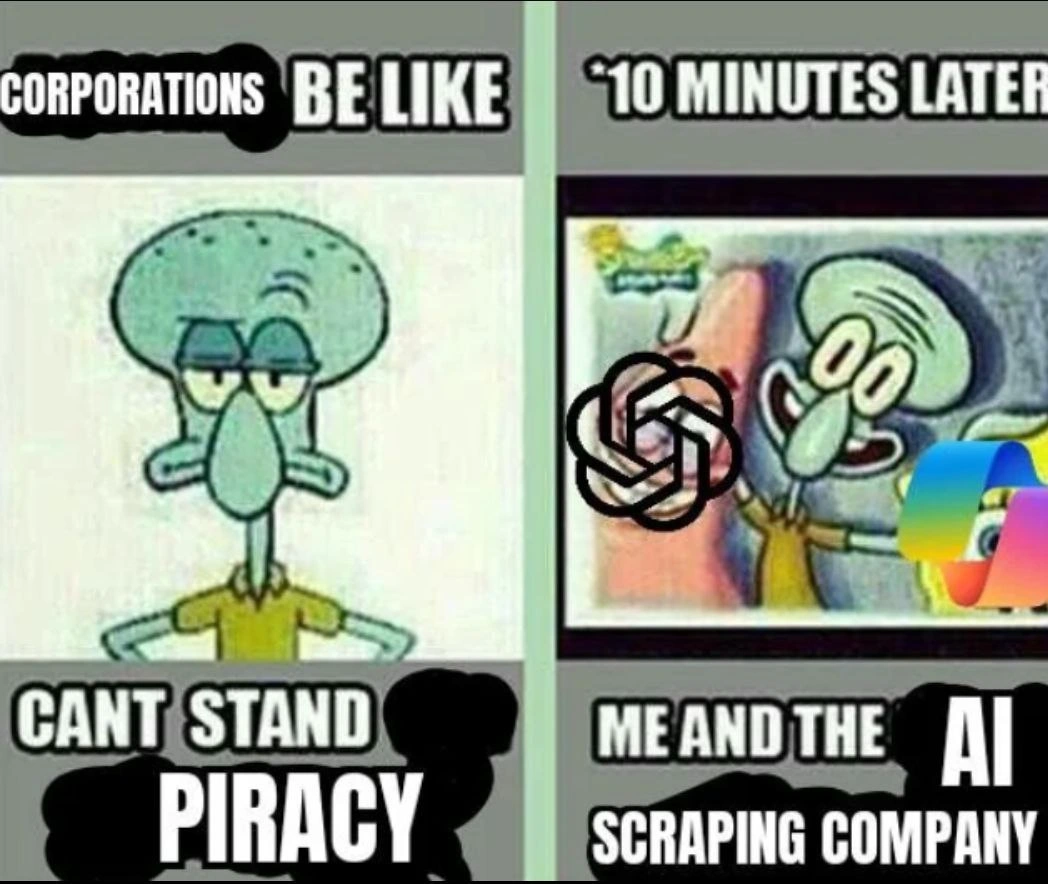
Let’s break down the joke in simpler terms. This meme uses characters from SpongeBob SquarePants to illustrate a point about tech companies and hypocrisy. On the left, we have Squidward (the grumpy squid character) looking annoyed with arms folded. The text above and below him says “Corporations be like… can’t stand PIRACY.” Here, piracy means illegally copying or sharing things like software, music, movies, or other content without permission. Companies have long been very strict about this – for example, they don’t want people downloading their movies from torrent sites or copying proprietary code. “Can’t stand piracy” is how they publicly feel: they absolutely hate when people take their stuff for free. They often call it stealing.

Now the right side is captioned “10 minutes later” (like in the cartoon when time jumps forward). Suddenly Squidward is happy and excited, hugging SpongeBob. In the picture, Squidward’s face has been covered by the OpenAI logo (that black geometric swirl), and SpongeBob has a colorful AI logo on him. The bottom text labels this scene “Me and the AI scraping company.” So it implies that just moments after saying “piracy is bad,” the corporation (Squidward) is buddy-buddy with an AI data-scraping company (SpongeBob). In other words, the corporation is now doing something very similar to piracy – grabbing tons of data – but framing it as an okay thing because it’s for AI. When we say “scraping,” we’re talking about web_scraping: using bots or scripts to automatically collect information from websites (like copying all the text or images). An “AI scraping company” would be a business that gathers huge amounts of data from all over the internet to use in AI training. For example, to teach an AI to chat like ChatGPT, companies collect millions of webpages, discussions, books, etc., by scraping them. That data often isn’t originally theirs – it comes from various authors and creators on the web.

So why is this ironic? The corporation is acting like that’s not “piracy” because it’s feeding an AI. It’s a bit like a double standard: “It’s wrong when you copy our stuff, but it’s fine when we copy everyone’s stuff for our AI.” The meme calls this out in a humorous way. It uses the popular Squidward meme format where Squidward’s mood changes after a short time to show hypocrisy or a quick change of heart. The SpongeBob reference makes it cartoonish and clear: first panel serious, second panel suddenly super friendly. The addition of the OpenAI logo overlay on Squidward hints that major AI players (like OpenAI, the makers of ChatGPT) are involved in this story – they did in fact scrape lots of data to train their AI. The rainbow “AI” on SpongeBob represents any AI company collecting data. Essentially, the company that said “no copying!” is now hugging someone who copy-pastes the whole internet.

Some key terms here: copyright_hypocrisy means saying one thing about copyright (like “respect our copyrights”) but doing the opposite when it comes to others’ material. DataPrivacy gets a nod too – companies often claim to care about users’ privacy and rights, yet they might take data without asking to improve their AI models. AI_training_data_usage is just the practice of using lots of collected data to train AI systems. And AIEthicsConcerns refers to the ethical questions raised by AI practices – for example, “Is it okay to use someone’s artwork or writing to train a profit-making AI without giving them credit or choice?” These concerns are at the heart of the meme’s message. It’s pointing out that what corporations label as “theft” in one context looks an awful lot like what they’re doing themselves in another context, just with fancier words.

For a junior developer or someone new to this topic, think of it this way: imagine you just learned about web scraping at your job. It’s a technique to write a script that goes through webpages and saves useful info – like writing a Python script with requests or a headless browser to pull data from hundreds of URLs. It’s a powerful tool. Now, if you do it on your own to download a bunch of movies or copy someone’s entire website, the same company that taught you scraping might fire you for “piracy” or violating terms of service. But that company’s AI division might also be using similar scripts to stockpile training data from all over the internet. They justify it by saying, “We need data to make our AI smart.” The meme’s second panel basically shows the company hugging that practice – they’re thrilled about it (“Me and the AI scraping company, best friends!”). It’s a sarcastic way to expose the gap between what companies preach and what they practice. If you’ve ever heard the phrase “do as I say, not as I do,” that’s exactly what’s happening here. The corporation says “Don’t copy stuff,” but it does copy stuff (through an AI partner).

Level 3: Ethical Whiplash

In the AI_ML era, this meme spotlights a blazing case of CorporateIrony every seasoned developer recognizes. It’s calling out how the same companies that thunder against digital piracy (“Sharing our content without permission is theft!”) will, in the next breath, gleefully gorge on data scraped from the web to fuel their AI models. The two-panel SpongeBob format nails this flip-flop perfectly. In the first panel, Squidward (representing big corporations) stands arms-crossed and scowling beneath the caption “CORPORATIONS BE LIKECANT STAND PIRACY.” This reflects those stern anti-piracy postures we’ve all seen: companies wielding copyright law, DMCA takedowns, and moral outrage to stop people from illegally copying music, movies, software, or code. We’ve lived through eras of DVD anti-piracy ads and “Don’t copy that floppy” vibes – corporations hate when you share their IP without paying.

Then comes the punchline: a SpongeBob time-card joke “10 MINUTES LATER…”, and suddenly Squidward is grinning ear-to-ear, hugging SpongeBob. But here Squidward’s face is overlaid with the black OpenAI swirl logo, and SpongeBob sports a big rainbow “AI” icon. The bottom caption crows: “ME AND THE AI SCRAPING COMPANY.” In other words, not even ten minutes pass before that same corporation is best buddies with an AI outfit that web_scraping every piece of data it can find. It’s a classic “rules for thee, not for me” scenario. Piracy_vs_scraping is the core contrast: if you or I copy their content, it’s “piracy.” But when they quietly copy everyone else’s content to train an AI, suddenly it’s innovation, partnership, AIGeneratedContent magic. The meme’s humor comes from exposing this double standard so bluntly. The bored Squidward vs. excited Squidward highlights the whiplash: outrage at others doing it, excitement when they do it themselves.

This isn’t just theoretical humor – it’s happening in real life. Take OpenAI (reflected by that logo on Squidward): they trained ChatGPT on a huge chunk of the internet, likely including copyrighted books, articles, stackoverflow answers, you name it, all grabbed by automated crawlers. Tech giants who once ran anti-piracy campaigns are now investing in or partnering with these very AI scraping efforts. Microsoft is a prime example: years ago they were busting people for unlicensed Windows copies; now they bankroll OpenAI and deploy GitHub Copilot, an AI that learned to code by reading millions of public code repositories. Copilot has even been caught outputting big swaths of licensed code verbatim, effectively software piracy by AI proxy. There’s an ongoing lawsuit about that exact issue – talk about copyright_hypocrisy! Similarly, image-generation AIs were trained on billions of pictures scraped from artists’ online portfolios and stock photo sites. Many of those images were copyrighted, but the AI companies didn’t ask permission; they just vacuumed them up. Artists later recognized their own styles (and even signatures) in AI-generated art and went, “Hey, you essentially copied my work!” Companies that would sue you for using their photos suddenly shrug and call it ai_training_data_usage when it’s their AI doing the copying. No wonder AIEthicsConcerns are through the roof here.

Why do smart people in big companies keep making this contradiction? Incentives. There’s huge $$$ in AI right now – a veritable AI gold rush – and data is the fuel. Publicly, the CorporateCulture playbook demands a hard line on copyright to protect revenue. But privately, that same culture will bend rules if it means gaining a competitive edge with AI. It’s a form of corporate doublethink: holding two contradictory attitudes and justifying each as needed. On one hand, “Piracy is a crime, we must uphold DataPrivacy and creators’ rights.” On the other, behind closed doors: “Our AI needs all the data, scrape everything you can – we’ll call it fair use or deal with the lawsuits later.” The meme exaggerates it with the “10 minutes later” joke, but honestly the turnaround from principled stance to profit-driven exception can be that swift in tech. We’ve all sat through company all-hands where leadership talks about ethics, only to read an internal memo a week later about some sketchy data collection initiative. AIHypeVsReality in a nutshell: the hype says “we’re revolutionizing tech responsibly,” the reality is often “we’ll do whatever until someone stops us.”

From a senior dev perspective, this image is painfully on-point. It’s dripping with dark CorporateHumor. We’ve seen departments that send stern legal threats over a trademark, while another team at the same company scrapes a competitor’s website or mines users’ data without clear consent. The left hand wags a finger about ethics as the right hand raids the cookie jar. The SpongeBob reference makes it funny and shareable, but the underlying sentiment is pretty cutting: AIEthicsConcerns and the moral high ground seem to get thrown out the window as soon as AI enters the chat. And because AI models regurgitate training data in unpredictable ways, this hypocrisy can even backfire spectacularly. (Imagine a copyrighted paragraph from some company’s own manual popping out of ChatGPT – it’s happened!). As a battle-scarred engineer, you can’t help but smirk: of course the corporation is hugging the AI data-scraper – they’ve found a way to monetize “piracy” while still claiming the moral high ground. It’s like watching someone loudly condemn thieves, then quietly hire a pickpocket because they need a wallet fetched. A classic case of Piracy_vs_scraping hypocrisy laid bare.

Description

A two-panel Spongebob Squarepants meme highlighting corporate double standards regarding intellectual property. The first panel has the text "CORPORATIONS BE LIKE" and "CANT STAND PIRACY" and shows the character Squidward looking stern and disapproving. The second panel, labeled "*10 MINUTES LATER*", shows a happy Squidward next to Spongebob, with the OpenAI (ChatGPT) logo and another abstract colorful AI logo superimposed. The text below reads "ME AND THE AI SCRAPING COMPANY". The meme satirizes corporations that publicly condemn piracy and copyright infringement while simultaneously partnering with or using AI companies whose models are trained on vast amounts of scraped internet data, which often includes copyrighted material without permission. This highlights the ethical and legal gray area of AI training data, a topic of significant debate among senior engineers who understand the implications of data sourcing and intellectual property
Comments

21
Anonymous ★ Top Pick It's not piracy if you launder the data through a multi-billion parameter model and call the output 'inference.'
  1. Anonymous ★ Top Pick

    It's not piracy if you launder the data through a multi-billion parameter model and call the output 'inference.'

  2. Anonymous

    The same exec who made us burn a sprint excising a GPL’d icon just green-lit vacuuming half the internet into an LLM because “embeddings aren’t copies, they’re vibes.”

  3. Anonymous

    The same legal teams that send DMCA takedowns for a 5-second movie clip are now arguing that scraping the entire internet for AI training is 'transformative use' - turns out the real transformation was their ethics all along

  4. Anonymous

    Corporations: 'Piracy is theft!' Also corporations when OpenAI offers them a check: 'Well, our robots.txt was more of a suggestion anyway. Besides, it's not scraping if we call it synthetic data partnership and get equity.'

  5. Anonymous

    Legal rejected a GPL snippet in my PR, then signed a seven‑figure LLM contract “trained on public web data” - enterprise‑grade robots.txt amnesia

  6. Anonymous

    Corporate ethics: torrents are theft; for the LLM corpus, 200 OK and a polite User-Agent apparently count as a license

  7. Anonymous

    Corporations: 'Piracy kills innovation!' AI team: 'Hold my Common Crawl scrape for fine-tuning.'

  8. @deerspangle 1y

    Absolutely. In both cases, the megacorp wins and the little guy gets stamped on, so they're happy with the hypocrisy

  9. @lilfluffyears 1y

    I will creatively rethink Nintendos games uwu

    1. @linuxhasan 1y

      Already creatively rethinking Nintendo switch games :3

  10. @Sun_Serega 1y

    I don't think the meme is referring the "AI art=theft" bullshit... The biggest AI training datasets contain a lot of sketchy stuff, because no human team can properly review them

    1. @Bitals 1y

      How is that piracy? You think the fact that they didn't pay for that petabyte of CP is arguable in court?

      1. @Sun_Serega 1y

        is CP the only sketchy thing you know about? think about contents of sites like coomer.su and kemono.su there is nothing illegal in terms of type of porn, but all of it is pirated. a scrapper can easily find some rogue link on the internet and precede to download the whole thing

        1. @Bitals 1y

          That's exactly what the meme is about? You are arguing against your own point here.

          1. @Sun_Serega 1y

            no, it's not against my point because "AI art=theft" doesn't care how the art is sourced, and is mostly about publicly available art. it's an argument by humanitarians who can't be bothered to figure out the difference between copying the inputs and pattern recognition

            1. @Bitals 1y

              You are ignoring the license under which the art is "publicly available", looking like a very technically educated person (no). If we take the best case scenario for a scrapper, the CC license, most of its variants still do not allow you to use the work for any commercial purpose, while you are free to repost it on your personal pages as much as you want, or print and hang on your wall, or even train your personal network on it. It gets illegal the moment you monetize derivative work.

              1. @Sun_Serega 1y

                alright, that's a valid point

      2. @purplesyringa 1y

        As far as I'm aware, it has never been argued in court, precisely because everyone's afraid they don't know what the court would decide

  11. @Sun_Serega 1y

    if it's used by corpa like in this context, duh it's gonna be monetized...

    1. @Bitals 1y

      And that's piracy.

  12. @Algoinde 1y

    I feel like you had a strong opinion of "AI art = not piracy and morally ok" and tried to argue only the first part, which was the thing you should not have been arguing as it's pretty clear here. The meme is mainly about LLMs.

Use J and K for navigation