Skip to content
DevMeme
6649 of 7435
LLM Context Window Degradation Visualized as Wojak Meme
AI ML Post #7284, on Oct 16, 2025 in TG

LLM Context Window Degradation Visualized as Wojak Meme

Why is this AI ML meme funny?

Level 1: Big Brain Gets Tired

Imagine you’re asking your really smart friend a series of questions. In the beginning, your friend is full of energy and gives you great, detailed answers — kind of like the big brain character is calmly solving problems on the left. But if you keep asking question after question for a long time, your friend will get tired. They might start forgetting what you asked earlier, and their answers become short or a bit silly — a lot like the drooling character on the right who has lost his head (and his train of thought!). The meme is funny because it shows this happening to an AI: even a "genius" machine can get overwhelmed and act a little goofy when it runs out of room in its head. It’s like watching a brilliant idea fade away and turn into gibberish, which makes us laugh and reminds us that even computers have limits!

Level 2: When the Chatbot Forgets

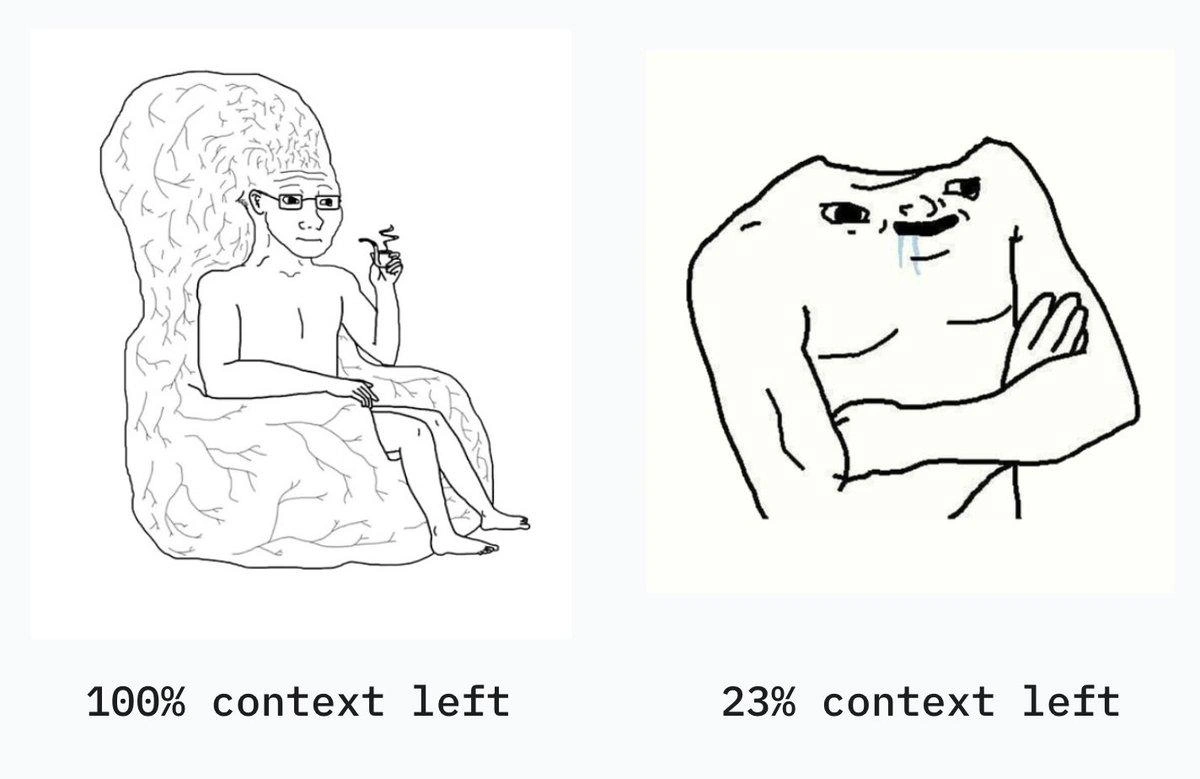
Let's break down what's going on in this meme in simpler terms. We have two cartoon panels. On the left is the Big Brain Wojak – a drawing of a person whose brain is comically large, looking calm and smart. On the right is the Drooling Wojak – a muscular guy with a tiny head (almost no head at all) and a bit of drool, looking confused or dopey. These are internet meme characters: the big-brain version means someone is being super intelligent, and the drooling version means someone is, well, pretty clueless. The captions under each panel say 100% context left and 23% context left respectively. In plain English, that means on the left the AI has all of its memory available, and on the right it's down to only about a quarter of its memory. The meme is comparing an AI language model's performance when it has a full "tank" of context versus when that tank is almost empty.

Now, what's context here? In AI terms, context refers to the conversation history or the amount of information the AI can hold in mind at once. An LLM (Large Language Model) like ChatGPT doesn’t have a long-term memory like humans do; instead, it has a context window of a fixed size. Think of this context window like a notepad the AI uses to keep track of the conversation. The notepad can only fit a certain amount of text. This capacity is measured in units called tokens (you can think of tokens as pieces of words; for example, "function" might be one token, but a longer word or sentence gets broken into multiple token pieces). Every time you or the AI says something in the chat, it writes it on this notepad. 100% context left means the notepad was empty at the start, so the AI could use its full space for new information. 23% context left means the notepad is 77% full — only 23% space remains for new stuff. When that space runs low, the AI has to start erasing the oldest notes to make room for new ones (it forgets what was discussed earlier). This automatic erasing is called memory truncation, and it leads to the AI losing some of the earlier details (that's conversation history loss).

For you as a developer using an AI assistant, the difference between a full context and a near-exhausted one is huge. At the beginning of a chat, the assistant remembers everything you've told it and can refer back to it easily. It’s in big-brain mode: it can recall that install command you mentioned, the variable name you defined, and all the other specifics, using them to give a very relevant answer. But after a long back-and-forth, if the conversation keeps going on and on, the assistant might not remember those details anymore. It's now in drooling mode: it might reply with something generic or forget something you said 20 messages ago. In other words, the AI's short-term memory is almost full, and it’s starting to act a bit forgetful.

Here’s a simple way to visualize it:

  • When the context notepad is mostly empty (close to 100% left): The AI is like a genius with total recall. It remembers the whole conversation and responds wisely and in detail.
  • When the context notepad is almost full (down to ~23% left): The AI becomes like a forgetful friend. It only remembers the last part of the conversation and gives shallow or confused answers, almost like it's saying, "Sorry, what were we doing again?"

This is why people joke about managing the token budget. The token budget is basically how many tokens (words) you can still use before the AI’s notepad is out of space. When you "exhaust the token budget," the AI hits a wall — that’s basically prompt exhaustion, meaning the poor thing has run out of room to keep all the details in its head. There's a whole skill in the field called prompt engineering which involves phrasing questions or splitting up information in smart ways to make the best use of that limited context. For example, if you notice the AI is getting confused late in a conversation, you might start a new chat or provide a quick recap of the important points so it can remember them again. That helps the AI regain its big-brain clarity by clearing or refilling its notepad in a more efficient way.

In short, the meme is a funny illustration of an important quirk: even a super-smart AI assistant can go from Einstein-level brilliant to acting like it got bonked on the head, all because it ran low on its conversation memory. To a new developer or anyone using these AI tools, it’s a memorable lesson: if your AI helper suddenly seems to get "dumber," it's probably not broken — it might just be forgetting things because you've nearly filled up its context window!

Level 3: Context Window Woes

If you've ever integrated an AI assistant into your dev workflow or had a marathon chat with ChatGPT, you probably recognize this progression all too well. The meme nails that before and after contrast: at the start of a session (with "100% context left"), the LLM feels like a genius coding buddy or an omniscient code reviewer. It's pulling in all the details from your prompt, remembering variable names, understanding the full scope of your question — basically flexing that huge cerebral cortex like the left-panel Wojak with the big brain. You ask it something complex, and it responds with a well-structured explanation or a snippet of code that actually compiles. Victory! 🎉

Fast-forward through dozens of follow-up questions, and things start to get... weird. By the time you're down to "23% context left," the once-eloquent model begins to sound a bit like the right-panel caveman. It might forget the function names you mentioned two turns ago, or ignore a crucial constraint you specified at the start. The tone might shift from professor to blunt ogre: shorter sentences, generic advice, maybe even an "I'm not sure what you're asking?" when you’ve been asking the same thing repeatedly. This is the dreaded token budget crash. The AI has effectively run out of "working space" to juggle all the info, so it defaults to simpler, dumber replies. Every senior engineer who lives in token-budget land has seen an AI go from Albert Einstein to Drooling Wojak in the span of a long JIRA ticket discussion. It's both hilarious and frustrating — hilarious because you can almost see the model's big brain deflating, and frustrating because now you have to either live with a caveman answer or start a fresh session to get the smart AI back.

Under the hood, what’s happening is the model’s context window is overflowing and older messages are getting dropped. In practice, many LLM-driven tools implement a sliding window or prompt trimming strategy. Here's a peek at what that might look like in pseudocode:

conversation = [
    {"role": "user", "content": "Initial detailed question with code and context..."},
    {"role": "assistant", "content": "Very insightful answer utilizing all provided context."},
    # ... after many back-and-forth messages ...
    {"role": "user", "content": "Follow-up #42: asking something based on everything above..."},
]
MAX_TOKENS = 8192  # hypothetical model limit
if token_count(conversation) > MAX_TOKENS:
    # Drop the oldest messages to avoid context overflow
    conversation = conversation[-MAX_TOKENS:]
response = model.generate(conversation)

In a real scenario, that means your earlier chats (the ones where you defined foo and bar, or established that crucial requirement) might have been evicted from the conversation memory by the time you're on follow-up #42, leading to inevitable information loss. The AI no longer sees those details when formulating a response. No wonder its answers have started drooling! Seasoned developers have learned to do a bit of prompt engineering as a remedy: when the AI starts acting forgetful, you either explicitly remind it of key facts ("Remember: foo is an integer, and we already imported the X library...") or you summarize the important context yourself and feed it back in. Essentially, you start managing the AI's token budget for it, in hopes of reviving that big-brain energy.

The humor here also taps into a broader developer experience: it's reminiscent of maintaining any stateful system with limited resources. Like a server running low on memory that begins to thrash, an LLM running low on context starts to swap out intellect for nonsense. Everyone from DBAs (who deal with query optimizers losing the plot with overly long SQL) to old-school programmers (who remember fitting whole apps in 640 KB) can chuckle at this. We’ve all seen systems go from brilliant to brain-dead when they hit a resource ceiling. In the AI's case, that resource is tokens in the context window. The meme perfectly personifies it: one moment you're interacting with a sharp-witted, big brain AI sage, and a few thousand tokens later you're basically chatting with its primitive alter ego uttering, "Ugh, code good."

Level 4: The Attention Span Limit

Large Language Models (LLMs) like GPT-4 are essentially advanced transformer networks with a fixed-size context window — the maximum number of tokens (pieces of text) they can process in one go. At 100% context, the model is operating with its full cognitive capacity: it has all relevant information loaded into its "working memory." But as a conversation grows, the context window starts filling up. By the time only 23% context remains, the model is approaching its built-in memory limit, and it has to start making hard choices about what to remember and what to (unintentionally) forget.

Under the hood, this is a direct consequence of the transformer architecture. Transformers use a self-attention mechanism where each token weighs its relationship to every other token in the input. This design makes them incredibly eloquent (hence the left panel's enormous galaxy brain), but it also means the computational cost grows quadratically with the number of tokens. If $n$ is the number of tokens, the model’s work grows on the order of $O(n^2)$ — doubling the text length can quadruple the processing required. To keep things efficient (and fit the model on available hardware), engineers impose a fixed N-token context window (like 2048, 8192, or now even 32k tokens in cutting-edge models). Everything beyond that limit? Snip! The earliest messages in the conversation get chopped off or compressed, a process known as memory truncation. The model isn’t intentionally turning into a caveman; it’s literally losing pieces of the conversation history because it has no more "brain RAM" left to hold them (resulting in conversation history loss).

This is why an LLM can start as that ultra-confident Big Brain Wojak character on the left — it has the entire problem context and instructions in mind — and then devolve into the Drooling Wojak on the right once the context window overflows. The moment the chat crosses too many follow-ups and tokens, the model enters a state of prompt exhaustion. It's like an LRU cache: new tokens push out the oldest ones. The AI’s knowledge of earlier details evaporates, and with it goes that erudite tone, leading to a kind of degraded answer mode. Researchers have been working on ways to extend or sidestep these limits (from retrieval-augmented generation to transformers with clever long-range attention), but fundamentally, no matter how "big brain" an AI is, it can’t have an infinite attention span without either massive computational costs or clever workarounds. In other words, even the smartest model can be reduced to a drooling simpleton if you overflow its context window — exactly as the meme humorously illustrates.

Description

Two-panel meme showing the contrast between an LLM at 100% context left (drawn as a calm, sophisticated Wojak figure sitting in a chair smoking a pipe with glasses) versus 23% context left (a deformed, crying, compressed Wojak barely holding itself together). The text reads '100% context left' and '23% context left' beneath each panel respectively. The meme captures the well-known phenomenon where LLM performance degrades significantly as the context window fills up and the model loses coherence

Comments

7
Anonymous ★ Top Pick Your LLM starts the conversation like a Harvard professor and ends it like a concussed goldfish trying to remember what a for-loop is
  1. Anonymous ★ Top Pick

    Your LLM starts the conversation like a Harvard professor and ends it like a concussed goldfish trying to remember what a for-loop is

  2. Anonymous

    An LLM with a full context window is like a senior architect. An LLM with 23% context left is like a senior architect who just got back from a three-week vacation and is now confidently making decisions based on the one email they skimmed

  3. Anonymous

    That moment when your LLM starts replying like a swaggering Neanderthal - yep, the vector store just garbage-collected your entire architectural rationale

  4. Anonymous

    Just like how your carefully architected microservices devolve into a distributed monolith after the third reorg, LLMs transform from eloquent technical advisors to 'have you tried turning it off and on again?' once you've burned through 77% of the context window discussing your legacy COBOL migration strategy

  5. Anonymous

    When your LLM conversation hits 8K tokens and suddenly forgets it's a senior architect, starts suggesting jQuery for your microservices mesh

  6. Anonymous

    At 100% context it cites papers and corrects your Big-O; at 23% it forgets the system prompt and confidently POSTs to DELETE

  7. Anonymous

    20+ YoE architect skims the one-pager (97% context left): 'Crystal clear saga.' Mid-level impl reads the RFC appendix (23% left): 'CAP theorem everywhere...'

Use J and K for navigation