Skip to content
DevMeme
7303 of 7435
Comment Typos: Embarrassing Before AI, Load-Bearing After AI
AI ML Post #8005, on May 18, 2026 in TG

Comment Typos: Embarrassing Before AI, Load-Bearing After AI

Why is this AI ML meme funny?

Level 1: The Note on the Fridge

Imagine you always left little notes on the fridge for yourself — "by milk" instead of "buy milk" — and nobody cared, because you knew what you meant. Then your family hires a very strong, very literal robot butler who reads every note and does exactly what it says. Now your sloppy note doesn't just sit there looking silly; the robot is out in the yard at dawn standing dutifully by the milk. The tiny dog is your typo when notes were just notes; the giant muscle dog is that same typo once a powerful helper started taking it seriously. The joke is that little mistakes grew muscles the moment something started obeying them.

Level 2: Why the Robot Reads Your Notes

The moving parts for those newer to this:

  • Code comments: Notes in source code (// like this) the computer ignores. They exist purely to explain things to humans — or did, until recently.
  • AI coding assistants (Copilot-style tools): They watch your file and suggest the next lines. They were trained on millions of repos where a comment like // sort users by signup date is followed by code doing exactly that. So your comments effectively become instructions.
  • LLM context: Everything visible to the model — code, comments, file names — shapes its output. A typo or wrong word in that context can tilt generated code in the wrong direction, the garbage in, garbage out principle applied to English.
  • Swole Doge vs. Cheems: The meme template contrasting a weak past version of something (small Cheems) with a powerful current version (buff Doge).

The junior-dev translation: before, writing // recieve data got you a teasing emoji in review. Now, you might tab-accept thirty lines generated from a comment you didn't proofread, and the bug report comes back to you. Reading AI suggestions as critically as you'd read a stranger's PR is the new survival skill.

Level 3: Comments Are Prompts Now

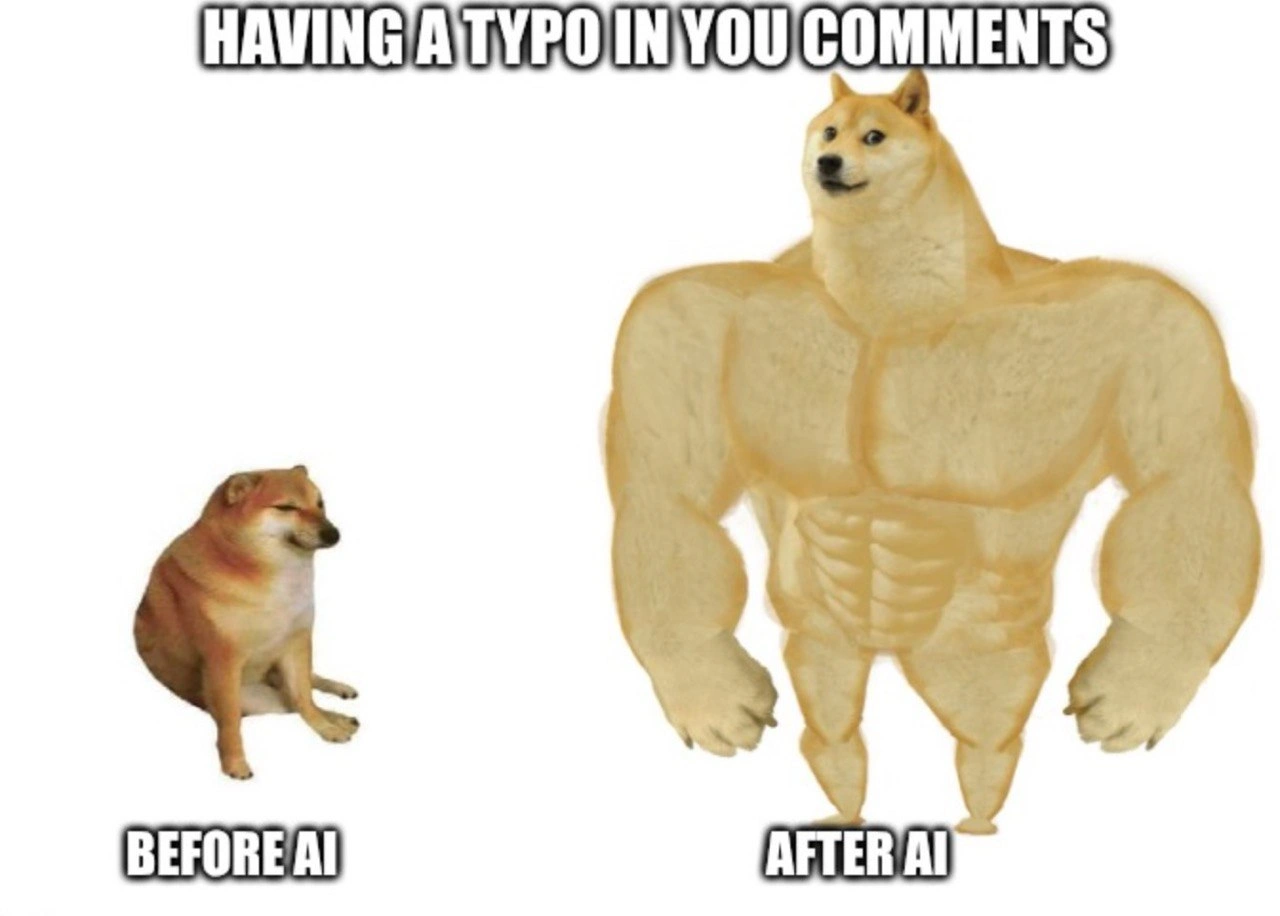
The caption — "HAVING A TYPO IN YOU COMMENTS" — is itself missing an "R", and whether that's an accident or a plant, it's the perfect self-demonstrating artifact for a meme about how typos stopped being harmless. The Swole Doge vs. Cheems format encodes a before/after power shift: the small, sad Cheems is the typo "BEFORE AI" — a cosmetic embarrassment someone might mock in code review — and the massive, muscular Swole Doge is the same typo "AFTER AI": suddenly jacked, consequential, capable of doing real damage.

The mechanism behind the joke is the quiet ontological change that AI coding assistants imposed on code comments. For fifty years, comments were inert — compilers strip them, runtimes never see them, and their only consumer was a future human who might roll their eyes at // recieve the payload. The worst a bad comment could do was mislead a colleague slowly. But an LLM consuming your file as context makes no distinction between executable truth and annotation: comments are weighted heavily as intent signals, because that's exactly what tools like Copilot were trained to do — comment-to-code completion is their core trick. Write // returns user's permissions, exluding admin roles and the model may faithfully implement your typo'd, half-wrong sentence rather than your intention. The comment graduated from documentation to prompt — from describing the code to causing it.

Experienced developers will recognize the deeper pattern: a long-standing piece of engineering folklore — "comments lie, code doesn't" — just got inverted in the worst way. Comments used to lie only to humans, who at least had skepticism; now a stale or sloppy comment gets executed-by-proxy through an eager autocomplete that treats it as gospel. This blurs into genuine security territory too: if natural-language text inside a file steers code generation, then misleading text is a soft form of prompt injection, and "comment hygiene" quietly joined the supply-chain-paranoia checklist. The old garbage in, garbage out rule now applies to your prose, not just your data. Somewhere a linter author is adding a spellchecker and calling it a security feature — and honestly, they're not wrong.

Description

A classic Swole Doge vs. Cheems meme. Top caption reads 'HAVING A TYPO IN YOU COMMENTS' (itself containing the typo 'YOU' instead of 'YOUR'). On the left, a small sad Cheems shiba inu sits labeled 'BEFORE AI'; on the right, a massive muscular Swole Doge stands labeled 'AFTER AI'. The joke is that before AI coding assistants, a typo in a code comment was a harmless embarrassment, but now that LLMs consume comments as context for code generation, a typo can mislead the model - making comment hygiene unexpectedly consequential. The caption's own typo is a self-demonstrating bonus

Comments

5
Anonymous ★ Top Pick Comments used to lie only to humans; now a typo'd one gets faithfully implemented by the AI
  1. Anonymous ★ Top Pick

    Comments used to lie only to humans; now a typo'd one gets faithfully implemented by the AI

  2. @adm877 1mo

    ICWYDT

  3. @neogrimer 1mo

    fak iu

  4. @furry_onko 1mo

    lmao true

  5. @Nucradkillsrats 1mo

    Im type O negative

Use J and K for navigation