The Hidden Rage in Code Coverage Metrics
Why is this Testing meme funny?
Level 1: Every Question Answered
Imagine you take a test in school and afterwards you brag, "I answered every single question on the test!" – but then you find out most of your answers were wrong. 😅 Just because you attempted all the questions doesn’t mean you actually did well, right? This meme is making a similar point about software testing. Code coverage is like a score that tells how much of the code was checked by tests (kind of like saying “I tried all the questions”). The funny picture shows that number, code coverage, acting like it’s a helpful friend who guarantees everything is tested. But in reality, having a high score (covering all the code) doesn’t guarantee that the program has no mistakes – just like answering every question doesn’t guarantee a perfect test score. It’s silly and funny because we all know a big confident claim (“I did 100% of the job!”) isn’t very comforting if the quality isn’t there. The meme basically teases people who treat that testing score too seriously, reminding us that doing something completely isn’t the same as doing it correctly.
Level 2: Meet Code Coverage
Code coverage is basically a measure of how much of your code is executed when your tests run. Think of your software like a book and tests like a reader — code coverage tells you how many pages of the book the reader looked at. It’s usually given as a percentage. For example, 80% coverage means that out of all the lines of code in your program, 80% of those lines were run during the tests. The goal of many teams is to keep this number high, which means tests are touching most parts of the code. In continuous integration pipelines (which automatically build and test code whenever you push changes), you often see a coverage report at the end. It might say something like “Coverage: 75%” and even color-code it (e.g., red for low, green for high) to give you a quick idea of how much of the code is under test.
In practice, tools generate this metric by instrumenting the code. When you run your unit tests or integration tests, the tool records which lines got executed. Afterwards, it can list which lines were never touched by any test. Those untested lines are like blank spots on a map – they might hide bugs because no test went there. If a critical function has 0% coverage, that’s a red flag since it means no automated test is checking if that function works. Developers often use coverage to find these gaps and write more tests for them. For instance, if you see that the file payment_processor.py is only 50% covered, you might realize, "Oops, we never wrote tests for the refund scenario." In this way, coverage is indeed a helpful testing assistant for spotting untested code.
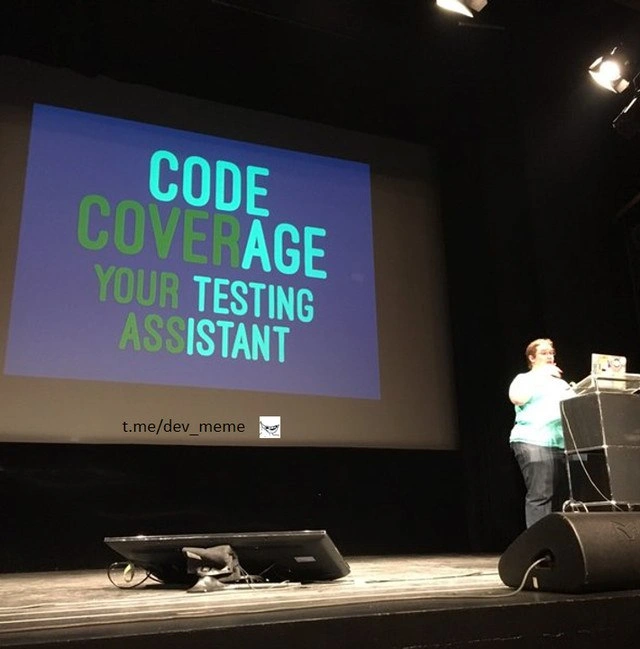
However, the meme is poking fun at over-reliance on the coverage number. At tech talks or team meetings, you might hear phrases like “We’ve reached 90% code coverage, so our code quality is great!” The slide in the image exaggerates this by making it look like Code Coverage itself is giving a TED-style talk, proudly calling itself "YOUR TESTING ASSISTANT." It’s humorous because code coverage is just a metric — a number — but here it’s being treated like an enthusiastic team member who guarantees quality. For a newer developer, it’s important to understand that high coverage doesn’t automatically equal high quality. You could write a bunch of tests that each call a function but never check if the output is correct (so-called dummy tests). Those tests would make the coverage percentage go up (since they run the code), but they wouldn’t catch a bug if the function was doing the wrong thing.
Imagine a function calculateTax(invoice) and you write a test that calls calculateTax(sampleInvoice) but you never assert what the result is. The test passes as long as calculateTax() doesn’t crash, and it contributes to code coverage. But it didn’t actually verify the tax calculation was right! This is a common rookie mistake: focusing on covering lines of code instead of thinking about test cases that verify behavior. In good testing practices, every test should have an assertion (a check) that the code did what was expected. Code coverage tools can’t tell if you asserted the right things; they only know whether the line ran.
The categories here – Testing, QA, Build Systems/CI-CD, Code Quality – all relate to how we ensure software works correctly. Code coverage falls under these because it’s part of automated testing and quality measurement. In a continuous integration (CI) system, after running the test suite, you might see a line like “All 150 tests passed. Coverage: 88%”. Some teams even configure the build to fail if coverage drops below a certain threshold (say, below 80%). This encourages developers to write tests for new code. As a junior developer, you might experience this when you open a pull request: a bot might comment “Coverage decreased by 2%, please add more tests.” It can feel like a game of keeping the numbers up. The meme is riffing on that culture – it’s as if the percentage is so important that it’s doing victory laps on stage.
It’s worth noting that while code coverage is helpful for finding untested parts of the code, it should not be the only measure of testing quality. Other aspects include testing important user behaviors, handling edge cases, and doing integration tests (ensuring different pieces of the system work together). You might have 100% line coverage but still miss scenarios – for example, maybe all your tests only use typical data and you never test weird or unexpected inputs. The meme’s joke implies some teams mistakenly treat the coverage metric as a one-stop solution (“our automated testing assistant!”) rather than just one QA process tool among many. It’s a lighthearted reminder not to be overly confident just because a number is high. In real life, a balanced testing strategy involves unit tests, integration tests, maybe manual testing, and yes, keeping an eye on code coverage – but also understanding its limits.
Level 3: Coverage Theater
In this meme, code coverage is literally taking the stage as if it were a rockstar developer tool claiming, "I'm your testing assistant, trust me!" Seasoned engineers in the audience would smirk at this sight. Why? Because they've seen teams obsess over that coverage percentage on the CI/CD dashboard as if it's the ultimate judge of code quality. The slide’s bold neon text ("CODE COVERAGE – YOUR TESTING ASSISTANT") lampoons how managers and dev teams sometimes treat a high coverage number like a full-fledged QA team member. It’s a classic case of vanity metrics getting a spotlight they might not deserve.
Experienced developers know that code coverage is a useful metric, but it's not a magic bug-catcher. Code coverage measures the proportion of your code executed by tests (often expressed as a percentage of lines or branches). It shows you which parts of the code have been run during automated tests. In theory, 100% coverage means every line runs at least once during testing. In practice, it can become coverage theater – a performance where hitting an impressive number doesn’t necessarily mean the audience (your software) is any safer from bugs. The humor here is that code coverage is boastfully personified as "everyone’s automated testing assistant," implying it can do the whole QA job. Every battle-worn dev knows that feeling: “Sure, buddy, you ran our code, but did you actually catch the bugs?”
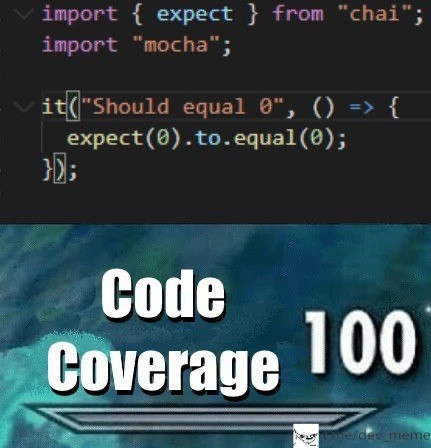
This sardonic scene reflects real-world patterns. In many QA processes and build systems, teams set an arbitrary goal like “80% or 90% coverage” as a quality gate. All tests must pass, and the coverage must stay high, or the build fails. This does encourage writing tests – which is good! – but it also incentivizes gaming the system. Engineers under pressure to raise the number might write superficial tests that do just enough to count. Imagine a test that calls a function without asserting any outcome; it executes the code (increasing coverage) but doesn’t verify correctness. Pro tip (that may induce an eye-roll from seniors): it’s possible to hit 100% coverage and still have glaring bugs. For example, you might cover every line but only with “happy path” tests, and never try unusual inputs or error conditions.
Let's illustrate how one could cheat coverage without improving quality:
def calculate_total(items):
return sum(items) # Bug: what if items is None? This line would error out
def test_calculate_total():
items = [1, 2, 3]
calculate_total(items) # This calls the function (increases coverage)
# No assertion to check the result or catch errors.
# The test will pass as long as calculate_total doesn't crash.
In the code above, the test executes calculate_total (so that line is counted as covered) but doesn't assert the result. If calculate_total were flawed (say it miscalculates or crashes on an edge case), this test wouldn’t notice – yet a coverage tool would still credit it. This is the crux of the joke: line coverage metrics can be fooled. A high percentage might just mean we ran a lot of code, not that we tested it thoroughly.
From a senior perspective, the meme hits on an industry truth: many of us have inherited projects boasting “95% coverage!” that still fell apart when reality hit. (Often it’s that remaining 5% untested error-handling that blows up at 3 AM 🕒.) We’ve learned that chasing coverage for its own sake is a numbers game. It creates a false sense of security — a green badge that says “100% tested” with an implied wink. The phrase "Coverage: Your Testing Assistant" is tongue-in-cheek because any veteran knows this assistant needs supervision. It won’t think of missing test cases for you. As testing gurus often remind us: coverage is a map of what code is tested, but not a guarantee that the code works. The metric can tell you where you lack tests (which is valuable!), but it can't tell you if your tests are any good.
There’s a bit of history and irony here too. Practices like Test-Driven Development (TDD) popularized the idea of writing lots of tests and naturally achieving high coverage. The intent was better design and fewer bugs, but some teams reduced it to “make those coverage numbers look good.” The meme magnifies that absurdity by giving the metric itself a megaphone at a conference. It’s like a jab at all those slick presentations where a single tool or number is pitched as the hero of QA. In reality, quality assurance comes from thoughtful testing, code reviews, and careful design – not just a boastful dashboard statistic. So, the senior dev humor here is a mix of “been there, done that” and “don’t worship false idols (especially not a percentage)”. Code coverage can be a helpful QA process tool, but treating it as an infallible team member is a tech industry folly we've seen play out many times before.
Description
A photo taken during a tech presentation in a dimly lit auditorium. On the large projector screen, a slide is displayed with a dark blue background. The text on the slide reads 'CODE COVERAGE YOUR TESTING ASSISTANT'. The words 'CODE' and 'YOUR TESTING ASSISTANT' are in a bright, light green font. The word 'COVERAGE' is in a darker green, but the letters 'R', 'A', 'G', 'E' within it are highlighted in the same light green, subtly spelling out the word 'RAGE'. To the right of the screen, a person stands at a podium, presumably giving the talk. A watermark for 't.me/dev_meme' is visible at the bottom of the slide. The humor is derived from this hidden message, which reflects a common sentiment among experienced developers. While code coverage is promoted as a helpful tool, the pressure to achieve high percentage targets often leads to writing trivial or meaningless tests, causing immense frustration and 'rage' - a critique of metric-driven development over meaningful quality assurance
Comments
7Comment deleted
The only thing 100% code coverage guarantees is that you've tested your getters and setters. The rage comes from knowing it tells you nothing about whether the system actually works
“Code coverage is my testing assistant” - sure, in the same way `wc -l` is my architecture review: impressive number, zero guarantee the thing actually works
Ah yes, code coverage - the metric that tells you 100% of your lines were executed but 0% of your edge cases were considered. It's like saying you've visited every room in your house but never checked if the windows actually close
This presentation brilliantly captures what every senior engineer knows but junior devs learn the hard way: achieving 100% code coverage is easy when you write tests that execute every line but assert nothing. It's the software equivalent of a Potemkin village - impressive metrics on the dashboard, but when production breaks at 3 AM, those green checkmarks won't save you. The real test of test quality isn't coverage percentage, it's whether your tests would actually catch the bug that's about to ruin your weekend
Code coverage is like uptime: impressive until mutation testing asks what any of those 95% executed lines actually asserted
Code coverage: the OKR you hit right before prod reminds you that branches aren’t paths and mocks aren’t users
Code coverage: the assistant boasting 100% lines hit, blissfully ignoring the uncovered branches that nuke prod at midnight