Skip to content
DevMeme
7040 of 7435
Claude Subagents Pictured as the 'Me and the Boys' Villain Squad
AI ML Post #7719, on Feb 17, 2026 in TG

Claude Subagents Pictured as the 'Me and the Boys' Villain Squad

Why is this AI ML meme funny?

Level 1: Sending Out the Crew

Imagine you're building a giant sandcastle and you summon four eager friends to help. You yell "You get water! You dig! You find shells! You guard it!" — and they all sprint off grinning like they're in a heist movie. Will they do exactly what you asked? Mostly. Will one of them come back proudly holding a confused crab instead of shells? Absolutely. The joke is that picture of the four grinning faces right at the start — everyone's thrilled, nothing has gone wrong yet, and that moment of overconfident teamwork is the funniest part of asking anyone, human or AI, for help.

Level 2: What "Spawning Subagents" Means

In tools like Claude Code, the main AI session can launch subagents — independent copies of the model given a single task ("find every place this function is called", "run the tests and summarize failures"). Key mechanics:

  • Each subagent has its own context window — its own working memory. It does not see your chat history; it sees only the instructions the parent wrote for it.
  • Subagents run in parallel, which is the appeal: four investigations at once instead of one long sequential slog.
  • When done, each returns a report to the parent, which merges the findings and continues.

The catch you'll hit in your first week of using this: a subagent is only as good as its briefing. Vague mission, confident nonsense back. It's the same lesson as delegating to a new intern — except the intern types at 200 tokens per second and never asks clarifying questions. The meme's grinning villains are those interns, mid-dispatch, certain of victory.

Level 3: Henchmen With Root Access

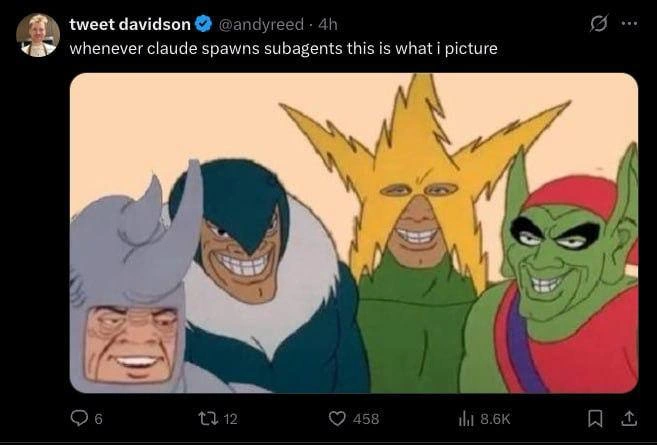
The tweet — "whenever claude spawns subagents this is what i picture" — attaches the canonical "Me and the Boys" image: four grinning supervillains from the 1960s Spider-Man cartoon (Rhino, Vulture, Electro, and Green Goblin), all wearing the same delighted, slightly unhinged smile. The mapping onto multi-agent orchestration is devastatingly accurate, and experienced users of agentic coding tools know exactly why it got 458 likes.

When a parent agent fans out subagents, the architecture sounds like a special-forces deployment: parallel specialists, isolated contexts, focused missions. What you actually get is closer to the image — a squad of enthusiastic henchmen, each supremely confident, each operating with zero shared context beyond the briefing the boss remembered to give them. The defining property of a subagent is that it starts fresh: it has not seen the conversation, the failed attempts, the file you said not to touch. It knows only its prompt, and like any good 1960s henchman, it will execute that prompt with a huge grin and no peripheral vision. The villain casting lands a second joke: these are Spider-Man's villains, famous for elaborate schemes that almost work. Anyone who has dispatched four research subagents and received back four reports — three excellent, one describing a file that does not exist, all four declaring total success — recognizes the energy. Subagents don't return uncertainty; they return henchman optimism.

The deeper pattern being satirized is the orchestration trade-off itself. Fan-out buys parallelism and context isolation (a subagent can grind through a 10,000-line log without polluting the boss's memory), but it pays in coordination cost: briefings must be self-contained, results must be verified, and two boys editing the same file produce the distributed-systems classic, a merge conflict with extra steps. The community knows the failure taxonomy well enough that "trust but verify your subagents" is standard advice — which is precisely how one manages henchmen. The affection in the meme is real, though. The picture isn't of failure; it's of the moment of dispatch, when all four are smiling and anything is possible. Every orchestrator feels that little surge of villainous pride watching the Task calls spin up. The codebase trembles. The boys are out.

Description

A screenshot of a tweet (dark mode X/Twitter UI) by 'tweet davidson' (@andyreed, verified, posted 4h ago) reading 'whenever claude spawns subagents this is what i picture'. Attached is the classic 'Me and the Boys' meme image from the 1960s Spider-Man cartoon: four grinning supervillains - Rhino, Vulture, Electro, and Green Goblin - huddled together with goofy, mischievous smiles. Engagement stats show 6 replies, 12 reposts, 458 likes, 8.6K views. The joke maps Claude's multi-agent orchestration (a parent agent spawning parallel subagents for tasks) onto a gang of dim but enthusiastic henchmen heading off to do the boss's bidding - capturing the mix of delight and mild menace of watching autonomous agents fan out across your codebase

Comments

1
Anonymous ★ Top Pick Accurate: four overconfident specialists, zero shared context, and each one returns claiming the mission succeeded
  1. Anonymous ★ Top Pick

    Accurate: four overconfident specialists, zero shared context, and each one returns claiming the mission succeeded

Use J and K for navigation