Skip to content
DevMeme
6258 of 7435
Claude Gov: the LLM where FedRAMP meets prompt engineering paperwork
AI ML Post #6861, on Jun 8, 2025 in TG

Claude Gov: the LLM where FedRAMP meets prompt engineering paperwork

Why is this AI ML meme funny?

Level 1: Permission Slip to Ask

Imagine you have a magical talking robot friend who can answer any question. Sounds fun, right? Now imagine your parents say, “Sure, you can ask the robot a question… but first, you must fill out this big form, get our neighbor (who’s a notary) to stamp it, and then mail it off and wait a month for a reply.” That would be pretty silly! You’d be thinking, “By the time I get an answer, I might even forget why I asked.” This meme is joking about that kind of situation. It’s saying that even though we have a super advanced AI (like a really smart robot that usually answers in seconds), if it’s being used by the government, you might have to go through a slow, formal process – almost like asking for permission each time. In simple terms, it’s funny because it’s like having a race car but only being allowed to drive it after doing tons of paperwork. We expect high-tech things to be fast and easy, so when someone says “actually, you need to wait in a long line and stamp papers to use it,” it feels upside-down. The joke makes us laugh at how over-complicated that is, kind of like needing a permission slip just to ask your own smart toy a question.

Level 2: Compliance 101

Let’s break down the key terms and ideas for those newer to these concepts. Claude is the name of an AI language model created by Anthropic, similar to how OpenAI has GPT-4 (like the model behind ChatGPT). When they say Claude Gov, they mean a version of Claude specifically configured for government use, especially U.S. national security agencies. Now, why would the government need a special version? Mainly because of security and compliance requirements. The U.S. government can’t just use any cloud service or AI tool; it has rules to protect sensitive information. FedRAMP is one big program that sets the standards for cloud services used by the government. You can think of FedRAMP as a giant checklist and review process ensuring a service is super secure and vetted. If a cloud product is FedRAMP authorized, it means an army of security professionals went through its design with a fine-toothed comb (covering things like data encryption, network firewall rules, user access controls, etc.). It’s a bit like a security seal of approval, but getting that seal is a long, paperwork-heavy process.

Now, the meme joke introduces a fake form “AI-2847B”. In real life, government processes do involve a lot of forms (each with a code number). For example, to start a new government IT project, you might fill out forms for approvals, budget, and security assessments. The commenter jokingly invents Form AI-2847B to represent “the form you’d have to fill out to use the Claude Gov AI.” The details – having it notarized – poke fun at how formal these processes can get. A notary is someone licensed to officially witness signatures on legal documents. Usually, you’d notarize things like affidavits or property documents, not an AI prompt! By saying you need a notary, the joke highlights just how over-the-top and old-fashioned government procedures can feel to tech folks. And “wait 6-8 weeks for processing” is a phrase many recognize from government applications (like applying for a passport or permit). In a world where an AI can answer in 5 seconds, waiting over a month to even submit your question is laughably slow – that absurd mismatch is the punchline.

A few more terms: prompt engineering is the craft of writing prompts (questions or instructions) to get useful answers from an AI model. Typically, prompt engineering is quick and iterative – you try a prompt, see the result, refine it, and so on. The meme imagines prompt engineering in a government setting slowing to a crawl, because each prompt must go through bureaucratic steps. The mention of GovCloud refers to special cloud environments (like Amazon’s AWS GovCloud or Azure Government) that meet government security standards. Usually, government projects use those instead of the regular public cloud. And an ATO, or Authority to Operate, is basically official approval for a system to be used in a government agency. Getting an ATO involves producing a stack of documentation about how a system is secured and having officials sign off on it. It can take a long time (often months). So, when you see “compliance wait time” or “ATO checklist”, it’s about that slow review cycle for security.

In summary, the meme’s context is combining the world of AI/ML (fast-moving, new tech) with the world of government compliance (slow-moving, lots of rules). It jokes that using a super-smart AI designed for government isn’t as easy as talking to a smart friend; instead, it’s more like filing taxes – fill out forms and wait patiently. It’s humor that rings true for developers and IT folks who have dealt with StakeholderExpectations in strict corporate or government environments: no matter how cool the tech is, you have to satisfy the paperwork.

Level 3: FedRAMP Follies

For the seasoned developer or IT professional, this meme hits a nerve. It’s highlighting the absurdly relatable scenario of bringing modern tech into a highly regulated environment. FedRAMP (Federal Risk and Authorization Management Program) is essentially the U.S. government’s long checklist to ensure cloud services meet strict security standards. If you’ve ever tried to deploy a new app or cloud service for a federal client, you know the drill: countless control documents, security assessments, ATO checklists, and a lot of hurry-up-and-wait. The LinkedIn post announces Claude Gov, Anthropic’s AI model tailored to government needs – presumably running in a secure enclave and pre-vetted for handling sensitive data. The comedic commenter beneath quips that using Claude Gov might be just as bureaucratic as any other government process: submit your prompt in triplicate via Form AI-2847B, get it notarized, then wait 6-8 weeks. This joke lands because experienced folks have lived versions of this pain. CorporateCulture and public-sector culture often require multiple approvals for even trivial changes, and here we’re extending that trope to something as simple as querying an AI. It’s a mashup of the fastest tech (AI responses in seconds) with the slowest processes (government paperwork that literally says “allow 6-8 weeks for processing” in fine print).

Why is that funny to an industry insider? Because it’s too real. Anyone who’s worked with Stakeholders_Clients in government or big enterprise has stories of filling out redundant forms and waiting eternities to get access to a tool or data. The meme exaggerates prompt engineering – normally an interactive, quick tweak-and-run activity – by inserting govcloud bureaucracy in front of it. It’s poking fun at the idea that even your AI assistant needs a stack of signed forms before it can assist. By referencing a fictitious Form AI-2847B, the commenter is parodying the naming of real government forms (which often have numbers and letters, sounding dry and arcane). The notary part – having it notarized – adds an extra layer of comedic overkill, since notarization is that old-school requirement to prove a document is legit, usually reserved for property deeds or affidavits, not daily work requests! And yet, if you switch “AI prompt” to, say, “server change request” or “data access request”, plenty of government contractors will nod grimly: yes, sometimes you literally get paperwork notarized for approvals.

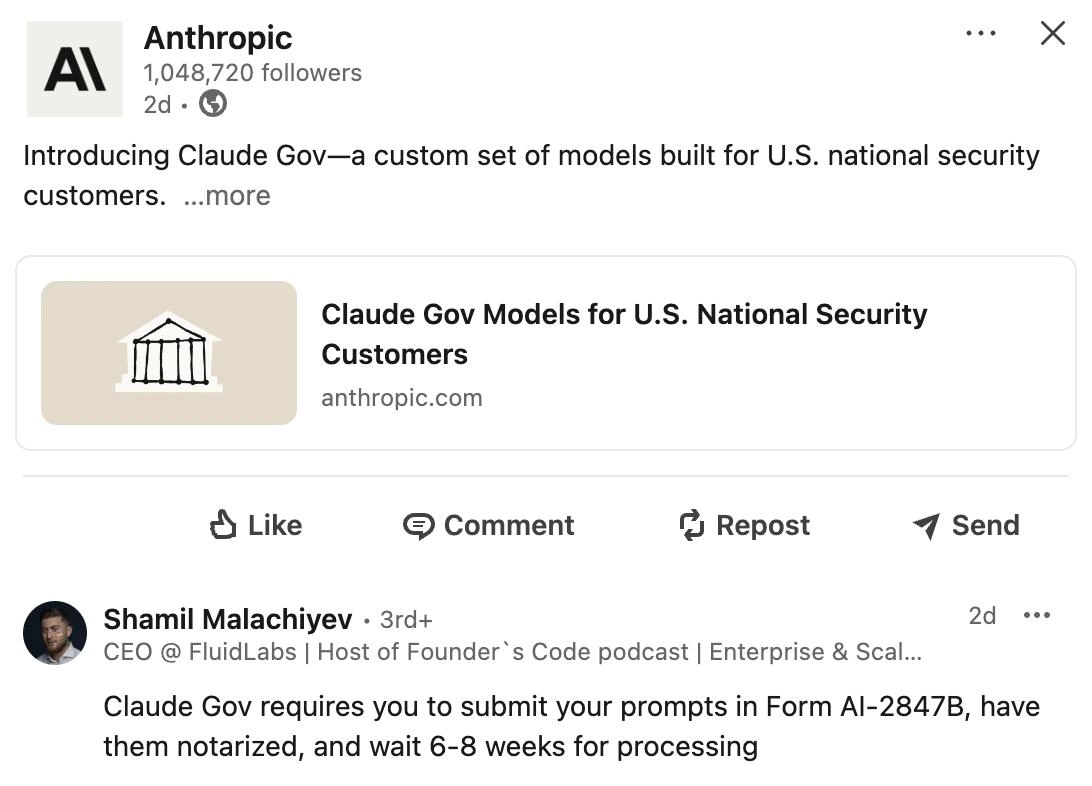
The image itself sets up the contrast: Anthropic’s official announcement uses a courthouse icon (a classical pillar building) suggesting formality and government institutions. The text “custom set of models for U.S. national security customers” is formal and full of gravitas, as if to assure everyone: we did the paperwork so you don’t have to. But the commenter’s joke implies that from the user’s perspective, the hoops remain. It satirizes the reality that even if a tech company preps an offering for government, the end-user engineers and analysts will still slog through internal compliance to use it. This is AIIndustryTrends meets old-school red tape. Over the past years, we’ve seen government agencies cautiously adopt cloud and AI, usually trailing the private sector by a few years and a mountain of compliance documents. Everyone remembers how moving to the cloud required FedRAMP authorization – a process that can take months or longer. Now with LLMs, history repeats itself: no matter how advanced the AI, the deployment will be gated by procurement officers, security reviewers, and legal teams. The shared laughter comes from that collective frustration: we finally have sci-fi level tech, yet we’re shackled by processes that feel straight out of the 20th century.

There’s also a nod to Security concerns. In high-security environments (think DoD or intelligence agencies), you truly can’t just run a web service without clearance. Data sensitivity means even your machine-learning model might need to reside on classified networks. Engineers who’ve endured ATO cycles joke that by the time you get approval, the technology is outdated – and here, by the time your prompt is approved, maybe the model has a new version or the answer is no longer needed. It’s a gentle jab at how innovation bumps up against institutional inertia. The phrase “wait 6-8 weeks for processing” is a classic line you’d see on DMV forms or passport applications, deliberately hyperbolizing the experience of IT requests in bureaucracy. It’s funny because it’s a little true: maybe not six whole weeks for a prompt, but getting a new AI tool approved in a gov org can involve endless meetings, compliance reviews, security scans, and yes, a mountain of paperwork that feels as slow as molasses. The ComplianceHumor of it all is that developers in these spaces often joke that they spend more time on compliance than on coding. So this meme resonates: it’s basically saying “Sure, we got a fancy AI model for you, but don’t worry – you’ll still get to enjoy the classic government paperwork that comes with it!” and that contrast is both hilarious and painfully familiar.

Level 4: Security Clearance for Code

At the highest level, Claude Gov is where cutting-edge AI meets the full force of government security compliance. Think of it like giving a Large Language Model a security clearance. Just as an intelligence analyst needs background checks and polygraphs, an LLM designed for U.S. national security customers must pass rigorous reviews. Under the hood, this means meeting standards like FedRAMP High – a cloud security framework mapping to hundreds of controls from NIST Special Publication 800-53. In practical terms, every piece of Claude Gov’s infrastructure from its data encryption to memory handling would need FIPS 140-2 validated crypto modules and audit logging that would make a bank jealous. When Anthropic says “custom models for national security,” they imply the model runs in a fortified environment (imagine an AWS GovCloud region or an on-premise air-gapped server farm) with strict Authority to Operate (ATO) paperwork. This isn’t just marketing – it’s a response to the reality that sensitive government data can’t be piped into just any AI. There’s a deep ** AI_bureaucracy** at play: before an LLM can even output “Hello, world” in a classified context, it likely needs a stack of documentation describing in excruciating detail how it won’t leak information, how it handles memory, how it was trained ethically, and which compliance controls are inherited from underlying cloud services. It’s the meeting of two worlds: the fluid, data-driven universe of AI_ML models and the checklist-heavy universe of infosec Compliance. The meme exaggerates this collision by joking that you’d have to treat each prompt as if it were a formal government form submission. It playfully conjures “Form AI-2847B” – which sounds absurd, but to anyone who’s browsed the catalog of federal forms (SF-86 for security clearance, anyone?), it’s scarily plausible. In essence, the humor draws on the contrast between the theoretical instantaneous intelligence of an AI and the very real latency of bureaucracy. We’re talking about a clash of paradigms: a neural network that thinks in tokens per second versus a government that moves in weeks per signature. It’s a reminder that even the most advanced algorithms can be slowed by human governance protocols. Ironically, the prompt engineering here isn’t about clever phrasing to coax a better answer – it’s literally engineering the prompt through layers of paperwork protocols. The meme tickles the technical brain by hinting at this heavy juxtaposition: on one side, bleeding-edge AI capabilities; on the other, the ancient (in tech time) rituals of government procurement and security review. For senior engineers familiar with securing systems, it rings true – an inadvertent nod to the CAP theorem of bureaucracy: you can have innovation, compliance, or speed – pick two (and the government will definitely pick compliance and security over speed).

Description

Screenshot of a LinkedIn post. At the top, the official Anthropic account (logo with stylized “AI”) announces: “Introducing Claude Gov - a custom set of models built for U.S. national security customers.” A beige link-preview card shows a simple courthouse icon and the headline “Claude Gov Models for U.S. National Security Customers - anthropic.com.” Beneath the usual LinkedIn reaction bar (“Like · Comment · Repost · Send”), a commenter jokes: “Claude Gov requires you to submit your prompts in Form AI-2847B, have them notarized, and wait 6-8 weeks for processing.” The visual gag contrasts cutting-edge LLMs with classic government red tape, poking fun at the compliance hoops enterprise and public-sector engineers recognise all too well - FedRAMP checklists, ATO cycles, and interminable procurement forms


Comments

9
Anonymous ★ Top Pick Finally, an LLM that can answer classified questions - just as soon as your prompt clears the Joint Authorization Board’s 42-page change-control spreadsheet
  1. Anonymous ★ Top Pick

    Finally, an LLM that can answer classified questions - just as soon as your prompt clears the Joint Authorization Board’s 42-page change-control spreadsheet

  2. Anonymous

    Finally, an AI model that responds with 'Your request has been received and will be processed in accordance with Section 3.2.1 of the AI Operations Manual. Expected completion time: Q3 2025. Please submit Form AI-2847C if you need expedited processing.'

  3. Anonymous

    Finally, an AI model that truly understands government workflows: it takes longer to get approval for your prompt than it does to train the model from scratch. At least now we know why government AI projects have 18-month timelines - 6 weeks per API call adds up quickly when you're building a chatbot

  4. Anonymous

    Claude Gov: prompt engineering becomes a CCB change with an SSP diff, waiting on ATO - latency measured in weeks, not tokens per second

  5. Anonymous

    Claude Gov: Fine-tuned for compliance, where prompt latency rivals ATO approval in a DoD acquisition program

  6. Anonymous

    Claude Gov’s p99 isn’t in milliseconds - it starts after ATO; you file the prompt as a change request and hope procurement doesn’t bounce it

  7. @SamsonovAnton 1y

    Soviet-era form for querying Google, submitted to KGB: in addition to name and account number, the applicant must have specified his personal KGB supervisor credentials and clearance number. "In Soviet Russia, you don't search — you are being searched".

    1. Sure Not 1y

      Brooooo

      1. @SamsonovAnton 1y

        Comrade! 🫡

Use J and K for navigation