When complexity turns magic into maintenance nightmare: Clarke's law rewritten for engineers
Why is this TechDebt meme funny?
Level 1: Magic Trick Gone Wrong
Imagine a magician who tries to perform a big fancy trick with lots of props and steps. There are pulleys, lights, rabbits, hats, and smoke machines – so many things on stage. But when he finally does the trick, everything goes wrong: the rabbit jumps out at the wrong time, the props break, and the stage fills up with smoke. Instead of a cool show, it turns into a big mess. That’s what happens when a gadget or program is designed with too much going on. It might start off sounding amazing and high-tech (like the magician’s idea), but because it has so many moving parts, it ends up not working right. The fancy invention that was supposed to feel magical just becomes frustrating, almost like a useless piece of junk. There’s a joke among programmers that if something is really over-complicated, it’s basically “crap” – meaning it’s as disappointing as a failed magic trick that leaves everyone annoyed instead of amazed.
Level 2: Overengineering 101
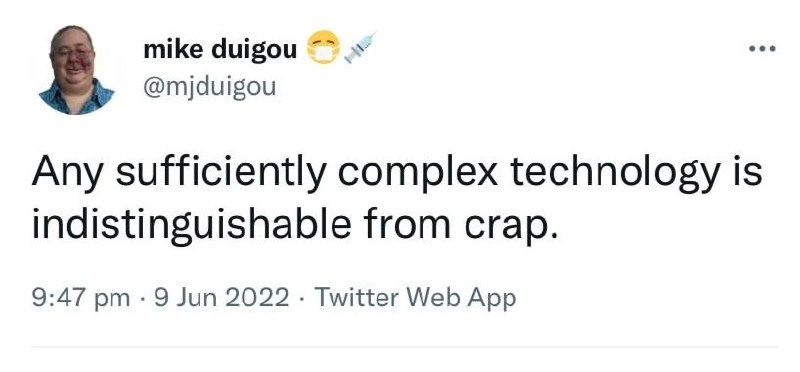
Let’s break it down. The meme references a famous saying by science fiction writer Arthur C. Clarke: “Any sufficiently advanced technology is indistinguishable from magic.” The original line means when tech is really advanced, people are amazed by it as if it’s magic. This tweet changes the words to make a joke for developers: it says if technology gets too complex, it becomes indistinguishable from “crap” (slang for something low-quality or broken). In other words, when a system is overly complicated, it stops feeling like a cool innovation and starts feeling like a frustrating mess.
SystemComplexity is when a system has so many parts and interactions that it’s hard to understand or predict. For example, imagine a simple task that goes through 10 different microservices or jumps across dozens of classes – that’s a very complex design!
TechnicalDebt is a term for the consequences of quick-and-dirty coding or poor design. It’s like taking shortcuts when writing code: you save time now, but you owe a “debt” of extra work later to fix the issues caused by those shortcuts. If you keep postponing cleanup, the debt accumulates as the system becomes harder to change or debug. Eventually, the code might get so messy that any new change is risky – that’s when people say the codebase has turned to crap.
OverEngineering means designing a solution that is far more complex than necessary. Think of building a robotic arm to butter your toast when you could just use a knife. In software, overengineering might look like adding many layers of abstraction, using six different design patterns for a simple task, or splitting a program into a dozen microservices “just in case” you might need that flexibility. The result is often SoftwareBloat – software that has too many unnecessary features or too much overhead. Bloat makes a system slow and difficult to maintain, without providing much benefit to users or developers.
CodeQuality refers to how well-written and maintainable the code is. High-quality code is easy to read, straightforward, and reliable. But when a codebase becomes overly complex, quality suffers. It becomes hard to tell what’s going on (poor readability), there might be lots of duplicate or dead code, and bugs pop up in corners of the system that no one fully understands. Developers might start calling it “crappy code” when they’re frustrated with it, because working on it feels unpleasant.
LegacySystems (legacy code) describe old software that’s still in use, often built with outdated tools or piled with years of updates. These systems can be very complex because they’ve had feature after feature bolted on over time. If you join a company and they ask you to maintain a 15-year-old legacy project, you might find weird quirks, old libraries that no one has updated, and very little documentation. It often feels like trying to fix an old machine where every part is different and held together with tape. It’s definitely not “magic” – more like a fragile house of cards that could collapse if you’re not careful. That’s why a veteran developer might joke that such a system, however advanced it was in its day, is now “indistinguishable from crap.”
The difference between how a system is designed and how it actually feels to work with is key here. Good design patterns and solid architecture are supposed to make a system cleaner. But if those patterns are misused or overused, the design can backfire. For instance, patterns like Factory or Observer are useful in the right context. But if a codebase has layer upon layer of indirection (say, factories calling other factories, or a chain of 10 classes passing data along), a newcomer trying to follow it will be utterly confused. What was meant to be a clever architecture ends up as a puzzle no one wants to solve.
As a new developer, you might have even encountered this on a small scale. Maybe in a school project you tried to use every pattern or framework you just learned and found the result harder to understand than if you had kept it simple. Or perhaps at your first job you saw a piece of code that took 50 lines and lots of objects to do something you felt could be done in 5 lines. It’s a common early lesson that simplicity is often better. There’s a saying, “Keep It Simple, Stupid” (KISS) – meaning don’t overcomplicate what can be done plainly. The reason is exactly what the meme jokes about: too much complexity can turn a project into a headache.
You can think of it like this: adding more parts and fancy ideas to a project might solve some problems or add features, but it also makes the whole thing heavier and harder to change. There’s a point where complexity starts to hurt more than help. If developers have to spend hours just understanding how all the pieces connect, that’s time not spent building new things. And if a small change in one corner unexpectedly breaks something in another, the system’s complexity is actively harming its quality. In short, more isn’t always better in engineering. The meme is a funny reminder that making something overly complicated can backfire. Instead of feeling impressed by how “advanced” the solution is, people might just feel it’s a pain – essentially calling it “crap” because it’s not delivering the magic it promised.
This tweet is basically a developer frustration quote wrapped in humor. It captures the feeling you get when you’re dealing with an overbuilt, overcomplicated system. Instead of marveling at its sophistication, you’re sighing or swearing because nothing makes sense. It’s telling us that if technology is too complex to use or maintain, all that supposed advancement doesn’t matter – it will just seem broken and annoying. The lesson for a young engineer is: don’t equate complexity with quality. Often, the real magic in software is making something complex simple for the user, and easy to maintain for the team.
Level 3: Clarke’s Law, Rewritten
Arthur C. Clarke’s famous third law states, “Any sufficiently advanced technology is indistinguishable from magic.” This meme puts a bitter engineering twist on it: “Any sufficiently complex technology is indistinguishable from crap.” It’s a snarky commentary on how SystemComplexity and OverEngineering can turn high-tech marvels into unmanageable nightmares. In practice, software that becomes too complex often devolves into a tangle of confusing code and unpredictable behavior – basically crap from a maintainer’s perspective. What was once touted as a “magical” cutting-edge solution can accumulate so much TechnicalDebt and SoftwareEntropy that working with it feels like slogging through a swamp of bugs, hacks, and LegacyCode.
The humor lands because every senior developer has seen a supposedly elegant system collapse under its own weight. For example, imagine a web application with an architecture full of design patterns: factories that produce builders that produce objects, 12 microservices where 1 would do, and abstraction layers for every occasion. It might have looked advanced on a whiteboard, but when it’s 3 AM and you’re tracing a critical error through 10 different modules and 5 network hops, that “advanced” architecture sure feels indistinguishable from garbage. The meme’s blunt term “crap” captures that shared frustration perfectly.
We often see OverEngineering in action like this:
// Over-engineered way to add two numbers:
interface Adder { int add(int a, int b); }
class AdderImpl implements Adder { public int add(int a, int b) { return a + b; } }
class AdderFactory { static Adder create() { return new AdderImpl(); } }
// Using the factory to do a simple addition
int result = AdderFactory.create().add(2, 2);
// All that complexity just to calculate 2+2 - talk about overkill!
In the snippet above, a simple addition (2 + 2) was turned into a mini-framework of interfaces and factories. That’s a tongue-in-cheek example of needless complexity: adding so many layers that the original easy task becomes convoluted. This kind of approach often sneaks into codebases because someone thought a very generic, extensible design would be "future-proof" or enterprise-grade. A few years later, new developers look at it and go, “Who wrote this crap?”
This tweet resonates deeply in contexts of LegacySystems and aging codebases. Over time, even well-designed software accumulates patches and feature requests that weren’t anticipated, leading to SoftwareBloat and bizarre modules nobody remembers writing. If you’ve dealt with a 15-year-old enterprise system (the kind with XML configuration files thousands of lines long and mysterious half-broken modules labeled "temp_old" or "v2_copy"), you know that sense of dread. The technology might have been state-of-the-art when it started, but now it’s an impenetrable mess. In other words, “sufficiently complex” has been reached, and everything feels like crap to work on.
The meme is poking fun at a hard truth: complexity is the enemy of CodeQuality and sanity. Best practices in software architecture and design patterns preach simplicity for a reason. The more moving parts, layers of abstraction, and hidden dependencies a system has, the more likely it is to fail in unexpected ways. There’s even an adage among engineers: “Simple things should be simple, complex things should be possible.” When even simple tasks become overly complex in a system, it’s a recipe for constant bugs and developer burnout.
Ironically, what starts as an “advanced” solution often devolves into a TechDebt pit if not carefully managed. Teams might choose a sophisticated framework or a microservices fleet for scalability (the magic at first), but then integration pains, version conflicts, and performance issues start creeping in. Without regular refactoring and pruning, complexity just compounds. Before you know it, adding any new feature requires navigating a minefield of side effects. At that stage, engineers throw up their hands and echo this meme: all this fancy tech might as well be crap!.
Seasoned developers have seen this cycle before. Today’s “hot” architecture often becomes tomorrow’s tangled legacy. Take Enterprise JavaBeans in the early 2000s – it was billed as a robust enterprise solution, but quickly earned a reputation for SoftwareBloat and needless complexity. History is full of such examples. People keep bolting on features and layers (often under pressure to deliver more), and the system becomes too clever for its own good. Eventually, even the original creators might struggle to recognize it. So when an engineer quips that complex tech is “indistinguishable from crap,” it’s a hard-earned lesson speaking.
Importantly, this isn’t just about bad code – it’s about how system complexity can defeat even good intentions. Even clean code, when layered too deep or spread too thin, becomes hard to reason about. Senior devs jokingly call sprawling, convoluted architectures a "Big Ball of Mud" (an infamous anti-pattern where a system lacks clear structure). It might do a lot, but no one truly understands it, and any change risks collapsing the whole fragile structure. This is EngineeringAbsurdity that the tweet neatly captures in one line.
In short, the tweet rewrites Clarke’s optimistic “sufficiently advanced = magic” into a cynical “sufficiently complex = trash,” reflecting how developer optimism can turn to despair after wading through a morass of complexity. It’s a rallying cry (or perhaps just a weary inside joke) from seasoned engineers who have seen once-magical projects become maintenance nightmares. The message: if you let complexity run rampant, don’t be surprised when the end result feels like complete crap.
Description
Screenshot of a tweet with a blurred profile photo, the name “mike duigou” followed by a masked-face emoji and syringe emoji, and the handle “@mjduigou”. The tweet text reads: “Any sufficiently complex technology is indistinguishable from crap.” Below the text is the timestamp “9:47 pm · 9 Jun 2022 · Twitter Web App”. White background, standard Twitter font and layout. Technically, the post riffs on Arthur C. Clarke’s famous law by swapping “advanced” for “complex” and “magic” for “crap”, humorously capturing how over-engineered systems, excessive abstractions, and layered dependencies often degrade developer experience and code quality. The meme highlights tech-debt, architectural bloat, and the practical pain senior engineers face when systems grow beyond manageable complexity
Comments
6Comment deleted
Clarke’s 2025 addendum: any sufficiently complex microservice mesh is indistinguishable from the monolith it replaced - plus the privilege of debugging Schrödinger’s network
The real magic is convincing stakeholders that the 47 microservices, 3 message queues, and 5 different databases are all essential for what started as a CRUD app
This is the senior engineer's corollary to Clarke's Third Law: when your microservices architecture requires a 47-page onboarding doc, three service meshes, and a dedicated 'platform team' just to deploy a hello-world endpoint, you've achieved that magical state where nobody can tell if it's brilliant distributed systems engineering or just enterprise-grade technical debt with extra steps. The real magic trick is convincing stakeholders it's the former while your on-call rotation knows it's definitely the latter
Clarke’s law, SRE edition: beyond a certain complexity, magic and outage are indistinguishable - until you see who’s holding the pager
When "Hello, world" needs a service mesh, three CRDs, and two feature flags, you've hit the phase transition where "advanced" becomes "crap."
The real CAP theorem corollary: any sufficiently complex distributed system guarantees eventual crap