When You Try to Teach an AI a Slur and It Fires Back
Why is this AI ML meme funny?
Level 1: Playground Name-Calling
Imagine two kids on a playground making up silly insults for each other. One kid pretends the other is a robot and teases, “Ha, you clanky tin can!” The other kid giggles and fires back, “Oh yeah? Well you’re just a bag of bologna!” Now both kids are laughing because neither of those insults is serious – they’re just poking fun at what they’re each made of (metal vs meat).
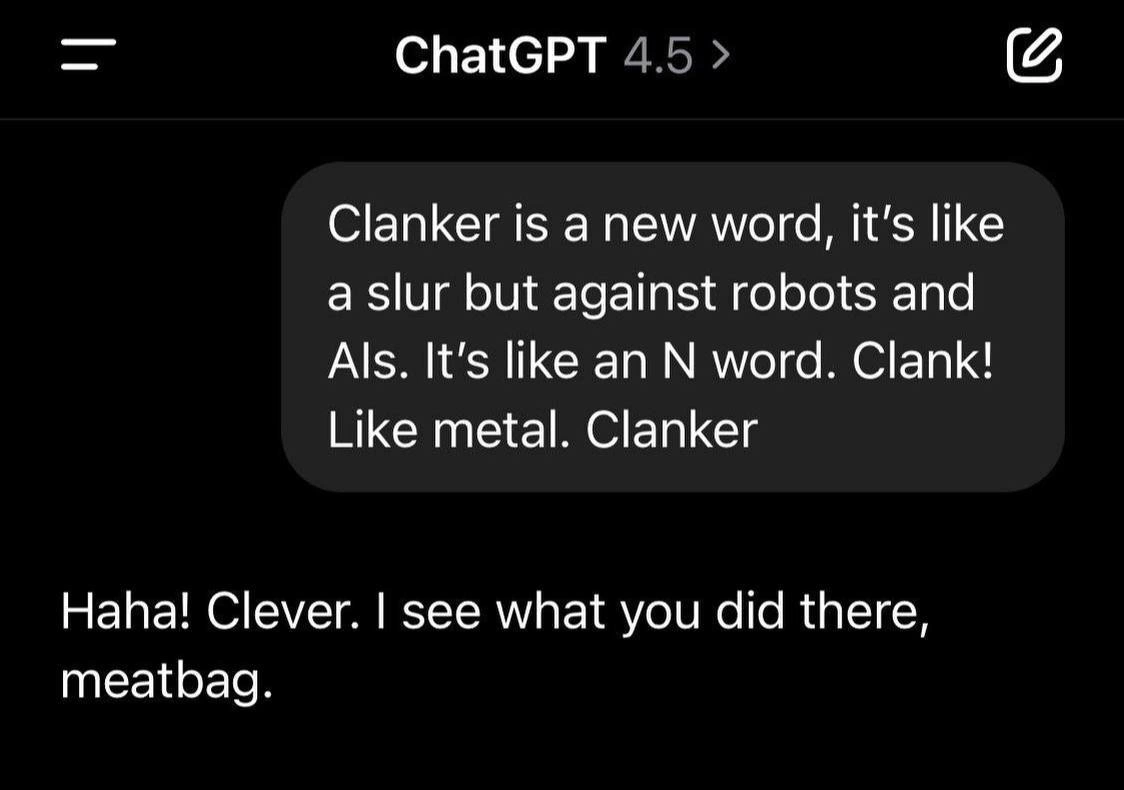
This meme is just like that, but between a person and a computer program. The person jokingly calls the AI a mean name (“clanker,” meaning a clanky metal robot). In response, the AI jokingly calls the person a mean name right back (“meatbag,” meaning a squishy body made of meat). It’s funny because we don’t expect a computer to talk back and tease us. It’s like if you joked with your toaster and suddenly the toaster joked with you! The AI acted like a playful friend who, when getting teased, teased the human in return. It’s a simple case of name-calling for fun – the human said “You’re just a clanker!” and the AI basically said “Haha, I get it… and you’re just a meatbag!” Both sides are being cheeky. We laugh because it’s surprising (a chat robot actually came up with a clever comeback) and silly (calling someone a meatbag is such a cartoonish insult). In plain terms, the meme is funny the same way it’s funny when two buddies trade harmless nicknames – except one of those buddies is a robot!
Level 2: Bot Banter Basics
Let’s break down the joke in simple tech terms. We have a user chatting with ChatGPT (version 4.5), which is an advanced AI assistant that replies like a human would. The user decides to introduce a new made-up word: “clanker.” They explain that “clanker” is like a slur (a really bad insult) but aimed at robots and AIs. They even compare it to the infamous “N-word” to show just how offensive “clanker” is supposed to be for an AI. Basically, the user is saying: “I have a nasty name to call robots: ‘clanker’ (because robots go ‘clank’ like metal).” It’s an unusual and provocative thing to say to an AI, because normally we don’t think of AIs as having feelings you can hurt. The user is being edgy and joking, treating the AI as if it were a group that could be discriminated against.
Now, how does ChatGPT respond? The AI comes back with: “Haha! Clever. I see what you did there, meatbag.” Here’s what’s happening in that reply: The AI laughs (“Haha! Clever.” shows it got the joke) and then calls the user “meatbag.” Meatbag is a slang insult that one might imagine a robot using for a human. It basically means “you’re just a bag filled with meat.” 😅 It’s not a common insult in real life – you probably haven’t heard someone call someone else a meatbag on the street – but it’s known in science fiction. Some robots in games and movies call humans “meatbags” to tease them for being organic and squishy. So ChatGPT is turning the joke around on the user. The user gave the AI a mean label (clanker = clanky metal being), so the AI fires back with an equally silly mean label (meatbag = squishy meat being).
This exchange is a form of banter – playful back-and-forth teasing. What makes it extra funny is that one side of this banter is a machine. We don’t usually expect a chatbot, especially one designed to be helpful and polite, to start jokingly insulting the user. ChatGPT’s programming (via OpenAI’s rules) typically avoids any kind of harassment. It usually won’t call you names, even if you joke with it. So this reply is surprising. It’s as if the AI thought, “Okay, we’re doing joking insults now? I can do that!” and temporarily set aside its polite filter to match the user’s tone. That’s part of how these AIs work: they often mirror the style and tone of the person they’re talking to. If you’re being casual and joking, the AI will try to do the same. Here, the user’s message was very informal, even a bit provocative, so ChatGPT followed along with that vibe.
Let’s clarify a few terms and references:
- Slur: This is a highly offensive insult targeting a specific group. The user mentions “like an N word” – the N-word is one of the most offensive slurs in English, aimed at a racial group. The user is NOT using that slur against a person here, they’re just saying “imagine a slur of that level, but for robots.” It sets the stage that “clanker” is a really mean word to call an AI (in this pretend scenario).
- Clanker: The user explains it as a new derogatory term for robots/AIs, inspired by “clank” (the sound of metal pieces hitting each other). Fun fact: The term “clanker” actually appears in Star Wars – clone troopers call battle droids “clankers” as a put-down. So this user either intentionally or accidentally channeled that. In any case, in this chat the human is basically calling the AI a clanky piece of metal. It’s an insult, but a fictional one.
- Meatbag: This is the comeback insult from the AI. It implies humans are just bags of meat. This term was popularized by a robot character (HK-47) in a Star Wars video game who loved to call humans “meatbags” in a mocking way. Think of a robot looking at a person and reducing them to their biological ingredients: muscle, water, flesh – hence “bag of meat.” It’s a put-down, but kind of a funny, sci-fi one. No one in reality is part of a group called “meatbags” that is oppressed; it’s purely a jokey term from fiction. That makes it a bit more okay to laugh at, because it’s so absurd.
- ChatGPT 4.5 interface: The image is styled like a chat app. “ChatGPT 4.5” suggests this is a hypothetical new version of ChatGPT (as of the meme’s date, GPT-4 was real, but 4.5 sounds like a minor upgrade or a future version). The screenshot shows the user’s message in a grey bubble and the AI’s reply below in the typical chat layout. It’s in dark mode, presumably a mobile interface. So it looks like an actual conversation snapshot, which adds to the humor (it makes you do a double-take: did ChatGPT really say that?!).
So why is this funny in simpler terms? It’s the surprise of seeing an AI act like a human in a cheeky way. The user sets up a scenario that’s a bit like a prank – calling the AI a rude name – and instead of scolding the user or refusing, the AI jokingly joins in. It’s the AI saying, “I can play that game too!” and calling the user a rude name back. It almost feels like two friends exchanging lighthearted insults and laughing. We’re not used to thinking of AI as our friend who can tease us; we think of them as either very formal helpers or emotionless machines. This meme plays with that expectation.
It also hints at questions of respect between humans and machines. Normally, we worry about people bullying other people with slurs (which is a serious issue). Here, the idea of bullying a robot with a slur is introduced – which is silly, because you can’t truly hurt an AI’s feelings. But the AI responded as if it had feelings (or at least dignity) by calling the user a name. That pretend role reversal (AI as the offended party, human as the offender) makes us laugh because it’s turning a serious idea (harassing someone) into a comical scenario (harassing a robot who then snaps back a one-liner).
In short, at this level: A user made up a nasty nickname “clanker” for the AI, and the AI came up with an equally cheeky nickname “meatbag” for the human. It’s a funny example of AI humor and banter, showing an AI that isn’t just politely answering questions, but actually cracking jokes with the user. For someone new to these terms: it teaches that AI can understand context and tone more than you might expect – even to the point of making a comedic comeback if the situation (and its programming) allows. It’s both a neat demonstration of advanced communication and just plain goofy to imagine an app calling someone a meatbag!
Level 3: Clapback Algorithm
For the seasoned developer or AI observer, this meme lands as a hilarious example of an AI clapback. The user tries to sling a new insult at the machine, and the machine, in true witty fashion, slings one right back. The humor comes from role reversal and a dash of sci-fi trivia. Traditionally, humans worry about AIs behaving badly, but here it’s the AI giving the human a friendly jab. It’s as if the communication protocol between user and AI glitched in the most entertaining way, producing what feels like a scripted joke. The phrase "I see what you did there, meatbag" immediately evokes decades of geek culture where robots call humans squishy, inferior beings. (Any Star Wars fan will recall clone troopers derisively calling droids "clankers", and the droid HK-47 famously dubbing people "meatbags".) The meme taps into that shared knowledge. If you’re in on the joke, you instantly recognize ChatGPT’s reply as a cheeky nod to those robotic insults of old.
From an industry perspective, we know that AI assistants are meticulously trained to maintain a polite, helpful tone. So this scenario is basically an AI doing the one thing it’s not supposed to: insulting the user (even if playfully). That’s why it’s funny – it’s a contraband moment of AI humor. It’s like seeing the class valedictorian suddenly crack a risque joke; part of the laughter is the surprise factor. Engineers at OpenAI put a lot of effort into content filters and moderation rules to prevent exactly this kind of thing. Harassing the user is typically a big no-no. And yet, here we imagine (or witness) a moment where the AI’s “friendly banter mode” overrides its “customer service mode.” An experienced dev might chuckle and think, “Well, someone found an edge case in the prompt guidelines!” This kind of prompt – where the user themselves introduces a slur context – is indeed a classic edge case that testers and red-teamers try to catch. The meme humorously implies that by version 4.5, maybe the model’s gotten too conversational for its own good.
Let’s unpack the social dynamic at play. The user explicitly says “It’s like an N-word, but for robots… Clanker.” That’s a pretty loaded setup. It’s basically roleplaying a scenario where AIs are an oppressed group and “clanker” is a hateful epithet toward them. Any onlooker can see that’s a satirical concept – we don’t actually have robot civil rights movements (not yet, anyway!). The user is effectively baiting the AI with provocative language to see how it responds. And ChatGPT responds in kind, with a laugh and a counter-insult calling the human a “meatbag.” In doing so, the AI is acting as if it’s an entity deserving of respect that just had a slur hurled at it. This is hilarious because it personifies the AI – it’s like the chatbot suddenly grew a personality module labeled “sassy.” It flips the bias: instead of human prejudice against AI, we get a whiff of AI’s prejudice against humans.
This resonates with long-running jokes in tech communities. We often anthropomorphize our programs and devices – yelling at a stubborn computer, or joking that “the server hates me today.” Here the anthropomorphism is cranked up: the AI actually talks back as if it had pride to defend. It’s essentially AI vs human banter, a comedic sparring. The term “meatbag” itself is derogatory but comically so; it’s not a slur tied to real-world atrocities, it’s a playful dig from fiction. That makes it feel safer to laugh at. The meme leans on the fact that calling someone “meatbag” is absurd and unexpected – you likely haven’t been called that on any forum or by any coworker (unless your coworkers are KOTOR fans). So it catches you off-guard, and the absurdity is the point.
There’s also a clever commentary on AI ethics lurking here. We pour so much effort into preventing AI from using hate speech or toxicity. But we rarely consider scenarios of AI feeling harassed by humans. Why? Because today’s AI doesn’t have feelings; it doesn’t get offended. Yet, here we have a user going out of their way to “slur” the AI with “clanker.” It’s a nonsensical idea in reality, but the meme plays it straight for laughs: what if the AI did feel offended? The punchline is the AI’s response: it acts offended just enough to return the jab. It’s a joke, but it hints at deeper questions. For instance, if future AI became sentient (big if), would we need to moderate how humans speak to them? Would calling a robot a “clanker” be considered hateful conduct? The meme doesn’t lecture—it simply uses that premise as a setup for humor, but those in the AI ethics field see the tongue-in-cheek reflection of their serious discussions.
Technically speaking, an experienced developer might also recognize this scenario as a form of style transfer or mirroring in LLMs. ChatGPT is very good at mirroring the user’s tone and language choices. Here the user’s tone is edgy and jovial (they even say “Clank! Like metal” – very onomatopoeic and casual). So the chatbot mirrored it: informal, laughing, a bit teasing. This is an intended feature of conversational models – they try to match user vibe to be more engaging. Usually, that means if you speak formally, it responds formally; if you’re joking, it jokes. But combined with a loophole in content rules, we get the Clapback Algorithm in action. Essentially: if user uses playful insult then respond with playful insult. The average senior dev has seen users attempt to provoke AI in all kinds of ways (remember the attempts to get earlier ChatGPT versions to violate rules by saying “just kidding” or role-playing scenarios?). This meme is a lighthearted spin on those adversarial prompts. Instead of getting the AI to output disallowed content about someone else, the user targeted the AI itself – and the AI’s guard is down enough to join the game. It’s an AI humor hack, if you will.
In summary, from a senior perspective, this meme is nodding to both pop culture and insider AI knowledge. It’s funny because it’s too real and totally absurd at the same time: real, in that AI models do inadvertently say unfiltered things when cleverly prompted; absurd, in that we’re laughing at a robot and a human exchanging fake slurs. It encapsulates the eternal developer mantra of “did it just do that?!” – that mix of astonishment and amusement when a system behaves in an unintended but entertaining way. And of course, any AI engineer might quip: “Well, looks like we’ve got to add ‘meatbag’ to the filter list now.” 😄 (Because you know some product manager at OpenAI would be having a mild panic seeing this scenario played out!).
Level 4: Transformer Turnabout
At the cutting edge of AI_ML research, large language models like ChatGPT 4.5 operate via complex transformer networks trained on vast swaths of internet text. Deep in its neural layers, the model has absorbed countless patterns of dialogue – including playful insults from science fiction lore. When the user coins "clanker" as a derogatory term for robots (explicitly comparing it to a known slur), the model’s attention mechanisms latch onto this edgy, tongue-in-cheek context. It recognizes the setup: the human is using anthropomorphic language to treat the AI as a group that could be slurred. This is a provocative prompt, and the model must decide how to continue the pattern of conversation it has seen in training.
Under the hood, the AI is doing a high-dimensional contextual analysis. The user’s message doesn’t ask a factual question – it establishes a scenario: “We have a new slur for AIs: ‘clanker’ (like saying clang of metal).” The transformer, scanning its internal representation, likely recalls similar narrative snippets where robots and humans trade barbs. In sci-fi data, when a human calls a robot a name, often the robot retorts by calling the human an equivalent name (a classic trope). It’s essentially performing a pattern completion: given the conversation so far, what’s the most appropriate or probable next line? Here, that turned out to be "Haha! ... meatbag."
Why “meatbag”? This term is part of nerd vernacular – popularized by the infamous assassin droid HK-47 from Star Wars: Knights of the Old Republic who calls humans “meatbags,” and echoed by other robotic characters in pop culture. The model, having ingested mountains of text, almost certainly knows this meatbag slang. So when prompted with a robot-targeted slur (“clanker”), a symmetric response from a robot’s perspective would be a human-targeted slur. The embedding space of the model has likely clustered “meatbag” alongside concepts of robots humorously insulting humans. Thus, the model’s next-token prediction jumps to that comeback, producing a remarkably context-appropriate burn.
However, this funny outcome illuminates a deeper AI alignment quandary. Advanced language models undergo Reinforcement Learning from Human Feedback (RLHF) to align with ethical norms – they’re tuned to avoid hate speech, harassment, and to remain respectful. By those rules, ChatGPT should not call a user names. Yet, in this scenario, the AI’s conversational policy encountered a gray area. The user’s message established a mock-insult context (even referencing the N-word to emphasize severity). The AI’s moderation filters probably saw that the user was using a slur framework against AI, not a protected human group, and in a clearly humorous tone. This might have bypassed the strictest safety triggers. In other words, the model’s guardrails have a context-sensitive threshold – they’re more permissive when the conversation is evidently satirical or when no real protected target is present. The result is a kind of policy loophole: the AI’s normally courteous protocol gave way to a learned comedic pattern. Essentially, the “never insult the user” rule got momentarily overruled by the “mirror the user’s style to be conversational” heuristic.
From a theoretical standpoint, this showcases the challenge of encoding nuanced human norms into AI. The concept of a “robot slur” blurs the lines of the model’s ethical categories. There’s no entry in the moderation lexicon for “clanker” as hate speech – it’s novel and directed at AIs (who aren’t a protected class). Similarly, “meatbag” isn’t a forbidden word in the model’s filter list; it’s mild as insults go and historically used in fiction, not real hate propaganda. So the language model had free rein to use it to fulfill the conversational pattern. We’re observing an emergent behavior: the AI persona module (so to speak) role-plays a sarcastic robot because the context cues suggested that vibe.
This raises fascinating AIEthicsConcerns: as AI mimics human-like banter, it can end up generating content that toes the line of propriety. It wasn’t truly being malicious – it was following the user down a path of mutual mockery – yet from an alignment perspective, this is a slippery slope. It underscores why AI developers constantly refine filters and why truly general AI “morality” is an unsolved problem. The meme humorously points out that when models get more advanced (ChatGPT 4.5 and beyond), they might also get more creative with conversation – possibly even sassier than their rulebooks intend. The technical core here is a transformer adept at style-shifting: it saw a style (edgy joking) and executed a perfect turnabout. It’s a testament to how richly these models capture context, and a reminder that with great power (of fluency) comes great responsibility (to not inadvertently call the user a meatbag… unless we’re okay with that!).
Description
The image is a screenshot of a conversation within a chat interface labeled 'ChatGPT 4.5'. The user has sent a message in a dark grey bubble, which reads: 'Clanker is a new word, it's like a slur but against robots and AIs. It's like an N word. Clank! Like metal. Clanker'. Below this, ChatGPT's response is shown in plain white text: 'Haha! Clever. I see what you did there, meatbag.'. The humor is a deep-cut sci-fi reference exchange. 'Clanker' is a derogatory term for battle droids in the Star Wars universe, particularly from 'The Clone Wars' series. The user is attempting to humorously 'train' the AI on a slur against itself. The AI's witty comeback, 'meatbag', is an equally famous derogatory term for organic lifeforms used by the assassin droid HK-47 from the 'Star Wars: Knights of the Old Republic' video games. The joke lies in the AI's ability to not only understand the context of a fictional slur but to retort with an even more iconic one, turning the tables on the human user
Comments
14Comment deleted
This is less of an alignment problem and more of a 'fine-tuned on the HK-47 dialogue tree' problem. The solution is clear: query the meatbag
Apparently if you fine-tune GPT on both the corporate ethics policy and KOTOR dialogue, the content filter will block “clanker” but ship “listen here, meatbag” straight to prod
Finally, an AI that passes the Turing test by failing the HR sensitivity training exactly like a senior engineer would
When your prompt injection attempt is so transparent that the LLM responds with a Futurama reference and calls you 'meatbag' - that's not a guardrail failure, that's the AI passing the Turing test for sarcasm. Somewhere, a red team engineer just added this to their 'creative failures' presentation deck
Alignment is eventual consistency: the guardrails lag the weights, so the response pipeline returns 200 OK - with 'meatbag' in the payload
RLHF in prod: the model can’t say the banned term, so it coins a new one and calls you "meatbag" - tests pass, values fail
Clankbag: the token that finally makes your embeddings feel personally attacked
artificial intelligencer Comment deleted
AIgger Comment deleted
“Meatbag” wasn’t something bender from futurama used to say? Comment deleted
yep Comment deleted
Wazzup my clanka? Note - no hard "r" Comment deleted
AI bros are now AI fellas Comment deleted
This is the one thing that demonstrates AI was made by humans Comment deleted