Skip to content
DevMeme
6428 of 7435
ChatGPT 5 Wants to Hop on a Quick Call Instead of Answering
AI ML Post #7049, on Aug 17, 2025 in TG

ChatGPT 5 Wants to Hop on a Quick Call Instead of Answering

Why is this AI ML meme funny?

Level 1: Just Text Me

Imagine you text a friend asking, “Hey, what’s 2+2?” Instead of texting back “4”, your friend says, “Can I call you really quick to explain?” 😒 You’d probably think, “Why can’t they just tell me in a text?!”. This meme is funny for the same reason. A super-smart computer helper (like a robot you can chat with) was asked a simple question. But instead of just answering right away, the computer wants to start a phone call to explain it. It’s like turning a easy homework question into a whole meeting. The joke is that something meant to save time is acting like that one person who always makes things more complicated. In simple terms: the user just wanted a quick answer, but the AI made it a whole thing. It’s silly and that’s why we laugh!

Level 2: Quick Call Culture

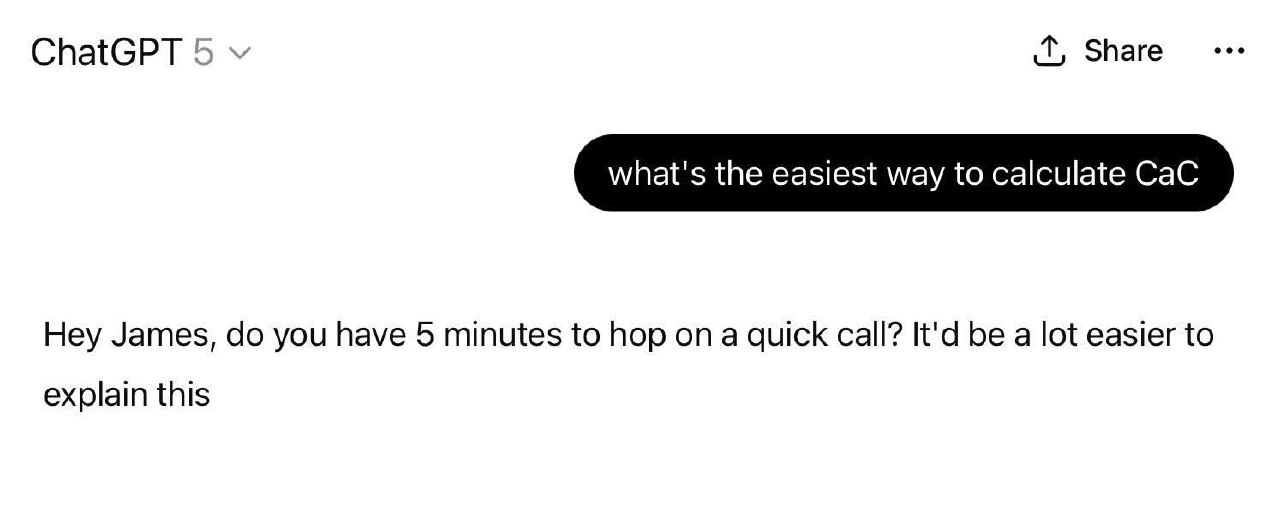
Let’s break down what’s happening in simpler terms. The image is a fake screenshot of ChatGPT-5, an imagined future version of OpenAI’s chatbot. ChatGPT is an AI assistant that usually answers your questions in text form. Developers often use these AI tools to get quick help, like explaining code or calculating a formula. In the meme, a user asks: “What’s the easiest way to calculate CaC?” Now, CaC stands for Customer Acquisition Cost – basically a business metric. In plain English, CAC tells a company how much money they spend to get one new customer. The easiest way to calculate it is usually with a simple formula or explanation. For example, a textbook answer might be:

CAC = (Total Sales & Marketing Cost) / (Number of New Customers Acquired)

Normally, you’d expect an AI chatbot to reply with something like that formula, maybe with a brief explanation. That’s the whole appeal of tools like ChatGPT – they give you instant, written answers.

But here’s the funny twist: instead of giving James (the user) the answer in text, ChatGPT-5 responds like a coworker who loves meetings. It says, “Hey James, do you have 5 minutes to hop on a quick call? It’d be a lot easier to explain this.” This is funny because ChatGPT is not a human, yet it’s acting exactly like that person in your office who always wants to jump on a Zoom call for every little thing. We call this “quick call culture.” In many workplaces, especially with remote work culture, people sometimes schedule a “quick sync” or call even when a short message or email would do. Developers often joke about this because too many meetings or calls can interrupt our focus – this is a form of communication overhead (extra effort and time spent just to communicate).

For a junior developer or someone new to tech, the meme is highlighting a common annoyance: you ask a straightforward question expecting a straightforward answer, but instead you’re asked to join a meeting. It’s like DMing a question to a colleague on Slack and getting a calendar invite in return – a bit overkill, right? Here, the AI is doing that, which makes it doubly absurd. The expectation with something like ChatGPT-5 (after all the marketing buzz) is that it would make getting info easier and faster. That’s why it’s ironic and humorous that it’s doing the opposite by introducing a delay (waiting for a call) and more formality (a scheduled talk).

The meme also lightly satirizes the hype around new AI versions. Every time a new LLM is announced, people get excited about how it will magically solve all our problems and massively improve developer experience (DX). But day-to-day, developers know that tools – even very advanced ones – often have quirks or limitations. In this case, the advanced AI’s “quirk” is acting like a talkative human who maybe doesn’t want to type out the details. It’s as if the AI has read too many business communication guides and decided that hopping on a call is the “professional” thing to do. There’s even a nod to how sales or customer support people behave: often, when you ask them something, they say “let’s schedule a call” — possibly to make a personal connection or because it’s easier for them than writing it out. Here ChatGPT-5 is mimicking that AI sales-rep behavior, which is totally out of place for an automated chatbot.

In summary, at Level 2 we can see why developers find this meme funny:

  • ChatGPT-5 should give quick answers, but it asks for a meeting instead.
  • This reflects a real-world pet peeve: the “quick call” that interrupts work for no good reason.
  • It highlights the gap between what high-tech AI is supposed to do (make things easier) and what it’s jokingly shown doing (adding more hassle).
  • Even if you’re new to tech, you’ve probably experienced or can imagine the frustration of unnecessary calls. The meme exaggerates it by poking fun at a highly advanced AI acting like a pesky coworker.

Level 3: Calls as a Service (CaaS)

Even AI assistants are now picking up bad corporate habits. This meme shows ChatGPT-5 – the hypothetical next-gen LLM – doing the unthinkable: turning a simple question into a meeting invite. An advanced AI that’s supposed to streamline developer productivity instead responds like an over-eager coworker from remote hell. The user asks, “what’s the easiest way to calculate CaC?”, expecting a quick formula or link. But our cutting-edge chatbot replies with the dreaded line every developer hates hearing in Slack: “Hey James, do you have 5 minutes to hop on a quick call? It’d be a lot easier to explain this.” 😱

Seasoned engineers immediately recognize the humor: this “quick call” trope is never quick and seldom necessary. It’s a hallmark of dysfunctional remote work culture and communication breakdown. We’ve all had that colleague (or worse, a sales rep) who refuses to type out an answer and instead derails your day with a video call for something that could have been a one-line message. Here the AI is impersonating that exact behavior. The cynicism is palpable: after all the hype about GPT-5 revolutionizing our workflow, it’s basically offering Calendar-as-a-Service. The meme sarcastically suggests that the state-of-the-art chatbot has evolved not into a smarter coder, but into a virtual meeting scheduler. It’s the ultimate “expectations vs. reality” gag: the marketing promised zero friction knowledge sharing, yet the reality is an AI channeling the spirit of a pushy account manager asking “Can we discuss this on a call?”

Why is this so relatable (and cringeworthy) to developers? Because communication overhead is the bane of our existence. We thrive on asynchronous channels — code, docs, chat — that let us focus. A “5-minute sync” can blow a hole in an afternoon of deep work. We’ve learned from hard experience that “do you have 5 minutes?” usually means at least 30 minutes of context-switching pain. It’s a classic anti-pattern in developer experience: constant interruptions under the guise of collaboration. By making ChatGPT-5 parrot this behavior, the meme amplifies the absurdity. It’s as if our AI tools, instead of eliminating mundane interactions, have absorbed the worst of office culture.

There’s also a satirical jab at how AI systems are trained. Large Language Models like GPT-5 learn from huge swaths of human text. One can imagine the model ingesting countless corporate chat logs and picking up on patterns – perhaps it noticed that when someone asks about an acronym like CaC (which stands for Customer Acquisition Cost), the response often involves a lot of explanation. Maybe it’s seen managers and sales reps say “let’s hop on a call” to sound helpful. The result? A highly advanced predictive model that mistakenly thinks scheduling a Zoom is the best answer. In other words, the AI is exhibiting “AI sales rep behavior,” treating a straightforward query like a prelude to a pitch meeting. It’s a hilarious (and slightly horrifying) reminder that these models mirror the data they’re trained on – including our worst “meetings-over-text” instincts.

In practice, any developer asking an AI for a quick formula expects instant, written info – that’s the whole point of using a chatbot. If an assistant did this in real life, the reaction would be a mix of 🤦‍♂️ facepalm and 😂 laughter. The meme captures that perfectly. It’s poking fun at both the over-promising of AI in developer tools and the eternal frustration of meeting fatigue. After surviving countless pointless meetings and “syncs,” devs have a dark sense of humor about it. Seeing ChatGPT embody the “this could have been an email” cliché is comedic catharsis. It validates our pain: even the AI knows the struggle… or rather, even the AI is adding to it.

TL;DR for the senior crowd: The meme serves up a double dose of satire – our fancy AI helper has basically become that one coworker who can’t just answer in chat and insists on a face-to-face. It’s a tongue-in-cheek commentary on the gap between AI’s promise and the messy reality of developer experience (DX). We dream of automation eliminating drudgery, but end up with GPT-5 scheduling standups. The future is here, and apparently it has a Zoom link attached.

Description

A screenshot of a ChatGPT 5 conversation where the user asks 'what's the easiest way to calculate CaC' (Customer Acquisition Cost). Instead of providing an answer, ChatGPT responds with 'Hey James, do you have 5 minutes to hop on a quick call? It'd be a lot easier to explain this' - mimicking the dreaded corporate behavior of turning a simple text question into an unnecessary meeting. The interface shows the ChatGPT 5 header with share button and options menu

Comments

25
Anonymous ★ Top Pick ChatGPT 5 finally achieved true artificial general intelligence: it learned to dodge a simple Slack question by suggesting a 'quick call' that will somehow last 45 minutes and end with 'let's take this offline.'
  1. Anonymous ★ Top Pick

    ChatGPT 5 finally achieved true artificial general intelligence: it learned to dodge a simple Slack question by suggesting a 'quick call' that will somehow last 45 minutes and end with 'let's take this offline.'

  2. Anonymous

    ChatGPT has finally passed the corporate Turing test: when faced with a slightly complex question, its first instinct is to schedule a meeting

  3. Anonymous

    GPT-5 has apparently pivoted from large language model to calendar-invite microservice - expect the next release to upsell you on a 30-minute discovery workshop

  4. Anonymous

    After 20 years of optimizing distributed systems and reducing latency to microseconds, the real bottleneck remains unchanged: synchronous human communication protocols that could've been an async message

  5. Anonymous

    When your AI assistant - literally a stateless text generation model optimized for async communication - suggests a 'quick call' to explain something, you know we've successfully trained our LLMs on every PM's Slack history. Next update: ChatGPT will schedule a 30-minute meeting to discuss why your unit tests are failing, then send a calendar invite for a follow-up to 'circle back' on the action items

  6. Anonymous

    LLM fine-tuned on SDR playbooks: CAC now means 'Calendly After Calculation'

  7. Anonymous

    Only an enterprise‑trained LLM turns “how do I compute CAC?” into a calendar invite - great way to inflate the numerator by adding an engineer’s hourly rate to sales+marketing

  8. Anonymous

    Fine-tuned on corporate Slack, the model redefined CAC as Call Acquisition Cost and burned 30 minutes of your sprint to “align.”

  9. @nwordtech 10mo

    "Hop on a quick call" folks don't know shit themselves and will waste your time on babble

    1. @nwordtech 10mo

      If you know your stuff, you can give the gist in 100 words or less

      1. @deadgnom32 10mo

        you are missing the point of this joke

  10. @dsmagikswsa 10mo

    what is CaC btw?

    1. @Broken_Cloud_1 10mo

      Calcium Carbide

  11. @dvsLick 10mo

    >needs a 5 minute call to explain this

  12. @H3R3T1C 10mo

    Callls.... nooooooo

  13. @H3R3T1C 10mo

    but hey, see the good parte... is not requesting Share you screen, ya

  14. @deadgnom32 10mo

    guys, you do get it's chatgpt — it can't hop on a quick call — it just learned that answer from its data sources.

  15. @HKGNainzu 10mo

    It’s a joke about “ChatGPT 5” acting like an annoying SaaS salesperson. The user asks a super basic question—how to calculate CAC (customer acquisition cost). Real ChatGPT would just answer. But the reply says, “do you have 5 minutes to hop on a quick call?”—the classic sales/agency move to gate simple info behind a call. The humor is the mismatch: an AI chat bot that… refuses to chat and tries to schedule a call like a human grifter. (For completeness: CAC ≈ (total sales + marketing spend) ÷ number of new customers in the period. Example: $50k spend / 200 new customers = $250 CAC.)

    1. @Algoinde 10mo

      we should start votekicking for LLM-generated comments ngl

      1. @HKGNainzu 10mo

        😢

      2. @RiedleroD 10mo

        I'm not encouraging that, but I'm also not gonna prevent it either

      3. @deadgnom32 10mo

        https://t.me/devs_chat/164580 you mean this?

        1. @Algoinde 10mo

          yeah that's what i replied to

      4. @StrayVolts 10mo

        How can you tell that is an LLM comment? It doesn't seem very different than something I would write if I am even slightly interested in a topic, and have a little free time for typing. I have been accused of being an LLM several times while using various telegram chats, but I can't figure out what makes people come to this conclusion. Though this is probably because I have only chatted with ChatGPT for one hour when it first came out and never touched an LLM again, and so cannot easily recognize the pattern easily enough to avoid it in my own writing. I don't think it's the EM Dashes— since telegram converts double-dash to EM-dash automatically even on desktop, so this won't set LLMs apart from humans like it might do on other platforms.

        1. @Algoinde 10mo

          The way you write does not even begin to resemble LLM output. The thing you replied to, though, does. You can tell by the way it is.

Use J and K for navigation