CERN's Compassionate Care for Retired Computer Mice
Why is this TechHistory meme funny?
Level 1: Mice on the Farm
Imagine you have a bunch of old computer clickers that people call “mice.” This joke pretends those computer mice are like real little mice living on a farm. They put the old computer accessories in straw, give them a tiny food bowl, a water dish, and even a little house – just like you would for real pets. It looks like these plastic mice are eating, drinking, playing, and cuddling together. It’s funny because we know they’re not alive, but they’re being treated as if they are cute animals. There’s even a real cat that comes by, and normally cats chase mice – so we pretend the computer mice are scared and “panicking” even though they’re just objects. The whole thing is like playing make-believe: imagine telling a story to a kid that all your old gadgets have feelings and live happily in a special place. People laugh because it’s a silly mix-up: we don’t usually think of our devices as pets. It also feels a bit sweet – like saying “don’t worry, our old trusty computer friends are safe and happy on a nice farm now.” It’s the same kind of chuckle you get when someone gives a goofy send-off to something old they loved. In short, the meme is funny because it treats old computer stuff with the warmth and care we’d normally give a fluffy little animal, and that playful pretending can make anyone smile.
Level 2: When Computers Had Tails
This meme might seem bizarre at first: it shows computer mice (the handheld pointing devices for PCs) being treated like real mice in an animal shelter. The whole poster is styled like a notice for a pet shelter, but instead of furry animals, they’ve put old computer hardware on display. The title “CERN Animal Shelter for Computer Mice” is a big clue to the joke. CERN is a famous science institute in Switzerland known for the Large Hadron Collider and lots of advanced tech, not for running a pet shelter! By using the word “mice” in a playful way, the meme mixes up two ideas: computer peripherals and little rodent animals.
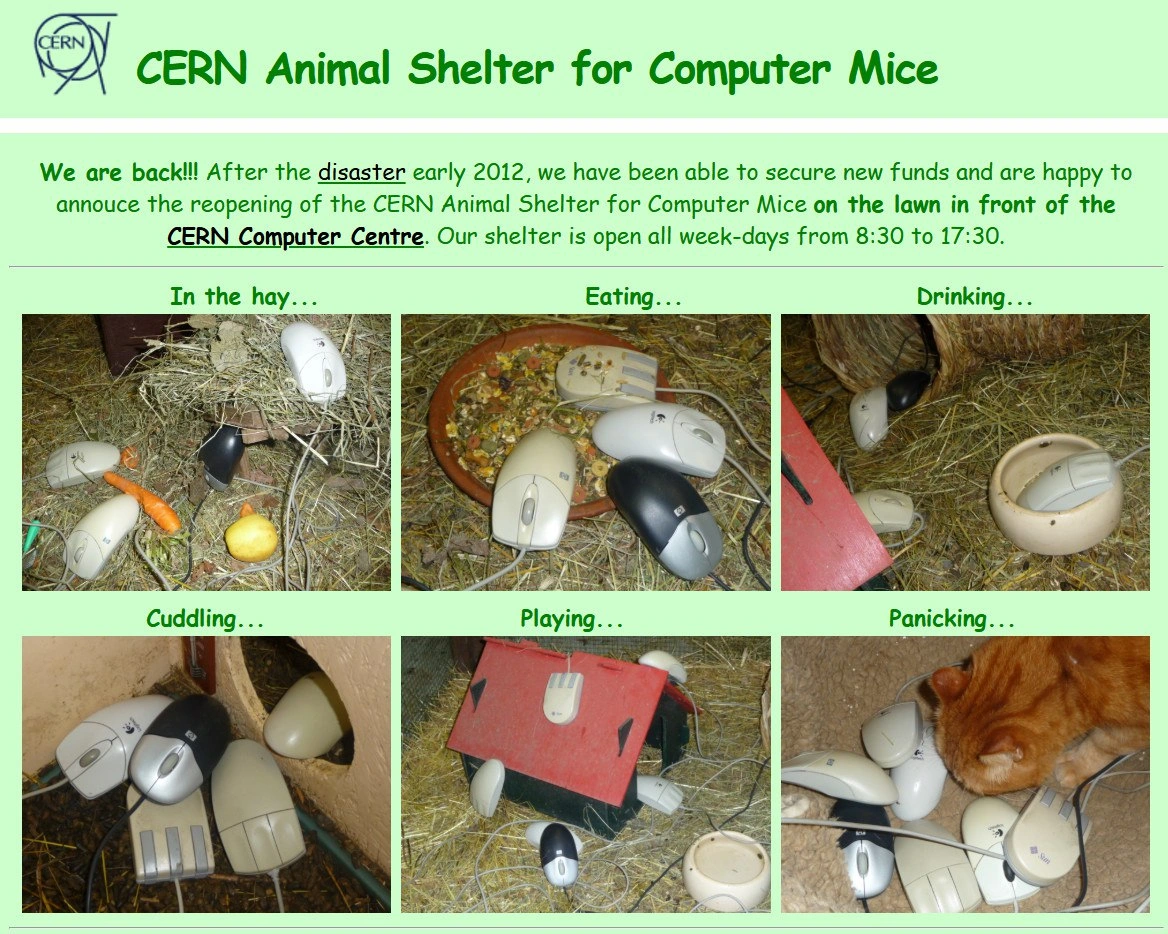
Each section of the poster has a caption and a photo, just like an adoption brochure showing pets. Only here, the “pets” are those beige PS/2 ball mice from the 1990s (back before sleek optical and wireless mice took over). These old mice have a rubber ball inside that detects movement – a very old-school design by today’s standards. In the images, several of these mice devices are placed on real straw and props as if they are alive. For example, one picture captioned “Eating…” has the mice gathered around a dish filled with what looks like grains or maybe electronic bits pretending to be food. Another, “Drinking…”, shows them next to a little water bowl (even though, of course, a real computer mouse would short-circuit if it got wet – that’s part of the silliness!). There’s “Cuddling…” where a few mice are snugly piled inside a tiny house structure, as if they’re baby animals in a shelter sleeping together. “Playing…” shows them around a small red house (almost like a dollhouse or a pet shelter house) as if they’re romping in a pen. And the funniest might be “Panicking…”, where a real ginger cat is sniffing at the cluster of computer mice. In nature, cats chase mice, so the computer mice are “panicking” – it’s a pretend scenario, but we can imagine if they were alive, they’d be scared of that cat! This visual pun is super literal: computer mice meet a real cat. It’s like a cartoon come to life on a photographer’s set.
Now, why CERN and why an animal shelter theme? This is where tech history and inside jokes come in. CERN’s computer department likely had tons of these old mice lying around from the days before USB and wireless. By 2012 or 2024, such mice were pretty much legacy tech – no one at a high-tech lab really uses a mouse with a ball and PS/2 plug anymore. However, instead of just throwing them away, someone had the clever idea to frame it like the mice are “retiring” and need a home. It’s a pun on the common phrase people use when an old pet or an old piece of farm stock is sent away – “sent to a farm” – implying it’ll live out its days happily. Here, the farm or shelter is literally on the lawn in front of the CERN Computer Centre (as the poster text says). That textual detail makes it extra funny: picturing a little petting zoo of outdated computer parts set up outside a serious research facility is a goofy contrast. The mention “After the disaster early 2012, we have been able to secure new funds” adds a mock storyline: apparently, they tried this joke before in 2012 and maybe something chaotic happened (we don’t know what – that’s part of the humor, imagining how an “animal shelter” for devices could go wrong). By saying they got “new funds,” it parodies how official projects talk. Of course, no real money is needed to gather some old mice and straw, which makes it absurd and funny. It’s basically geeks role-playing that caring for obsolete gadgets is a funded project!
For a junior developer or someone new to tech, some terms here might be unfamiliar. Ball mouse refers to the old type of computer mouse that has a heavy ball inside for tracking movement. Before optical sensors (the red light under modern mice) were invented, this was how mice worked: you roll the mouse on a pad, the ball turns, and internal sensors translate that to pointer movement on screen. These ball mice often needed cleaning because dust would make the ball slip – a very common maintenance task in the past. PS/2 is the round plug these mice used to connect to the computer (named after the IBM Personal System/2 line). It was the standard mouse and keyboard port before USB became universal. So a legacy hardware or legacy system is just a nice way to say “old technology that is still around or remembered.” In the meme, all the devices are visibly beige and wired, which is a giveaway of their age (today most peripherals are black/silver and often wireless or USB). The Comic Sans-style font in green is also a cheeky detail – Comic Sans is a font often joked about for being childish or unprofessional, so using it here signals that this is not a serious poster; it’s meant to be humorous and playful.
The heart of the joke is pretty accessible: it’s personifying inanimate objects. We call them “mice,” so let’s treat them literally like mice. It’s the same kind of laugh you get from those scenes in cartoons where a robot wants to be a real boy, or someone treats their car like a pet. There’s also an element of shared experience for folks in tech: many of us have a drawer of old gadgets (like a beloved old mouse or keyboard) that we can’t quite throw out. Seeing CERN make a faux shelter for them is like saying, “It’s okay, we love our old devices too; they deserve a happy retirement.” It’s both sweet and silly.
Level 3: Peripheral Pastures
In this witty hardware humor piece, the meme transforms old computer mice into literal barnyard “animals.” It’s set at CERN, the famous physics lab, which makes the contrast even juicier: a hub of cutting-edge computing poking fun at legacy hardware. The title "CERN Animal Shelter for Computer Mice" plays on the double meaning of mouse (the device vs. the rodent) and imagines a retirement home for these once-indispensable peripherals. The poster’s design mimics an official announcement, complete with the CERN logo and a cheerful mint-green border, but the content is pure tongue-in-cheek nostalgia. The text proclaims “We are back!!! After the disaster early 2012, we have secured new funds...” – an absurdly formal update for such a silly concept. This mock-serious tone is a classic sysadmin prank style: treating a joke as if it’s a critical project proposal. It implies there was a previous “shelter” in 2012 that ended in disaster (perhaps an impish suggestion that the last batch of computer mice panicked and escaped, or a cat literally got into the server room!). By creating a fictional history and funding narrative, the meme satirizes how even the most trivial tech projects often get wrapped in grandiose language.
Each photo panel in the meme shows beige 1990s-era ball mice staged in a straw-filled enclosure, parodying snapshots from a real animal shelter or petting zoo. The captions like “In the hay…”, “Eating…”, “Drinking…”, “Cuddling…”, “Playing…”, and “Panicking…” anthropomorphize these devices. For instance, “In the hay…” shows the mice half-buried in hay as if nesting, their long cords trailing like tails (back when computers had literal tails attached!). “Eating…” depicts several mice gathered around a bowl of motherboard screws and cable bits (standing in for kibble or veggies), a clever nod to the idea that old hardware might “feed” on spare parts. “Drinking…” has mice next to a water dish – an amusingly futile image since, of course, electronics and water don’t mix (one might chuckle that these mice risk shorting out if they actually tried to drink). The “Cuddling…” panel shows a snug little hardware house (perhaps made from a PC case or cardboard) with mice devices huddled together, lampooning how we sometimes sentimentally hoard our old gadgets in a cozy corner. In “Playing…”, mice are arranged around a tiny toy house or barn, as if frolicking like young pups – highlighting just how adorably obsolete they are. And finally, “Panicking…” brings in a live ginger cat sniffing at the cluster of mice: the classic predator meets prey scenario. A real cat would chase a real mouse, so the sight of a confused cat finding only plastic shells is tech irony at its finest. The mice are “panicking” in caption only – a silent film comedy moment for anyone who’s ever watched a cat toy with a USB cable or bat at a dangling mouse cord.
From an experienced developer’s perspective, this meme hits a nostalgic nerve. These legacy hardware mice (mostly old Logitech and Microsoft models by the looks of them) were once the pride of every office desktop. Many of us recall popping out the trackball and cleaning the gunk off the rollers with isopropyl alcohol to get our cursor moving smoothly – a ritual of 90s tech life that modern optical mice (with their red LEDs or laser sensors) have eliminated. The meme gently ribs the fact that such hardware, once mission-critical for GUI navigation, is now a museum piece. At a place like CERN, which has been at the forefront of computing (Tim Berners-Lee invented the World Wide Web there, after all), these old PS/2 ball mice truly are dinosaurs roaming a high-tech Jurassic Park. The TechHistory angle is strong: the beige color and PS/2 connectors evoke an era when PCs had IRQ conflicts and no plug-and-play – you couldn’t even hot-swap a PS/2 mouse without rebooting the machine (imagine a “shelter” full of devices that literally froze your system if unplugged unexpectedly!). The meme taps into that collective memory and laughs at how far we’ve come. It’s a hardware zoo: a whimsical reminder that even cold, obsolete gadgets can inspire warmth and laughter.
Beyond the chuckles, there’s an underlying commentary on LegacySystems in big institutions. CERN, like many organizations, likely has storerooms (or lawns!) full of retired equipment: old terminals, tape drives, and yes, boxes of old mice and keyboards. The “animal shelter” gag could be seen as a playful jab at how we treat aging tech. Instead of just scrapping it, here the hardware is afforded dignity and care, as if entering a comfy retirement rather than a landfill. It’s a sentiment any senior engineer with crates of old parts in the garage can relate to – that irrational affection for the tools that once helped us build the digital world. We joke that these devices have personalities: that one mouse that always stuck on the Y-axis, or the keyboard missing an “N” key that somehow became your favorite. By casting them as animals in need of adoption, the meme hyperbolizes this sentimental attachment. It’s also a punny reminder that “computer mice” share their name with real mice, and here the English language joke becomes visually literal. The shared experience being satirized is how tech workers often have to “retire” old gear. We’ve all heard or told the joke, “Don’t worry, your beloved old PC went to a farm upstate where it has lots of room to run.” Here, that cliché is given form on CERN’s lawn. The addition of a cat (perhaps a nod to Schrödinger’s cat, given the physics setting?) chasing the mice is the cherry on top – blending geeky inside jokes with universal slapstick.
Overall, why is it so funny? It’s the absurdity of world-class computer engineers and physicists essentially running a petting zoo for computer parts. The meme stands at the intersection of TechIndustryHumor and pure silliness: even the uber-serious world of particle accelerators and large data centers has room for dad-joke-level puns. The humor also lies in the impeccable execution: the use of Comic Sans-esque font in bright green (the quintessential “bad flyer” look from the 90s) and the deliberately low-tech staging of the photos give the whole thing a retro authenticity. It feels like something a bored IT staffer actually put on the company bulletin board for April Fool’s. For seasoned tech folks, it’s a laugh at our own expense – a gentle roast of how attached we get to hardware that objectively should be e-waste by now. And for anyone who’s ever chased a cursor with a sluggish ball mouse or untangled a nest of PS/2 cords, this meme is a comforting reminder that we’re not alone in treating our wired peripherals with a bit of human affection, even as we usher them out the door.
Description
A whimsical, webpage-style image advertising the 'CERN Animal Shelter for Computer Mice,' complete with the official CERN logo. The text announces the shelter's reopening after a 'disaster early 2012' and provides its location and hours. Below this, a six-panel photo series illustrates the lives of the inhabitants: old, beige, and black wired computer mice (the kind with scroll wheels and balls). The panels are captioned 'In the hay...', 'Eating...', 'Drinking...', 'Cuddling...', 'Playing...', and finally, 'Panicking...'. The first five panels show the mice in various charming, animal-like scenarios within a hay-filled environment. The final 'Panicking...' panel hilariously breaks the calm by showing a large orange tabby cat sniffing the pile of terrified computer mice. The humor is multi-layered: it's a direct pun on 'computer mice,' a nostalgic nod to obsolete hardware that senior tech professionals grew up with, and an ironic parody of a high-tech institution like CERN engaging in such a folksy, low-tech endeavor. It's a classic piece of nerdy, insider tech humor

Comments
7Comment deleted
Of course CERN runs this. They have to do something with all the hardware that becomes obsolete every time they upgrade the LHC's data pipeline. The cat is just their automated legacy hardware disposal system
Those PS/2 rodents get straw beds and visiting hours - meanwhile our decade-old prod microservice still sleeps on a RAID array floor
CERN finally found a use case for all those PS/2 mice after discovering the Higgs boson - turns out particle physics was easier than getting legacy hardware adopted
After years of dealing with memory leaks, race conditions, and pointer arithmetic, CERN finally addressed the real issue: what happens to computer mice when they reach end-of-life. Turns out the solution wasn't garbage collection or reference counting - it was literally hay, water bowls, and protection from predators. Though one wonders if they've considered the ethical implications of keeping PS/2 and USB mice in the same enclosure, or whether the adoption process requires proof of compatible drivers
Remember pets vs cattle? CERN went full pets - every PS/2 mouse gets LTS and visiting hours, because somewhere a KVM still only boots with that exact HID driver
CERN's HA solution for mice: high-availability haystacks with zero-downtime cuddling after collider-induced pointer drift
Finally, a place where legacy peripherals are treated like pets, not cattle - until the ops cat shows up and you remember PS/2 doesn’t support graceful failover