Skip to content
DevMeme
4354 of 7435
Image not processed
Post #4759, on Aug 10, 2022 in TG

Image not processed

Why is this developer meme funny?

Level 1: Fast Car, Slow Driver

Imagine two friends are going to race each other. One friend has a really fast sports car and boasts, “My car is way faster than yours, so I’ll win for sure!” The other friend has a normal car and smiles, asking, “But can you drive your sports car faster than I can drive my car?” In the race, it turns out the friend with the normal car is an excellent driver and the friend with the sports car isn’t used to all that power. The skilled driver in the ordinary car takes the turns smoothly and ends up winning the race, while the inexperienced driver in the super-fast car doesn’t use the car’s potential and falls behind. The boastful friend is left surprised and upset that his “faster” car didn’t guarantee a win.

This meme is just like that story, but with programming languages. The grey character thought using a fast tool (the C language — like the sports car) would automatically make his program run fast. The white character basically asks him, “Are you sure you can actually make it go that fast in practice?” It’s funny because it reminds us of a simple truth: having the best tool doesn’t help if you don’t use it well. A slower tool used skillfully can beat a faster tool used poorly. The grey guy boasted about his fast car (C), and the white guy’s question made him realize maybe he isn’t driving it as well as he thought. That little “gotcha!” moment — when bragging meets reality — is what makes the joke work, and it’s something even non-programmers can understand.

Level 2: Fast Language, Slow Code

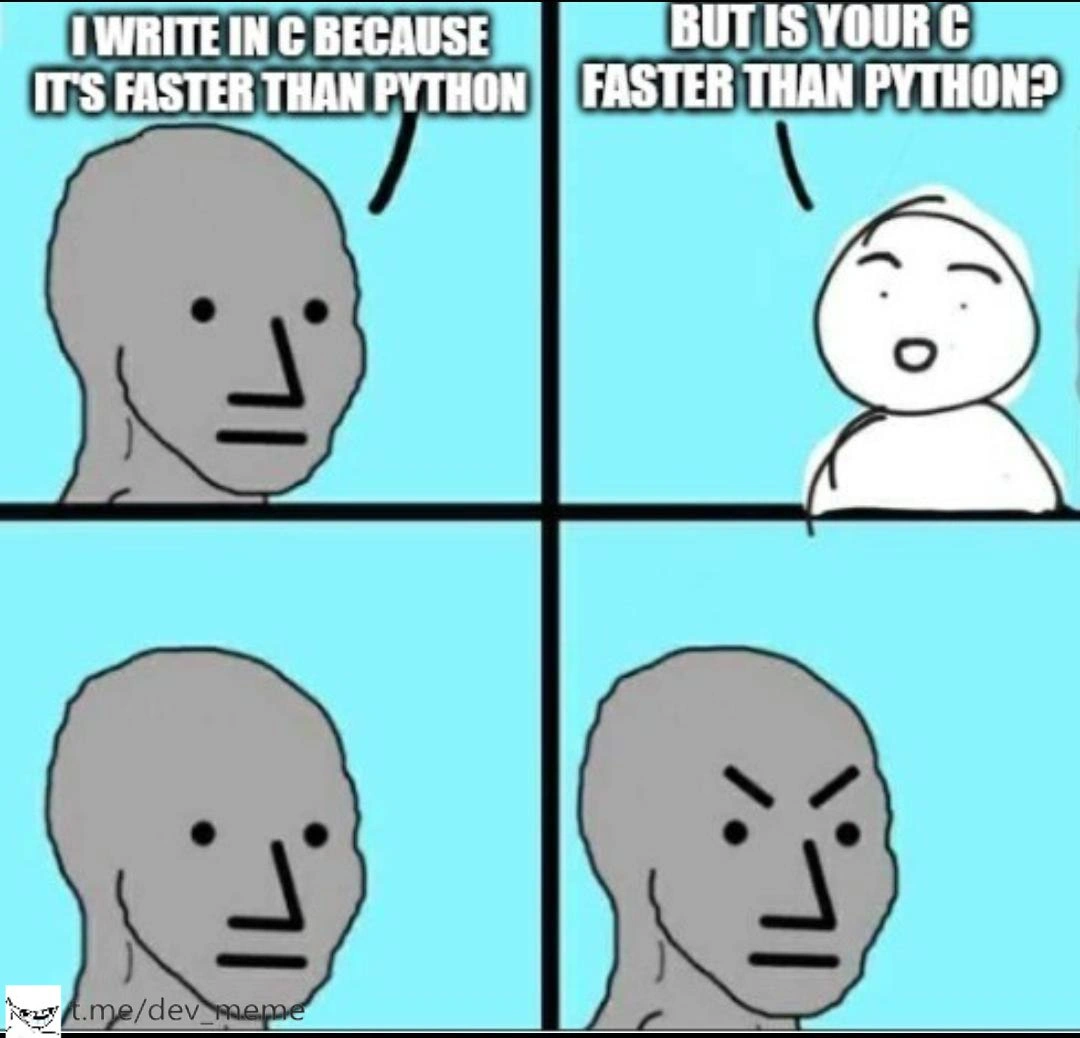
Let’s break down the joke in simple terms. In the meme, the grey character (drawn in the NPC meme style) confidently says: “I write in C because it’s faster than Python.” He’s basically bragging, “I use C since programs written in C run faster than programs written in Python.” The white cartoon character next to him responds: “But is your C faster than Python?” (with an emphasis on "your"). In plainer words, the white character is asking, “Okay, C is faster in general, but is the C code you wrote actually faster than if you wrote it in Python?”

After that question, the grey NPC is speechless (the third panel is just him staring blankly) and then he looks annoyed in the fourth panel. This silent reaction implies that the grey character didn’t have an answer – it hadn’t occurred to him that his own C code might not be faster. He assumed it would be, and now he’s caught off guard and a bit angry about it. The comic is highlighting the difference between saying “C is fast as a language” and the reality of “did I, the programmer, really make my program fast?”

Now, why would someone say "C is faster than Python" in the first place? This comes from how these languages work. C is a compiled language. That means when you write C code and build your program, a compiler translates all of your code into machine-level instructions ahead of time. When you run the program, those instructions execute directly on the computer’s processor. There’s no translator in between at runtime. This makes C code very efficient in execution. Python, on the other hand, is usually interpreted. When you run a Python program, there’s an interpreter that reads your Python code and performs the instructions on the fly, line by line. Python is also dynamically typed and does a lot of stuff behind the scenes (like managing memory for you, figuring out data types at runtime, etc.). All that convenience adds extra work for the computer to do while the program runs. So, generally speaking, a given task (especially heavy computation or loops) might take, say, 5x or 10x longer in pure Python than in C. That’s why the grey character is confidently saying "C is faster than Python" — it’s a well-known fact that, in general, C programs have the potential to run much faster than Python programs for the same work. This is a classic topic in language comparison discussions.

The twist here is the white character’s reply: “But is your C faster than Python?” This question zeros in on the implementation rather than the language reputation. It’s basically asking: Have you written your C code well enough to actually beat a Python version? See, writing something in a fast language like C doesn’t guarantee your program will be fast. How you write the code matters a lot. There’s a saying in programming: “premature optimization is the root of all evil.” In simple terms, it warns not to assume something will be faster or better without evidence – you should first write it clearly, then optimize the parts that need it. The grey NPC might be doing exactly that – prematurely focusing on speed by choosing C – and the white character is calling him out: maybe he optimized in the wrong place or too early.

Let’s use a concrete example to illustrate this: imagine you need to sort a list of 100,000 numbers. In Python, you could simply do sorted(my_list) and it will sort very quickly because Python’s built-in sort is highly optimized (it’s implemented in C under the hood and uses a fast algorithm called Timsort). Now, if a programmer using C writes their own sorting function but they choose a poor sorting method (let’s say they implement a basic bubble sort with two nested loops, which is an inefficient algorithm), that C program will actually run slower than Python’s built-in sort! In this scenario, Python wins despite C being “faster” generally, because the Python built-in is using better code. In short, a smartly written Python solution beat a carelessly written C solution.

That’s exactly what the meme is poking fun at. The white character basically asks, “Are you sure your C code is actually faster than what Python could do?” The grey NPC’s stunned look is the realization that, uh oh, maybe it isn’t! It’s a moment of doubt: perhaps his C program isn’t optimized at all. The angry frown that follows is him being upset that his boast backfired. It’s like he’s thinking, “How dare you suggest my C code might be slow... wait, is it actually slow?!” This is funny to developers because we’ve all seen scenarios where someone assumes their code is great just because of the tools they used, and then reality proves otherwise.

Now, let’s clarify a couple of terms that are relevant here. A benchmark is a test or experiment to measure performance – for example, timing how long a piece of code takes to run, or how many operations it can do per second. When the meme mentions "bad benchmarks," it’s referring to poorly designed or misleading performance tests. A bad benchmark might be something like testing the speed of two languages with a trivial task that isn’t representative of real work, or not accounting for things like startup time, or using different optimization settings. In developer conversations, people sometimes show microbenchmarks (very small targeted benchmarks) to claim one language is faster. But if those microbenchmarks are not realistic, they can give a false impression. This meme implies that the grey NPC might have been convinced by some simplistic tests (or no tests at all) that “C is always faster,” without actually benchmarking his own program properly. The white character’s question effectively says, “Did you really test it? Is your result in C actually outperforming Python in practice? Show me, otherwise it’s just talk.” In many cases, when someone actually does a proper benchmark on their specific situation, they might find their assumption was wrong.

Another term mentioned is premature optimization. This is a concept in programming which means trying to make your code super efficient before it's clear that you need to, or doing it too early in development. It’s considered a bad practice because you might spend a lot of time optimizing parts of the code that aren’t even the real problem, or you might make the code more complex for negligible gains. In our context, the grey NPC choosing C “because it’s faster” could be an act of premature optimization. He defaulted to a complex language for the sake of speed without first writing a clear solution and identifying if Python was truly too slow for that task. Often, the advice is: write it in the easiest/most clear way (maybe in Python), make sure it works, profile it to see where the slow part is, and if there is a real bottleneck that Python can’t handle, then consider rewriting that part in C or using optimizations. The meme basically wraps this whole advice into a one-liner joke.

In simpler terms, the lesson from the meme is: just because a tool can be faster doesn’t mean you’ll automatically get that benefit. You have to know what you’re doing. The grey character brought a sports car (C) expecting to win by default, and the white character is asking if he knows how to drive it effectively (otherwise, a regular car — Python — might overtake him). It’s a funny reality check. In developer communities, this resonates because we often see passionate arguments about which language is faster or better (those are the famed language wars). This meme is like a witty little commentary on those arguments, reminding everyone that the devil is in the details. At the end of the day, you have to measure and make sure your fancy choice is actually delivering results. The grey NPC learned (the hard way) that theory doesn’t always match practice, and that’s why we find it so amusing.

Level 3: Big O vs Big Ego

This four-panel comic is instantly familiar to any seasoned programmer who’s witnessed (or waded into) language wars over performance. The grey NPC character bluntly states, “I write in C because it’s faster than Python.” He’s parroting a common boast: that choosing a low-level, C family language like C automatically guarantees superior speed. The white Wojak-style figure’s sly response, “But is your C faster than Python?”, is a mic-drop retort. It’s the kind of comeback an experienced colleague might deliver in a performance review or an online forum: a single question that flips the boast on its head. Essentially, the white character asks, “Sure, C is fast in theory, but have you actually made your code faster than an equivalent Python version?” The grey NPC’s stunned silence in panel 3 and his annoyed scowl in panel 4 say it all — he didn’t see that coming, and now he’s a mix of embarrassed and irritated.

For veteran developers, this scenario elicits a knowing chuckle because we’ve seen it play out in real life. There’s always someone proudly claiming their language of choice will obliterate others in speed. And indeed, C can produce extremely fast programs. But experienced devs know to ask the next question: “Have you benchmarked it?” The humor here is exactly that reality check. It’s akin to a senior engineer responding to a newbie’s brag with, “Okay, you think C is faster, but did you profile your code and compare it to Python?” Often, the boastful person hasn’t actually measured anything – just like the blank-faced NPC in panel 3 who has no data to back his claim. The comic brilliantly compresses an entire code review or forum debate into that one pointed question.

The exchange highlights the clash between big ego and Big O (complexity). The grey NPC’s confidence stems from ego – the pride of using a “fast” language – but he’s forgetting the nitty-gritty of Big O and good coding. This is a gentle poke at premature optimization and misplaced focus. The NPC was so sure about C's speed advantage that he likely skipped asking, “Am I implementing this efficiently? Could Python, with the right approach, handle this task just as fast?” The white character essentially issues a reality check (we might even call it a premature optimization warning in joke form). It’s saying, “You optimized the wrong thing, my friend – you worried about the language but not about how well you actually solved the problem.”

The humor also draws on very real developer experiences. Picture a scenario from a team’s history: a developer spends a week rewriting a slow Python data-processing script in C for speed. In theory, it should be a big win. But if they choose a suboptimal method in C (say, reading files byte by byte, or using a slow algorithm), the result might only be a minor improvement – or embarrassingly, it could even run slower than the original Python version that used some optimized library calls. Meanwhile, another team member might point out, “Hey, we could have just used Python’s built-in sorting and some numpy calls and gotten a huge speedup without rewriting everything.” The harsh reality is that writing truly high-performance C code is a skill that takes experience. It’s easy to write C that works but isn’t maximally efficient. This meme nails that lesson. It essentially shows a developer falling into a classic trap: assuming a faster language will paper over inefficiencies in the code. As many of us have learned, a language’s potential speed doesn’t automatically translate into a faster program — not unless you know how to leverage that potential.

We also recognize in this meme the shadow of countless online microbenchmark debates. One person will post a tiny benchmark that “proves” language X is faster than language Y, and then others will chime in pointing out flaws in the test or how it doesn’t reflect real-world usage. The white character’s question, “But is your C faster?”, is exactly the kind of response a seasoned engineer would have: show me the real stats. In other words, prove that your C code outperforms, say, Python using a proper, fair test. It calls out the tendency to make sweeping claims without evidence. The grey NPC’s change of expression – from blank to angry – is so relatable. It’s the look of a developer who just had their confident assumption dismantled by a simple question. It’s a mix of “I have no answer for that” and “How dare you question my claim”. We’ve all been there in some form, which is why it’s relatable humor. Maybe you were the one bragging about a tech stack and got humbled, or you were the one asking the awkward question that burst a myth.

The choice of the NPC meme format here is spot-on. The grey NPC is meant to represent a one-dimensional viewpoint (a dev just repeating “C is faster” like an automated script), and the smiling white Wojak represents the voice of practical wisdom or skepticism that cuts through that one-liner. Developer culture loves these memetic formats because they capture complex interpersonal moments in a simple, familiar image. This particular meme resonates because it’s basically a comic-strip version of a code review or forum argument. The takeaway for a seasoned dev is crystal clear (and oddly satisfying): don’t claim performance superiority without data. The humor has an underlying nod of approval from senior engineers — we love seeing an unverified claim meet the cold hard truth. In essence, this meme is a playful reminder that in programming, you put up (real metrics) or you shut up. The fastest way to deflate overconfidence is often just to ask, “Did you actually test that assumption?” Here, that question landed, and the ego-boosting balloon popped, much to the amusement of anyone who's been through the wars of tech one-upmanship.

Level 4: Microbenchmark Mirage

In theory, C enjoys a reputation for raw speed: it's a low-level, compiled language that runs directly on the CPU without an interpreter, often delivering operations with minimal overhead. Meanwhile, Python is a high-level interpreted language (executing via a virtual machine) with dynamic typing, which adds significant runtime overhead. On paper, a loop or algorithm written in C should indeed run much faster than the same logic in Python. Language comparisons in terms of speed often start here: at a purely technical level, C can perform primitive operations in a fraction of the time Python requires.

However, the meme’s punchline reveals a deeper performance trade-off reality: theoretical speed means nothing if the specific code isn't optimized. In practice, a poorly written C program can run slower than a well-written Python program. Why? Because raw language speed can be nullified by factors like algorithmic complexity, inefficient use of hardware, or just bad coding practices. For instance, if our C programmer uses an $\mathcal{O}(n^2)$ algorithm (say, a naive double nested loop) while a Python user calls an $\mathcal{O}(n \log n)$ routine (perhaps using Python’s highly optimized built-in sort or search), the Python code can actually finish first for large enough n. In other words, a clever approach in Python can outrun a brute-force approach in C. The Big O (complexity) of your code often matters more than the language's raw speed. It’s like a classic tortoise-and-hare scenario in computing: the “faster” language (hare) can lose if it’s running a much less efficient race.

Another deep factor lies in how code interacts with hardware. C gives developers fine-grained control over memory and data structures, but with great power comes great responsibility. If the C code isn't written with cache locality in mind or if it triggers lots of branch mispredictions (e.g. unpredictable if conditions inside a tight loop), it can suffer CPU pipeline stalls and constant cache misses. These hardware-level inefficiencies slow things down drastically. Meanwhile, a high-level approach in Python might indirectly use optimized native code that handles data in bulk. For example, if the Python code uses a library function (like a sorting routine or a NumPy array operation), that work is executed in a contiguous, highly optimized way down at the C/C++ level. This means fewer cache misses and the ability to use SIMD vectorization or even parallel instructions. In short, a naive C loop might end up slower than a Python call that internally exploits low-level optimizations. The supposed “faster” language can lose if it doesn't utilize the CPU effectively.

Bad benchmarks are another culprit in this story. It's all too easy to write misleading microbenchmarks. For instance, a trivial test might show C performing a million simple arithmetic operations faster than Python by a wide margin. But such a micro-scale test can be a mirage – it isolates one tiny aspect and doesn’t reflect full application performance. Real software isn’t just a tight loop of math; there are function calls, I/O waits, memory allocations, and interactions with the OS. If our proud C programmer measured the wrong thing or tested in unrealistic conditions (e.g. compiling without optimizations enabled, or not accounting for Python’s startup time in a short run), they might draw false conclusions about being “faster.” It’s a common pitfall in microbenchmark debates: focusing on narrow scenarios and ignoring the bigger picture. We’ve seen cases where someone rewrote a Python snippet in C expecting a 10x speed boost, only to get little improvement (or even a slowdown) because the true bottleneck wasn’t the language’s loop speed at all.

One of Python’s secret weapons is that it can be both slow and fast at the same time — slow at pure Python loops, but fast when it hands work off to lower-level libraries. Many of Python’s built-in operations and libraries (like sort, regular expressions, or especially scientific libraries like NumPy) are implemented in C or C++ under the hood. When a Python developer uses these, they're effectively running highly optimized C code that has been tuned by experts. That means a Python one-liner can invoke, say, a matrix multiplication or sorting algorithm that’s been optimized within an inch of its life in compiled code. If our C coder manually reimplements the same functionality in a quick-and-dirty way, they might not come close to that level of efficiency. It’s quite possible for Python (by outsourcing heavy lifting to optimized native code) to beat a hand-written C program at the same task. In essence, the Python user is standing on the shoulders of giants — reusing battle-tested, high-performance routines — whereas the NPC’s own C code might be reinventing a slower wheel.

Summing up the deep dive: performance isn’t just about language choice, it’s about how you engineer the solution. This scenario is a textbook case of premature optimization. The grey NPC assumed using C would automatically make things fast, skipping the crucial steps of profiling and sound engineering. Donald Knuth famously said “premature optimization is the root of all evil,” cautioning developers not to micro-optimize or pick a technology for speed without evidence. The meme humorously echoes that wisdom. The question “But is your C faster than Python?” brings us back to empirical reality: you have to prove it with real benchmarks, not just assume it. The blank stare then angry frown in the last panels perfectly portray that humbling moment when a developer’s assumption runs into cold, hard data. It’s a reminder that you cannot rely on a language’s reputation alone – you need good algorithms, effective use of system resources, and actual measurements. In the end, the meme delivers a slice of truth: a fast language doesn’t guarantee a fast program, because it’s how you use the language that determines speed.

Description

This image could not be processed due to an error

Comments

7
Anonymous ★ Top Pick I'd make a joke about this image, but I can't see it. Maybe it's a 404 error?
  1. Anonymous ★ Top Pick

    I'd make a joke about this image, but I can't see it. Maybe it's a 404 error?

  2. Anonymous

    “C is faster” - until your hand-rolled O(n²) linked-list shuffle compiled without -O2 gets lapped by the data scientist’s one-liner `numpy.dot` that’s really just marching BLAS in Fortran boots

  3. Anonymous

    Nothing says "I understand performance" quite like spending three weeks implementing a custom hash table that's 10% slower than Python's dict, which is written in C by people who actually know what they're doing

  4. Anonymous

    The real performance bottleneck isn't the language - it's the O(n²) algorithm you wrote because you skipped the data structures course. Sure, C gives you raw speed, but when your 'optimized' C code is doing nested loops while Python's NumPy is calling BLAS routines written in Fortran, suddenly that malloc() isn't looking so fast. As the saying goes: premature optimization is the root of all evil, but premature language selection is the root of all arguments

  5. Anonymous

    “C is faster than Python” - sure, until your C is a malloc-per-node linked list at -O0 while Python punts the hot loop to NumPy/BLAS

  6. Anonymous

    Raw language speed is irrelevant if your O(n^2) C loop is memory-bound and gets lapped by a single NumPy call into MKL; profile before you posture

  7. Anonymous

    C's faster than Python until your O(n²) bubblesort meets NumPy's vectorized bliss

Use J and K for navigation