Why is this developer meme funny?
Level 1: Copying Homework
Imagine you had a tough homework assignment and you didn’t know how to solve it, so you found an answer online or copied a friend’s work without really learning it. You turn it in and think everything is fine. Later, the teacher (or another friend) comes to you and says, “Hey, I found a mistake in your assignment.” Now, since you copied it and don’t actually understand it, you feel totally lost about how to fix it. Instead of trying to figure it out (because you really don’t know how!), you say, “Yeah, I actually didn’t do it myself. Could you please also tell me the correct answer? I’ll even give you a reward if you do.” 😅
That’s essentially what’s happening in this meme, but in a software context. The developers made their app by copying someone else’s “homework” (code) from the internet. When an outside person found a serious mistake in it (a bug that could cause trouble), the developers basically admitted, “We didn’t really do this ourselves and don’t understand it. Can you fix it for us if we pay you?” It’s funny (and a bit silly) because normally we expect the people who built something to know how it works. This is like building a LEGO set by randomly following pieces of five different instruction books, and when it falls apart, telling a bystander, “I have no idea how this thing is put together. If you rebuild it correctly for me, I’ll give you a cookie.” The humor comes from that childlike honesty and laziness – copying without understanding and then needing someone else to solve the problem. In simple terms, it’s a joke about why just copying answers can lead to trouble when you’re faced with a real test.
Level 2: Copy-Paste Pitfalls
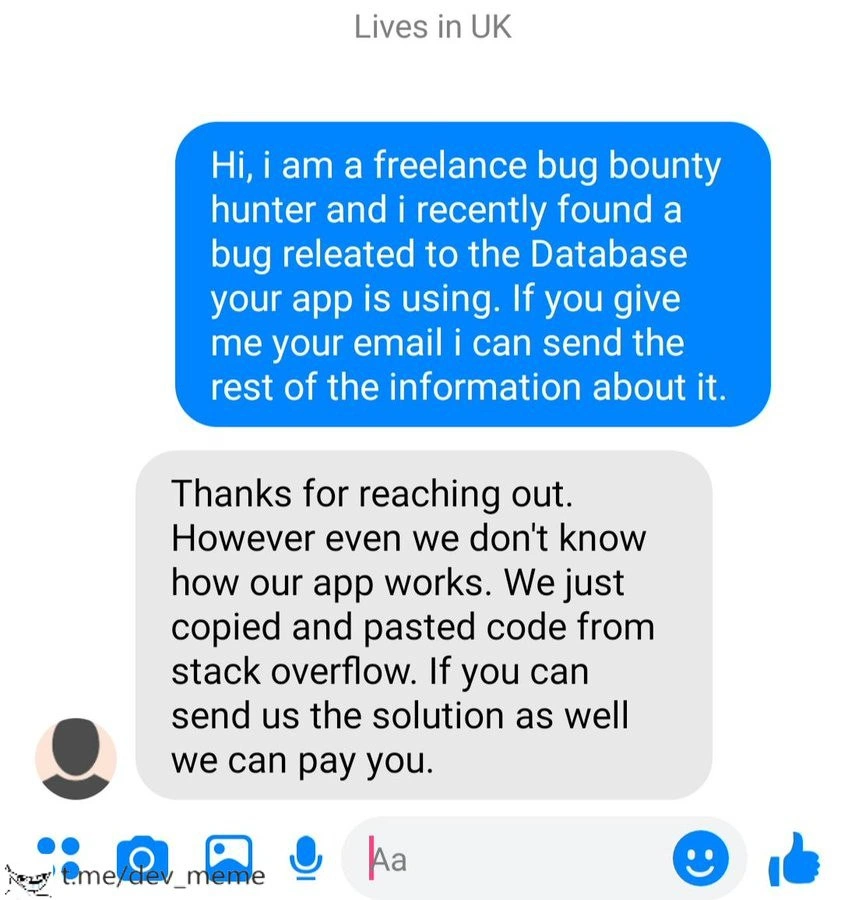
This meme shows a conversation between a bug bounty hunter and a developer, illustrating the dangers of copying code without understanding it. Let’s break down the key elements for a newer developer:
Stack Overflow: This is a popular online Q&A forum where developers ask questions and get code solutions from the community. It’s basically the go-to place when you’re stuck on a programming problem. Copy-paste coding refers to taking an answer from a site like Stack Overflow and dropping it directly into your project. Everyone uses Stack Overflow, but the pitfall is doing so blindly. In the meme, the developers admit “We just copied and pasted code from Stack Overflow”. This implies they likely grabbed some database code from an answer without fully understanding or adapting it. That’s risky because the snippet might not fit their situation exactly, or it might have hidden issues.
Bug Bounty Hunter: This is a freelance security researcher – basically an ethical hacker who looks for security vulnerabilities in apps and websites. Many companies have bug bounty programs, offering rewards (bounties) if someone finds a serious bug or security hole and reports it responsibly. In the conversation, the hunter says, “I recently found a bug related to the database your app is using. If you give me your email I can send the rest of the information.” This sounds like a typical bug bounty report: the person is trying to alert the company about a flaw privately so they can fix it. The bug is “related to the database”, which could mean maybe there’s a way to trick the app into giving out data or some way to break the database queries. A common example would be something like an SQL injection, where an attacker can send special text input that the database interprets as a command (if the code isn’t written securely).
Developers’ Response: The dev replies, “Thanks for reaching out. However even we don't know how our app works. We just copied and pasted code from Stack Overflow. If you can send us the solution as well we can pay you.” This reply is both funny and alarming. It’s funny because of its blunt honesty – they basically say “we have no idea what’s going on in our own app.” For a developer, that’s an embarrassing admission. It’s also alarming because it suggests the team has no documentation or understanding of their own codebase. They likely assembled the application from various online examples, and now if something is wrong, they don’t know how to fix it.
Code Quality and Ownership: The meme highlights a code quality issue: lack of code ownership. Ideally, when you use code from Stack Overflow (or any external source), you should learn how it works, test it, and integrate it properly. Here it appears the team didn’t do that – they might have been in a hurry or lacked the experience, so they just dropped the code in. As a result, when a bug is found, they are caught off-guard. They even ask the bug hunter for a solution and offer payment. Normally, in a bug bounty, the hunter provides the report (what the bug is and how to trigger it), and the company’s developers are responsible for fixing it. The fact that these devs ask for the solution as well shows they’re not confident they can figure it out themselves. It’s like saying, “We didn’t really write this code, so could you also tell us how to fix it?” This is humorous in the meme, but in real life it’s a sign of an inexperienced or sloppy development practice.
Why it’s Funny: For developers (even relatively new ones), the scenario is a bit absurd. It’s poking fun at the stereotype of developers who glue code together from Stack Overflow without truly coding their own solution. Many of us have copied a line or two from an answer, but we try to understand it afterward. The meme takes that to an extreme: imagine a whole app built that way! The idea that even the dev team doesn’t know how their app works is an exaggeration meant to make us laugh (and maybe cringe a little, because we know there’s some truth to it in certain cases). It also has a bit of developer humor about security: usually, security researchers expect devs to be somewhat knowledgeable, so a dev saying “we don’t know what we’re doing, please help” is an unexpected twist.
In summary, for a junior developer, this meme is a light-hearted warning. Copy-paste coding might save you time now, but if you don’t understand the code, it can lead to big problems later – from bugs you can’t troubleshoot to security holes you didn’t realize were there. It emphasizes the importance of truly learning from any code you borrow. Also, it’s a peek into how security bug reports work: strangers might contact you saying “I found a bug in your app,” and how you respond matters. (Preferably not by admitting you have no clue! 😅) The best practice is to take such reports seriously, investigate the issue, and learn how that part of your code works (which ideally, you’d know from the start).
Level 3: Stack Overflow Driven Development
This meme hits a nerve in software engineering by combining a security bug with a brutally honest admission of poor code practices. The setup: a bug bounty hunter found a database vulnerability in an app and reached out to the developers. The punchline: the devs reply that they “don’t even know how our app works. We just copied and pasted code from Stack Overflow.” It's a cringeworthy confession that senior engineers both laugh at and shudder about. Why? Because it satirizes a Stack Overflow-driven development culture taken to the extreme.
In real projects, using Stack Overflow is practically a given – everyone Googles error messages or looks up snippets. But there’s a huge difference between referencing an answer and blindly copy-pasting code into production without understanding it. This meme exaggerates that difference for comic effect. The developers in the chat basically admit they have zero code ownership or insight into their own system’s internals. For a seasoned engineer, this is the ultimate horror story: code running in production that nobody on the team truly understands. It’s the perfect breeding ground for nasty bugs and security vulnerabilities. If something breaks (or gets hacked), the on-call developer at 3 AM has no idea where to even start. Been there, debugged that.
Let's unpack the security angle: the bug bounty hunter says they found a bug related to the database. That hints at a classic mistake – perhaps a SQL injection vulnerability or misconfigured database access. Why would that happen? Often, copy-paste coding from Stack Overflow means you might grab a snippet that works on the surface but isn’t hardened for production. For example, a developer under deadline pressure might grab the highest-voted answer for “how to query a database in framework X,” which might use a quick-and-dirty approach (like building an SQL string with user input directly). It works for the demo, so they ship it. What could possibly go wrong? Well, everything: unsanitized input could let an attacker run malicious queries (classic SQL injection), or perhaps the code snippet relies on outdated practices that expose data. Security vulnerabilities love to hide in plain sight in code that no one really vetted. This meme nails that scenario: the team didn’t vet the code because they didn’t really write it – they just copy-pasted it.
From a code quality perspective, this situation screams technical debt. Technical debt isn’t just old code; it’s any quick-and-dirty solution that will cost you more to fix later. Here the debt collector came in the form of a bug bounty hunter highlighting the flaw. The dev team’s response – “If you can send us the solution as well we can pay you” – is dripping with irony. Usually, companies have formal bug bounty programs where ethical hackers report issues and the devs themselves patch the code. Here, the developers are effectively saying: we don’t know how to fix it either, so please do our job for us. It’s a role reversal that underscores how helpless they are due to poor practices. It’s funny on the surface (imagine a chef saying to a food critic, “Thanks for finding the rotten ingredient, could you also cook the dish correctly for us? We’ll pay you.”) – but it’s also painfully plausible in some teams.
The humor works because it’s relatable and outrageous at the same time. Many veteran engineers have encountered code that looks copy-pasted from Stack Overflow (sometimes with the original question’s comments still in place!). It often happens in hastily built features or legacy sections of the codebase. We chuckle because we know the truth in the joke: some software out in the wild is indeed held together by Stack Overflow answers and prayer. The difference is most of us try to hide that fact, whereas the meme’s dev is hilariously candid about it. That candidness – “even we don’t know how our app works” – is the ultimate punchline. It’s the textbook definition of “lack of code ownership.” No one on the team took the time to properly learn or document the code, likely because they trusted that if it compiled and solved the immediate problem, it was “good enough to ship.” This is an absolute anti-pattern in development: treating borrowed code as a black box.
Another layer here is the communication method shown: a casual Messenger chat (with the label “Lives in UK” at the top, indicating the profile of the sender). Bug bounty reports usually go through formal channels (like dedicated platforms or security emails), not a DM. So this chat UI format highlights the absurdity – it’s probably a tongue-in-cheek portrayal rather than a real incident. The informality of a chat emphasizes how unprofessional the situation is: an outside hacker has to slide into the DMs to alert the team about a critical bug, and the team responds as if they’re asking a stranger for homework answers. That absurd mismatch is what makes the meme land so well among developers. It’s poking fun at the worst-case scenario of a development team: no process, no knowledge, and relying on the kindness of strangers (or paid bounty hunters) to keep their product secure.
For senior folks, this meme is a facepalm and a warning. Code reuse and learning from community examples are great – we all stand on the shoulders of open-source and shared knowledge. But copy-paste coding without understanding turns that strength into a weakness. The scare here is real: if you don’t know how your own app works, you can neither maintain it nor secure it. The next outage, weird bug, or security breach will blindside you. And as the meme jokingly suggests, you’ll end up effectively outsourcing your debugging to random people on the internet. (At least these devs offered to pay the bug hunter – usually, people copy Stack Overflow solutions for free! 😜) The meme cleverly exaggerates this dynamic to remind us that ignorance isn’t bliss in software, it’s a ticking time bomb. And everyone who’s been in the industry long enough has a war story about defusing such a bomb – or watching it go off.
Description
This image could not be processed due to an error
Comments
7Comment deleted
I'd make a joke about this image, but I can't see it. Maybe it's a 404 error?
Our security pipeline is basically: copy Stack Overflow answer to prod, wait for the bug-bounty report, then copy their PoC into the test suite and call it continuous delivery
The best security posture is admitting your entire codebase is held together by accepted Stack Overflow answers from 2012 and hoping the scammers give up out of pity
When your entire architecture is held together by Stack Overflow answers and prayer, 'responsible disclosure' takes on a whole new meaning - the bug bounty hunter is essentially being asked to reverse-engineer someone else's copy-pasted solution to fix a vulnerability in code the team doesn't understand. It's like hiring a structural engineer to fix your house, only to discover it was built entirely from IKEA instructions you can't read, and now you're asking them to also provide the missing Allen wrench and assembly guide
When the vendor asks the researcher to include the fix, you've outsourced code ownership to your bug-bounty program: SDLC-by-Stack-Overflow
Nothing says “mature SDLC” like a bug bounty that asks for the patch - SODD: Stack Overflow - Driven Development, where the database layer’s bus factor is one expired link
Bug bounties: because no architect ever modeled a schema around yesterday's Stack Overflow hotfix