C Developers Meet Garbage Collection
Why is this LowLevelProgramming meme funny?
Level 1: Cleaning Up Your Toys
Imagine you play with toys and then must put every toy back yourself. That is like C memory management. In another room, a helper watches for toys nobody is using and puts them away automatically. That helper is like garbage collection. The meme is funny because someone hears "garbage collection" and thinks of a trash truck instead of the helper cleaning up computer memory.
Level 2: Who Frees The Memory?
Programs need memory to store data while they run. In C, a programmer can manually request memory with functions like malloc() and later return it with free(). If they forget to free it, the program may slowly use more and more memory. That is called a memory leak.
Garbage collection is a feature in some languages where the runtime automatically finds memory that the program can no longer use and frees it. The programmer still has to write sensible code, but they do not usually call free() for every object.
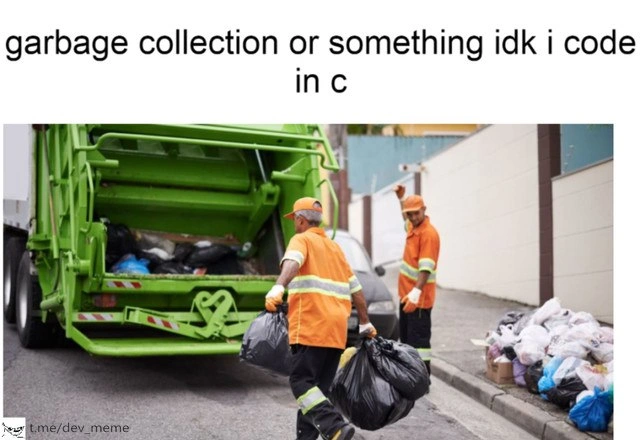
The meme is funny because the words "garbage collection" have two meanings. In programming, it means automatic memory cleanup. In the picture, it means people collecting actual trash bags. The caption pretends a C programmer only understands the physical version because C makes memory cleanup the programmer's job.
Level 3: Manual Memory Hangover
The senior laugh comes from the phrase "idk i code in c." A C programmer can plausibly act as if garbage collection is somebody else's high-level-language luxury, because C's standard model does not include automatic reclamation of unreachable heap objects. If you allocate memory, you are responsible for releasing it at the correct time. The computer will not politely infer your intent just because the variable went out of scope.
The literal garbage truck makes the abstraction look silly, but the contrast is real. Managed languages such as Java, Go, C#, JavaScript, and many others pay runtime complexity to reduce whole classes of manual memory bugs. C keeps the bargain closer to the hardware: fast, explicit, portable, dangerous. That is why ManualMemoryManagement is both a badge of honor and a source of production incidents with names like "RSS keeps growing" and "why did the daemon die after six days?"
This is not a simple "GC good, C bad" joke. Garbage collection can introduce latency spikes, unpredictable reclamation timing, and memory overhead. C can be extremely efficient and deterministic when written carefully. The humor is that both camps inherit pain: managed-language developers negotiate with collectors, while C developers negotiate with every allocation they have ever made. Naturally, both groups claim the other one is the problem, which is how you know everyone is awake.
Level 4: Reachability Takes Out Trash
The caption says:
garbage collection or something idk i code in c
The image literalizes that with sanitation workers loading black trash bags into a green garbage truck. Under the pun is a real runtime design divide: garbage collection in managed languages is not "the program deletes random junk." It is a set of algorithms for deciding which allocated objects are no longer reachable from a program's live references, then reclaiming their memory.
Most tracing collectors start from roots: stack variables, CPU registers, global references, thread-local state, and runtime-managed handles. They walk the object graph, mark everything reachable, and treat unmarked heap objects as collectible. More advanced collectors use generational heaps because most objects die young; compacting collectors move live objects to reduce fragmentation; concurrent collectors try to reduce stop-the-world pauses without letting the program mutate the graph faster than the collector can reason about it. The math is not mystical, but the engineering is rude: object identity, pointer updates, write barriers, cache locality, pause latency, and throughput all start arguing at once.
C largely opts out of that contract. With malloc, calloc, realloc, and free, the program owns lifetime management directly. That gives systems programmers control over layout, timing, and overhead, but it also means the program can leak memory, free the same allocation twice, use memory after freeing it, or keep a dangling pointer around like a tiny loaded footgun with excellent performance characteristics.
Description
A white meme caption at the top reads, "garbage collection or something idk i code in C." Below it, a photo shows sanitation workers in orange safety uniforms loading black trash bags into a green garbage truck, with more trash bags piled along the curb and a small "t.me/dev_meme" watermark in the lower left. The meme uses literal garbage collection to parody managed-language runtime garbage collection. Technically, it contrasts C's manual memory management model with languages that reclaim unreachable objects automatically, turning allocation ownership, leaks, and `free()` discipline into the punchline.
Comments
1Comment deleted
C has garbage collection too; it is just called production RSS growth followed by a very sincere postmortem.