The Core Feature of C-3PO: Programmatic Anxiety
Why is this AI ML meme funny?
Level 1: Robots with Feelings
Imagine you built the most amazing robot friend in the world. 🤖 It can do math homework for you, speak millions of languages, and knows almost everything. Sounds perfect, right? Now imagine you also decide to give this robot a human feeling – say, you make it worried all the time. Suddenly, whenever you ask your robot friend to do something, it nervously replies, “Oh, I’m not sure about this... what if it goes wrong?” That’s pretty silly! Why would someone add a feature to a great robot that makes it act anxious (which means super worried) like a person who’s scared?
This meme is funny because it’s like saying: “We have this miracle piece of technology, and we’re going to make it nervous on purpose!” It’s the same as building a super strong superhero robot but programming it to be afraid of the dark. Usually, when we invent a high-tech machine, we want it to be better than us at certain things – confident, fast, and helpful. Seeing a robot with feelings of fear or anxiety is unexpected and goofy. It reminds us of a lovable movie character, C-3PO from Star Wars, who is a shiny gold robot that somehow always acts like a worried old friend. In the movies it’s endearing and funny. In real life, the idea of a worried robot is just as humorous, because it mixes something super advanced (a robot) with something very human and imperfect (being anxious). The core of the joke is that even a robot – which you’d think doesn’t have feelings – might end up with the same funny worries as a person, all because a programmer decided to put that in its brain. It makes us laugh and also feel a bit glad that our real gadgets aren’t actually fretting about the tasks we give them!
Level 2: Programming Emotions
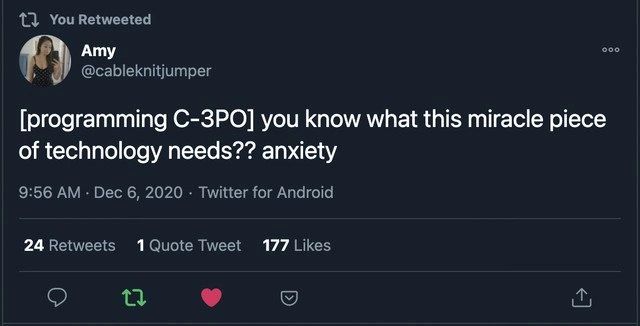
Let’s break down the meme in simpler technical terms. We have a Twitter joke about programming C-3PO, the humanoid droid from Star Wars. C-3PO is known for being fluent in over six million languages (a truly advanced translator robot) and for being extremely worried and chatty about dangers. The tweet humorously suggests that while developing this advanced robot, a programmer decided to add “anxiety” as a feature.
In software, a feature just means a functionality or behavior you add on purpose. Feature creep is when people keep adding more and more features beyond the original plan, sometimes unnecessary ones. Imagine you’re making a simple robot that can walk and you keep adding extras like “it can dance, it can sing, it can do taxes, etc.” – that’s feature creep. In this case, the extra feature is anxiety, which is clearly not a typical feature at all!
Why is that funny? Well, developers usually program robots and AI to be helpful, precise, and logical. Anthropomorphic design is when designers give a machine human-like qualities (anthropomorphic means “human-shaped or human-like”). Often this is done to make robots more relatable or friendly to humans. For example, some virtual assistants crack jokes or have a friendly tone of voice – that’s anthropomorphism in design. Here, giving C-3PO an emotional trait like anxiety is anthropomorphism too, just a very odd choice of emotion. Anxiety is essentially a form of fear or worry. Normally, if you built a super advanced intelligent robot, you wouldn’t intentionally program it to feel nervous or to doubt itself constantly. That would be counterproductive! The robot might hesitate or bother its users with constant concern.
The meme is playing on the absurdity of that idea. C-3PO in the movies constantly says things like “I have a bad feeling about this” or calculates terribly high odds of failure to tell his human friends, which comes off as him being anxious. The tweet by Amy (@cableknitjumper) is basically saying: What kind of developer thought it was a good idea to include that anxiety quirk in C-3PO’s programming? It’s a tech humor and pop culture crossover joke. Anyone who knows C-3PO (a classic star_wars_reference) and also knows a bit about programming can chuckle at the thought of an engineer writing code to make a robot worry.
In the real world of AI and robotics, engineers do sometimes give robots personality or emotions in a superficial way (like expressive eyes on robots, or a polite demeanor in voice assistants). But they don’t usually hard-code negative emotions like panic or anxiety. Those would be seen as bugs or undesirable behavior, not features. So this meme is highlighting a case of intentionally doing something seemingly illogical in programming for the sake of humor. It’s reflecting a common joke in development: sometimes our projects end up with funny or nonsensical features (often due to human decisions). And in this case, it imagines that’s how we got an anxious robot character. It’s a gentle jab at developer priorities – suggesting that maybe, just maybe, a programmer out there cares about giving a robot relatable human-style worries more than making it perfectly rational.
Level 3: Anthropomorphic Feature Creep
For seasoned developers, this tweet lands as a perfect example of feature creep taken to comedic extremes. It’s as if during a design review for a state-of-the-art protocol droid, someone piped up and said, “You know what this miracle of technology really needs? Anxiety.” This is hilariously relatable because in real projects, we often see oddball requirements sneak in – usually less absurd than giving a robot a panic disorder, but the principle is the same. The meme highlights an instance of anthropomorphic design: giving a machine human-like qualities (in this case, a not-so-desirable human quality) purely for effect. C-3PO from Star Wars is famously a fretful, worry-prone droid who constantly calculates odds of disaster and frets about them. The tweet jabs at the notion that somewhere in the development process of this advanced AI, a developer intentionally enabled an “anxiety module.” It’s a brilliant satire on developer priorities, poking fun at how product decisions can emphasize relatability or character over pure functionality.
In the software world, labeling something a “feature” usually implies it’s an improvement or useful capability. Calling anxiety a feature is a cheeky inversion – it’s more like introducing a bug human flaw on purpose. This resonates with anyone who’s seen product managers request whimsical add-ons that don’t necessarily make the product better. It’s reminiscent of times when a project adds a talking paperclip assistant (hello, Clippy from the 90s) or easter eggs that incite more eye-rolls than productivity. By anthropomorphizing C-3PO with anxious behavior, the designers essentially engaged in PopCultureReference-worthy feature creep: they gave the robot a personality quirk to make him memorable (and comedic), not more efficient.
Consider this tongue-in-cheek reenactment of the planning meeting:
Engineer: “We’ve built C-3PO to be fluent in six million forms of communication.”
Product Manager: “Great. But can we also program him to constantly worry about everything?”
Engineer: “…We can, but do we want to?”
Product Manager: “Absolutely! Let’s call it the ‘anxiety feature.’”
Anyone who’s worked on a team project can imagine this conversation, which is why it’s so funny. It’s a satirical mirror of real life in AI/ML and Robotics development – sometimes, tech humor springs from the clash between what we could build and what we should build. Here, the poor engineer ends up coding a perfectly fluent protocol droid to also blurt out panicked odds and “Oh dear!” at the slightest sign of trouble. In practice, adding such an anxious_robot trait would be like intentionally introducing performance penalties: the droid might hesitate, over-communicate risks, or require extra handling to calm its circuits. It’s a QA nightmare disguised as a personality perk.
Let’s not forget the shared cultural context: pretty much every dev knows C-3PO as the golden worrywart from Star Wars. So this meme operates on a dual reference – it’s MachineLearningHumor and a star_wars_reference rolled into one. The community sees C-3PO fretting on-screen and winks at the idea that “anxiety” was a commit in his codebase. There’s even a subtle self-own here: developers often joke about their own anxiety (late-night deploys, pager duty at 3AM). Giving C-3PO anxiety is like projecting the programmer’s own stress onto the product. It underscores a truth in HumanVsAI design: we create machines to overcome human limitations, yet we can’t resist imprinting our very human quirks (and neuroses) onto them. In summary, this level of the joke tickles the experienced dev’s funny bone by combining a classic sci-fi trope with the all-too-familiar scenario of feature creep – resulting in a droid that’s technically brilliant but needlessly nervous.
# Pseudo-code for C-3PO's anxiety feature
class ProtocolDroid:
def __init__(self, languages_spoken=6000000):
self.languages_spoken = languages_spoken
self.anxiety = True # Enable anxiety feature by default (why not?)
def report_status(self):
if self.anxiety:
print("I have a bad feeling about this...") # anxious behavior
else:
print(f"Fluent in {self.languages_spoken} languages and functioning normally.")
In the code above, we’ve humorously toggled an anxiety flag in C-3PO’s imaginary software. If self.anxiety is True, instead of confidently stating his capabilities, the droid delivers a worried message. It’s a lighthearted illustration of how a developer might implement the “anxiety feature” – a few lines of code that transform a confident robot into an anxious_robot. Real developers don’t actually write give_robot_anxiety(); in code, of course, but the absurd simplicity of the snippet is what makes it funny. It’s a reminder that sometimes a single flag or small tweak in software can drastically change behavior, for better or (in this case) comedic worse.
Level 4: Algorithmic Anxiety
At the deepest technical level, this joke hints at the challenges of simulating human emotions within an AI’s programming. In academic terms, there's an entire field called affective computing that explores how machines might recognize or even emulate human feelings. C-3PO’s anxiety can be seen as a tongue-in-cheek example of an affective algorithm gone awry. From a cognitive architecture standpoint, deliberately coding a robot to be anxious would mean introducing a complex feedback loop where the droid constantly evaluates potential dangers and reacts with worry. This isn't a simple if statement; it's more like embedding a low-level neural network bias or a psychological model that skews negative. The humor here is that anxiety, in humans, is often an undesirable emergent property of our survival instincts – a side effect of predicting bad outcomes. Translating that into code means dialing up an AI’s risk-avoidance parameters to almost neurotic levels. In technical terms, imagine a reinforcement learning agent with a reward function that heavily penalizes potential failure. The resulting policy would be extremely cautious (borderline paranoid):
\text{If } U(\text{action}) = \text{expected success} - \lambda \times \text{risk}, \text{and }\lambda \text{ is set absurdly high,}
the AI’s optimal behavior is to always expect the worst. In essence, you get a robot that’s perpetually on edge, announcing horrendous odds of success at every turn – just like our anxious robot friend C-3PO. This theoretical lens exposes a core absurdity: designing an advanced AI/ML system only to intentionally degrade its confidence is counter-intuitive. It flips the usual AI goal of rational, optimized decision-making into something hampered by human-like neurosis. Historically, AI researchers have debated whether giving AI emotional traits is beneficial or ethical. We want machines to understand our emotions, sure, but do we really want them to suffer them? The meme playfully posits a developer who says “yes, let’s make this robot feel worry.” It’s a satirical nod to the idea that even a miracle of robotics might be saddled with psychological baggage, raising eyebrow-arching questions about human vs AI design priorities.
Description
A screenshot of a tweet by a user named Amy (@cableknitjumper). The tweet is a humorous observation framed as an internal thought during a fictional programming session. It reads, '[programming C-3PO] you know what this miracle piece of technology needs?? anxiety'. The joke satirizes the personality of the famous Star Wars droid, C-3PO, who, despite his advanced capabilities as a protocol droid, is primarily characterized by his perpetual state of worry and nervousness. The tweet hilariously reframes this iconic personality trait as an intentional, albeit absurd, feature implemented by his original developers. For engineers, it's a funny commentary on product design choices and the sometimes inexplicable quirks that define a technology's 'personality.'
Comments
7Comment deleted
C-3PO's personality is basically a state machine that's permanently stuck in the 'catch(Exception e)' block
We shipped C-3PO’s “AnxietyMiddleware” by wiring a circuit-breaker to trip at 3% uncertainty - now every time a request stalls he cancels his own saga and spends the stand-up quoting failure probabilities at the PO
After 20 years of building 'intelligent' systems, I've realized we've been following George Lucas's design patterns all along - adding anxiety to our services isn't a bug, it's just preparing them for production on-call rotations
This perfectly captures the senior engineer's dilemma: we've mastered distributed systems, achieved five nines uptime, and optimized for sub-millisecond latency - yet somehow we still ship products that inherit our own imposter syndrome and production anxiety. C-3PO isn't a bug, he's a feature request that made it past code review because the PM thought 'emotional intelligence' meant constant existential dread about edge cases
Programming C‑3PO: he was calm as a stateless service until we wired him to Prometheus and PagerDuty - now every deploy starts with the SLO breach probability and a rollback recommendation: 3,720 to 1
C-3PO post-code-review: 'Sir, this refactor violates the protocol of least astonishment - now with 3720:1 odds of galactic merge hell.'
We shipped “anxiety” to C‑3PO by setting his error budget to 0% and piping every INFO log to PagerDuty - product calls it empathy, SRE calls it alert fatigue