Deflecting Code Explanation Questions With Aggressive Topic Changes
Why is this CodeReviews meme funny?
Level 1: Asking About the Messy Drawer
Imagine asking someone, "Hey, what's this weird knot of cables in your drawer for?" — and instead of answering, they stand up, point at you, and shout, "The garden looks AMAZING this year, that's what we should be talking about!" Everyone can see they have no idea what the cables do, even though they tied them. The joke is that the louder and prouder the subject change, the more obvious the secret: they don't know either. Programmers laugh because they've all built something that works, forgotten how it works, and then been asked about it in front of everyone — and felt that exact finger-pointing panic rise up.
Level 2: The Question You Fear in Code Review
Some vocabulary for the scene. A code review (or PR review, for pull request) is when teammates read your proposed changes and ask questions before the code is merged. A code walkthrough is the live version: you share your screen and narrate what each part does. The meme freezes the moment that process meets write-only code — code that could be written but apparently cannot be read, even by its author.
Why does this happen to everyone? Because understanding evaporates faster than code does. You hold a complex solution in your head for the afternoon you write it; the head moves on, the code stays. Without comments, decent naming, or documentation explaining why (not just what), the future reader — including future you — gets a puzzle instead of an explanation. Juniors usually discover this the first time they git blame a baffling line and find their own name. The professional response is to admit it, re-derive the logic, and leave the comment you wish you'd found. The meme response is the one pictured: point the finger and cite an impressive unrelated number, the engineering equivalent of "the demo went great, didn't it?!"
The practical takeaway hiding in the joke: if you can't explain a block you wrote, that's the codebase telling you it needs a refactor or a comment now, while any memory remains. Deflection works in the meeting; it does not work at 3 AM when that exact block pages you.
Level 3: Hostile Witness in My Own Codebase
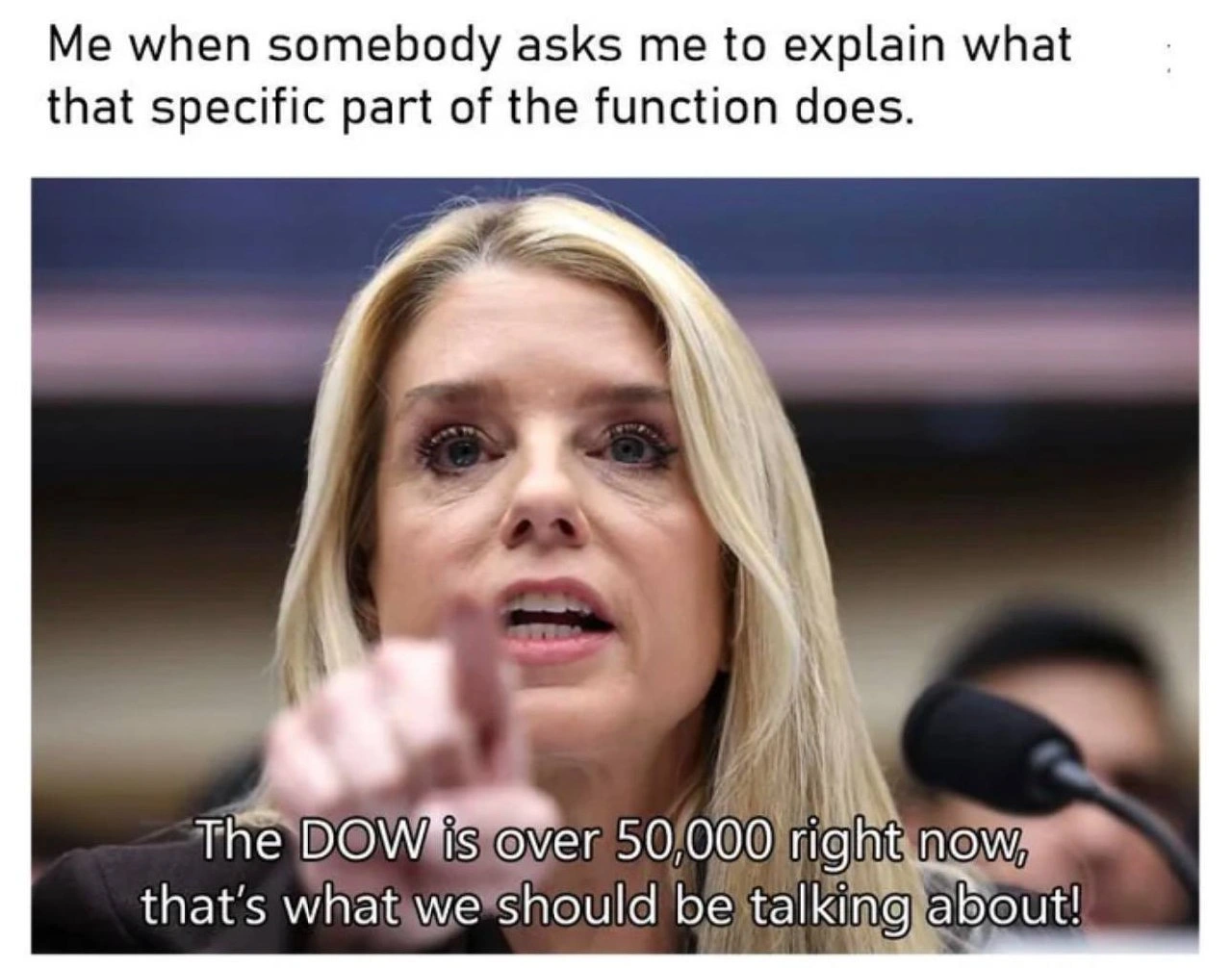
The format borrows a political-hearing photo — a blonde woman mid-testimony, finger jabbed at her questioner, microphone at her shoulder, eyes wide with the specific intensity of someone who absolutely will not be answering the question — captioned:
Me when somebody asks me to explain what that specific part of the function does.
with her deflection subtitled in news-chyron style:
The DOW is over 50,000 right now, that's what we should be talking about!
The deflection-by-irrelevant-good-news is a precise transcription of an actual code review pathology. The honest answer to "what does this part do?" is frequently "I don't know anymore" — and the meme's economic pivot is the developer equivalent: "all tests pass," "it's been stable in prod for eight months," "throughput is up 30%." Every one of those is the DOW at 50,000: a true, favorable, completely non-responsive metric deployed as a human shield for a chunk of logic nobody can narrate. The outcome is healthy; the mechanism is unexplained; please direct further questions elsewhere.
What makes this "too real" is that the gap between working and understood is where technical debt actually lives. Code you can't explain is code you can't safely change — and the inability to explain your own function is rarely stupidity. It's the natural product of how the function got there: written at 11 PM under deadline, grown by five incremental patches each individually sensible, half-pasted from an old Stack Overflow answer (or, in the current era, exhaled by an AI assistant and accepted because the tests went green). Six months of memory decay later, the author has the same epistemic relationship to it as any stranger — except with accountability attached, which is what turns a normal question in a PR walkthrough into a congressional hearing. The defensive finger-point is the tell: the questioner isn't hostile, but the witness has something to hide, and the something is // magic, do not touch.
There's also a quiet organizational critique embedded here: teams ritually require review and walkthroughs, but rarely budget the time to re-derive understanding of old code. So the incentive structure rewards exactly this performance — change the subject, cite the green dashboard, get the approval, and pray nobody ever needs to modify line 47.
Description
A meme with the top caption in black text on white: 'Me when somebody asks me to explain what that specific part of the function does.' Below is a photo of a blonde woman testifying at a hearing, pointing a finger forward with an intense, defensive expression, a microphone visible beside her. The subtitle caption over the photo reads: 'The DOW is over 50,000 right now, that's what we should be talking about!' The joke is the universal developer move of aggressively deflecting when asked to explain a chunk of their own code they no longer understand - changing the subject rather than admitting the function is a mystery even to its author
Comments
3Comment deleted
The function has 100% test coverage and zero percent explainability - like any healthy economy, you don't question it while the numbers are up
I get your back guys: The Dow Jones is a stock market index that tracks the performance of 30 of the largest companies in the US Comment deleted
Neuroslöpp shitcoder problem. GTFO of IT dept if you cannot explain your code Comment deleted