The True Meaning of 'Bug Free' Software
Why is this Bugs meme funny?
Level 1: Sugar-Free vs Free Sugar
Imagine you go to an ice cream shop and see a sign that says “sugar free ice cream.” You think, “Great, this ice cream has no sugar in it, it must be healthier!” But when you take a bite, it’s super sweet. You ask the shopkeeper, “Hey, I thought this was sugar-free? Why is it so sweet?” The shopkeeper smiles and says, “Oh, you misunderstood. Sugar free doesn’t mean free of sugar. It means the sugar is free, as a bonus! We included the sugar at no extra cost. Enjoy, cheers!”
You’d probably laugh or be confused, right? 😂 Clearly, that’s a silly play on words. Usually “sugar-free” means there’s no sugar. The shopkeeper is joking that “sugar free” means the sugar is included for free (for no money). That’s exactly what the meme is doing, but with software bugs instead of sugar.
In the meme, a software company might say their program is “bug free.” Normally, we’d think that means it has no bugs (no mistakes, no problems). But the joke is pretending that “bug free” means the bugs are free – the program definitely has bugs, but the user gets those bugs without having to pay for them. It’s like saying, “Our product comes with some mistakes, but those are free gifts from us to you!” It’s absurd and funny because no company would really admit to giving you bugs as a bonus.
Why do developers find this funny? Because it feels true in a joking way. Almost every piece of software has a few bugs hiding in it. When someone promises “no bugs at all,” something usually goes wrong later and everyone finds out there were bugs. So instead of crying about it, programmers make a joke: “Hey, we never said there were no bugs, just that the bugs were free!” It’s like a little wink and nod saying that problems happen, but we’ll laugh and fix them.
So, just like the silly ice cream example with “free sugar”, the meme uses playful language to turn a broken promise into a joke. It’s funny because it’s obviously the opposite of what we expect. And it reminds us that when something sounds too perfect (like 100% bug-free!), there might be a cheeky catch. In other words: the bugs are always there, but at least you didn’t pay extra for them! 😜
Level 2: Bug-Free vs Free Bugs
Let’s break down the joke in simpler terms. First, what’s a bug in software? In programming, a bug is a mistake or flaw in the code that causes something to go wrong. For example, if a calculator app is supposed to add 2+2 but shows 5, that’s a bug. Bugs can make programs crash, behave oddly, or give wrong results. Every developer aims to write bug-free code – meaning code with no bugs at all. You might hear phrases like “this app is bug free” to claim it has zero known issues. Sounds great, right? CodeQuality is high when there are few or no bugs.
But here’s the catch: in real life, almost no app of any complexity is truly free of bugs. Even with lots of testing and Quality Assurance (QA), there’s always a chance something was missed. New developers quickly learn that “bug free” is an almost impossible promise except for the simplest programs. (Ever notice how even big companies keep releasing updates and patches? They’re fixing bugs!) So, when someone says “our software is bug-free”, seasoned devs get a little skeptical. Often it really means “we didn’t find any bugs in our testing, but who knows what users will find.”
Now, the meme takes the phrase “bug free” and plays a word trick. In English, the word “free” can mean “without” (like sugar-free means no sugar in a drink) or it can mean “at no cost” (like free samples at a store). The tweet jokes that when a company says “bug free”, they don’t mean without bugs. Instead, they supposedly mean “we included the bugs for free!” – as in, you get bugs free-of-charge along with your purchase. It’s a goofy re-interpretation, basically saying the product does have bugs, but hey, you didn’t pay for those bugs, so it’s “bug free” in the cost sense. This is a classic bit of DeveloperHumor and wordplay. It highlights a CommunicationBreakdown or a semantics mix-up: the term bug-free is interpreted in the totally wrong (and funny) way.
Think of it like this: imagine a brand selling “bug-free software” as if it’s a feature, and then in the fine print they clarify, “All bugs included at no extra charge.” 😂 It’s poking fun at marketing language. In tech, sometimes labels and quality claims can be misleading or overly optimistic (semantics_of_quality_labels can be tricky!). New developers learn to read between the lines. For instance, “enterprise-grade” might be marketing speak, and “bug-free” might really mean “we think it’s bug-free (fingers crossed)”. Here the meme pushes it to the extreme: “bug-free” outright means the opposite of what you’d expect – the bugs are definitely there, you just don’t have to pay for them.
This joke is very relatable humor in software circles because everyone has experienced bugs showing up despite claims of perfection. It’s almost a rite of passage in a developer’s career: you deploy something you thought was bug-free, and then boom – a user finds a crashing bug in five minutes. 😅 You feel embarrassed and maybe frustrated: “Ugh, I swore it was fine!” That’s why many devs will never claim their code is absolutely bug-free. Instead, they say things like “no known bugs” or “we haven’t found any more issues after testing” to be safe.
The tweet’s format (looking like a fake Twitter post) adds to the humor. It reads like someone sarcastically correcting a misunderstanding: “no you misunderstand…” and then delivering the punchline explanation. The “cheers mate” at the end is the cherry on top – a friendly, almost joking sign-off, as if this were just friendly advice. It’s the meme author’s way of saying “I’m just messing with you, pal.” The whole tone is joking, not serious. In reality, no company would openly advertise “bugs included for free,” of course! But that’s what makes it funny – it’s absurd.
Let’s clarify a few terms and why this meme hits home for developers:
- Bug – a mistake or problem in code that causes errors. Called a “bug” ever since an actual insect was famously found in an early computer! (Yes, in 1947 engineers found a moth causing a hardware fault in a room-sized computer, and taped it into a logbook noting “First actual case of bug found.” Ever since, software errors have been nicknamed bugs 🐞).
- Bug-Free – a term meaning no bugs at all. For example, if someone says “This game is bug-free,” they claim you won’t encounter glitches or errors. It’s an ideal state.
- Free-of-Charge – means you don’t have to pay for something. A “free gift” with a product means it’s included without extra cost.
- Miscommunication – when two parties understand words differently. Here, the word “free” causes a mix-up. The developer in the meme pretends that “free” was meant in the “no cost” sense, not the “without bugs” sense. This is a tongue-in-cheek CommunicationBreakdown moment.
The humor also touches on the reality of software quality. High-quality software strives for as few bugs as possible. Teams use CodeQuality practices: code reviews, automated tests, etc., to catch bugs early. Still, there’s almost always a tiny bug hiding somewhere. It might be in a feature nobody tried before, or only happen on old phones, or only when the clock strikes midnight – weird stuff you didn’t think of. So delivering a complex app with absolutely zero bugs is extremely rare. When tech folks see a slogan like “Bug Free Guarantee!”, we tend to grin and think “We’ll see about that…”
Developers often joke about turning bugs into “features.” For example, if an app behavior is wrong but kinda funny, someone might quip, “It’s not a bug, it’s a feature!” 😜 This meme is similar tongue-in-cheek logic: “It’s not a bug (problem)… it’s a bonus!” By saying the bugs are free, the tweet humorously reframes the bugs as if they were an intended, free feature of the software. Of course in reality, bugs are not features – they’re mistakes to fix. But humor helps us cope with the stress of debugging.
So, essentially, why is this meme funny? It plays with language and the universal developer experience of bugs. It mocks the overly optimistic claim of bug-free software by sarcastically “redefining” it. Everyone in programming has seen a situation where a product touted as perfect turned out to hide issues. This meme gives a silly explanation for that: the bugs came bundled for free! It’s like a tech inside-joke acknowledging that BugsInSoftware are inevitable, and any promise to the contrary is just asking to be subverted. When you’re new to coding, keep this in mind: always test and be humble about your code. If someone says their code has zero bugs, now you can jokingly reply, “oh, you mean the bugs come at no extra cost? 😉” – you’ll get a laugh (just be careful using that with your boss!).
Level 3: The Bugs Are On Us
In the world of software, “bug free” is a mythical label – a unicorn promise that CodeQuality marketing loves to slap on products. Any battle-scarred developer reading that phrase immediately smirks. We know it doesn’t mean the code has zero defects; it usually means someone hasn’t found the defects yet. The meme’s tweet brilliantly twists the semantics: “bug free” doesn’t mean free of bugs, it means bugs included free-of-charge. In other words, the bugs are indeed there, we just don’t charge extra for delivering them! This is classic DeveloperHumor playing on ambiguous language. The word "free" can mean without something (like bug-free meaning without bugs) or at no cost (free beer, free gift). Here, the tweet flips the meaning: “We have included the bugs free of charge”. It’s as if a cheeky developer is clarifying the fine print of a marketing claim. It skewers the disconnect between what non-technical stakeholders say and what actually happens – a prime example of software_quality_miscommunication and CommunicationBreakdown in tech.
Seasoned devs laugh (perhaps a bit bitterly) because we’ve all lived this. A manager or sales brochure touts “no known bugs” or “bug-free release”, and we roll our eyes. Sure, buddy. As Quality Assurance folks will tell you, finding no bugs in testing doesn’t prove there are none – it just means you haven’t discovered the sneaky ones. The great computer scientist Edsger Dijkstra put it succinctly: “Testing can show the presence of bugs, but never their absence.” In practice, claiming bug-free is tempting fate. 😈 You just know some BugsInSoftware will scurry out as soon as real users start using the thing. The tweet’s humor is a nod to this inevitability: bugs will be shipped to production, but hey, at least those defects come complimentary.
This meme hits on developer cynicism about CodeQuality guarantees. There’s a shared industry joke that the phrase “works on my machine” is about as close as we get to a quality guarantee. We’ve learned that “bug free” is often marketing-speak, akin to saying a car is “maintenance free” – the reality is you’ll still be visiting the mechanic, or in our case, the debugger. When a company declares their app is bug free, experienced devs hear a silent addendum: “…and any bugs you find are on the house.” It’s a coping mechanism for us to joke about this, because we know no non-trivial software is truly flawless. In fact, there’s an old quip: “There’s always one more bug.” If you think you’ve squashed them all, you probably just haven’t looked hard enough. Like a dark twist on a BOGO sale, for every bug you fix, another pops up free. (Cue that T-shirt meme: “99 little bugs in the code, take one down, patch it around, 127 bugs in the code…”)
Crucially, this tweet also mocks the Communication gap between tech and business. A stakeholder might boast, “Our product is bug free!” – expecting applause – while the dev team cringes, knowing it’s only a matter of time before a user tweets back with a bug report. The phrase “cheers mate” at the end of the tweet adds a perfect dollop of sarcasm. It’s the equivalent of a developer raising a glass after delivering bad news in a polite tone: “We included plenty of bugs for free, cheers!” – as if that makes everything alright. That polite but cheeky sign-off underscores the absurdity: the speaker isn’t even apologizing for the bugs; they’re mockingly congratulating the user on getting them for free. It’s a gallows humor brand of CodingHumor – we laugh so we don’t cry.
This all lands as extremely relatable humor in dev circles because it touches on our collective PTSD from Bugs in production. We’ve all had that release where we swore everything was tested, only for a critical bug to surface hours later, prompting frantic fixes. When the tweet says “cheers mate”, I can practically hear the exhausted irony of a developer who’s been up all night patching a “bug-free” release. In summary, the meme combines wordplay and shared experience: it’s poking fun at bug_free_marketing spin, highlighting how terms like “bug free” can be twisted. In reality, “bug free” often just means the bugs come included as a free bonus feature. With a knowing chuckle, developers nod and think, “Yup, been there – got the free bugs to prove it.”
To visualize the satire, here’s how the promise vs reality breaks down:
| What We Promise | What We Deliver (Fine Print) | What Actually Happens |
|---|---|---|
| “Bug free” software 🚀 | Bugs included at no extra cost 🐛 | Users inevitably find bugs 😬 |
The Bugs are on us, literally and figuratively. SoftwareBugs are simply part of the package, and this meme wryly admits that truth with a play on words. It’s a spicy reminder that in software, “no bugs” often just means “no charge for the bugs.” Cheers, mate. 🙃
Description
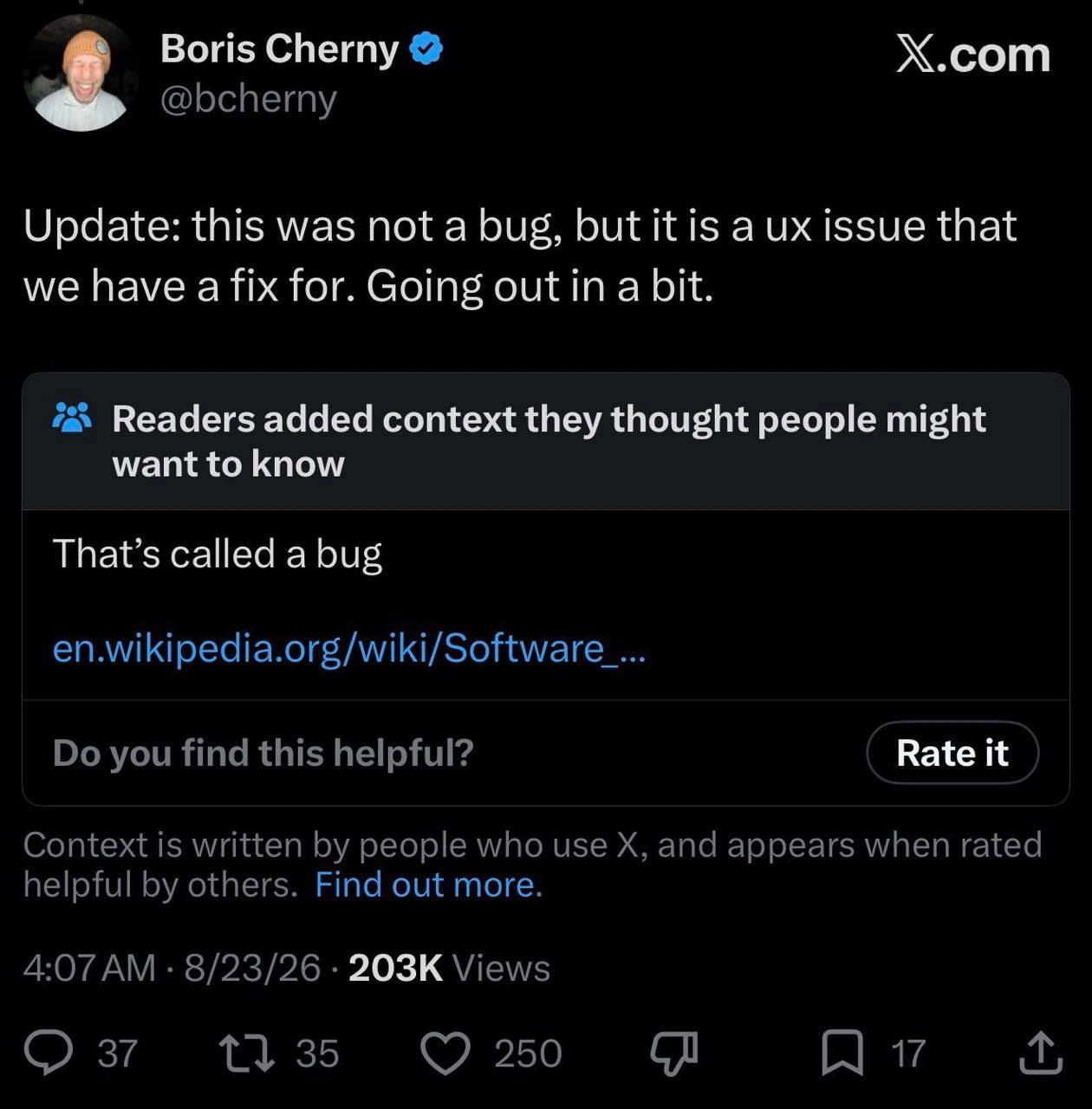
This image is a screenshot of a tweet from the Twitter account 'Computer Facts' (@computerfact), which has a profile picture of a vintage computer. The tweet, posted on January 6th, reads: 'no you misunderstand "bug free" does not mean "free of bugs" it means "we have included the bugs free of charge" cheers mate'. Below the text, the engagement metrics show 13 comments, 470 retweets, and 2.1K likes. The humor is a classic example of developer wit, playing on the ambiguity of the word 'free'. It reinterprets the common marketing claim 'bug-free' (meaning without defects) as 'bugs, free of charge'. This cynical take is deeply relatable to experienced software engineers, who understand that all non-trivial software contains bugs. The joke serves as a commentary on the gap between marketing promises and the reality of software development, humorously reframing defects as an included, un-billed bonus
Comments
13Comment deleted
Our new release is 'bug-free,' which is our engineering team's way of saying the known-issue list is now longer than the feature list
Marketing insisted on “Bug-Free Edition,” so the release script now appends UnitPrice: $0.00 to every stack trace - legal says if the defects are complimentary, the slogan’s technically accurate
After twenty years in this industry, I've finally understood the enterprise software pricing model: the base license gets you the bugs, but you need the premium support contract to have someone acknowledge they exist
This perfectly captures the eternal optimism of release notes versus the reality of production monitoring. It's the software equivalent of 'all-inclusive resort' - yes, everything's included, especially the things you didn't want. Senior engineers know that 'bug-free' is just 'bug-undiscovered' with better PR, and the real question isn't whether bugs exist, but whether they're documented as features in the backlog yet
Enterprise translation: “bug‑free” means the defects are complimentary; remediation requires a separate SOW and a fresh sprint you don’t have
Bug-free means the defects are pro bono - externalized straight to your on-call rotation, no charge for the 3AM wakeups
In the enterprise glossary, a 'bug‑free release' means defects are pre‑bundled and amortized over the error budget - procurement calls it a value add, SRE calls it Tuesday
How is the opposite supposed to look like? Bugs as paid DLC? Comment deleted
Why not 😂 Comment deleted
Microtransactions Comment deleted
Sounds like a pretty cool feature Comment deleted
Paid beta Comment deleted
*tarkov music intensifies* Comment deleted