Brain Keeps Developer Awake with Palindrome Parentheses Mind-Bender
Why is this CS Fundamentals meme funny?
Level 1: Midnight Mind Games
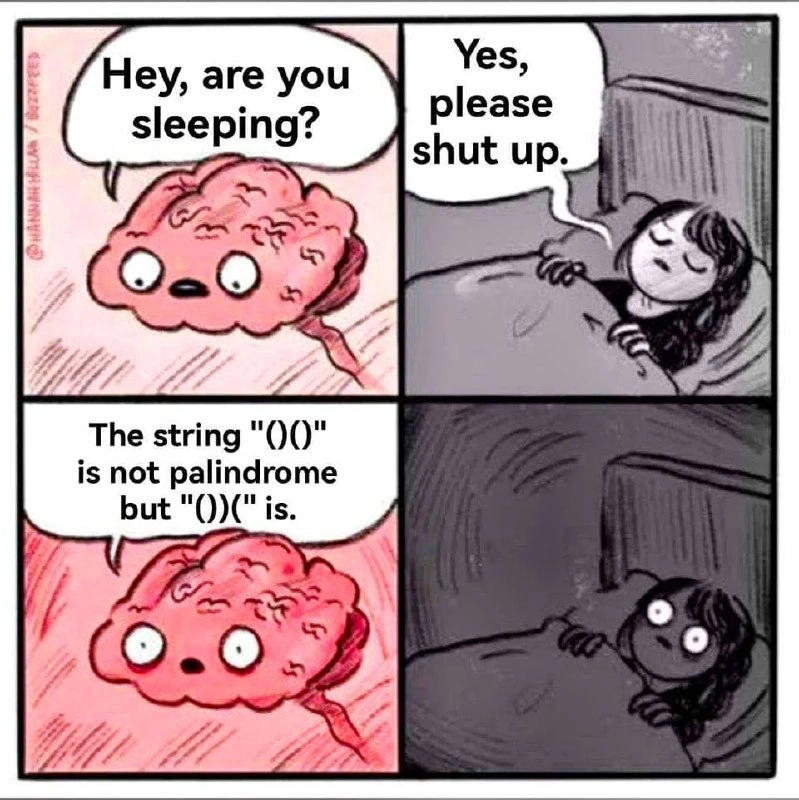
Imagine you’re snug in bed, almost asleep, and then your brain whispers a random riddle in your ear – something utterly unhelpful like, “Did you realize that one pattern isn’t the same backwards, but this other goofy pattern is?” Suddenly, you’re wide awake, thinking “Huh, really? That’s so weird!” This meme shows exactly that feeling. In the pictures, a pink cartoon brain asks a woman in bed if she’s sleeping. She says “Yes, please shut up.” (She just wants to sleep!) But the brain excitedly blurts out a weird little puzzle: one string of brackets ()() doesn’t read the same in reverse, but another string ())( does. Now, you don’t actually need to know anything about code or brackets to get the point: it’s a totally random fact, and it makes the woman’s eyes fly open in the dark. Why? Because once someone says a strange fact like that, it’s hard not to think about it! It’s like if you were about to doze off and a friend leaned over and said, “Hey, did you know the word ‘desserts’ backwards is ‘stressed’?” You might not have wanted to hear anything, but now your mind is turning it over and you’re suddenly more awake.
The humor here is that our brains can be troublemakers. Late at night, when we desperately want to rest, sometimes our mind starts playing mind games. It might remind us of something silly or worrying – anything to keep busy. In this case, it’s a super niche little brain teaser about a mirror-like word puzzle (palindrome) and matching pairs puzzle (brackets). The woman’s reaction – those big, round, startled eyes – is funny because it’s so relatable. We’ve all had moments where a random thought or fact pops up in our head at the worst possible time, and suddenly we’re completely awake thinking about it. It could be as simple as remembering an embarrassing moment from years ago, or some useless trivia, but it has the same effect: goodbye sleep.
So in plain terms, this meme is like a bedtime story gone wrong. Instead of counting sheep or drifting into dreams, the brain decides to tell a riddle. And not even a normal riddle – a really nerdy, picky one about sequences of parentheses! That absurdity is what makes it so amusing. You don’t need to understand the details of the riddle to get the joke: the content is deliberately odd. What matters is the feeling: that little voice in your head can sometimes be your own worst enemy when you’re trying to sleep. It’s poking you with “Hey, think about this!” and you’re left staring at the ceiling, wide-eyed, exactly like the woman in the final panel. In short, it’s funny because it’s true – our brains can be insomniac pranksters, and even a tiny, goofy thought at 2 AM can flip your night from peaceful to perplexed in an instant.
Level 2: Palindromes vs Parentheses
Let’s break down the actual tech trivia the brain is torturing her with. We have two different concepts here, both common in programming and CSFundamentals:
A palindrome is a string that reads the same forwards and backwards. For example,
"racecar"is a palindrome because if you reverse the order of its letters, you still get"racecar". Same with"level"or"madam"or even"10101". A quick way to check a palindrome in code is to reverse the string and compare it to itself. In Python, for instance:def is_palindrome(s: str) -> bool: return s == s[::-1] # s[::-1] creates a reversed copy of the stringIf
is_palindrome("racecar")returnsTrue, butis_palindrome("hello")returnsFalse– as expected, since"hello"backwards is"olleh", not the same.Balanced parentheses means that in a string composed of just parentheses characters
(and), every opening parenthesis has a matching closing parenthesis in the correct order. It’s like validating that parentheses are properly nested and closed, which is crucial in math expressions or code. For example,"()"or"(())"or"()()"are balanced because they make sense as pairs. But")("or"())("or"(()"are not balanced. Commonly, we use a stack or a counter to check this. Here’s a simple approach in Python:def is_balanced_paren(seq: str) -> bool: count = 0 for char in seq: if char == '(': count += 1 # Found an open parenthesis elif char == ')': count -= 1 # Found a close parenthesis if count < 0: # A closing came without a matching opening return False return count == 0 # True if all opens were matched and closedUsing this:
is_balanced_paren("()()")would returnTruebecause we have two pairs correctly ordered. The counter goes +1, -1, +1, -1 and never drops below 0, ending at 0.is_balanced_paren("())(")would returnFalse. Stepping through:(gives count=1, then)gives count=0, another)makes count=-1 (oops, too many)early!), so it flags unbalanced immediately. Indeed,"())("tries to close more parentheses than opened in the first half of the string.
Now the brain’s mischievous statement: "()() is not a palindrome but ())( is." Let’s verify that:
- The string
"()()"forward is()()as given. If we reverse it, we swap the order of characters: it becomes")(")((i.e.,")()("). That reversed string")()("is clearly not the same as the original()(). So yes,"()()"is not a palindrome. It’s balanced, but not symmetric in that mirror-image way. - The string
"())("forward is exactly those four characters. If we reverse it, let’s do it carefully: the original sequence of chars is('(', ')', ')', '('). Reversed, it becomes('(', ')', ')', '(')– actually identical to the original! So"())("is a palindrome because reading it backwards yields the same sequence())(. However (and this is the kicker),"())("is not a valid parentheses sequence. As we saw with the counter, it fails the balance test (an extra)appeared too soon). It has the right number of each bracket (two of each), but in the wrong order.
So why is this interesting or funny? Because typically when programmers deal with strings of parentheses, we care about them being balanced (especially if it’s code or math). And when we deal with palindromes, we’re usually thinking of alphanumeric strings (words, sentences, numbers) that read the same backwards. It’s not often that someone asks, “Hey, what’s a palindromic sequence of parentheses?” In fact, that question itself is a bit of a palindrome_paradox: a palindrome cares about symmetric order, while balanced parentheses care about matching pairs. They’re completely separate concerns. You normally wouldn’t apply a palindrome check to a parentheses string, because whether ())( reads the same backwards is irrelevant if you’re checking for correctness of parentheses placement, and vice versa.
LateNightCoding sessions, however, can mash concepts together in weird ways. If you’ve been grinding on coding problems or debugging, you might have written both kinds of functions (one to reverse strings or check palindromes, another to validate parentheses). Maybe earlier that day the developer in the meme was working on a piece of code dealing with parentheses (say a parser or a calculator) and also reviewing a utility from some StringHandlingLibraries for palindromes. It’s easy to imagine a tired brain merging the two topics. The result is this random factoid that sounds like it could be important (“one string isn’t a palindrome, the other is”) but in context is just RelatableHumor — it’s a brain glitch. It shows how a programmer’s mind, even when trying to rest, keeps churning through trivial test cases or combining CS fundamentals in odd ways.
For a junior developer or a student, this meme is also a quick lesson: always know which property you’re checking for. A string might meet one criterion and utterly fail another. If someone wrote a test that mistakenly treated palindromic order as a sign of correctness for parentheses, they’d get a false positive with ())( – clearly a bug! This comic exaggerates that idea for laughs. The take-home concept is simple though:
- Palindrome check: is the string the same backwards?
- Balanced parentheses check: do all
(and)match up in the right order?
They intersect here in a funny way, but generally, one doesn’t substitute for the other. And yes, it’s absolutely the kind of weird example you might joke about during DeveloperHumor chats: “Technically, ())( is a palindrome… just not one you’d ever want in your code!” The poor woman in the meme probably knew both these facts individually; it’s just that her brain decided to present them as a brain_teaser when she least wanted to think about algorithms. That’s why it’s funny and so true to life for anyone who’s spent long hours immersed in code and then struggled to sleep while their brain keeps running unit tests on random thoughts.
Level 3: Edge-Case Insomnia
For seasoned developers, this scenario is painfully relatable – it’s late-night coding brain in a nutshell. All day you might be writing code or solving problems about strings, palindromes, balanced brackets, etc., and then at 2 AM, just when you’re finally drifting off, your brain goes: “Psst, what about this weird edge case?”. The meme nails that experience. The brain character leaning in with wide anxious eyes represents those intrusive thoughts every programmer has had: the sudden recollection of a corner-case you didn’t consider or a bizarre coding trivia that your mind serves up unbidden. Here it happens to be a cheeky piece of AlgorithmHumor: the brain blurts out, “The string ()() is not a palindrome but ())( is.” On the surface it’s a trivial string fact, but it’s exactly the kind of relatable humor that gets developers chuckling – and groaning – because it’s so true. We’ve all been there: lying in bed and our brain_wont_sleep, fixating on some leftover puzzle from the day’s coding session or a sudden doubt about whether that function will handle a bizarre input.
The humor works on multiple levels. Technically, it’s contrasting two string tests a developer might write: isPalindrome(s) vs isBalancedParentheses(s). In practice, these are completely unrelated checks – one cares about symmetric order of characters, the other cares about correctly nested structure. But at 2 AM, the overactive programmer brain finds a way to conflate them, serving up a random trivia nugget that’s both nerdy and useless (“not palindrome vs is palindrome”) just to keep you awake. It’s the absurdity of algorithmic edge-case meets insomnia. Seasoned devs recognize the pattern: after marathon LateNightCoding sessions or high-pressure debugging days, the mind can latch onto the tiniest detail – the sort of detail that might pop up in a tricky code review or a whiteboard interview – and then relentlessly obsess over it.
From a senior perspective, this also pokes fun at how our brains are basically running background processes all the time. When the comic’s brain says “Hey, are you sleeping?”, it’s exactly like those real-life moments where you’re almost asleep and then a mental alert fires: Did I consider the input where the string is just punctuation?, What if the user’s name spelled backwards is the same?, or Wait, does my algorithm treat ")(" strangely?. It’s like an unwanted on-call page from your own mind. And naturally, the “user” – in this case the tired woman – snaps wide awake with a WTF expression, because now that thought is in there, it’s impossible to ignore. Developers find this funny because it’s a shared experience: the number of times we’ve stared at the ceiling, brain buzzing with code, cannot be overstated. It’s a mix of CS_Fundamentals meets MentalHealth: we laugh, but we also empathize, because we know how unhealthy it is when you can’t mentally clock out. And of course, the particular factoid the brain chose is deliberately goofy – who cares if a nonsense string like ())( is a palindrome? It doesn’t matter at all… except now it’s in your head. The meme cleverly captures that ironic betrayal by your own intellect.
On another level, experienced devs chuckle at the specific content of the brain’s babble because it resembles those overzealous test cases or tricky interview questions that catch you off guard. Palindrome paradox scenarios or tricky string problems are common in coding interviews and competitive programming. Many of us have spent way too long on a LeetCode problem about palindromes or parentheses. That trauma means hearing “not palindrome vs is palindrome” about such strings strikes a chord. A senior engineer might also recall debugging code where someone accidentally mixed up two operations (like checking a string backward instead of verifying structure) – this could lead to a real bug if, say, you mistakenly thought a symmetric string must also be valid or vice versa. In a real system, confusing these checks would be nonsense, but the very absurdity is the point. It’s DeveloperHumor exposing how our minds sometimes work: we keep flipping problems around in our heads, even when we should be resting.
Finally, the format itself – a brain talking to its awake-but-exhausted owner – is a popular template online because it’s so accurate about nighttime_algo_thoughts. The developer community finds it hilarious because it validates a common struggle: the inability to switch off analytical thinking. It’s almost a rite of passage in software development: you know you’re truly in it when you’ve lost sleep over a 4-character string’s property or some similarly tiny detail. In short, the meme is roasting that aspect of programmer life where relatable humor meets a touch of painful truth. The next morning, you’ll probably laugh at how silly it was – but at 2 AM, oh boy, it feels crucial!
Level 4: Symmetry vs Syntax
At the deepest theoretical level, this meme highlights a clash between two fundamental formal language properties: palindrome vs well-formed parentheses. In computational theory, balanced parentheses belong to the famous Dyck language – a set of strings generated by a context-free grammar (every ( must eventually be closed by a )). This pushdown automaton realm (think of a stack machine) enforces a strict structure: a valid parentheses sequence can never start with a ) or end with a (. In contrast, a palindrome is a string that reads the same forwards and backwards – a property of symmetry rather than syntax. The brain’s 2 AM revelation that ()() is not a palindrome but ())( is one, underscores a neat quirk of these languages. Formally, aside from the empty string, no non-empty balanced parentheses string can be a palindrome. Why? Because any valid parentheses string of length > 0 must begin with '(' and end with ')'. If you reverse it, you’d start with ')' – instantly invalid as a balance, and obviously not equal to the original. Thus "())(" stands out as a weird specimen: it is symmetric (palindromic) since reversing its four characters yields the same sequence, yet it’s deeply ill-formed in terms of pairing rules. This contrast touches on how different computational checks operate: a palindrome checker scans from both ends (or uses half-memory to mirror the string), while a parentheses validator uses a stack discipline to ensure every opener is properly closed in order. The brain, in its insomnia-fueled curiosity, is essentially doing a mini language theory analysis at 2 AM – juxtaposing a mirror property against a context-free structural property. For a weary developer who might have studied automata or algorithm puzzles, this midnight thought is like a warped parsing puzzle: a reminder that symmetrical text ("())(") can flout all the logical rules of code syntax. It’s a subtle nod to CS fundamentals – the kind of detail you’d find in an algorithms or formal languages class, now invading the cozy darkness of bedtime. The humor emerges from this high-level paradox: the brain drags you into contemplating the constraints of formal grammars and the quirks of string algorithms at an hour when most sane parsers have shut down. It’s algorithmic trivia turned into a sleep-deprivation stunt, as if your brain decided to run unit tests on theoretical concepts while you’re off the clock.
Description
A four-panel 'brain won't let me sleep' comic. Panel 1: Brain says 'Hey, are you sleeping?' Panel 2: Person replies 'Yes, please shut up.' Panel 3: Brain reveals 'The string "()()" is not palindrome but ")()(" is.' Panel 4: The person is now wide awake with huge eyes, disturbed by this realization. The comic plays on the unsettling CS insight that balanced parentheses '()()' are NOT a palindrome (reversed would be ')()('), while the unbalanced, invalid parentheses ')()(' ARE a palindrome -- a fact that violates every developer's intuition about what 'correct' looks like
Comments
21Comment deleted
The universe's cruelest joke: balanced parentheses aren't palindromes, but unbalanced ones are. This is why Lisp developers have trust issues
My brain is a QA engineer that only files P0 bugs in my mental Jira board at 3 AM
Classic insomnia pipeline: O(n) palindrome check passes, stack-based parenthesis validator never gets scheduled, and now the alerting system (a.k.a. your eyelids) is stuck in 100 % CPU spin
After 20 years of implementing balanced parentheses validators and palindrome checkers, the real bug is that your brain's background thread has no graceful shutdown mechanism and keeps throwing exceptions at 3 AM about strings that would fail both your unit tests AND your code review
The real horror isn't that '()(' is technically a palindrome - it's realizing at 3 AM that your production bracket-matching validator has been using string reversal instead of stack-based parsing for the past two years, and now you're mentally auditing every edge case while your brain gleefully reminds you that palindrome checking is O(n) but your sleep debt is O(n²)
Brain's isPalindrome('00') returns false - classic off-by-one in the wetware string library's mirror neuron indexing
2am brain preempts the sleep thread to benchmark invariants: balanced ≠ symmetric; ')()(' passes palindrome but fails the stack - proof our properties don’t commute and neither does REM
Midnight reminder: balanced parentheses is a stack problem and palindrome is two‑pointers - somewhere there’s a validateParens(s) that does s == reverse(s) and it still passed code review
this is quite obvious, isn't it? Comment deleted
it is logically obvious, but thinking visually it isnt, 'cause brackets pair looks like a single unit, while it actually isn't Comment deleted
math tricks Comment deleted
mirrored opticaly from the middle line against mirroring characters. yes Comment deleted
yes Comment deleted
yes , ()() -> abab ())( -> abba Comment deleted
just as the fact that this comment of yours wasn't by any means needed here, it sounds just like this pic personified this isn't fucking obvious at all if you don't think about it for 5+ seconds, and that's why the meme is funny Comment deleted
nah. I'm a mathematician, it's native to me. Comment deleted
you see, when you look at a "()", you think that reversed it should remain a "()", because it looks like it is uncuttable, but it becomes ")(", and here you awake Comment deleted
Ngl I doubted for a moment Comment deleted
pathetic fun killer. Comment deleted
sometimes it's hard to comprehend, what other people don't understand, what you did natively all live long. Comment deleted
There's only one correct bracket sequence that is not a palindrome — an empty string You can see it by looking at the production rules of a Dyck language Comment deleted