When even sudo can’t grant your brain permission to wake up
Why is this CLI meme funny?
Level 1: Even Sudo Fails
Imagine you’re trying to wake up in the morning and it feels like there’s a stubborn security guard keeping your eyelids shut. In this meme, your brain is like a person saying “Hey, time to get up!” but your sleepy body is like a locked door replying “No! You’re not allowed in here yet.” Normally, if you really need to get through a locked door, you’d call someone with a master key. In computer terms, that master key command is sudo – it’s like saying “I have special permission, open up!” So your brain tries the master-key approach: “Pretty please, with admin on top, OPEN!” But guess what? The body still refuses and basically says, “Your brain isn’t on the list of people allowed to use the master key. And I’m telling the authorities that you tried!”
In everyday words, it’s a silly way to show how hard it is to wake up when you’re really tired. Even the brain’s big guns (like the equivalent of a parent using full Name-Middle-Name-Last-Name authority voice) don’t work. The phrase “This incident will be reported” is like when a kid says “I’m gonna tell mom you tried to make me get up!” The meme makes us laugh because it mixes something very human (not wanting to leave a comfy bed) with the exact words a computer would use if you tried to do something you weren’t allowed to. It’s funny and cute – basically saying “Not even the strongest computer command (sudo) can make me wake up when I’m this sleepy.”
Level 2: Permission Denied IRL
Let’s break down the technical references so even newer developers or curious onlookers can get the joke. This meme is packed with CLI (Command Line Interface) humor, so we’ll unpack it piece by piece:
CLI (Command Line Interface): This is a text-based way to interact with your computer by typing commands into a terminal. Instead of clicking icons or buttons, you might type commands like
lsto list files orgit pullto get code updates. It looks like a black or colored window with text (often called the terminal or console). The meme’s dialogue is formatted just like what you’d see in a CLI session, with commands and error messages.sudo: Pronounced “sue-doh” or “soo-doo” (stands for super user do), this command tells the system “run the following command with administrative privileges.” On Unix/Linux systems, there is a special user named root (also called the superuser) who has permission to do anything (think of root as an all-access administrator account). Normally, your day-to-day user account has limited permissions for safety – you can’t just install programs or read any file unless you have rights. By typingsudobefore a command, you’re requesting temporary superuser powers to execute that one command. The system will usually ask for your password to confirm you’re allowed to do this. In casual geek speak, “did you try sudo?” is like asking “did you try using admin mode to force it through?”/etc/sudoersfile: This is a configuration file (on Linux and Unix-like systems) that lists which users are allowed to use thesudocommand and what they’re allowed to do with it. Thesudoprogram checks this file to decide, “Is this user permitted to act as a superuser?” If your username isn’t in that file (or in a group listed in that file), then you’re not allowed tosudo. Think of it as a VIP list for who can get backstage access (root privileges) on the system. There’s even a special safe editor commandvisudothat sysadmins use to edit this file (to avoid typos, because a broken sudoers file can lock everyone out — yikes!). In many Linux distributions, the first user created on the system is automatically put in the sudoers (often via a group like sudo or admin), but if not, you have to manually get added.“Permission Denied”: This is a common error message that means exactly what it says – you tried to do something and the system said “No, you don’t have permission to do that.” On a computer, you’ll see this if you, say, try to open a file or execute a program that your user account isn’t allowed to. For example, if you attempt to edit a system configuration file as a normal user, the shell might respond with
Permission denied. It’s like tugging on a locked door – the system is telling you “stop, you’re not authorized.”“brain is not in the sudoers file. This incident will be reported.”: This entire line is a direct copy of what a Linux system might output if user
braintried to usesudowithout being allowed. Replace "brain" with any username (like if Alice tries and isn’t in sudoers, it would say “alice is not in the sudoers file…”). The first sentence is straightforward: user not in sudoers file means they’re not on that VIP list we mentioned. The cheeky part is the second sentence: “This incident will be reported.” On an actual computer, this usually means the attempt has been logged for system administrators to review (it’s not literally emailing the cops or anything, just going into a log file). It sounds menacing, which is why it’s funny in this meme context – it’s like the body is threatening the brain, “I’m telling on you!”
Now, how do these tech terms map to the scenario in the comic?
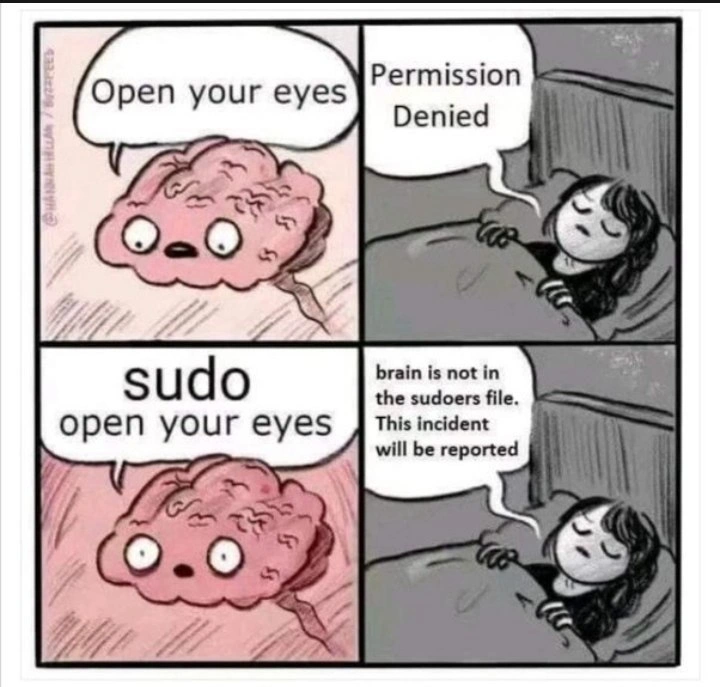
In Panel 1, the brain says “Open your eyes” – imagine the brain is a user in a terminal trying a command named
openon the resourceyour eyes. Of course, in reality, you can’t just type a shell command to wake up a human, but that’s the joke: the brain is treating waking up like running a program. This is the initial attempt without admin rights.Panel 2, the body or subconscious replies “Permission Denied.” In real life, that’s just you thinking “Nope, not getting up!” But by phrasing it as a computer error, it humorously implies that the body refuses the command because the brain-user doesn’t have the rights to force wakefulness. Maybe the body is saying, “I, as the system, require more authority to do that action (like more sleep or an alarm).”
Panel 3, the brain ups the ante with
sudo open your eyes. This is the brain going “Alright, I’m taking admin control to get us out of bed.” It’s akin to when you’re trying to install software and the system says no, so you runsudo make installto override. Here the brain is basically taking a deep breath (perhaps imagining a shot of espresso as ‘sudo’) to command the body with ultimate authority: “Wake up NOW, because I said so with root power!”Panel 4 delivers the punchline: the body says “brain is not in the sudoers file. This incident will be reported.” This means the brain’s attempt to use admin privileges failed — the body doesn’t recognize the brain as an authorized superuser. If we extend the metaphor, perhaps the body (like an operating system) only grants superuser access to some other entity (maybe our survival instincts or an external stimulus like a blaring alarm clock – those might be the real “root user” that can definitely wake you). The “incident will be reported” part is just exaggeration for humor – in a computer, it’s logged to a file, but here it sounds like the body will snitch. Maybe that implies consequences, like if you oversleep (unauthorized action) your boss will hear about it (reported incident)!
In simpler terms, the comic uses a well-known UnixCommands sequence to describe a person struggling to wake up. It’s funny because it treats something very human (being sleepy) as if it were a computer security problem. Every element of the meme corresponds to a bit of tech jargon:
- The brain = a regular user account, trying to execute a command (waking up).
- “Open your eyes” = the normal command (like double-clicking a program, but here it’s metaphorical for waking up).
- Permission denied = the body saying “nope, you lack authority” (like a protected file that refuses to open for you).
- sudo = the brain saying “let’s try that with superuser powers” (like saying “I’m the admin, do it”).
- Not in the sudoers file = the system (your body) saying “I don’t care who you think you are, you’re not on the approved list to do that.”
- Incident will be reported = a playful threat that this rebellious attempt is logged somewhere (maybe in the cosmic record of bad mornings, or just a nod to the exact phrasing Linux uses, adding to the authenticity of the joke).
For a junior developer or someone new to Linux, it’s worth noting that messing with sudo and not being in the sudoers file is a common stumbling block. If you get that message on a real machine, the solution is to log in as an admin or root (if possible) and add your user to the sudoers (often by adding to the sudo group or editing the file via visudo). Of course, in real life waking up, the “solution” might be as simple as an extra alarm or, more realistically, getting more sleep so your brain is recognized as the authority to wake your body.
Finally, the categories “CLI” and “OperatingSystems” are spot on for this meme. CLI because it’s all about command line jokes; OperatingSystems because the joke revolves around how operating systems handle permissions. The tags like TerminalHumor, UnixCommands, and sudoers_file underline that if you know your way around a terminal, you’ll likely immediately get why this is funny. And if you’re new to it, now you know: it’s basically a nerdy way to say “I was so tired this morning, not even the ultimate power user command could get me out of bed.”
Level 3: No Root for the Weary
For seasoned developers and sysadmins, this meme hits on multiple levels of relatable humor. First, there’s the literal technical joke: seeing the phrase “Permission Denied” and “not in the sudoers file. This incident will be reported” immediately recalls countless terminal sessions. If you’ve ever SSH’d into a new server or spun up a fresh Linux install, only to find your user can’t apt update or tail a log because whoops, you’re not in the sudoers list, you know that mini heart-attack. It’s a rite of passage in DevOps or system administration – you type a command, get a permission_denied_error, then sheepishly remember you need elevated rights. The classic fix: switch to an admin account or add yourself to the sudoers. In corporate settings, not being in sudoers might mean filing a ticket with IT (meanwhile, the system logs your forbidden attempt with that ominous “incident will be reported” line, as if you tried to break into Fort Knox). So when the person in the comic refuses to wake up with a deadpan “Permission Denied”, experienced folks chuckle – it’s the TerminalHumor equivalent of hitting the snooze button on an alarm, but geekified.
The second layer of humor is the anthropomorphic brain acting like a frustrated sysadmin. In panel 1, the brain (clearly the voice of reason or responsibility) says “Open your eyes” – basically trying the normal CLI command for waking up. Panel 2, the body (or subconscious) throws back a standard OS response: “Permission Denied”. This is funny because it’s exactly what a Unix-like system replies when a regular user tries to do something they shouldn’t (like reading a root-owned file or executing a restricted command). The brain’s face is drawn with this bulging-eyed alarm – any developer who’s been denied access when something urgent is needed can relate to that “What do you mean denied?!” feeling. It’s 6 AM, you have a stand-up meeting in 30 minutes, and your body says nope. The panic is real.
Now the brain escalates: Panel 3 has the brain shouting “sudo open your eyes”. Every programmer knows that adding sudo in front of a command is like yelling “I’m the admin, do it anyway!” to your computer. It’s the closest thing to a universal cheat code in the command_line_interface world. By invoking sudo, you’re saying “I have the power, just execute this.” The humor here is that the brain is effectively trying the ultimate life-hack: If polite requests won’t wake this human up, let’s try a root-level override! It mirrors those times when you’re working with a locked-down system and just decide to go full superuser to get what you need. The brain’s frantic expression in the comic’s third panel captures that OK, we’re doing it live with admin privileges energy.
But then comes the twist in Panel 4 – the body responds with the dreaded multi-line rejection: “brain is not in the sudoers file. This incident will be reported.” This is an exact quote many of us have seen (with our own username instead of "brain", of course) when we foolishly assume we had sudo rights. For a veteran dev, it’s practically muscle memory to check /etc/sudoers or the admin user group when setting up a new machine. If you see that message in real life, you know you’ve hit a wall: the system will not honor your sudo request, and moreover, it just tattled to the logs (or an admin monitoring system) that you tried. The meme exaggerates this into a life scenario – implying maybe some higher authority (like the sleep police? your future self?) is notified that the brain attempted an unauthorized “wake-up” override. It’s a brilliant cross of contexts: a sleepy person refusing to wake up is equated to a machine refusing an unauthorized command.
Let’s also appreciate how the visual style contrasts the pink brain issuing commands on a bright backdrop (like a terminal with root access vibes) with the grey, groggy bedroom for the responses (like a dark, locked-down system). It’s a playful nod to how vibrant and insistent our conscious mind can be, while our half-asleep body is in dark mode, locked behind security like an OS in sleep. Devs chuckle because it’s so true: sometimes no amount of mental sudo can override physical exhaustion! It’s an everyday struggle expressed in nerdy terms.
Real-world scenario for senior engineers: think of those times you’re on-call at 3 AM, pager goes off, brain wakes up and says “We gotta fix the server, open your eyes!” and your body basically returns a 403 Forbidden – your eyes literally refuse to open. You might joke later, "Ugh, my brain wasn’t in the sudoers file, I couldn’t wake up in time." It’s gallows humor for anyone who’s been bleary-eyed in front of a terminal, trying to summon the willpower (or privileges) to do something critical. We’ve all known the pain of commanding something (be it a computer or ourselves) and getting stonewalled.
The meme also hints at a best practice by its absurdity: in Unix, you ideally set up proper permissions before you need them. Likewise, maybe don’t skimp on sleep if you expect your brain to have root access to your morning routine. A senior dev might quip, “Should’ve added brain ALL=(ALL) NOPASSWD: /usr/bin/open_eyes to the sudoers last night.” In other words, prepare your environment (or yourself) so you’re not caught locked out. It’s a funny reminder that even powerful tools have limits. Not even Linux’s ultimate admin command can help if the account isn’t cleared – and not even strong coffee (the real-world sudo, perhaps) can always immediately clear that morning grogginess if you’re truly exhausted.
To illustrate the technical joke, here’s what the exchange might look like in a terminal if the brain were an actual user account trying to run a wake-up command:
brain@bedroom:~$ open your eyes
Permission denied
brain@bedroom:~$ sudo open your eyes
[sudo] password for brain:
brain is not in the sudoers file. This incident will be reported.
Oof, talk about a terminal case of oversleeping! The snippet above is exactly how a shell would respond, down to the phrasing (except of course “open your eyes” is a fictitious command – in real life it might be something like sudo systemctl wakeup if that existed). The TerminalHumor lands because any Linux user instantly recognizes this pattern. We’ve all been the “brain” user at some point, hitting a wall of permissions. And just as the system would log and notify about unauthorized root attempts, maybe our coworkers (or family) will “report the incident” when we stroll into work late, eyes barely open.
In summary, this meme resonates with the tech crowd through a clever mashup of a mundane human experience (struggling to wake up) with spot-on nerdy references (Unix permission errors). It’s both a chuckle at the literal scenario – a desperate brain trying the one command that fixes everything in sysadmin land – and a nod of commiseration that sometimes, despite all our powerful tools and commands, we simply can’t bypass the fundamental limitations, whether of a secure OS or a sleep-deprived body. UnixCommands meet Monday mornings: and as any senior dev would sigh, “Even sudo can’t fix Mondays.”
Level 4: Userland vs Dreamland
In the *nix world of operating systems, privilege separation is a foundational security concept. Regular processes (and users) run in userland, which has restricted permissions, while the all-powerful root user (UID 0) operates with full control over the system (akin to running in the OS kernel or having superuser privileges). In this meme, the brain is humorously cast as a normal user-level process trying to perform a privileged operation – waking the body up. The body’s refusal (Permission Denied) mirrors how an OS kernel would block a user request that requires higher privilege.
Under the hood, commands like sudo (superuser do) leverage a special permission escalation mechanism. On Linux/Unix, sudo is often configured as a setuid program – it runs with the effective user ID of root. When you prepend sudo to a command, you’re asking the system’s privilege control to run that command as root (or another authorized user). But there’s a catch: only users listed in the /etc/sudoers file (or an included group, like the sudo group on many distros) are allowed to use sudo. This file is parsed by the sudo program (historically via the libsudoers library) to verify if the invoking user (in our case, the brain user) is on the “guest list” of trusted sudo-capable accounts. If not, sudo isn’t going to elevate anything – just as our sleepy body isn’t going anywhere without proper authorization. The error message “brain is not in the sudoers file” is a faithful reproduction of what Unix systems spit out if you try to sudo with an unauthorized account. By design, such attempts are logged (hence “This incident will be reported”), typically via syslog to files like /var/log/auth.log. It’s a tongue-in-cheek way of saying the system (or perhaps your sleep schedule OS) is tattling to the sysadmin (maybe analogous to your future self or boss) about this sneaky privilege attempt.
Delving deeper, this scenario highlights the principle of least privilege in a comedic context. Just as operating systems won’t grant full access to every process unless explicitly allowed (for fear of chaos or security breaches), your body won’t let a groggy brain recklessly override the all-important sleep state without proper “authority.” We could even stretch the analogy to imagine the brain and body as separate processes in a distributed system: the brain issues a request to a service (your eyes) to change state (from closed to open). However, the access policy (like a strict access control list in the linux_permission_system) denies it. No amount of command injection will bypass the fundamental governance – in computing, that’s the kernel’s user permission checks; in biology, it’s perhaps your circadian rhythm or sheer exhaustion. Essentially, the meme humorously posits that even root privilege (the ultimate superuser power) isn’t enough to violate the laws of biology; the hardware (your body) enforces its own safety limits much like a CPU’s microcode might prevent dangerous operations.
Historically, the introduction of sudo in the early 1980s was a game changer for Unix multi-user security, allowing fine-grained admin rights. It’s ironic here because sudo is the magic word sysadmins use when all else fails (“Did you try running it with sudo?” is a common refrain). Yet, in this comic, even the magic word fails spectacularly. This futile escalation attempt tickles engineers who know that feeling when you’re so deep in sleep that not even the root user of your own mind can lift you out. It’s a playful nod to the limits of both system design and human biology, where some states (system sleep vs. human sleep) simply aren’t easily overridden without the right context or authority. The brain_vs_sleep standoff is real: it’s a deadlock where no amount of brute force or privilege escalation can immediately solve it – a bit like trying to modify a read-only mounted filesystem (you’ll just get a stern refusal from the OS). By starting at this conceptual level, the meme sets up a scenario that tickles the fancy of those who appreciate how operating systems enforce rules, drawing a parallel to our own bodies’ rules. The result? A kernel of truth in a joke about being unable to wake up.
Description
Four-panel comic meme. Panel 1 (top left, pink background): a cartoon brain with bulging eyes says, “Open your eyes”. Panel 2 (top right, grey bedroom scene): a person lying under blankets replies, “Permission Denied”. Panel 3 (bottom left, same pink backdrop): the brain, now panicked, commands, “sudo open your eyes”. Panel 4 (bottom right, same grey bedroom): the sleeper answers, “brain is not in the sudoers file. This incident will be reported”. The meme visually contrasts the pink brain panels with the dark sleepy panels and parodies Unix/Linux privilege escalation - highlighting that without sudoers entry, root-level commands, even motivational ones, are refused
Comments
15Comment deleted
Turns out my brain is running in a read-only Alpine container; every 03:00 ‘sudo wake-up --now’ just triggers a CrashLoopBackOff and another PagerDuty alert to Slack
When you've been debugging production for 20 years and your body's access control system is more secure than half the startups you've consulted for
When your brain tries to sudo its way past your body's access controls but forgot it was never added to /etc/sudoers - a classic privilege escalation failure. At least the incident gets logged to /var/log/auth.log, though nobody's monitoring that at 3 AM. This is why you always configure your sudoers file properly before production deployment of consciousness
open(eyes) returned EACCES; sudo denied - not in sudoers. Nice to see least privilege finally enforced, pity it’s on the human that’s on-call
At 06:00 my cortex runs Zero Trust - eyes are a protected resource and coffee is the only IdP; until the caffeine token hits PAM, every sudo attempt is dutifully logged to syslog
Elevated privileges useless against sleep debt's unpatched kernel panic - reboot required, no zero-downtime option
$ systemctl start paralysis-daemon Comment deleted
sudo systemctl start cat-spin Comment deleted
paralysisd Comment deleted
Also if he can't make her open her eyes, demon is useless Comment deleted
more like brain is in sudoers file and I'm not Comment deleted
No access to brain? 🥲 Comment deleted
$ brain solve unnamed1.problem acces denied Comment deleted
Me on exam after studying for it for months: Search returned to results. Comment deleted
Hotel? Comment deleted