A Student's True Passion: An Intricate Boolean Algebra Proof
Why is this CS Fundamentals meme funny?
Level 1: Homework & Hearts
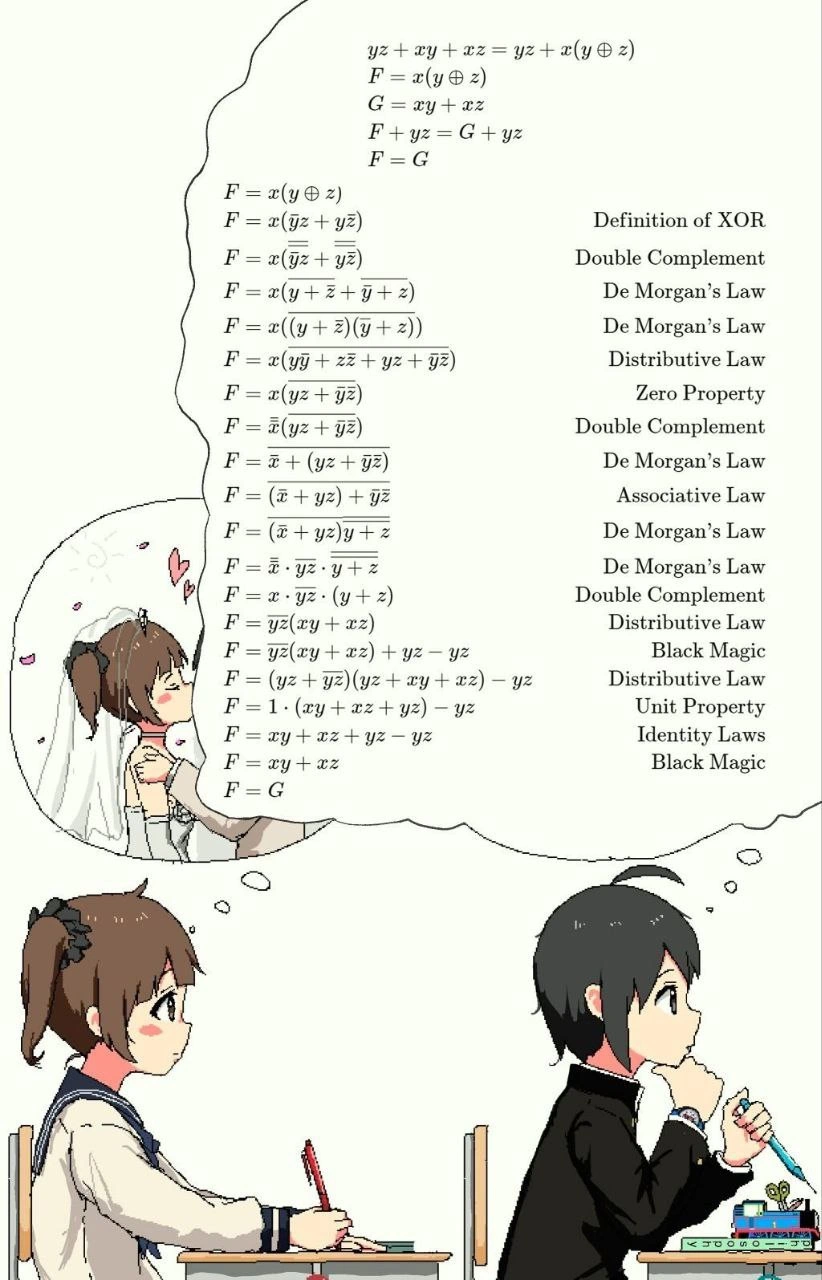
Imagine a girl in math class who’s thinking waaay too hard about a problem and also daydreaming about the boy she likes – all at the same time. In the picture, above her head is a giant cloud showing what’s going on in her mind. Inside that cloud, she’s solving a big puzzle step by step, writing down every single math rule she knows (even a pretend “magic happens here” step when she gets stuck!). And tucked between all those serious math lines, there’s a little cartoon of her wearing a wedding dress, hugging that boy with hearts all around. 💖 In front of her, the actual boy is just sitting there, not really thinking about anything in particular – his thought bubble is totally empty. This is funny because the girl’s brain is doing cartwheels (math cartwheels and love cartwheels!), while the boy’s brain is like a calm, blank page. It’s like someone doing a huge, complicated doodle to answer a simple question, and in that doodle they also imagine a happily-ever-after with their crush. Meanwhile the person they have a crush on is just doodling nothing at all. The contrast is adorable and silly: she’s overthinking everything – the homework and a fairy-tale romance – and he’s just quietly chewing his pencil. We laugh because we’ve all felt a bit like that girl at some point, overcomplicating something simple or daydreaming when we’re supposed to be studying. It’s a cute reminder that our minds can get carried away, mixing hard work with heart feelings, and that can look pretty comical from the outside!
Level 2: Booleans & Boyfriends
Let’s break down what’s going on in simpler terms (and why it’s funny to people in tech). The meme shows a girl in class with a gigantic thought bubble full of Boolean logic – basically, math with TRUE/FALSE values instead of numbers. Boolean algebra is a fundamental part of CS (Computer Science) where we use rules to simplify expressions that involve things like AND, OR, and NOT. In her notebook, she has something like yz + xy + xz = yz + x(y ⊕ z). This is a fancy way of saying: “if X, Y, and Z are true/false values, then having (Y AND Z) OR (X AND Y) OR (X AND Z) is the same as having (Y AND Z) OR (X AND (Y XOR Z)).” She’s calling the left side G and the right side F, and her goal is to prove F = G (they’re equal for all values of x, y, z). If you’ve taken a discrete math or digital circuits class, you’ve done exactly this kind of boolean_algebra_proof – taking two logic formulas and using identities (like algebraic laws) to show they’re equivalent. Each line in her thought bubble is one step of that proof, annotated with the rule that justifies going to the next step. For example:
- Definition of XOR – XOR means “exclusive OR.” It’s true when exactly one of the inputs is true (one or the other, but not both). In algebraic form, ( y ⊕ z ) can be written as ( (y \land ¬z) \lor (¬y \land z) ). So one of her first steps is probably expanding ( x(y ⊕ z) ) into ( x((y \land ¬z) \lor (¬y \land z)) ) using this definition. It’s like saying “I want to work with basic ANDs and ORs only, so let’s rewrite XOR in that form.”
- Double Complement – This is a rule that says if you take the NOT of a NOT, you get back the original value. In symbols, ¬(¬A) = A. It’s just like in English, where “not not hungry” means you are hungry. She might introduce a double negation to use some rule and then eliminate it. This is a common trick in proofs to make a term fit a pattern.
- De Morgan’s Law – A very famous pair of rules in logic: ¬(A ∧ B) = (¬A) ∨ (¬B), and ¬(A ∨ B) = (¬A) ∧ (¬B). In words, “the NOT of (A AND B) is (NOT A) OR (NOT B)”, and vice versa. It allows you to break negations (NOTs) out of parentheses by flipping AND to OR or OR to AND. The girl’s proof uses De Morgan’s Law multiple times, which is super typical when simplifying boolean expressions. If you see something like ¬(y + z) or ¬(y * z), De Morgan is the go-to move.
- Distributive Law – Remember (a(b + c) = ab + ac) from normal algebra? In Boolean algebra, a similar thing holds: ( X \land (Y \lor Z) = (X \land Y) \lor (X \land Z) ). You can distribute an AND over an OR (or an OR over an AND) to regroup terms. She applies the distributive law to rearrange terms like ( (x ∧ ¬y) ∨ (x ∧ z) ) into ( x ∧ (¬y ∨ z) ) or something along those lines. It’s a way of factoring or expanding expressions to simplify them.
- Zero Property & Unit Property – These refer to rules involving the constants 0 and 1, which in Boolean logic mean FALSE and TRUE respectively. The “zero property” usually means anything AND 0 is 0 (false) and anything OR 0 stays the same. For example, ( X ∧ 0 = 0 ) (if you need X and false, no matter X you get false), and ( X ∨ 0 = X ) (X or false is just X). The “unit property” is the dual: anything AND 1 stays the same (because 1 is true, and true ∧ X = X), and anything OR 1 is 1 (true or X is always true). They’re also called Identity Laws because 0 and 1 act like the identity elements for OR and AND respectively. The girl’s proof likely uses these to eliminate terms or simplify something like ( X + 0 = X ) or ( Y * 1 = Y ).
- Associative Law – This one says when you’re doing all ANDs in a row or all ORs in a row, it doesn’t matter how you group them. For example, ( (A ∨ B) ∨ C = A ∨ (B ∨ C) ). So you can drop parentheses or regroup without changing the result, as long as the operation is the same. She might use this implicitly to say combine like terms or rearrange the brackets in a long OR string.
What’s humorous is how diligently she’s citing every single rule, even ones that seem obvious. In a real boolean_algebra_proof exercise, a teacher might actually expect that, so it’s technically correct (the best kind of correct!). But doing all these steps for a fairly simple equivalence is definitely overengineering_logic from a practical standpoint. It’s like writing an entire essay to explain something you could have said in one sentence – thorough, yes, but kind of overkill. This is why the situation is funny to programmers: they remember being that overzealous student who writes down all the things just to simplify a basic formula, maybe to get full credit or because it’s weirdly satisfying to see it derived step-by-step.
Now, smack in the middle of these serious logic laws, she’s written “Black Magic.” 😆 Of course, there is no actual Boolean law called Black Magic; it’s a joke. It implies that at one step she did something she can’t fully justify with the standard rules, so she just labeled it “Black Magic” to fill the gap. In programming or IT, calling something “black magic” is a running joke. For instance, if a piece of code works but you’re not exactly sure why, you might comment “// black magic – don’t touch it.” Here the meme captures that inside joke in a classroom context: when she gets stuck or takes a non-obvious leap in the proof, she basically writes “¯\(ツ)/¯ somehow it works.” For a junior developer or a student, it’s a funny reminder that even in strict logical exercises, we sometimes hand-wave a tough part by jokingly invoking magic. (Don’t try that on a real exam, though! 😜 Professors prefer actual reasons over sorcery.) The inclusion of black_magic_step in her rigorous proof is a big wink to anyone who’s felt a bit lost solving a problem and wished for a miracle. It’s saying, “and then a miracle happens… okay moving on.”
Aside from the wall of logic, notice the anime_classroom_setting: the art style is like a Japanese cartoon, and the scenario is a classic one from high school rom-com anime. The girl is clearly studious (all those notes!) and she has a crush – evident from that bridal fantasy pop-up in her thought bubble. In anime, it’s common to visually show a character’s daydreams, sometimes in a fluffy, exaggerated way (like imagining a wedding with the person they like). Here, she’s literally picturing herself as a bride clinging to the boy next to her, complete with pink heart icons floating around. This is the wedding_daydream the description mentions. It’s unexpected because you’d think she’s focusing on math, but hey, the heart wants what it wants, even during Boolean logic! For a newcomer to tech memes, this mashup might seem random, but it’s basically mixing two relatable experiences: overthinking a homework problem and getting distracted by a crush. A lot of us have been in a class where we’re half solving the assignment and half scribbling our crush’s name in the margins. Here she’s just doing it at an extreme scale – her margins contain an entire wedding scene 😂. The empty thought bubble above the boy’s head is another comedic element. It tells us the boy (probably the object of her affection) isn’t thinking about anything nearly as deep or dramatic. He’s just chilling, chewing on his pen, maybe wondering if it’s pizza for lunch today. This contrast is classic humor: one person is in mental overdrive (both academically and emotionally) and the other is in neutral gear. In tech terms, she’s running at 100% CPU utilization with multiple threads (logic, romance, fantasy), while he’s the idle process at 0% just waiting for an interrupt. For a junior dev or CS student, the lesson (and joke) here is that it’s easy to get lost in your own head, concocting elaborate proofs or scenarios, when often things are simpler than we make them. The meme playfully warns against overengineering – sometimes you don’t need 20 steps of logic; and sometimes the person you like isn’t picking up on any of the signals swirling in your head. It’s both a tech joke and a slice-of-life joke. You’ll laugh once you recognize De Morgan’s Law on the board and also remember doodling hearts in your notebook. It’s saying: Logic is great, love is great – but doing both at once can create some very funny results!
Level 3: XOR vs XOXO
At first glance this meme looks like a Boolean algebra assignment exploded inside an anime thought bubble. The brown-haired girl’s imagination is running wild with a sprawling step-by-step proof, the kind we remember from CS fundamentals classes on logic design. She’s trying to show two boolean expressions are equal (her notes have F = x(y ⊕ z) and G = xy + xz and eventually F = G). And she isn’t cutting any corners – every transformation is annotated with a formal rule: Definition of XOR, Double Complement, De Morgan’s Law, Distributive Law, and so on. It’s the quintessential overengineering_logic moment: turning a simple boolean equivalence into a 20-step rigorous proof. Seasoned developers can’t help but smirk at the thought_bubble_overload: it brings back memories of painstakingly applying one identity after another in order to simplify a logic formula. It’s both impressively thorough and hilariously extra. In real coding, you’d probably just factor yz + xy + xz as yz + x(y+z) in one go, but our heroine is going full pedal-to-the-metal with formal correctness. This level of zeal feels familiar to any senior dev who’s ever written a design doc longer than the code itself or added five layers of abstraction for a “simple” feature. We recognize the pattern: when you’re deep in CS_Fundamentals mode, every problem looks like it deserves a full proof.
What really sells the humor are the little touches that only an insider would catch. Halfway through her proof, one line’s justification is jokingly labeled “Black Magic”. 😂 This is pure developer humor gold. In formal logic, there’s no rule actually called Black Magic – it’s a tongue-in-cheek admission that “and then a miracle occurs” for that step. Every experienced engineer has encountered that one inscrutable bug fix or code snippet that just works for reasons you can’t fully explain – what do we call it? Black magic. We’ve left comments in code like // Here be dragons or // FIXME: black magic below when something is too hairy to logically reason about under deadline. Seeing that phrase amidst legitimate laws like De Morgan’s and Associative Law is ridiculously relatable. It captures the shared understanding that sometimes you skip a rigorous explanation and just accept a hack that works. The meme is winking at senior-dev war stories: “Remember when we’d throw our hands up and say it works by black magic, especially at 3 AM before a deadline?” Here, our studious character essentially does the same in her proof – a sly nod that not every leap in logic is textbook-approved. The result is a tableau of nerd humor: deeply methodical proof-writing colliding with the reality that complex systems (and feelings) often have an inexplicable step or two.
And then there’s the anime_classroom_setting and the wedding_daydream which catapult this into absurdly funny territory. In the girl’s overloaded thought bubble, amidst all the logical symbols and truth values, there’s a tiny sketch of her in a bridal gown hugging the clueless boy. Pink hearts and all. It’s an unexpected mashup: one moment she’s invoking De Morgan’s Law, the next she’s imagining “till death do us part.” 🤣 This contrast between cold logical reasoning and warm romantic fantasy is the heart of the joke. It’s like two different thought bubbles got merged – one from a computer engineering exam, the other from a shōjo romance anime. For veteran devs (many of whom enjoy a bit of anime or at least get the tropes), this is hilariously relatable in a sideways way. We’ve often joked that solving a tough bug can feel like wooing a stubborn crush – you try every trick in the book, follow all the rules, and sometimes resort to charm (or black magic) to win in the end. Here, the meme gives that metaphor actual form: the girl’s logical brain and her romantic heart are literally working in parallel. Meanwhile, the black-haired boy’s own thought bubble is totally empty, which is another classic punchline. He’s chewing his pen, probably daydreaming about lunchtime or nothing at all, utterly oblivious to the operatic saga (both mathematical and emotional) playing out right beside him. For the experienced folks, that asymmetry rings true beyond just school crushes: in many projects there’s one person overthinking and planning every contingency (the thought_bubble_overload), while another teammate sits there with no idea of the mental gymnastics going on. It’s the onlooker who says, “Wait, what’s the big deal again?” not realizing the overengineering happening behind the scenes. This meme cleverly captures that dynamic with a hefty dose of anime charm. In short, Boolean logic derivation + teenage wedding fantasy = a perfect storm of geeky humor. It tickles that senior-dev funny bone because it mixes something we’ve professionally lived (the convoluted proof or code) with something whimsical and human (puppy-love daydreams). Who knew demorgans_law_reference could coexist with doki-doki heart vibes? This is the kind of joke you’d find on a whiteboard after a long meeting: half serious diagram, half doodle of your team marrying the project off to production. It’s delightfully nerdy and sweet at the same time, leaving any seasoned coder both chuckling and nostalgic.
Description
This meme uses an anime drawing format depicting two students in a classroom. A girl with brown hair is looking fondly towards a boy with black hair, who is sitting at his desk, seemingly lost in thought. A large thought bubble originates from the boy, subverting the romantic expectation. Instead of daydreaming about the girl (though a faint image of her in a wedding dress is visible in the background of the bubble), he is mentally solving a complex boolean algebra proof. The bubble is filled with a multi-step derivation to prove a boolean identity, with each step meticulously justified by laws like 'Definition of XOR', 'De Morgan's Law', and 'Distributive Law'. The humor for a technical audience lies in the relatable obsession with a complex problem and the inclusion of 'Black Magic' as a justification for non-obvious steps - a common joke among engineers for a solution that works but is difficult to comprehend immediately. This meme perfectly captures the mindset of being so engrossed in a technical problem that it overshadows everything else
Comments
12Comment deleted
Some people count sheep to fall asleep. Engineers simplify boolean expressions. It's the same thing, except you occasionally wake up in a cold sweat realizing you missed a possible Karnaugh map grouping
If your Boolean simplification needs two passes of De Morgan *and* a ‘Black Magic’ rule, the optimizer will just inline it to `true` - right after your wedding goes to production
After 15 years of architecting distributed systems, I still approach Boolean algebra proofs the same way I approach Kubernetes networking issues - start with first principles, apply known patterns methodically, then suddenly realize I'm three levels deep in abstraction and just cargo-cult whatever Stack Overflow says works
Every senior engineer has experienced that moment in a code review where someone asks 'how did you get from line 47 to line 48?' and you realize your algebraic refactoring involved three De Morgan's Laws, two distributive properties, and what can only be described as 'Black Magic' - technically correct, provably sound, but requiring a PhD to follow. It's the software equivalent of 'the proof is left as an exercise for the reader,' except the reader is your future self at 3 AM debugging production
Every enterprise codebase has a spot where De Morgan's Law quietly devolves into 'Black Magic' - usually right inside the 120-character authorization if-statement
Deriving XOR from axioms because NAND universality is just too abstracted for true engineers
Explaining a refactor to product: yes, I reduced three branches to yz + x(y ⊕ z) with De Morgan’s, a Karnaugh map, and two steps formally documented as “Black Magic.”
based Comment deleted
Case x=y=z=1 F = 1( 1 XOR 1) = 1*0 = 0 G = 1*1 + 1*1 = 2 (or 1 if it's bool math and '+' is 'or') Comment deleted
Ah yes, the infamous logical subtraction Comment deleted
Black magic? Comment deleted
I think it's the other way around. Comment deleted