Skip to content
DevMeme
349 of 7435
The Price of Pragmatism in a Buzzword-Driven World
IndustryTrends Hype Post #410, on Jun 1, 2019 in TG

The Price of Pragmatism in a Buzzword-Driven World

Why is this IndustryTrends Hype meme funny?

Level 1: Counting Candy vs Building a Robot

Imagine you have a jar of candies and you want to know how many candies you eat in one day. It’s a pretty simple thing to figure out, right? You could just count the candies as you eat them or use a little click-counter or calculator to add them up. That would tell you the answer quickly.

Now picture a group of grown-ups in a room trying to solve this. One is the big boss who asks, “How should we figure out how many candies are eaten in a day? This sounds super hard!” Two of the other grown-ups get all excited and start suggesting wild, complicated ideas: one says “Let’s build a super-smart robot with AI brains that records every candy and uses a worldwide blockchain network to track it!” The other chimes in, “Yes, and let’s have a machine learning algorithm (like a computer that groups things automatically) analyze the candy eating patterns, and we’ll use super high-precision computers so it’s really accurate, and also involve NLP (even though that’s about language, we just want it because it sounds cool)!” They’re basically proposing to create an entire space-age system – like using a rocket ship computer and an international ledger – just to count candies.

Then, the youngest person in the room (maybe an intern or a new employee) quietly says, “Um… why don’t we just use a calculator and add them up?” That’s the obvious, commonsense answer – like simply counting on your fingers or using a normal calculator.

But here’s the funny part: the boss giving an angry look because he didn’t want the easy answer. Maybe he was excited about doing something fancy and complicated, and the simple suggestion kind of pops his balloon. In the final funny scene, the boss is so upset that he (in a cartoonish over-the-top way) throws the poor junior employee out the window! (Don’t worry, it’s just a jokey cartoon – nobody would really do that.)

Why is this funny? It’s the silliness of the whole situation. We all recognize that counting candies (or money spent in a day) isn’t hard. So it’s ridiculous that the others want to invent a crazy high-tech solution for it. It’s like using a giant hammer to crack a tiny nut, or hiring a world-class chef to microwave a cup of water. And it’s also funny because the one person who suggests the simple, correct solution gets a comically unfair punishment. It’s a bit like a kid in class who gives a very simple correct answer and the teacher yells “No recess for you!” because the teacher expected something more grandiose.

So, in plain terms: the meme is joking that sometimes grown-ups at work ignore the easy way to do things because they’re too busy chasing fancy ideas. And the poor person who points out the easy way might get in trouble for making everyone else feel a bit silly. It exaggerates it to the point of someone being flung out a window, which is so outlandish that it makes us laugh. The core feeling is frustration turned into humor – we laugh because we know it’s true that people often over-complicate things, but the way it’s shown is very cartoonish and absurd, which makes it funny instead of sad.

Level 2: Buzzwords vs Basics

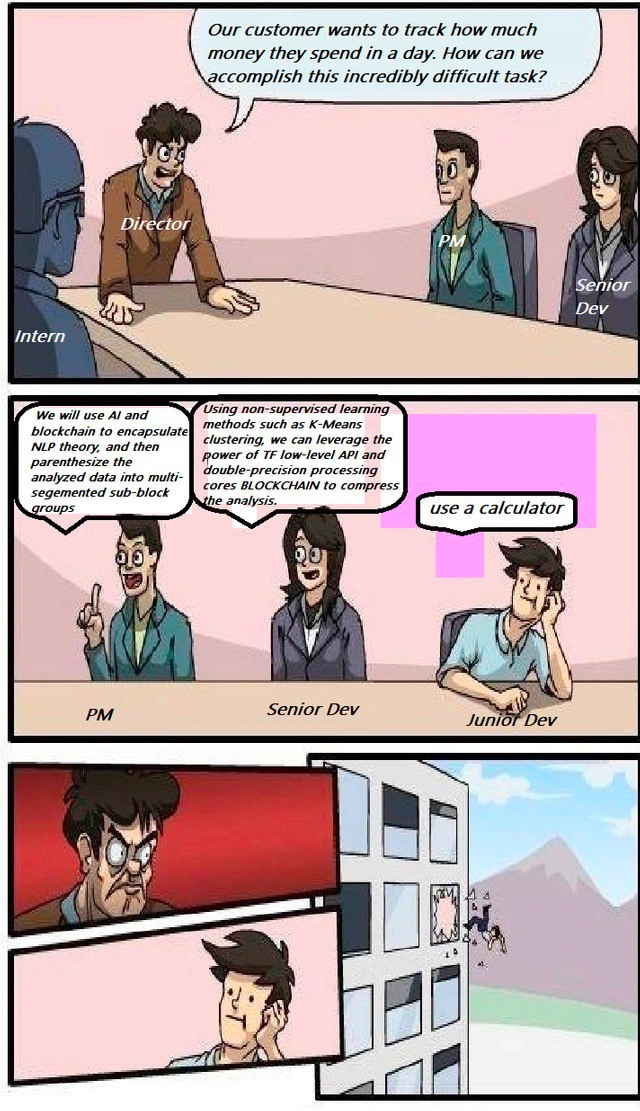
Let’s break down what’s happening in simpler terms and explain some of the jargon in the meme. The scenario is a meeting (boardroom) with four people: an Intern/Junior Developer, a Director (boss), a PM (Project Manager), and a Senior Developer. The boss (Director) asks how to solve a very simple problem: the customer just wants to know how much money they spend in a day. Essentially, the customer needs to add up their daily expenses.

Now, a straightforward solution to this is literally to add the numbers using a calculator or a basic program. It’s elementary: if you spend $5 on coffee and $10 on lunch, by the end of the day you’ve spent $15. Even writing that down on paper or typing it into a phone’s calculator app would answer the question. That’s the simple solution the Junior Dev suggests: “use a calculator.” It’s the obvious, no-nonsense answer. In tech terms, this could mean use an existing simple tool or write a few lines of code to sum up amounts.

However, the other two people (the PM and the Senior Dev) give very elaborate, buzzword-filled proposals. They start talking about utilizing AI and blockchain and other fancy tech concepts. Why would they do that? This is poking fun at a trend where people try to use the most trendy, complex technologies (the buzzwords) even when they’re not needed. It’s like if someone asked for a light in a room and you suggested building a fusion reactor to power a smart lighting system – it sounds high-tech and impressive, but it’s extreme overkill for the problem.

Let’s clarify the buzzwords they used:

  • AI (Artificial Intelligence): In general, AI refers to making computers perform tasks that normally require human intelligence. Often when people say AI today, they mean machine learning – techniques where algorithms learn patterns from data. For example, teaching a program to recognize images of cats by showing it many cat photos. It’s powerful for complex problems like image recognition or language translation. But using AI for adding numbers is like hiring a detective to count your pennies; it’s not necessary.

  • Machine Learning: A subset of AI, where algorithms improve at tasks as they process more data. The meme specifically mentions unsupervised learning and K-Means clustering.

    • Unsupervised learning means the algorithm tries to find structure in data without being given correct answers to learn from.
    • K-Means clustering is a common unsupervised learning method. It takes a bunch of data points (imagine a scatter plot of dots) and groups them into K clusters based on distance (it finds cluster centers and assigns points to the nearest center). In plain terms, it’s used to discover groups in your data when you don’t know the groups ahead of time. For instance, grouping customers by buying habits without pre-labeled categories. In the context of daily spending, K-Means could maybe group days by spending patterns (e.g., high-spending days vs low-spending days), but it doesn’t actually total the money. It’s certainly not the tool for simply computing “how much did they spend.” Mentioning K-Means here is a comically poor fit – it shows the speakers are just name-dropping an algorithm to sound smart.
  • NLP (Natural Language Processing): This is an AI field where the goal is to make sense of human language (like English sentences). NLP involves things like understanding text, sentiment analysis, speech recognition, etc. The PM in the meme says “encapsulate NLP theory” – that sounds like gibberish in this context. If the data we care about is how much money someone spent, there’s no language to process (unless we imagine parsing receipts, but that’s not suggested). This line is parodying how people insert an unrelated hot tech term (NLP was hot due to voice assistants and such) just to impress others. It’s basically techno-babble here.

  • TensorFlow (TF) low-level API: TensorFlow is an open-source machine learning framework by Google. It’s used to build and train neural networks (the brains of AI that, say, recognize images or text). The “low-level API” means using TensorFlow in a very detailed way, coding with its core operations (as opposed to using easier high-level helper libraries). This is a very programming-heavy, complex approach. In the meme, invoking “the power of TF low-level API” implies writing a bunch of ML code from scratch for this problem. It’s humorous because to add daily expenses, you absolutely do not need a fancy neural network library. It would be like busting out an industrial crane to move a chair. Yes, TensorFlow is powerful, but not at all needed for summing a few numbers.

  • Double-Precision Processing Cores: This refers to using hardware that can handle very precise large number calculations (double-precision refers to 64-bit floating point numbers used in computing for high precision). Some GPUs (graphics processing units) or specialized processors have cores optimized for this. The Senior Dev mentions it to make their plan sound even more high-tech: as if normal computing isn’t enough, we need specialized processors! In reality, summing a day’s expenses doesn’t require any special precision or hardware beyond a normal phone or PC. This is another exaggeration to illustrate how needlessly grand their approach is. They’re essentially bragging about using supercomputer-grade tech for a pocket-calculator problem.

  • Blockchain: A blockchain is essentially a digital ledger (like a record book) that is duplicated across many computers and secured through cryptography. Every time you add data (like a transaction), it’s grouped into a block with other data and linked to the previous block, forming a chain. The buzz around blockchain comes from cryptocurrencies (like Bitcoin) and the promise of secure, decentralized record-keeping. The key point: blockchains are great when multiple parties who don’t fully trust each other need a tamper-proof, shared ledger. But they come with a big cost: they require a network of computers to constantly agree on the data (this is called consensus), which can be slow and computationally heavy. In the meme, suggesting a blockchain for a single customer’s expense tracking is overkill to the max. It’s like using a whole courtroom of notaries to record that you bought a sandwich, when you could just note it down yourself. The phrase “multi-segmented sub-block groups” in the bubble is just pseudo-technical fluff referencing blockchain’s block structure. It’s not a real term, it’s there to sound fancy. So the team is basically saying “we’ll put the data on a blockchain to analyze it,” which in a real-world sense would mean they want to log every expense in a distributed ledger. It’s hype-driven because around 2019, lots of companies were trying to inject blockchain into everything (often unnecessarily) just to stay trendy.

  • Over-engineering: This is a term for when a solution is more complicated than it needs to be. The meme is a prime example of over-engineering: taking a very simple problem (daily addition of expenses) and proposing an extremely complex solution (AI + ML + blockchain + specialized hardware!). Over-engineering often happens when people get carried away with technology or try to anticipate problems that don’t exist. It results in solutions that are harder to build, maintain, and use. In contrast, a simple solution might do the job with a fraction of the effort and cost.

So in panel 2 of the comic, the PM and Senior Dev both present these grand plans filled with buzzwords:

PM: “We will use AI and blockchain to encapsulate NLP theory, and then parenthesize the analyzed data into multi-segmented sub-block groups.”
Senior Dev: “Using non-supervised learning methods such as K-Means clustering, we can leverage the power of TF low-level API and double-precision processing cores BLOCKCHAIN to compress the analysis.”

They’re basically one-upping each other on how many trendy concepts they can throw in. Notice the Senior Dev even randomly shouts “BLOCKCHAIN” mid-sentence (in the image text it’s capitalized and kind of wedged in) – a sign that they’re just cramming the hottest buzzword wherever possible. This is classic tech BS jargon: it sounds superficially impressive, but if you know these terms, the sentences range from overkill to outright nonsense. It’s intentionally written to be too much, which is why it’s funny.

Meanwhile, the Junior Dev just says, “use a calculator.” That tiny speech bubble is the voice of reason. In an everyday sense, that’s like someone calmly pointing out: “We could just do it the easy way.” It highlights how absurd the others’ suggestions are by contrast. The junior is basically saying, “Why don’t we just do basic addition? Why involve all this fancy stuff?”

Now, panel 3 shows the Director glowering at the junior while the junior gives a weak, nervous smile. This is the turning point joke: the boss clearly didn’t want to hear the simple answer. Maybe it makes him feel stupid, or maybe it undermines the whole “innovative project” vibe he was hoping for. In many offices, bosses love to have things that sound impressive (to higher executives or investors). If a junior says “we don’t need an expensive project, this is easy,” it can actually upset people who were gearing up to justify a budget or assert their importance. It’s a bit of real-world office politics captured in a cartoon: the higher-ups sometimes ignore the junior staff or even get annoyed when a junior offers a solution that’s outside the expected narrative (especially if it makes the big plans look foolish).

Finally, panel 4 is the exaggerated punchline: the junior literally gets tossed out of the building’s window – a cartoon way to show he got kicked out/fired for his suggestion. This panel is a well-known ending in the “boardroom suggestion” meme template. It visualizes an over-dramatic punishment for speaking up with the “wrong” idea. Of course, in real life people don’t get thrown out of windows in meetings, but they might get metaphorically thrown out – e.g., ignored, reprimanded, or removed from the project. The broken glass and the junior flying out is just a dark humor way to depict that.

The key takeaway for a junior developer or anyone newer to these buzzwords is:

  • Simple solutions can be right. Just because something uses fewer technologies or isn’t “fancy” doesn’t mean it’s bad. In fact, simpler is usually more reliable.
  • Buzzwords are trendy words that sound techy (like AI, blockchain, IoT, etc.). People sometimes use them to impress others, even if they’re not the best fit. It’s important to understand what they really mean and not be seduced by them.
  • Hype-driven development means choosing technologies because they are hyped, not because they are appropriate. This comic is warning against that in a humorous way.
  • And a cultural note: the scenario of someone getting metaphorically “thrown out” for a simple suggestion is a joke about corporate culture valuing big-sounding ideas over obvious practical ones.

If you’ve ever been the person in a class or meeting who suggests, “Can’t we just do it this easy way?” and gotten weird looks because everyone else was obsessed with a more complicated approach, this meme captures that feeling. It’s exaggeration, but it shines a light on a real phenomenon in tech and businesses. As a junior, it can be confusing – you might think, “Am I missing something? Why are they talking about all these complicated things when the problem seems straightforward?” Often you’re not missing anything; it really is straightforward and others are complicating it unnecessarily. The trick is, in real life, how to diplomatically voice that without getting “thrown out the window.”

Level 3: Hype-Driven Development

Now zooming out to a senior developer or industry perspective: this meme is a tongue-in-cheek critique of hype-driven development and overengineering in our field. In the scene, we have a Director, a PM (Project/Product Manager), a Senior Developer, and a Junior Dev (possibly an intern) in a meeting. The question on the table is laughably simple: “Our customer wants to track how much money they spend in a day. How can we accomplish this...?” This should immediately ring alarm bells for any experienced engineer, because tracking daily expenditure is essentially just adding up numbers (the kind of thing a grade-school kid or a $5 calculator can do).

Yet, the responses from the PM and Senior Dev are overflowing with buzzwords and convoluted ideas: they suggest using AI, machine learning (K-Means clustering even!), NLP, and of course the obligatory blockchain – basically every trendy tech term from the late 2010s playbook. This is classic IndustryTrends_Hype being lampooned. By 2019, terms like AI/ML and blockchain were such hot fads that managers tried to sprinkle them on every problem like salt on fries. The meme captures that period’s corporate mindset where solving any problem straightforwardly almost felt out of fashion; instead, you had to mention “leveraging the power of TensorFlow” or “blockchain-based analytics” to sound innovative in meetings. It’s playing on the phenomenon where decision-makers chase the shiny new technologies (often to impress higher-ups or customers) rather than focusing on the simplest effective solution. In the software world, we jokingly call this “buzzword-compliant” strategy – ensuring your project includes whatever tech is currently trending, whether it’s cloud, blockchain, AI, microservices, etc., just so it sounds cutting-edge.

The humor really lands with anyone who’s sat through absurd meetings or pitches. Many senior devs have experienced a meeting where a straightforward problem gets a ridiculously complex proposal because someone read an article about “the blockchain revolution” or “AI will solve everything.” It becomes a game of Buzzword Bingo in the boardroom. Here we literally see buzzword overload: the PM and Senior Dev’s speech bubbles are crammed so full of jargon that it’s practically satirical gibberish. They’re using phrases like “encapsulate NLP theory” and “leverage the power of TF low-level API and double-precision processing cores” – these sound grand, but don’t really mean anything coherent for the task at hand. This satirizes how people with just enough knowledge to throw around fancy terms can dominate meetings. The Project Manager in the second panel likely wants to impress the Director with grandiose ideas, and the Senior Dev might be cynically adding technical gibberish either to brown-nose or because they’re caught up in the hype themselves. In real teams, we sometimes see this when a senior person is either out of depth or trying to upsell the project’s complexity (“Look boss, we’re using blockchain and AI, aren’t we innovative?”) – even if those technologies are unnecessary. It’s a form of technical one-upmanship, and it can lead to over-engineered solutions that are brittle, costly, and late.

On the flip side, the Junior Developer proposes the obvious: “use a calculator.” This is the simplest possible correct answer. It cuts through the nonsense – you have numbers, just add them. A basic calculator (or a single Excel formula, or a five-line script) would solve the customer’s request in seconds. This one line from the junior is the voice of common sense and it highlights the core joke: amidst all the high-falutin “AI/blockchain” talk, the simplest tool that everyone learned in school would do the job. The junior’s body language (leaning forward casually, looking bored or unimpressed by the others’ grandstanding) also says: “Why are we complicating this? It’s literally a trivial problem.” This resonates especially with experienced developers who have learned (often the hard way) that the simplest solution is usually best. There’s a saying in software engineering: “Don’t use a chainsaw to cut butter.” Here the junior is effectively saying, “We don’t need a chainsaw, we have a butter knife right here.”

The comedic tension comes from the familiar corporate hierarchy dynamic. The Director (the boss figure) asks the question, expecting some big innovative proposal. The PM and Senior Dev oblige with exactly the kind of buzzword-filled answers upper management often falls for. But the junior, who doesn’t know any better (or perhaps knows too well), breaks the spell with a plain, correct solution. In many real scenarios, the junior or new team member might be hesitant but can see the emperor has no clothes – they might think “why not just do the obvious thing?” but fear it sounds stupid. This meme exaggerates that to comic effect. The junior actually says it out loud (“use a calculator”) and we see what happens: the Director’s face turns furious in the third panel. The boss’s pride or grand vision is challenged by such a mundane solution. How dare this junior suggest something so straightforward that it undercuts all the innovative synergy in the room!

The final panel – the defenestration punchline – is classic for the “boardroom suggestion” meme template. The term defenestration literally means getting thrown out of a window. In the meme image, we see an external shot of the office building with a big broken window and the poor Junior Dev being hurled out, arms flailing. This slapstick exaggeration is a metaphor for what happens to simple, sensible ideas in a hype-obsessed environment: they get thrown out (sometimes along with the person who voiced them). It’s an extremely on-the-nose representation of a junior employee being ejected (fired, or at least yelled at and booted from the meeting) for not toeing the line of buzzword-driven insanity.

For seasoned folks, this hits home as dark humor: we’ve all seen how simple solutions get ignored or even punished in organizations when they don’t fit the narrative of needing a big sexy project. There’s often pressure to justify budgets, headcounts, or just to follow trends so the company appears innovative. If a project is as simple as using a calculator, nobody gets promotions or huge consulting fees from that. But if you propose an “AI-driven blockchain-enabled spending analytics platform,” oh boy, that sounds like a project worth funding! So ironically, in some dysfunctional environments, the right answer (“just do the easy thing”) gets you in trouble because it doesn’t feed the hype machine. That’s exactly what this meme is poking fun at: Hype over substance. The junior’s suggestion threatens the others’ elaborate plans, so out the window he goes – literally.

Another layer here is the inversion of roles: typically, you’d expect a Senior Developer to be the pragmatic one advocating simplicity, and perhaps a naive junior to suggest something over-complicated because they just learned a fancy new technology in school. But this meme flips that. The Senior Dev character is shown spouting gibberish buzzwords, which implies either this “Senior” isn’t very competent or they’re cynically giving the boss what he wants. Meanwhile, the Junior (or Intern) is the lone voice of reason. This reversal itself is a commentary: sometimes experience doesn’t travel in a straight line. A fresh outlook (junior) might see the obvious truth that veterans in an echo chamber miss, or conversely a supposed senior might just be someone who’s learned to play corporate buzzword games rather than actually solve problems simply. It’s a cautionary tale about not drinking the Kool-Aid of tech fads.

The setting and labels (Intern, Director, PM, Senior Dev) also evoke a common office scenario, which is why this counts as MeetingHumor. We’ve all been in that conference room where managers throw around the latest buzzwords hoping to impress, while the real solution might be embarrassingly simple. This comic exaggerates it to an extreme degree, making it hilarious. It’s essentially a satirical skit: imagine a meeting where someone literally says “we’ll parenthesize the analyzed data into multi-segmented sub-block groups using blockchain!” – it’s so over-the-top that it’s funny, yet it’s only a slightly caricatured version of actual tech meetings during hype cycles.

In summary, from a senior perspective, this meme nails the absurdity of over-engineering due to buzzword hype. It’s a commentary on industry trends where AI hype vs. reality is stark: companies often chase solutions that are far more complicated than necessary just to feel they’re using the “in” technology. The poor junior suggesting the equivalent of a pen-and-paper solution gets metaphorically clobbered for his common sense. It’s funny, it’s painful, and it’s so relatable to anyone who has witnessed decision-makers favor coolness over correctness. The laughter it induces is a knowing, perhaps slightly bitter laugh: We’ve seen this nonsense before, haven’t we?

Level 4: Buzzword Salad Architecture

At the highest technical level, this meme parodies an absurd mash-up of advanced computing paradigms for a trivially simple task. The boardroom suggestions read like a jargon tornado, mixing AI/ML algorithms, NLP theory, and blockchain architecture in a way that no sane system design would. For an expert, the humor is in how blatantly inappropriate these solutions are:

  • Unsupervised Learning & K-Means: The team proposes using non-supervised learning (likely meaning unsupervised learning) with K-Means clustering. In reality, K-Means is a machine learning algorithm for finding groups in data by iterative centroid adjustment. It’s useful for pattern detection – not for straightforward arithmetic like summing expenses. Academically, applying K-Means here is like attempting to solve a linear equation with gradient descent: possible but ridiculously overcomplicated. The mention of K-Means and TensorFlow (TF) low-level API implies building a full ML pipeline (perhaps even coding directly with TensorFlow’s graph primitives) just to handle daily expense data. That’s equivalent to using a neural network to add two numbers – a textbook case of overengineering.

  • NLP Theory: They toss in Natural Language Processing theory and talk of “encapsulating NLP theory” into sub-block groups. NLP is about teaching computers to understand human language (parsing sentences, understanding context via algorithms like word embeddings or transformers). Here it’s absurd because tracking how much money someone spends is a numeric problem, not a language-processing problem. It’s as if they’re randomly grabbing complex academic domains to sound impressive. Encapsulating NLP theory for numeric data is a nonsensical phrase – an expert recognizes it as pure buzzword soup. NLP might involve techniques like tokenization or semantic analysis, none of which help add up dollar amounts. This part of the proposal is deliberately technobabble – it has all the right fancy words but zero relevance, highlighting how people invoke “AI” and “NLP” even when they have nothing to do with the task at hand.

  • Blockchain & “sub-block groups”: The suggestion includes blockchain as a silver bullet – “multi-segmented sub-block groups” sounds like a misguided attempt to say we’ll use a blockchain’s block structure. Blockchains are distributed ledgers where each block of transactions is cryptographically linked to the next, ensuring tamper-evident records across decentralized nodes. Introducing a blockchain here means you’d theoretically record each expense in an immutable ledger, possibly across many computers, achieving trust without a central authority. For one person’s spending log, this is extreme overkill. From a systems architecture angle, you’re adding Byzantine Fault Tolerance and consensus algorithms (like Proof-of-Work or Raft/Paxos) just to track a single user’s expenses. The computational overhead is enormous: imagine calculating a SHA-256 hash and solving a proof-of-work puzzle every time you buy a coffee, simply to update your budget – that’s comically inefficient. Using a blockchain for a personal ledger sacrifices speed and simplicity for distributed trust that isn’t needed (you don’t distrust yourself!). The line about using blockchain “to compress the analysis” is humorous to an expert because blockchains do the opposite of data compression – they replicate and append data (every full node stores all the blocks, forever). An engineer sees that and immediately recognizes it as nonsense jargon thrown in to make the solution sound cutting-edge.

  • Double-Precision Processing Cores: They even mention double-precision processing cores, hinting at high-performance computing hardware or GPUs to handle the math. Double precision (64-bit floating point) is used in scientific computing for its accuracy on very large or precise calculations. But daily spending totals are typically small sums of money that even an 8-bit microcontroller could handle. In fact, using floating-point arithmetic for currency can introduce rounding errors due to binary representation issues (for example, 0.1 dollars can’t be represented exactly in binary floating point). Financial applications usually prefer integer cents or fixed-point decimals to avoid those pitfalls. So invoking double-precision cores here is hilariously off-target – it’s like suggesting a quantum computer to balance your checkbook. The meme quietly pokes at how out-of-touch the suggestion is: they’re bragging about numeric precision and processing power for a task that a basic calculator (or a single SQL sum query) can do instantly with pennies, both figuratively and literally.

Under the hood, the meme highlights the gulf between AI hype and reality. Each buzzword comes from a legitimate domain of computer science: clustering algorithms, neural network libraries, cryptographic ledgers, natural language models. But their combination in this context creates an impossible Frankenstein system. If one were to truly implement what the PM and Senior Dev propose, the architecture might involve: training an unnecessary ML model (wasting time tuning hyperparameters for something as simple as addition), then perhaps storing or summarizing results on a custom blockchain (dealing with consensus, block creation, possibly writing smart contracts), all while maybe doing some bizarre text analysis that has no input text. The theoretical complexity is through the roof for a problem that, computationally, is O(n) to just sum n transactions. In other words, they’re suggesting an algorithmic pipeline that might be $O(n \cdot k \cdot t)$ for clustering (n data points, k clusters, t iterations) plus additional overhead for distributed ledger operations, instead of a direct $O(n)$ summation. The contrast is mathematically absurd and that’s exactly the point—this buzzword-driven overkill is so preposterous that it tickles the funny bone of anyone who knows these technologies.

An experienced engineer or computer scientist reading those speech bubbles can’t help but laugh at the hype-driven insanity. It’s a satire of situations where decision-makers throw every trending tech term at a project to impress others or justify a budget. The meme’s humor at this deep level comes from recognizing that the proposed solution isn’t just overkill; it’s a pile of mutually mismatched techniques that betray a lack of understanding of each. It’s the technical equivalent of suggesting we solve a simple arithmetic problem by constructing a Large Hadron Collider because it sounds advanced. The fundamental lesson hiding in the humor: always beware of “buzzword salad” in proposals – if someone recommends solving a basic issue with an AI-blockchain-NLP cocktail, either they’re joking or they seriously misunderstand the technologies involved.

Description

A three-panel comic strip in the 'Boardroom Suggestion' or 'Defenestration' meme format. In the first panel, a director in a meeting asks his team, including an intern, a PM, and a senior dev, how to solve the 'incredibly difficult task' of tracking a customer's daily spending. In the second panel, the PM and Senior Dev propose absurdly complex solutions involving 'AI and blockchain,' 'NLP theory,' 'K-Means clustering,' and 'TF low-level API.' In contrast, a relaxed-looking Junior Dev simply suggests, 'use a calculator.' The final panel shows the angry director and the unfazed junior dev in close-up, followed by a wide shot of the junior dev being thrown out of a high-rise office window. The meme satirizes corporate culture's obsession with over-engineering and buzzwords, where simple, practical solutions are violently rejected in favor of needlessly complex and expensive technologies. For senior engineers, it's a painfully relatable commentary on how hype cycles can distort technical decision-making

Comments

7
Anonymous ★ Top Pick The director's only mistake was not asking for a JIRA ticket first. The story points for 'AI-powered blockchain spending analysis' would have been legendary
  1. Anonymous ★ Top Pick

    The director's only mistake was not asking for a JIRA ticket first. The story points for 'AI-powered blockchain spending analysis' would have been legendary

  2. Anonymous

    Pro tip for architecture meetings: if everyone’s whiteboarding an AI-driven, blockchain-sharded microservice to total yesterday’s spend, resist the urge to point out that SQL already has a SUM() function - your idea will be horizontally scaled out the nearest window

  3. Anonymous

    The junior dev's calculator suggestion would've saved us from the 47-microservice architecture we're now maintaining for what turned out to be a SUM() function with a date filter

  4. Anonymous

    When your PM suggests blockchain for summing daily expenses, you realize they've successfully encapsulated the entire tech industry's approach to problem-solving: take a trivial O(1) operation, add three layers of distributed consensus, sprinkle in some unsupervised learning on a dataset of one, and somehow convince everyone that double-precision floating-point arithmetic on a blockchain is the future - all while the junior dev's calculator app sits unused in the corner, quietly mocking your architectural decisions

  5. Anonymous

    Only in enterprise can “track daily spend” become an AI‑on‑blockchain initiative while “SELECT SUM(amount) WHERE date=today” gets you escorted out for violating the OKR: insufficient buzzword density

  6. Anonymous

    Only in enterprise meetings can SELECT SUM(amount) GROUP BY day be rebranded as “unsupervised TensorFlow on a blockchain.”

  7. Anonymous

    Interns fitting transformers to Jira tickets while seniors know true velocity is 'whatever fits before the PM's next pivot'

Use J and K for navigation