Skip to content
DevMeme
5708 of 7435
Embracing the Grind: Blue Light Blockers vs. Enhancers
MentalHealth Post #6260, on Sep 23, 2024 in TG

Embracing the Grind: Blue Light Blockers vs. Enhancers

Why is this MentalHealth meme funny?

Level 1: Staring at the Sun

Imagine two friends playing outside on a very sunny day. One friend puts on sunglasses to protect their eyes from the bright sun – that’s a smart, normal thing to do. The other friend also puts on super dark, high-tech sunglasses, but not just for safety… he uses them so he can stare directly at the sun and keep playing outside all day long without ever going inside to rest. Then that second friend turns to the first and boasts, “See? I can look at the sun for hours and never stop. We are not the same.” 😎

It’s a funny comparison because the second friend thinks he’s being better or more “hardcore,” but really he’s just doing something silly and harmful. Most people know that staring at the sun, even with sunglasses, is a bad idea – you’ll hurt your eyes or get extremely tired later. In the same way, the meme is joking about one developer who takes care of himself (like wearing sunglasses normally) versus another developer who pushes himself too far (using those “sunglasses” as an excuse to never take a break). The second person is acting proud of not sleeping, which is as absurd as being proud of staring at the sun all day. We laugh because it’s obviously not a wise thing to do, and the bragging just makes it more ridiculous. The meme is basically saying: taking care of yourself and completely overdoing it are not the same – and it uses a silly extreme example to make that point in a light-hearted way.

Level 2: 404 Sleep Not Found

Let’s step back and explain the joke in simpler terms. Blue light is the high-energy light emitted by computer and phone screens (it’s what makes the screen look bright white-blue). Our brains associate blue light with daytime, so seeing a lot of it, especially later in the evening, can trick our bodies into staying alert. That’s why people wear blue light blocking glasses – these glasses have special lenses (often with a yellow/orange tint or anti-blue coatings) that filter out that blue glow. The idea is to protect your eyes from strain and help your brain realize “night time is coming, let’s get sleepy” even if you’re still looking at a screen. So when the meme says, “You wear blue light blockers,” it’s referring to someone doing a normal healthy thing: using those glasses to reduce eye strain and avoid messing up their sleep too much when coding late.

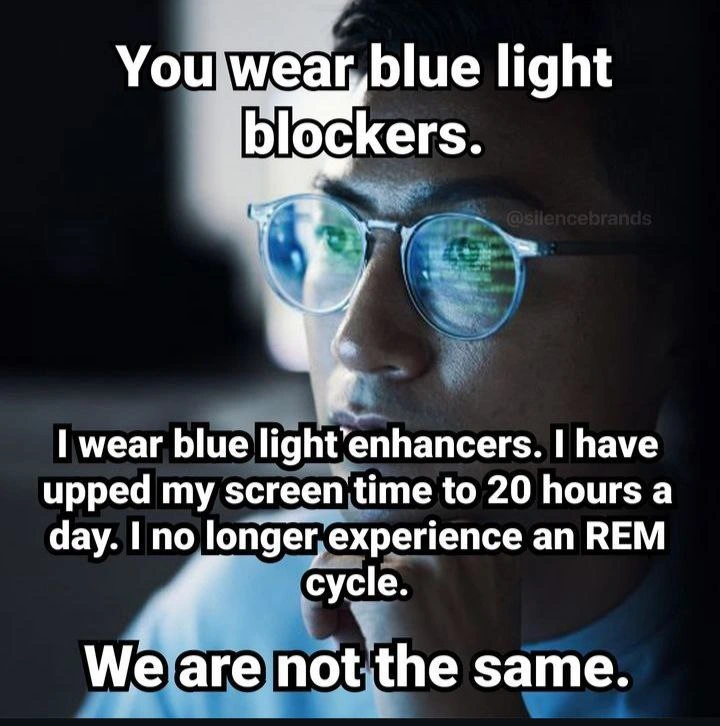
Now, the meme contrasts that with the second person’s wild claim: “I wear blue light enhancers. I’ve upped my screen time to 16 hours a day. I no longer experience a circadian cycle.” This is a joke, because there’s no such thing as “blue light enhancers” – the glasses don’t boost light, they block it. The meme’s author is being facetious: the guy is using the glasses in such an extreme way that it’s as if he’s doing the opposite of their intended purpose. By wearing them, he’s able to look at screens even longer (16 hours out of 24!), and he’s basically bragging that he has eliminated his circadian cycle. Your circadian cycle (or circadian rhythm) is your body’s natural 24-hour clock that tells you when to wake up and when to sleep, linked to day and night. Saying you don’t have a circadian cycle means your sleep schedule is completely wrecked – you’re awake at all hours, sleeping at odd times (if at all), with no regular day-night pattern. Essentially, “I no longer experience an REM cycle” (REM is the dream stage of sleep) or “I have no circadian rhythm” both mean “I don’t really sleep properly anymore.” It’s a ridiculous thing to boast about, which is exactly the point – the meme is using exaggeration to be funny.

So why would anyone do that? The context here is the always-online developer lifestyle, especially in remote work situations. When you work from home or on a passionate coding project, it’s easy to lose track of time. Many new developers start out very enthusiastic, maybe coding late into the night because they’re “in the zone.” And in tech culture, there’s this notion of crunch time – periods when a team has to work extra hours (nights, weekends) to meet a deadline or ship a product. It’s common in game development and startups, and it can create a sort of warped pride where people brag about how much they worked. You might hear someone say, “I worked 80 hours this week” as if it’s an achievement. This meme is poking fun at that mentality. The first person is doing a normal self-care thing (wearing glasses to help with screen glare), and the second person has taken it to a crazy extreme. He’s basically saying: “Oh, you use those glasses? Well I use them so I never have to stop coding, even at 3 AM. Sleep? Never heard of her.” The phrase “We are not the same” is a popular meme way of saying one person is on a completely different level than another. Here it’s used ironically – the second person is implying he’s superior for being an ultra-workaholic, which is funny because it’s a pretty self-destructive kind of “superior.”

If you’re a junior dev or just starting out, you might relate to pulling an all-nighter once or twice. Maybe you had a school project or a bug that you stayed up until dawn to fix. You remember how wearing something like blue-light glasses or turning on your screen’s night mode made it a bit more comfortable to stare at the screen at 1 AM. You might also remember how messed up you felt the next day after barely sleeping! That’s essentially what’s happening to the guy in the meme, except he’s doing it every day and acting proud of it. Sleep deprivation can make you feel terrible: it’s harder to think straight, you get irritable, and over time it can really hurt your mental health. Seasoned developers have learned (sometimes the hard way) that coding while exhausted often means more mistakes and less productivity overall. It’s like diminishing returns: after a certain number of hours, each additional hour of work might actually do more harm (bugs, bad code) than good. But when you’re newer or caught up in the moment, you might not realize that and just push yourself thinking “I must be super productive, I’m working 16 hours!” This meme is a tongue-in-cheek warning about that trap.

Work-life balance tips often tell us to set boundaries: have a cutoff time for work, get a full night’s sleep, take breaks – basically, don’t be the person who lives in front of the screen 24/7. The meme’s extreme character is the poster child of not following that advice. He has all the gear (fancy blue-light glasses) but is using it to enable a bad habit (never logging off). It’s a bit like someone drinking caffeinated energy drinks not just to get through a rough morning, but so they can skip sleeping for two nights straight. Most people know that’s not sustainable. Developer burnout is the stage where a coder has worked so hard for so long without rest that they lose motivation, feel constantly exhausted, and their performance drops. Companies these days (the good ones, at least) try to discourage behaviors that lead to burnout – like constant crunch or being always on call – because they know it’s bad for both the developer and the product. That’s why this meme is tagged with MentalHealth and WorkLifeBalanceTips. It’s humor, but with a little nugget of truth: take care of yourself, because wearing all the blue-light glasses in the world won’t save you if you never allow yourself to sleep. In short, the meme exaggerates a real developer habit (working crazy hours and bragging about it) to remind us how silly it is. The two people in the meme both have the same tool, but one uses it reasonably and the other uses it to do something ridiculously unhealthy. The joke lands because as developers (or students, or anyone who’s been on a late-night grind), we recognize a bit of ourselves in that second guy – and we know that way madness lies.

Level 3: Human Overclocking

This meme captures a twisted developer productivity flex that seasoned engineers know all too well. The setup: one person responsibly wears blue light blocking glasses to reduce eye strain and help maintain healthy sleep. The punchline: the other person boasts about using these glasses as “blue light enhancers” so they can jack up their screen time to 16+ hours a day, proudly declaring “I no longer have a circadian cycle.” Finally, the kicker: “We are not the same.” It’s an absurd arms race in the always-online dev life, where a supposed self-care tool gets turned into a catalyst for self-destruction. The humor has that dark, knowing edge – a veteran dev bragging about being a sleepless coding zombie as if it’s a badge of honor. We laugh, but also cringe, because we’ve seen this movie before (some of us starred in it during release week).

For experienced developers, the joke lands close to home. It satirizes crunch culture – those death-march coding sprints where everyone subsists on coffee and sheer willpower. The meme’s extreme character is basically saying, “You practice a bit of self-care? That’s cute. I optimized away my need for self-care.” It’s a caricature of the senior engineer who’s been through so many all-nighters that they treat sleep deprivation as a competitive sport. The line “I no longer experience REM cycle” (REM being the deep dream stage of sleep) is hilariously grim. It’s like bragging, “I’ve literally hacked my biology to skip the ‘unproductive’ parts of being human.” Seasoned devs chuckle because they recognize the underlying truth: we’ve all met that grizzled colleague who wears their 3 AM commit history like a Medal of Valor. The meme exaggerates it to comic extremes – trading sanity and REM sleep for a few more commits – but the core joke is painfully relatable.

Technically speaking, there’s irony in how blue light works. Normally, those high-energy blue wavelengths from our monitors and phone screens suppress the hormone melatonin, tricking our brains into staying alert. Blue light blocking glasses (or software like f.lux and Night Mode) are meant to filter out that stimulating light so your brain can unwind and respect the circadian rhythm (your 24-hour internal clock that says “hey, it’s night, go to sleep”). Many devs use these glasses to avoid insomnia after late-night coding. But here the meme flips the script: the guy in the dark room is wearing vivid blue-tinted lenses not to sleep better, but so he can stare at bright screens even longer without feeling immediate eye fatigue. He’s essentially abusing a health tool as a productivity booster. It’s as if he found a way to disable the natural “time to rest” warning in his brain. The result? His day no longer has a meaningful night — a case of circadian drift so extreme that day, night, and cycles of REM are all irrelevant to him. This is biohacking gone off the rails, and the meme milks that absurdity.

Why is this so familiar (and funny) to veteran devs? Because pushing past healthy limits in the name of “getting things done” is a well-trodden path in tech. We’ve seen startups where pulling 14-16 hour days is glorified, or big product launches where the team jokes about sleeping under their desks. Work smarter, not harder sounds great until the deadline looms — then suddenly it’s “work harder and pretend it’s smarter.” Remote work has only amplified this always-online mentality; when your home is your office, it’s dangerously easy to blur the line and keep coding till the birds chirp. There’s a perverse pride in saying “I haven’t taken a day off” or “I fixed that 3 AM production bug while you were asleep” – it’s half lament, half one-upmanship. This meme nails that toxic comparison. The first person is doing the sane thing (protecting their health), and the second basically says: Health? I sacrificed that to the codebase long ago. Developer burnout often manifests exactly like this: people push themselves to the brink, then weirdly tout it as dedication. The meme takes that to a comical extreme to highlight the folly.

Let’s break down the contrast in plain terms. One developer is using a sensible habit to maintain work-life balance, the other is using an “optimizing” mentality to obliterate it. It’s like:

Sensible Dev Habit Crunch Culture Habit
Wears blue-light glasses to reduce eye strain and then logs off at a decent hour. Wears blue-light glasses as “enhancers” to keep coding through the night (eyes on fire, who cares).
Respects their circadian rhythm – gets some sleep after coding. Ignores any sleep cycle – proudly claims to have “no REM cycle” (zombie mode engaged).
Knows that after ~8-10 hours of coding, productivity drops and bugs creep in. Believes 16 hours of coding is twice as productive as 8 (ignoring the law of diminishing returns).
Treats health as a priority: good sleep, breaks, maybe touches grass occasionally. Treats health as an obstacle: hacks diet, sleep, and eyeballs for maximum screen time.

We end up with a darkly comic picture of two very different developer lifestyles. The meme’s caption “We are not the same” drives it home: the second dev is almost a parody of hardcore hustle culture. Seasoned engineers see the joke as a mirror – a bit of “there but for the grace of sanity go I.” It’s funny because it’s true: many of us have tried to be the hero who fixes everything in one marathon stint, optimizing ourselves into oblivion. And it’s also funny because it’s ridiculous: no matter what gadgets or hacks you use, burnout isn’t a boast, it’s a liability. In the end, the meme is a tongue-in-cheek PSA: go ahead and wear your blue blockers, but if you think they’ll let you cheat nature and code 24/7... well, enjoy the ride to Sleepless City. We’ve got plenty of free coffee and regrets waiting there.

Description

A 'We are not the same' meme format. The image shows a close-up of a person wearing glasses with green code reflected in the lenses. The text on the image reads: 'You wear blue light blockers. I wear blue light enhancers. I have upped my screen time to 20 hours a day. I no longer experience an REM cycle. We are not the same.' This meme satirizes the toxic 'hustle culture' within the tech industry, exaggerating the lengths some developers go to maximize productivity at the expense of their health, particularly sleep. It humorously critiques the glorification of burnout and unhealthy work habits as a sign of dedication

Comments

14
Anonymous ★ Top Pick My doctor told me to reduce blue light exposure before bed. So I switched my IDE to a dark theme. We are not the same
  1. Anonymous ★ Top Pick

    My doctor told me to reduce blue light exposure before bed. So I switched my IDE to a dark theme. We are not the same

  2. Anonymous

    Performance tip: if you disable the human-sleep thread entirely, your throughput spikes - right until garbage collection in the form of burnout SIGKILLs the process

  3. Anonymous

    After 20 years in tech, I've learned that blue light blockers are just a placebo for junior devs who still believe in work-life balance. Real architects have evolved beyond the need for REM sleep - our brains now defragment during stand-ups and our dreams compile directly to production

  4. Anonymous

    The real architectural decision isn't microservices vs monolith - it's whether your blue light strategy optimizes for longevity or throughput. Some engineers implement circuit breakers for their health; others just remove the sleep() function entirely and run in production 24/7. Both approaches scale differently, but only one requires a post-mortem before age 40

  5. Anonymous

    I treat blue light like a production keepalive - 1000 nits, circadian GC disabled, melatonin marked @Deprecated

  6. Anonymous

    No REM cycle? That's my brain's garbage collector running non-stop to free up RAM for the next hotfix sprint

  7. Anonymous

    Blue‑light blockers are just a feature flag that turns sleep into eventual consistency - great for commit velocity, terrible for SLOs

  8. @azizhakberdiev 1y

    Those who use blue light filter: 🗿

  9. @SlickSorcerer 1y

    Blue light filters are only useful for moving money from a person's pocket to another person's pocket.

    1. @callofvoid0 1y

      huh?

    2. @SamsonovAnton 1y

      You mean UV-light filters that usually reveal that the money being moved from one person to another is fake or has tracking marks?

      1. dev_meme 1y

        I think they meant the blue light filters are expensive

  10. @DIRECTcut 1y

    rem cycle, my ass. cycles are for pussies anyway

    1. @AmindaEU 1y

      Meow...

Use J and K for navigation