Skip to content
DevMeme
Backend Kryptonite: A Single Line of CSS
Backend Post #84, on Feb 9, 2019 in TG

Backend Kryptonite: A Single Line of CSS

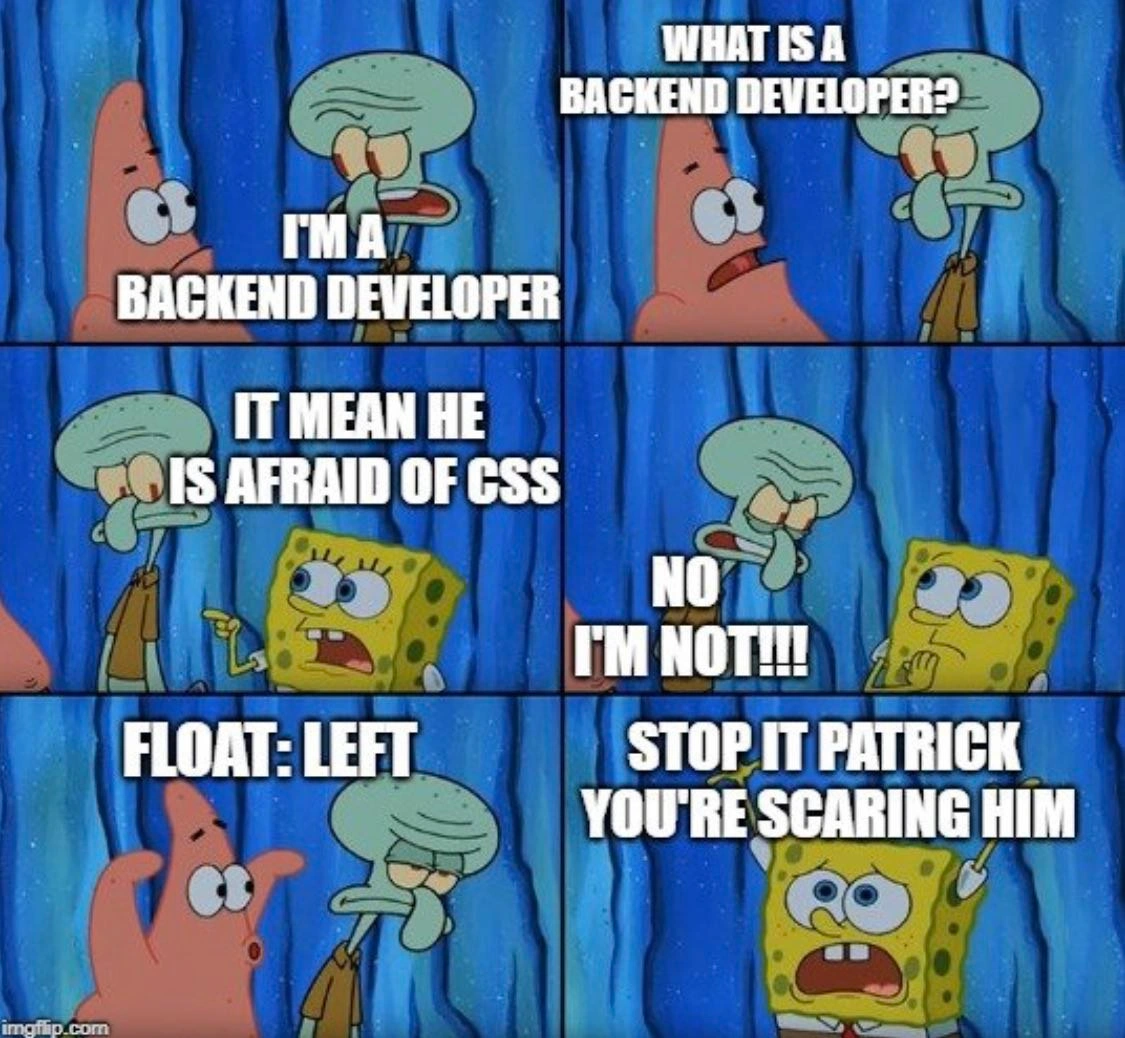
Why is this Backend meme funny?

Level 1: Stop It, Patrick

This is the same joke as telling someone "he's not avoiding the swimming pool, he's afraid of water" — and then yelling "SPLASH!" to watch them flinch. The backend developer insists he simply prefers working in the kitchen instead of decorating the dining room, but the moment someone whispers two little decorating words, he screams. It's funny because we all have that one chore we swear we're "just not into," when really, one bad experience scared us off it forever — and our friends know exactly which words to say to prove it.

Level 2: Why "Float: Left" Is the Scary Word

Some vocabulary for decoding the panels:

  • Backend developer: writes the server-side code — APIs, databases, business logic. Their work has no visual appearance; correctness is judged by tests and logs.
  • Frontend developer: builds what users see in the browser, using HTML for structure, JavaScript for behavior, and CSS for appearance and layout.
  • CSS (Cascading Style Sheets): the language that controls colors, fonts, spacing, and — most painfully — where things go on the page.
  • float: left: a CSS property that pushes an element to the left edge and lets other content flow around it. For years it was the main (mis)used tool for placing things side by side.

The rite of passage being referenced: a backend dev gets asked to "just move the button a little to the left." Three hours later, the button hasn't moved, but the footer is now inside the navigation bar and somehow the page scrolls horizontally forever. Nothing crashed, no error was thrown, no stack trace exists — the page is just wrong, silently. That's the trauma. In backend work, failure announces itself; in CSS, failure just stares back at you, slightly misaligned.

So when Patrick says the magic words and SpongeBob recoils, every developer who has ever typed display: block !important in desperation knows exactly which memory just resurfaced.

Level 3: The Phobia Has a Diagnosis Code

The genius of this six-panel exchange — Squidward's deadpan "IT MEAN HE IS AFRAID OF CSS" followed by Patrick weaponizing FLOAT: LEFT like a jump scare — is that it inverts the usual prestige hierarchy of the backend vs frontend divide. Backend developers traditionally frame their specialization as a choice rooted in rigor: databases, concurrency, algorithms, "real engineering." The meme reframes it as avoidance behavior. You didn't choose the backend; the backend chose you the day a <div> refused to center.

And float: left is the perfect trigger word, because it represents an entire era of CSS layout built on a property that was never designed for layout at all. float was created so text could wrap around images, magazine-style. The industry then spent roughly fifteen years constructing entire multi-column page architectures out of it — which meant living with its side effects:

  • Floated elements leave the normal document flow, so parent containers collapse to zero height unless you apply a clearfix hack (overflow: hidden, the ::after { clear: both } incantation, or the ancient empty <div style="clear:both">).
  • Source order, float direction, and margin interactions combined into layouts that worked until they catastrophically didn't — usually when content was one word longer than the designer's lorem ipsum.
  • Debugging meant binary-searching your stylesheet with border: 1px solid red, the backend developer's equivalent of printf debugging, except the output is a Mondrian painting of your failure.

The deeper satire is about learned helplessness as specialization. CSS isn't objectively harder than distributed transactions — it's differently hard. It's a constraint-resolution system with global scope, cascading specificity rules, and a rendering model (formatting contexts, stacking contexts, margin collapsing) that punishes intuition built on imperative programming. A backend developer who can reason about isolation levels will still flinch at why z-index: 9999 does nothing, because the mental model isn't transferable. So they retreat, the retreat calcifies into identity, and the identity gets printed on a job title. By 2019, when this was posted, flexbox and grid had already made float layouts obsolete — meaning SpongeBob here is terrified of a ghost. Which is exactly how phobias work.

Description

A six-panel meme using the 'Stop it Patrick, You're Scaring Him' format from the cartoon SpongeBob SquarePants. The scene depicts Patrick, Squidward, and SpongeBob. In the first panel, Patrick asks, 'WHAT IS A BACKEND DEVELOPER?' and Squidward replies, 'I'M A BACKEND DEVELOPER'. SpongeBob then explains, 'IT MEAN HE IS AFRAID OF CSS'. Squidward angrily denies this, shouting 'NO I'M NOT!!!'. Patrick then taunts him with the words 'FLOAT: LEFT', causing Squidward to recoil in fear. The final panel shows SpongeBob yelling, 'STOP IT PATRICK YOU'RE SCARING HIM'. The meme humorously plays on the common stereotype that backend developers, who focus on server-side logic, are often uncomfortable or inept with frontend styling, particularly the notoriously tricky aspects of CSS. For experienced developers, 'float: left' is a nostalgic trigger for the headaches of old-school CSS layouts before modern tools like Flexbox and Grid
Comments

8
Anonymous ★ Top Pick A backend dev's idea of a robust user interface is a 200 OK response. The moment you mention z-index, they start talking about eventual consistency and retreat behind their API gateway
  1. Anonymous ★ Top Pick

    A backend dev's idea of a robust user interface is a 200 OK response. The moment you mention z-index, they start talking about eventual consistency and retreat behind their API gateway

  2. Anonymous

    Tell a 20-year backend vet “float:left” and watch them relive IE6 PTSD - zero-downtime schema migrations are fine, but one clearfix hack and we’re paging ops for emotional support

  3. Anonymous

    I've spent 15 years convincing myself that my API-first architecture philosophy is about scalability and separation of concerns, when really it's just PTSD from that one time I had to debug why a clearfix wasn't clearing in IE6

  4. Anonymous

    Calling yourself 'backend' is just CSS avoidance with a salary band. Twenty years of experience and float: left still clears the room faster than it clears floats

  5. Anonymous

    The real horror isn't float:left itself - it's the phantom margin collapse, the clearfix ritual you forgot to perform, and that one div that refuses to contain its floated children. Modern backend devs have survived microservices hell and distributed transaction nightmares, yet the mere whisper of 'CSS Box Model' still triggers their fight-or-flight response. At least with a database deadlock, you get a stack trace; CSS just silently judges your layout choices

  6. Anonymous

    Backend engineers aren’t afraid of CSS; they just treat the cascade like distributed state - whisper “float:left” and someone drafts an RFC for a new consistency level: Cascade Isolation

  7. Anonymous

    Say 'float: left' and every senior remembers the night a clearfix/BFC hack fixed IE7, broke Safari, and triggered PagerDuty - CSS’s flavor of eventual consistency

  8. Anonymous

    They orchestrate Kubernetes at scale but flee 'float: left' like a browser compatibility nightmare

Use J and K for navigation