When Management Anoints You the 'Full-Stack Developer'
Why is this Management PMs meme funny?
Level 1: One Time Doesn't Mean Always
Imagine you're really good at drawing pictures, and one day in school you manage to solve a hard math problem correctly. Suddenly your teacher starts calling you a "math genius" and gives you all the tough math homework from then on. You'd probably protest, "Wait, I just got one problem right. That doesn't make me a math expert!" You might feel it's unfair or silly, because doing something successfully one time doesn't mean you can do it every time. That's exactly what's happening in this meme. The developer usually works on one part of making software (the behind-the-scenes stuff). But after he fixes a single issue on the visual side of the project, all the bosses start acting like he's some kind of all-around coding wizard who can do everything now. It's funny (and ridiculous) because we know you shouldn't jump to big conclusions from one small success — just like solving one math problem doesn't instantly make you Albert Einstein.
Level 2: One Ticket Wonder
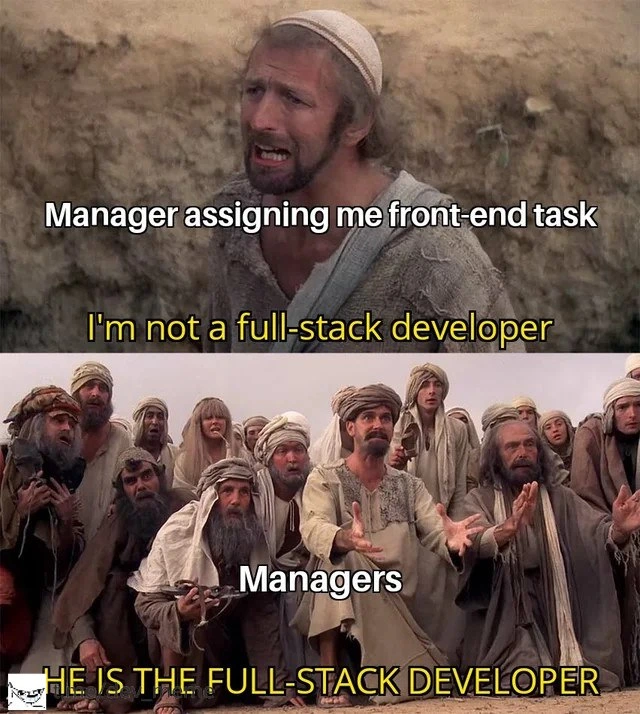
This meme shows a funny situation at work. In the top panel, a developer (the man in the robe) is assigned a front-end task by his boss. The text says: "Manager assigning me front-end task" and the developer replies in yellow text, "I'm not a full-stack developer." He’s basically telling his manager, "Hey, I usually work on back-end stuff, not the website interface." In the bottom panel, we see a whole crowd labeled Managers enthusiastically proclaiming, "HE IS THE FULL-STACK DEVELOPER." In other words, all the managers immediately decide this programmer can do everything now. They completely ignore his protest.
Let's break down the terms here, because they're key to the joke:
- Front-end: This is the part of the software that users directly see and interact with. For a web application, the front-end is the website itself — all the buttons, text, and layouts in your browser. Front-end developers use technologies like HTML, CSS, and JavaScript to create a good user experience. For example, making a button change color when you hover over it, or building a form that collects user input, are front-end tasks.
- Back-end: This is the behind-the-scenes part of the software that users don't directly see. It's like the engine under the hood of a car. Back-end developers work on the server side, dealing with databases, server logic, and application performance. They might write code in languages like Python, Java, or C#, handle data storage with SQL databases, or set up servers. For instance, when you submit a form on a website, the back-end code takes that data and saves it to a database or processes it.
- Full-stack developer: Someone who is comfortable working with both the front-end and the back-end. In other words, a jack-of-all-trades in web development. They can build the user interface and also handle the server logic and database. It's like being fluent in two languages — the language of the browser and the language of the server.
In a typical software team, developers often specialize. One person might be awesome at front-end – making a beautiful, responsive website – while another is a database wizard on the back-end. They each have their domain. When the developer in the meme says, "I'm not a full-stack developer," he's indicating, "I don't normally do front-end. That's not my specialty." Maybe he's a back-end specialist who rarely touches the UI.
The humor is that his Managers ignore that completely and label him full-stack anyway. It's like saying, "Oh, you handled that one front-end ticket? Great, you're officially our full-stack guy now!" The phrase "ticket" refers to a work item or task (like a bug fix or feature request) tracked in a system such as Jira. So with just one completed front-end ticket, they treat him as a master of the whole stack.
Why is this relatable? Because in real life, managers sometimes assume that if you're a software developer, you can tackle any kind of development task thrown at you. It's a common misconception, especially among non-technical bosses or project managers. They might think, "Coding is coding, right? If you can write Python code, you can probably tweak the website as well." But in reality, front-end and back-end technologies are quite different, almost like two different jobs. Not everyone is up-to-date on both.
If you're a newer developer, you might experience something like this: imagine you've mostly worked on server code, but then you're asked to fix a minor bug on the website's interface. You manage to solve it (perhaps by searching for a quick CSS fix or JavaScript snippet). Great! But then, because you succeeded once, management starts believing you can handle the whole website front-end whenever needed. You might be thinking, "Uh oh, that was just a one-time thing. I’m not really comfortable with all this front-end stuff," but from the manager's perspective, you're now the team's go-to person for anything UI-related. That can be both flattering and daunting.
This meme exaggerates that exact scenario for comedic effect. The developer is clearly uncomfortable: he's basically saying "I'm not the right guy for this," which shows he's aware of his own skill boundaries. Meanwhile, the managers are portrayed as an overeager crowd, cheering "Yes you are, we believe in you!" They instantly pronounce him full-stack as soon as they see an opportunity. The misaligned expectation here is that the managers assume one success means permanent expertise. It's funny because it's an exaggeration of a real communication gap.
For a junior dev, the takeaway is that titles and skills in tech aren't one-size-fits-all. Just because someone is a great back-end developer doesn't automatically make them a great front-end developer, and vice versa. Each side involves different tools and knowledge. It's totally okay to speak up (like the guy in the meme did) and say "That's not my area" or ask for help when you're thrown into unfamiliar territory. The joke lands because the poor dev's honesty is ignored in favor of what the managers want to believe.
"One Ticket Wonder" is a playful way to describe what's happening: with just one completed ticket outside his usual work, the developer is treated like a wonder-worker who can do it all. To him, it's frustrating (he's thinking "I only did a small fix, I'm no expert"), but to the managers, it's like they discovered a hidden talent in their team overnight. The meme takes this misunderstanding and blows it up to make us laugh and say, "Yep, I've seen that kind of thing happen!" It's a lighthearted poke at how differently managers and developers can view the same situation.
Level 3: The Full-Stack Messiah
Manager: "Here's a new front-end ticket for you to handle."
Developer: "I'm not a full-stack developer."
Managers (crowd, excitedly): "He is the Full-Stack Developer!"
This meme scene hits a little too close to home for many of us in software. It's directly parodying a classic moment from Monty Python's Life of Brian — in that film, an unwilling hero protests "I'm not the Messiah!" while a fervent crowd insists "He is the Messiah!". In this version, the developer is Brian, insisting "I'm not a full-stack developer," and the Managers around him are the zealous crowd, ecstatically declaring "He is the full-stack developer!" despite his denial. This tongue-in-cheek life_of_brian_reference perfectly captures the absurdity of a workplace situation: a single unexpected front-end success suddenly anoints a backend specialist as the chosen one for all things front-end.
Why is this funny (and painful)? Because it skewers a common developer headache: management's tendency to ignore role specialization. In real software teams, Frontend and Backend development are often distinct disciplines. A backend engineer might spend years mastering database transactions, server logic, and API design, while a frontend expert wrangles responsive layouts, browser quirks, and JavaScript frameworks. Being full-stack (skilled across the entire stack) is a real talent — some might even say a mythical one, like a coding unicorn. Yet here we have manager expectations so out-of-touch that the moment a backend dev resolves one UI ticket, they're instantly proclaimed a Full-Stack Developer. It's management humor meets tech humor: the boss figures "Eh, code is code, you'll handle the UI just fine" — a prime example of misaligned expectations between technical reality and managerial wishful thinking.
This scenario is all too relatable. Many developers have lived it: you fix one pesky CSS alignment bug or add a small React component as a favor, and suddenly you're volunteered to redesign the whole frontend. Your protest of "I'm not familiar with that tech stack" falls on deaf ears, just as the meme portrays. The crowd of managers behaves like they've discovered the chosen one in their team: "Behold, the developer who can do it all!" There's dark humor in how quickly a Manager can rewrite your job description. One day you're a Backend Specialist Full-Stack Engineer, congrats! 🎉 (If only the pay raise came as fast as the title change, right?)
From an experienced engineer's perspective, the joke highlights how non-technical decision-makers often conflate any development work with all development work. It's a commentary on the managerial mindset (think Management and PMs): they've got a tight deadline or a missing skill on the team, so they grab whoever kinda-sorta touched that area once. The developer's frustration is palpable: being labeled something you're not, tasked outside your expertise, and expected to succeed as if by magic. It's like being voluntold to step on stage without rehearsing the second act. Sure, you made one cameo in the frontend — now suddenly you're the lead UI actor every night.
Historically, the industry has hyped FullStackDevelopment as a desirable trait (startups especially love the "one-person army" dev). There's some truth that early web devs did wear many hats — back in the LAMP stack days, a single dev might code PHP on the server and also tweak the HTML in the same project. But modern web applications have grown in complexity. Now entire job roles exist for each layer of the stack because each one is a deep field of knowledge. The meme pokes fun at the fact that some managers haven't gotten that memo. It's a RelatableDeveloperExperience because teams continue to face this: the moment you demonstrate any frontend competence, you're drafted to handle both Frontend and Backend. The result? A developer feeling like Brian in Life of Brian, surrounded by a well-meaning mob chanting affirmations that completely ignore his actual words.
In essence, this comedic image shines light on a real workplace dynamic:
- Miscommunication: The developer says one thing ("I'm not full-stack") and managers hear something else entirely.
- Overgeneralization: Management sees one data point (a completed front-end task) and extrapolates a broad ability ("You can do ALL front-end now!").
- Underestimation of complexity: It implies a belief that front-end work is just a quick task any coder can pick up — which seasoned devs know is a recipe for bugs and technical debt if done without proper experience.
- Organizational pressure: Often there's a lack of resources (maybe no dedicated UI dev available), so managers enthusiastically convince themselves that existing staff can stretch to fill the gap. The meme exaggerates it to absurd levels, showing a whole crowd willing it to be true.
The humor lands because every developer who's been in this spot can both laugh and cringe. It's a satire of how ManagerExpectations can be wildly out of sync with reality. The developer in the meme is effectively thinking, "You have no idea what you're asking for..." while the managers celebrate their new all-in-one solution. In a way, it's cathartic humor: we laugh, but it's the laugh of recognition. We've seen those enthusiastic proclamations at sprint meetings: "Oh, you did great on that UI fix! Next sprint, you'll lead the whole front-end refactor, right?" 😅
At the senior engineering level, this meme is nodding to how easily specialization gets overlooked. It's a comedic reminder that BackendVsFrontend skills aren't interchangeable just because the word "developer" is in both job titles. And it resonates strongly because it captures a real tension in tech teams: the gap between what managers think is possible (or convenient) and what engineers know is practical. The poor developer is left doing double duty, juggling tasks they never signed up for, all because management decided to make him the Full-Stack Messiah after one little miracle. Cue the sarcastic applause.
Description
A two-panel meme using the 'He is the Messiah' format from the movie 'Monty Python's Life of Brian'. In the top panel, a distressed-looking man (Brian) is labeled 'Manager assigning me front-end task' and is saying, 'I'm not a full-stack developer.' In the bottom panel, a crowd of people, labeled 'Managers,' points at him and enthusiastically proclaims, 'HE IS THE FULL-STACK DEVELOPER'. This meme humorously captures a common scenario where a developer, often with a backend or specialized focus, is pressured into taking on tasks outside their expertise. Managers, in their need for flexible resources, anoint them as 'full-stack' regardless of the developer's actual skills or wishes, turning the title into a catch-all for 'does whatever we need'
Comments
7Comment deleted
In many companies, 'full-stack developer' isn't a title you earn, it's a resource allocation strategy you're subjected to
Fixed one stray z-index in a backend PR and now management’s calling me the “front-end practice lead” - apparently knowing B-tree indexes means I’m fluent in flexbox
After 15 years of optimizing database queries and building distributed systems, nothing quite prepares you for the existential crisis of centering a div or explaining why the CSS cascade means their 'simple change' just broke three other components in production
The 'full-stack developer' has become tech management's equivalent of a Swiss Army knife - theoretically capable of everything, but in practice, you really want the specialized tool for the job. Telling a backend engineer who's spent years optimizing database queries and designing distributed systems that they should 'just handle the CSS' because they're 'full-stack' is like asking a kernel developer to center a div. Sure, they *could* figure it out, but at what opportunity cost? The real irony is that the term was originally meant to describe T-shaped engineers with deep expertise in one area and broad familiarity with others - not someone who's expected to context-switch between React state management and database sharding in the same sprint
In our org’s type system, BackendEngineer auto-casts to ReactComponent when budget == 0; undefined behavior starts at CSS
Full-stack: the title you get when a hiring freeze outranks Conway's Law
Full-stack dev: backend wizard who 'just aligns the divs' until the monolith topples