AWS stack delete implodes everything except one resource, leaves shrugging aftermath
Why is this AWS meme funny?
Level 1: Everything’s Gone... Almost
Imagine you built a big tower out of toy blocks and then asked your friend to knock it down completely. Your friend runs in and kicks the tower as hard as they can. Blocks go flying everywhere – a huge crash, dust all over – just like a building being demolished. But when the dust settles, you see that one single block somehow didn’t fall over. It’s just sitting there, still standing upright. Your friend just gives a little shrug and says, “I couldn’t get that one block... oh well!” and walks away. Now almost the entire tower is gone, except for that one stubborn block left behind.
It’s both funny and a bit frustrating, right? You expected everything to be knocked down, but there’s this one piece left. That’s the joke of the meme. The big tower of blocks represents a bunch of things we wanted to destroy or clean up. The friend (like AWS in the cloud) did almost the whole job, but left one piece because it was a bit too tricky to knock down. The friend’s shrug is like saying, “Eh, close enough!” We find it humorous because it’s such a silly, relatable outcome: you ask for a complete cleanup and you get 99% of it done, with 1% left just sitting there. Even if you’re not into computers, you know that feeling when you try to finish a task and there’s a tiny bit that just won’t cooperate. The meme is playing on that feeling – it makes us laugh at how one little leftover can turn an “all done!” into an “almost done.”
Level 2: CloudFormation Cleanup 101
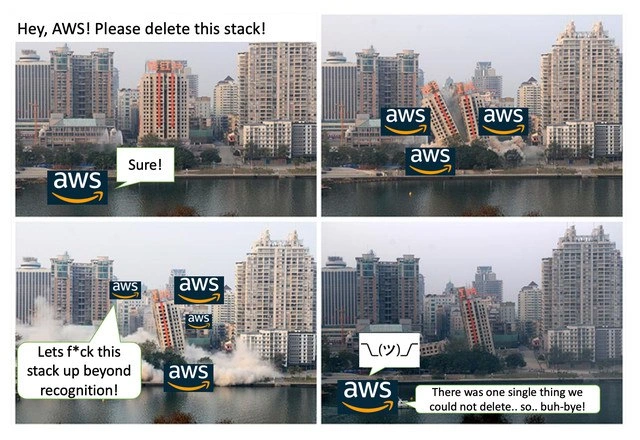
Let’s break down what’s happening in this meme in simpler terms. AWS CloudFormation is an automation service that lets developers define a bunch of cloud resources (like servers, databases, networks, storage buckets) in a template – this collection of resources is called a stack. When you create the stack, CloudFormation provisions all those resources for you automatically (basically building that red-and-white high-rise shown in the first panel). Now, when you’re done with those resources, you can tell AWS to delete the stack. This should, in theory, clean up everything it created – analogous to knocking down the entire building and carting away the debris.
In the meme’s first panel, the person says, "Hey, AWS! Please delete this stack!" and AWS cheerfully replies, "Sure!" That’s illustrating a developer using CloudFormation to delete an infrastructure stack. The next panels show the building (the stack) being demolished – that represents the deletion process in action. The AWS logos in the pictures are like the demolition crew (i.e. AWS services) doing the work of tearing down each part of the stack. If all goes well, the building (your stack of resources) should disappear entirely when AWS is done, just like a successful demolition where not a brick remains.
However, the final panel reveals that after the dust clears, AWS has a shrug emoji and says: "There was one single thing we could not delete... so... buh-bye!" This is exactly what sometimes happens in real life when using CloudFormation or other Infrastructure-as-Code tools. Most of the resources do get deleted, but maybe one resource fails to be removed. We call this a dangling resource – it’s like one piece of the building that’s mysteriously still standing after the explosion. In AWS terms, you might see in the CloudFormation console that the stack status becomes DELETE_FAILED, with an error message naming the specific resource that couldn’t be deleted.
Why would one resource not get deleted? Common reasons include dependency or cleanup issues. For example, consider an S3 bucket (an AWS storage container, like a cloud folder for files) that still has some files inside. When CloudFormation tries to delete that bucket as part of tearing down the stack, AWS will refuse because the bucket isn’t empty. This is a safety measure to prevent accidental data loss (imagine if those files were important and you didn’t really mean to wipe them out). Because of that rule, the deletion of the bucket fails. CloudFormation, encountering this, stops and reports that it couldn’t delete the bucket. The end result: everything else in the stack is gone – your servers, databases, etc. were successfully demolished – but that one S3 bucket is still sitting there in your account. It’s as if the demolition crew knocked down the whole building except for one last pillar that refused to crumble. The AWS logo shrugging in the meme is basically saying, "Oops! I did my best, but I couldn’t remove that last part."
For someone new to AWS or DevOps, this scenario can be puzzling at first. You expected AWS to handle all the cleanup automatically, but now you have this one leftover piece to deal with. The meme turns that frustration into humor by showing AWS literally blowing up a building and then casually waving goodbye despite one chunk remaining. The key lesson here is: even with cloud automation, you sometimes have to double-check and do a bit of manual cleanup. When you use CloudFormation to delete a stack, remember that if a resource has a special condition (like a bucket with files in it, or a database with a final backup setting), you might need to handle that before the stack can completely go away. In other words, the cloud tries to clean up everything for you, but occasionally it will leave one thing behind as a Gotcha!. The meme is basically laughing at that situation – “Haha, AWS destroyed everything except that one thing. Figures!” It’s a lighthearted way to remind us that even in the world of automation, a little human attention might be needed to finish the job.
Level 3: The Last Resource Standing
Anyone who's managed AWS infrastructure via CloudFormation or similar DevOps tools has likely felt this pain. You click "Delete" on an AWS stack, expecting a clean teardown of all your resources – only to end up with a big fat DELETE_FAILED error and one stubborn resource still hanging around. The meme captures that shared DevOps/SRE nightmare: CloudFormation cheerfully nukes almost everything (like a controlled building demolition leveling a skyscraper) but then announces with a shrug, "There was one single thing we could not delete... so, buh-bye!" In other words, AWS just left you with a partially-destroyed stack and a dangling resource. It’s funny in hindsight precisely because it’s such an absurdly common cloud experience.
Why does this happen? In practice, most stack deletion failures boil down to resource dependency hell or safety mechanisms kicking in. A classic example: an S3 bucket in the stack wasn’t empty – perhaps it accumulated some log files or data that you didn’t manually clear out. AWS by design refuses to delete a bucket that still has content (to prevent accidental data loss), so CloudFormation throws up its hands. Result: every other resource gets demolished except that bucket, which now stands alone like an indestructible red-and-white tower in the skyline (just like in panel 4 of the meme). Other usual suspects for "last resource standing" include an RDS database that won’t delete because you enabled final snapshot protection (AWS insists on creating a backup or having you opt-out before it lets the database go), or a security group that can’t be removed because some stray network interface outside the stack is still attached to it. In all these cases, automation gone wrong isn’t the cloud acting randomly – it’s the system stopping where it thinks it’s being safe. But from our perspective, it feels like AWS blew up our entire setup and then said “Oh, except that one piece — I’m leaving that.” Talk about deployment anxiety: even tearing things down induces worry that something will be left dangling!
The humor really lands with that shrugging AWS logo in the final panel. As engineers, we’ve seen that exact figurative shrug from CloudFormation. It’s the terse outcome message essentially saying:
"Cleanup complete... well, mostly.
¯\_(ツ)_/¯Good luck with the rest!"
The meme’s third panel line, "Let's fck this stack up beyond recognition!"*, adds to the dark comedy. It jokes that AWS goes in guns blazing, destroying resources left and right (which is often how it feels watching a stack deletion in the AWS Console – a rapid-fire list of tear-down events scrolling by). Then, after all that flashy destruction, you’re left staring at one lonely resource that survived. AWS’s shrug in the final panel perfectly represents that unhelpful outcome: basically the cloud saying, “We tried to delete everything, but one thing wouldn’t budge, so... oh well.”
Seasoned DevOps folks will chuckle (or more likely, groan) at this because they've been the ones manually cleaning up that last resource at 3 AM. In a real scenario, what happens next is the un-fun part: you often have to log in and resolve the issue yourself. Maybe you empty the S3 bucket’s contents and then retry the deletion, or delete that leftover RDS instance after confirming the backup, or detach whatever external thing is clinging to your security group. Essentially, you become the cleanup crew after the supposed “automatic” cleanup. This meme is a tongue-in-cheek reflection of CloudFormation’s limits and the gap between the promise of Infrastructure-as-Code (100% automation, even for tear-down) and the reality (some tasks still require a human touch or at least a custom script). The building collapse metaphor is perfect – an implosion of infrastructure – and that one remaining upright chunk of building is the bane of every cloud engineer’s existence: the remnant that didn’t go down cleanly. It’s funny because it’s true: AWS will tear down 99% of your stack in seconds, but that last 1% might require you to put on your hard hat and finish the job manually. Experienced engineers have come to expect this scenario and swap war stories about it. The meme basically says “Welcome to the club,” capturing our collective exasperated laughter when we realize our supposedly foolproof teardown has a stubborn sense of humor.
Level 4: Orchestrating Non-Atomic Destruction
Deleting an entire AWS CloudFormation stack is essentially initiating a distributed transaction that spans numerous independent services (EC2, S3, RDS, etc.). However, unlike a true database transaction, it’s not atomic – there's no all-or-nothing guarantee. CloudFormation acts as an orchestrator that sends out deletion commands to each resource in turn, but there's no global commit phase to ensure that either every resource is deleted or none are. Instead, the process is inherently non-atomic: if one resource fails to delete, the system can’t roll back the ones that were already destroyed. The meme humorously captures this by showing a building (the stack) being demolished: most of it collapses successfully, but one stubborn piece (a resource) remains, highlighting the lack of an all-or-nothing teardown.
Under the hood, CloudFormation builds a dependency graph (a Directed Acyclic Graph, DAG) of resources to figure out a safe deletion order. For example, if Resource B depends on Resource A, CloudFormation will delete B first, then A. This is akin to a topologically sorted destruction plan. But distributed systems have a mind of their own: each AWS service enforces its own rules and timing. Perhaps an S3 bucket refuses deletion because it's not empty or an RDS database won’t drop until a final snapshot is taken. These are external consistency conditions that CloudFormation must respect. When a resource deletion call fails (due to such a dependency or policy constraint), CloudFormation stops and marks the stack as DELETE_FAILED. There’s no two-phase commit across AWS services to automatically revert the already-vanished resources. In theoretical terms, the orchestrator faced a partial commit: some deletions completed (committed), one deletion aborted, and there's no global rollback. We end up with a dangling resource still alive and kicking, just as the last standing fragment of the demolished building.
This scenario embodies the fundamental limitations of distributed orchestration. To achieve a perfectly consistent teardown, CloudFormation would need to coordinate all services with something like a two-phase commit or a global lock, which would be wildly impractical (imagine pausing all of AWS just to ensure your stack deletion is atomic!). Instead, AWS opts for eventual consistency and best-effort cleanup. The meme exaggerates this with AWS logos gleefully shouting "Let's fck this stack up beyond recognition!"* during the collapse, emphasizing the chaotic, non-reversible nature of tearing down infrastructure. Once those delete calls are fired, there's no undo button in a global sense – if 19 out of 20 resources vaporize and the 20th says "nope," you're left with exactly 1/20th of a stack. It’s a cloud orchestration blues: the constraints of each service (like “bucket must be empty to delete”) become the gospel the orchestrator must obey, leading to an incomplete destruction if any one service objects.
In summary, this comical cloud failure mode stems from the way Infrastructure-as-Code tools like CloudFormation manage state across distributed systems. They can’t magically ensure that every single piece of infrastructure disappears in unison. Instead, they handle deletion much like a carefully planned building demolition, packing explosive charges at key points (i.e. deleting in dependency order). But if one charge fails to go off – analogous to a resource that refuses deletion – the building won't completely fall. AWS just shrugs (as in the final panel) because from a systems perspective, partial success is sometimes the best it can guarantee without risking more problems. The meme nails the absurdity of this: the DevOps team asked for a clean sweep, and the cloud said “Sure!” – delivering a nearly annihilated stack with one oddly persistent piece left standing, thanks to the realities of distributed teardown.
Description
Four-panel meme built from a photo sequence of a riverside high-rise demolition. Panel 1 shows an intact red-and-white building among taller towers; the caption reads "Hey, AWS! Please delete this stack!" with an AWS logo replying in a speech bubble: "Sure!". Panel 2 captures the building starting to tip while three floating AWS logos hover mid-scene. Panel 3 shows dust clouds as the structure collapses; an AWS logo shouts "Lets f*ck this stack up beyond recognition!". Panel 4 reveals the skyline minus the building, a lone AWS logo displaying the shrug emoji "¯\_(ツ)_/¯" above text: "There was one single thing we could not delete.. so.. buh-bye!". The visual joke mirrors CloudFormation or IaC tear-downs where most resources delete but one dependency fails, leaving engineers with a DELETE_FAILED stack and DevOps frustration
Comments
6Comment deleted
CloudFormation status report: 237 resources → DELETE_COMPLETE, one versioned S3 bucket → DELETE_FAILED - congrats, you just invented the ‘accidental data lake’ pattern
The only thing more persistent than a CloudFormation stack in DELETE_FAILED state is the AWS bill for the phantom resources it claims don't exist but somehow still charges you for
When you confidently run 'aws cloudformation delete-stack' on Friday afternoon without checking DependsOn relationships, and suddenly realize your 'simple cleanup' just triggered a cascade deletion across three environments because someone nested stacks like Russian dolls. AWS's ¯\_(ツ)_/¯ perfectly captures that moment when you discover DeletionPolicy wasn't set to Retain on the one RDS instance the entire company depends on. Pro tip: Always check cross-stack references before demolition - unlike real buildings, cloud infrastructure doesn't need permits, just regrets
CloudFormation delete: 90% fireworks, 10% eternal S3 billing - the architect's humility check
CloudFormation’s destroy algorithm: delete everything at warp speed until it hits one ENI‑referenced security group, shrug, and convert infrastructure as code into console archaeology
Deleting an AWS stack is just a controlled demolition that somehow leaves the one thing with a meter running - the NAT Gateway - because a zombie ENI refuses to detach