Skip to content
DevMeme
3504 of 7435
The Perils of AWS Success
AWS Post #3840, on Oct 20, 2021 in TG

The Perils of AWS Success

Why is this AWS meme funny?

Level 1: When Saving Costs More

Imagine you have a big cookie jar and your parents say you can take cookies whenever you want, instead of them giving you just one a day. You think, “Great, this will save cookies because I’ll only take what I need.” But then one day you invite all your friends, and everyone starts taking cookies from the jar. The jar almost empties out! Next thing you know, you have to buy a lot more cookies to fill it back up, and you spend way more money than if you had just limited the cookies in the first place. In other words, you tried to save, but ended up with a much bigger bill. That’s what happened in the meme: someone thought using the cloud (AWS) would save money, but when lots of people started using their stuff, the costs blew up like a balloon. It’s funny in the way a silly mistake is funny – he wanted to be cheap, but it turned out much more expensive, and the guys in the picture are laughing because they saw it coming a mile away.

Level 2: Pay-Per-Use Surprise

Let’s break down why this AWS cloud bill shock happens in simpler terms. AWS (Amazon Web Services) is basically a huge cloud computing platform where you rent servers, storage, and other tech resources over the internet, paying only for what you use. This sounds great and often is great for flexibility. Instead of buying a bunch of expensive computers (servers) upfront, a company can use AWS and only pay for hours of computing or gigabytes of storage they actually need. That’s what we mean by “use AWS to save costs” – no big purchase at the start, just smaller ongoing charges.

However, the joke here is that those ongoing charges can quietly grow much larger than expected once your application becomes popular. Imagine you’re a new developer who just launched an app. At first, only a few people use it, and AWS might cost just a few bucks a month – cool! Then suddenly your app gets popular (the project “takes off” 🚀). Now thousands of people are using it every day. AWS will automatically provide more servers and power to handle all those users (that’s called autoscaling, where AWS adds more server instances when demand increases). But each of those server instances costs money per hour. So 1 server at $0.10/hour was cheap, but 100 servers at $0.10/hour becomes $10/hour, which over 720 hours in a month is $7,200! Surprise! Your cost exploded along with your user count.

Another thing new folks learn is how data fees work in the cloud. For example, storing data in an S3 storage bucket is pretty cheap per GB, but if you have a ton of users downloading or transferring that data, AWS charges for the outbound data (often called data egress). It’s like a phone plan where incoming calls are free but outgoing calls cost you — if your app serves a lot of videos or large files to users, the “data out” fees can become a huge portion of the bill. Many beginners have been shocked by a bill because they didn’t realize moving data out of the cloud (to user devices or external systems) isn’t free.

Also, AWS has many helpful services (like managed databases, or message queues). They save you time because AWS runs them for you, but they charge per request or per hour, etc. A junior dev might enable a lot of these fancy services thinking, “hey, it’s just pennies each,” not realizing millions of pennies add up to big dollars. For instance, using Amazon’s CloudWatch to monitor your servers is super useful – until you get a bill for all the detailed logs and metrics you collected 24/7. It’s like subscribing to a bunch of small monthly services; each one seems cheap, but together the expenses pile up if you’re not watching.

In short, the meme is a cautionary laugh for anyone starting with cloud: pay-as-you-go is great until you go way more than you expected. New developers learn to be careful: turn off idle servers, set budgets and alerts, and always read the fine print of what AWS services cost. The humor comes from that hindsight — everyone entering the cloud thinks “we’ll save money,” and then many get that first shocking bill and go “uh-oh, what did we do?” It’s a rite-of-passage in cloud learning, and seeing those Goodfellas gangsters laugh is basically like the senior engineers laughing and saying “Welcome to the club, kid!” 😅

Level 3: Offer You Can’t Refuse

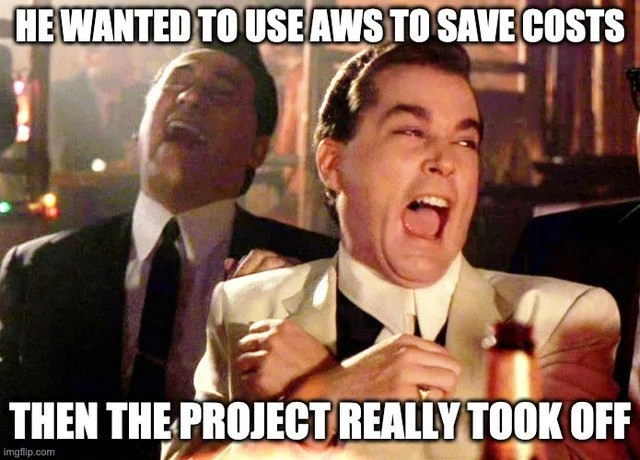
In the infamous Goodfellas scene used by this meme, seasoned wiseguys cackle at someone’s naive idea. He wanted to use AWS to save costs — those are famous last words in modern IT. Veterans who’ve survived a cloud billing nightmare will smirk at that line, knowing exactly what comes next. The bottom caption, “then the project really took off,” is dripping with irony: the project took off to the sky, and so did the cloud bill. It’s the classic tale of cloud cost overrun: you start with dreams of pay-as-you-go efficiency, and end with a skyrocketing invoice that makes your finance team laugh nervously (to keep from crying).

Why is this so funny to experienced engineers? Because we’ve all seen it. A team migrates to Amazon Web Services believing they’ll pay only for what they use and save money compared to owning hardware. Initially, it works — costs seem low during development and testing. But in production, usage grows explosively (a good problem to have until you see the bill). Auto-scaling kicks in, spinning up dozens of extra EC2 instances when traffic surges. S3 buckets fill up with user data and backups. Every extra gigabyte of data stored, every million Lambda function invocations, every GB of data egress (data leaving AWS) quietly adds to the bill. The punchline: all those “savings” fly out the window once real users arrive. It’s as if AWS made them an offer they couldn’t refuse – irresistible flexibility and scalability – and then, like a true mob boss, AWS comes to collect its cut. The house always wins. 💰

This meme hits on multiple notorious AWS cost pitfalls that senior devs know too well:

  • Autoscaling Stampede: Auto-scaling (on EC2 or Kubernetes) is great for handling more users, but it can multiply your instances overnight. One minute you have 2 servers, the next minute 200. At ~$0.10/hour each, that’s $20/hour suddenly – and about $14,400 in a month if traffic stays high. It’s easy to laugh until you’re the one explaining that AWS invoice to the CFO.
  • Data Egress Fees: Pushing data to your users isn’t free. AWS charges for outbound bandwidth, often a lot. That viral feature or huge data export can rack up thousands in transfer fees. It’s the classic “we didn’t think sending JSON to mobile apps would cost that much” mistake. Surprise! Now your “cheap” cloud app has a line item for data transfer bigger than the dev team’s salaries.
  • Managed Services Sprawl: AWS has a service for everything – databases, caches, queues – and teams often use many of them for convenience. Each managed service (DynamoDB, RDS, SQS, CloudWatch logs, etc.) has its own pricing model and meter running. It’s micro-billing mayhem: $0.000001 per request sounds great until you have billions of requests. The bill grows in so many dimensions that it’s like fighting a hydra. Cut down the EC2 cost, and the CloudWatch monitoring or NAT Gateway fee bites you from behind.

In theory, cloud cost optimization isn’t impossible. AWS offers tools like Cost Explorer, billing alarms, and even Savings Plans or Reserved Instances (where you pre-pay or commit for cheaper rates). But in practice, teams often overestimate savings and underestimate how easy it is to consume more resources. It’s as if every part of your architecture has an invisible “$$$” attached. One senior engineer might dryly joke, “Sure, our cloud architecture can handle 10x traffic – we just didn’t realize our budget couldn’t.” When the project “takes off,” it can literally take your expenses with it straight to the clouds. The meme’s dark humor comes from that too-familiar scenario where the cloud was supposed to be a cost haven but turned into a runaway tab. Seasoned devs laugh because it’s better than crying over the AWS bill 😅, and because we’ve all been that optimistic person at some point— until reality (and AWS billing) slapped us in the face.

Description

This image uses the popular 'Goodfellas Laughing' meme format, which features a still from the movie 'Goodfellas' where several characters, including Henry Hill (played by Ray Liotta), are laughing hysterically. The meme is typically used to mock a naive or misguided statement. The image has white, bold, all-caps text at the top and bottom. The top text reads, 'HE WANTED TO USE AWS TO SAVE COSTS'. The bottom text reads, 'THEN THE PROJECT REALLY TOOK OFF'. The humor is rooted in a common, painful experience for many developers and organizations. While cloud platforms like AWS offer low initial costs and the promise of 'paying for what you use,' the costs can escalate exponentially and become notoriously complex to manage as a service scales. The joke is that the project's success, which is normally a goal, becomes the direct cause of a financial crisis due to unforeseen cloud expenses, a scenario that senior engineers and architects who have managed budgets find painfully relatable

Comments

7
Anonymous ★ Top Pick The fastest way to understand logarithmic scales is to look at your AWS bill after your app gets featured on the front page of Reddit
  1. Anonymous ★ Top Pick

    The fastest way to understand logarithmic scales is to look at your AWS bill after your app gets featured on the front page of Reddit

  2. Anonymous

    We went serverless to save money - now 218 Lambdas gossip through Step Functions, CloudWatch logs every rumor twice, and the invoice reads like an unbounded Kafka topic: append-only and endlessly growing

  3. Anonymous

    Nothing quite matches the executive confidence of 'we'll save money in the cloud' followed by the engineering team's nervous laughter when auto-scaling meets viral traffic and suddenly you're explaining why the monthly AWS bill looks like a Silicon Valley engineer's salary

  4. Anonymous

    The classic AWS journey: 'We'll save money with cloud elasticity!' they said. Then your side project hits HackerNews frontpage at 3 AM, auto-scaling spins up 47 EC2 instances, NAT gateway charges go parabolic, and suddenly you're explaining to finance why last month's $200 AWS bill is now $47,000. Turns out 'pay-as-you-go' becomes 'pay-as-you-grow' real fast when you forgot to set billing alarms, enable Reserved Instances, or consider that S3 egress costs more than the storage itself. The real cloud optimization was the financial trauma we experienced along the way

  5. Anonymous

    Nothing teaches FinOps faster than discovering your NAT Gateway has a better growth curve than your MAUs

  6. Anonymous

    “We’ll save money on AWS,” he promised - then usage spiked and cross‑AZ chatter, the NAT‑gateway tax, and DEBUG CloudWatch turned our runway into egress

  7. Anonymous

    AWS cost savings strategy: Nail product-market fit, then pivot straight to bill-market regret

Use J and K for navigation