Skip to content
DevMeme
1005 of 7435
Assembly Language Challenges the 'Two Weeks' Rule
LowLevelProgramming Post #1131, on Mar 12, 2020 in TG

Assembly Language Challenges the 'Two Weeks' Rule

Why is this LowLevelProgramming meme funny?

Level 1: Whole New Ballgame

Imagine someone says, “If you can ride a bicycle, you’ll be able to drive any vehicle in just a week or two.” Riding a bike teaches you balance and steering, so you feel confident. But then you’re handed the keys to a helicopter and told to fly. Suddenly, all that bicycle practice doesn’t help much – the helicopter has tons of controls you’ve never seen before. You realize this is a whole different ballgame. Learning your first easy programming language (like making simple games or apps) is the bike. It gives you general balance and confidence. But assembly language is the helicopter. It’s not just a slightly bigger bike or a car; it’s a completely different machine that works in a way you haven’t experienced. The meme is funny because a teacher’s encouraging promise (“Oh, any new language will be easy!”) meets the reality of something much harder. It’s that relatable moment when you expect a new task to be simple, then find out it’s surprisingly complex. Assembly is standing there quietly behind the blinds, giving you a look that says, “This won’t be as simple as you thought,” and every programmer who’s been through it can’t help but laugh at how true that feeling is.

Level 2: No Training Wheels

Think of assembly language as the ultimate “under the hood” experience in coding. It’s a low-level programming language, meaning it deals directly with the computer’s core operations. In most high-level languages (like Python, Java, or C#), you have lots of conveniences: you write one line and it might do many things behind the scenes (looping over data, managing memory, etc.). In assembly, by contrast, you have no training wheels – you have to explicitly tell the CPU everything, step by step.

For example, imagine adding two numbers and storing the result. In Python you might do:

# High-level (Python)
c = a + b

In an x86 assembly language, the equivalent task requires multiple instructions:

; Low-level (x86 Assembly)
MOV EAX, [a]    ; move the value of a into the EAX register (CPU's small storage)
ADD EAX, [b]    ; add the value of b to EAX (now EAX holds a + b)
MOV [c], EAX    ; move the result from EAX into the memory location for c

Here you can literally see the register EAX being used as a container for calculations. Registers are like the CPU’s tiny built-in variables. When you code in assembly, you’re constantly loading values into registers, manipulating them, and storing them back to memory. There’s no concept of a friendly variable that grows automatically or a for loop you can write in one line – you implement all that logic with manual steps and jump instructions (JMP).

Another big difference: manual memory management. In assembly, nothing is going to automatically free memory for you or prevent you from writing data where you shouldn’t. If you need space for something, you might adjust the stack pointer or call an operating system service – and if you mess up, the program might crash (that’s the dreaded segmentation fault, basically the computer saying “stop, you’re not allowed to touch that memory!”). High-level languages usually shield you from this by either managing memory for you (garbage collection) or at least throwing a clear error when you go out of bounds.

Now, about that “learn any other language in one or two weeks” idea: it tends to be true only when the languages share a lot of similarities. Switching from, say, Java to C# or from Python to Ruby isn’t too bad because they have comparable concepts (variables, loops, functions) just with different syntax. But assembly is in a league of its own. It’s not just a different syntax; it’s a completely different level of abstraction. The meme specifically calls out “Assembler:” — that’s basically referring to assembly language itself as if it were a person in the room. (Technically, an assembler is the tool that converts assembly code into machine code, but people often use assembler to mean the language informally.) The joke is that assembly doesn’t follow the nice, easy learning path teachers promise. It’s as if Assembly is standing there with arms crossed, saying “Oh, you think picking up any language is easy? Try me.”

It’s also worth noting that assembly isn’t one universal language. It’s tied to the CPU’s instruction set. For instance, AssemblyLanguageX86 refers to the assembly for Intel/AMD processors (the kind in many PCs), whereas AssemblyLanguageARM is for ARM processors (common in phones, tablets, and some laptops). The two have entirely different instruction sets and even syntax styles. So learning “assembly” often means learning one dialect of it. Skills in one assembly language don’t directly transfer to another without additional effort, because the registers, instruction names, and quirks are all different. That’s another reason this meme lands so well: even if you became pretty good at x86 assembly in a few weeks (an impressive feat), picking up ARM assembly would be like learning a whole new language again.

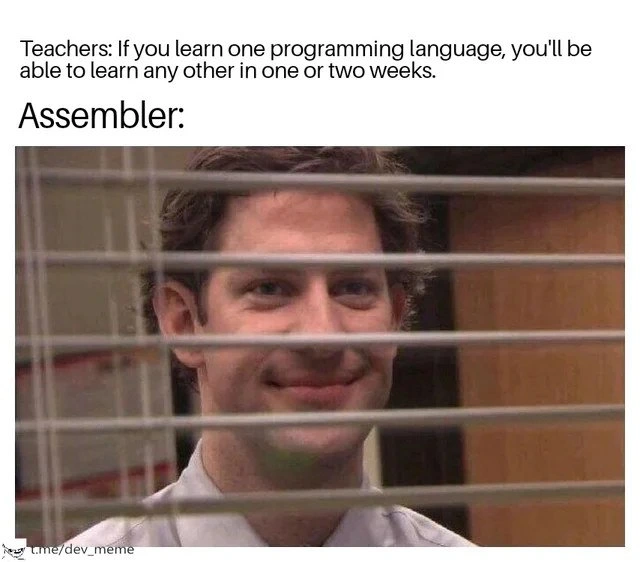
Finally, think about the image in the meme – a man peering through window blinds with a slight grin (that’s a character from a TV show, The Office). That image represents Assembly language watching you. The blinds create a bit of a barrier, like assembly is behind this window, not immediately accessible or friendly. The man’s expression is playfully unimpressed. It’s as if Assembly is quietly saying, “I’m here when you’re ready, but it’s not gonna be as easy as you say.” The whole joke comes down to this: teachers might encourage you by saying programming concepts transfer easily, but assembly language is the counter-example that makes every developer gulp. It has a steep learning curve and doesn’t let you reuse much from the languages you already know. In the world of coding humor, assembly is that notoriously tough nut that keeps you humble. So the meme humorously contrasts the optimistic claim with the harsh reality — and every programmer who’s struggled with a low-level language like assembly can’t help but smirk along with it.

Level 3: Hold My Segfault

Seasoned developers can practically hear the skepticism dripping through those blinds. The meme’s top text echoes a well-meaning myth in programming education: “Once you know one language, others are just a matter of syntax – give it a week or two!” For many modern high-level languages, there’s a kernel of truth there – switching from Java to Python or JavaScript mostly means relearning library quirks and syntax sugar. But when it comes to assembly language, that advice crashes harder than a null pointer dereference. The still image (Jim Halpert from The Office peeking through blinds with a barely contained smirk) perfectly personifies Assembly’s reaction to this claim. It’s as if Assembly itself is eavesdropping on that rosy proclamation and going, “Oh really? We’ll see about that…” in deadpan silence.

This resonates with every developer who’s ventured out of the cozy world of high-level languages into the wilds of low-level programming. We all remember that first time we opened an assembly code listing – it looked like a gibberish mix of three-letter opcodes (MOV, CMP, JMP) and mysterious hex numbers. That promise of “one or two weeks” to fluency quickly turns into one or two weeks just to print "Hello World" without the program segfaulting. The humor here leans on a shared understanding: picking up a new scripting language after Python might feel straightforward, but picking up assembly feels like hitting a wall of registers and manual memory addresses. It’s a humbling experience. In fact, the only thing you reliably learn in two weeks of assembly is a deep respect for compilers — and the realization that assembly is not Python.

In real life, this scenario plays out whenever a dev team needs to optimize a critical piece of code. Someone naively suggests, “I can rewrite it in assembly real quick.” Cue the assembly language lurking in the background with that knowing grin. Senior engineers know that “real quick” and “assembly” don’t belong in the same sentence. They’ve seen bright-eyed colleagues spend days debugging why their hand-written ASM routine crashes, only to discover they forgot to save a caller’s register or used the wrong calling convention. It’s the classic learning-curve whiplash: going from a world where the toughest part is remembering library functions, to a world where you’re counting CPU cycles and worrying about whether your data fits in 32 bits or 64 bits. The meme pokes fun at that overconfident claim – it’s a gentle nod to the shared joke that the “learn any language in weeks” line doesn’t apply universally. Everyone in on the joke has felt the sting when transferable skills suddenly… aren’t. Assembly is the ultimate reality check for any dev who thinks they’ve “mastered programming” after one easy course. It silently chuckles from behind the blinds, waiting for you to discover that learning a new programming language isn’t always just swapping syntax – sometimes it means plunging down to a level where the computer doesn’t meet you halfway at all.

Level 4: Bare-Metal Reality

At the lowest level, assembly language strips away nearly every comfort of modern programming. When educators cheerfully claim “learn one language, and you can learn any other in a couple of weeks,” they're picturing languages that share high-level structures and libraries. But assembly lives in a different world – the bare-metal world of the CPU. Here, every instruction corresponds directly to an opcode the processor recognizes. There's no interpreter or runtime holding your hand. Registers (tiny storage slots inside the CPU like EAX or R0) are your variables, and you must manipulate them explicitly for even simple tasks. Memory addresses aren’t abstract pointers hidden behind managed objects; you have to manually manage them, calculating where to store data and cleaning up when done. In high-level code, printing "Hello" might be one line; in assembly, it balloons into dozens of steps: loading registers with system call numbers, pointing them to character buffers, and invoking interrupts or BIOS calls. Each architecture has its own instruction set – write something in x86 assembly for an Intel/AMD processor and it means nothing on an ARM chip running your phone. This is why assembly's learning curve is notoriously steep: knowledge doesn’t seamlessly transfer across CPU architectures the way Python skills transfer to JavaScript. Assembly demands a mental model of the hardware itself. You aren’t working with convenient abstractions like lists or objects – you’re juggling bytes and jump instructions. One misstep (say, writing to an invalid memory address or forgetting to save a register) and your program doesn’t politely error out; it might just crash instantly or silently corrupt data. (Ever heard of a segfault? In assembly, you'll become intimately familiar.) The meme’s humor comes from this sobering truth: the myth of quick language learning hits a brick wall when it meets the reality of low-level programming. Mastering assembly in "one or two weeks" is a fantasy because you'd essentially have to absorb how a CPU really operates – caches, pipelines, and all. In fact, true assembly gurus even consider things like CPU pipeline hazards or cache misses, painstakingly ordering instructions to avoid stalls – complexities that no typical intro programming teacher would ever mention. In short, assembly is where you realize that each "simple" high-level command conceals a world of intricate operations, and learning that world isn’t just picking up new syntax – it’s learning to think like a computer.

Description

A meme consisting of text and an image. The top text reads, 'Teachers: If you learn one programming language, you'll be able to learn any other in one or two weeks.' Below this, the word 'Assembler:' introduces the reaction. The image is the 'Jim Halpert smiling through blinds' meme from the TV show 'The Office.' It shows Jim smirking slyly at the camera from behind horizontal window blinds. The meme humorously refutes the common educational advice about the transferability of programming skills by presenting Assembly language (Assembler) as a major exception. While the advice holds for most high-level languages, the smirk from 'Assembler' implies that its fundamentally different, low-level nature - being so close to the machine hardware - makes it a far greater challenge to learn than the simple two-week estimate suggests

Comments

7
Anonymous ★ Top Pick Learning another high-level language is like learning a dialect. Learning Assembly after Python is like being a fluent poet and then being asked to communicate using only Morse code clicks
  1. Anonymous ★ Top Pick

    Learning another high-level language is like learning a dialect. Learning Assembly after Python is like being a fluent poet and then being asked to communicate using only Morse code clicks

  2. Anonymous

    “Sure, assembler’s a two-week ramp-up - just long enough to memorize the ABI, write your own malloc, and accept that every typo is now undefined behavior at 3 GHz.”

  3. Anonymous

    After 20 years of shipping production code, I still remember the exact moment I realized my CS professor's 'two weeks to learn any language' claim didn't account for spending three days debugging why MOV AX, [BX+SI+7] was segfaulting - turns out knowing Python doesn't prepare you for manually calculating effective addresses and praying your stack frame doesn't corrupt the interrupt vector table

  4. Anonymous

    Sure, learning Python after Java takes two weeks - but learning Assembly after literally anything else is like being told 'you know how to drive a car, so piloting this 747 by manually adjusting fuel mixture and control surfaces should only take a fortnight.' Suddenly you're counting clock cycles, manually managing every register, and realizing that 'mov eax, [ebp-4]' is somehow both the most explicit and most cryptic thing you've ever written. The real kicker? After months of Assembly, you return to high-level languages with PTSD-level appreciation for garbage collection and the profound luxury of writing 'x = y + z' without contemplating which registers to clobber

  5. Anonymous

    Two weeks? Week one: pick Intel or AT&T; week two: learn the ABI, hand-roll prologue/epilogue, and discover printf isn’t a syscall

  6. Anonymous

    Two weeks to learn assembler? Perfect - week 1 memorizing the SysV ABI, week 2 figuring out why your stack is off by 8 and every SIMD call faceplants

  7. Anonymous

    Assembly: where high-level 'transferable skills' meet the cold reality of hand-rolling your own garbage collector

Use J and K for navigation