Skip to content
DevMeme
2695 of 7435
The Duality of Creation: Artists vs. Programmers
Bugs Post #2978, on Apr 17, 2021 in TG

The Duality of Creation: Artists vs. Programmers

Why is this Bugs meme funny?

Level 1: Little Mistake, Big Mess

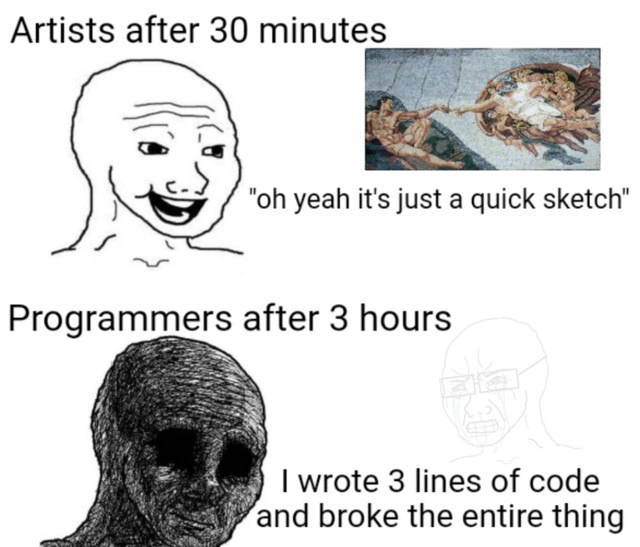
Imagine you spend all afternoon building a tall tower out of blocks. You’re being very careful and add just one small block to the top… and suddenly the whole tower collapses into a huge mess. You’d feel upset and shocked, right? That’s exactly the feeling in this meme. The artist drew a beautiful picture really fast and acted like it was no big deal. But the programmer added a tiny bit of new code and everything broke. It’s funny in the way that watching someone accidentally knock over their huge block tower is funny and sad at the same time – a small action caused a big disaster. The meme is showing how a little mistake can cause a huge problem, especially in coding, and that contrast is what makes it humorous and relatable.

Level 2: Small Change, Big Crash

This meme compares an artist’s easy confidence to a programmer’s total frustration. In the top half, an artist finishes an amazing piece of art (a detail from Michelangelo’s famous Sistine Chapel painting) in just 30 minutes and humbly says, “oh yeah, it’s just a quick sketch.” In other words, the artist is acting like it was no big deal to create something great. In the bottom half, a programmer has been working for 3 hours and only added 3 lines of code – but those three lines broke the entire program. The programmer (depicted by a dark, despairing Wojak character) is basically screaming, “I wrote 3 lines of code and broke the entire thing.” This contrast is funny to developers because it’s a scenario we know too well: even a tiny change in code can cause a huge bug.

Let’s break down the technical bits in simpler terms. A bug is an error or flaw in software that causes it to produce a wrong result or crash. Here, “broke the entire thing” means the program or system stopped working correctly because of those new lines of code. In software development, it’s surprisingly common that a small edit can have big consequences. For example, you might change one part of the code thinking it’s a minor tweak, but suddenly another part (which you didn’t even realize was connected) starts failing. This is known as a regression – a new code change introducing a failure in something that was previously working. It’s one of the most frustrating parts of debugging and troubleshooting, especially for less experienced devs who might not expect it.

The meme emphasizes time spent vs outcome: the artist creates a masterpiece sketch in 30 minutes, while the programmer spends 3 hours only to cause a disaster. In reality, writing code isn’t just typing – a lot of time goes into planning, testing, and fixing issues. Those “3 lines of code” might have taken hours of thought, and unfortunately they had side effects that weren’t obvious at first. The programmer’s exaggerated reaction (“broke the entire thing”) hints at a situation where maybe the app compiled and ran, but then everything crashed when those lines executed. It could be anything – perhaps a new calculation that accidentally divided by zero, a null pointer that wasn’t checked (causing a runtime error), or a simple logic mistake like using the wrong variable. Even forgetting a single character (like a missing } or a semicolon in some languages) can make the whole program fail to run!

To someone without a coding background, it might seem absurd: How can just three lines break an entire application? But developers learn early on that code is very interconnected. If those lines were in a critical part of the system (say, the authentication logic, or a core library function), a mistake there can ripple out and affect everything that relies on it. It’s like removing one tiny Jenga block that sends the whole tower tumbling down. This is why we have practices like code reviews and automated testing – to catch these issues. But even with tests, sometimes a change slips through that unexpectedly causes trouble.

Another aspect is the attitude difference shown in the meme. The artist’s phrase “just a quick sketch” is a humble brag; they created something impressive easily. The programmer’s line “I broke the entire thing” is panic and despair. This highlights a common developer feeling: imposter syndrome or frustration when a task that seemed simple goes horribly wrong. After three hours, only adding a few lines might feel like “nothing” accomplished – and worse, it made things worse! This can make a developer feel unproductive, even if those hours were spent investigating and testing. It’s a bit of dark humor about developer productivity: more code isn’t always better, and sometimes less is more (especially if the “more” is buggy code). In fact, an experienced developer might joke that the most productive day is when they delete code that’s not needed, rather than adding new lines.

To sum it up, this meme is poking fun at a classic programmer experience: working hard on a small code change and accidentally causing a big problem. It contrasts that with the stereotypical artist who effortlessly creates something great. The humor comes from the extreme contrast and the kernel of truth – every developer has felt that "oh no, what have I done" moment when a tiny change crashes everything. It’s both comforting and comic to know it’s not just you — it’s a universal developer pain point.

Artists (30 minutes) Programmers (3 hours)
Creates a masterpiece casually Updates a few lines of code
“It’s just a quick sketch.” 😎 “Everything is broken now!” 😱
Outcome: Great art, no issues Outcome: App crashes, big bug

Level 3: Trivial Commit, Total Meltdown

The meme juxtaposes effortless artistic mastery with nightmarish programming fragility. In the top panel, an artist breezily produces what looks like Michelangelo’s Creation of Adam in 30 minutes, calling it “just a quick sketch.” Meanwhile, the bottom panel shows a programmer after 3 hours, hollow-eyed and despairing, wailing “I wrote 3 lines of code and broke the entire thing.” This contrast is hilariously relatable to seasoned developers: even the tiniest code changes can trigger a cascade of failures in a complex software system. It’s a comedic take on Murphy’s Law of coding: if anything can go wrong, those three new lines will find a way to bring the whole app down.

Why is this so funny (and painful)? Because it's true. In a large, interconnected codebase, a seemingly innocent one-liner can unravel the entire tapestry. Software systems are a house of cards; a small tweak in one corner often causes unexpected side effects in another. The veteran coder in me recalls countless war stories: a one-character fix that tanked the build, a minor logic change that introduced a regression crashing production, or the classic “harmless” config update that took down an entire cluster. The meme nails this shared trauma — every developer has pushed a tiny commit only to watch in horror as everything explodes.

This speaks to the deeper truth of development: software is brittle and painfully precise. Unlike a painting, where an extra brush stroke might slightly change the art, code execution is binary – either it works or it fails catastrophically. One missed semicolon or an off-by-one error in a loop can halt a program. Consider a simple off-by-one bug:

def sum_list(data):
    total = 0
    for i in range(len(data) + 1):  # +1 here causes an IndexError on the last iteration
        total += data[i]           # Crash! Access out of range breaks the entire function
    return total

That +1 is literally one character, but it crashes the whole routine. This is the kind of chaos the meme highlights — three lines of code can introduce a fault that reverberates through the system like a butterfly causing a tornado. Seasoned devs know that tiny changes can have massive unintended consequences due to tight coupling, hidden dependencies, or just plain human error. The code might be interacting with a dozen modules (or a temperamental monolith legacy system) such that a small change in one place has a domino effect.

There's also an implicit commentary on developer productivity. To non-coders, writing “only 3 lines in 3 hours” might look like goofing off. But experienced developers nod knowingly: those 3 lines probably required reading 300 lines of error logs, tracing through spaghetti code, and a couple of Stack Overflow searches, all while the clock ticks. Writing code isn’t assembly-line work; a lot of the job is thinking and debugging. The meme exaggerates for effect (3 lines in 3 hours, big crash) but it underscores that measuring productivity by lines of code is laughably naive. Sometimes deleting 3 lines of bad code is an accomplishment, and not doing something stupid is the real victory.

The humor also lies in the cultural contrast: the artist casually downplays a masterpiece, whereas the programmer is freaking out over a tiny addition. It resonates with devs who’ve seen managers wonder how a “simple change” broke everything – it’s always the simple change! In reality, Michelangelo didn’t paint the Sistine Chapel ceiling in 30 minutes, and a good developer doesn’t intend to nuke the app with one commit. But the meme’s hyperbole captures that feeling when reality defies expectations. No matter how senior you are, there’s a familiar sting when a “quick fix” spirals into a system outage. It’s equal parts absurd and painfully authentic: we laugh because we’ve all been that doomer Wojak, staring at a broken system caused by our 3-line change, whispering to ourselves, “How the hell did this happen… again?”

Description

A two-panel Wojak comic meme comparing the creative process and output of artists and programmers. The top panel, titled 'Artists after 30 minutes', shows a smug, confident Wojak character (also known as 'Smugjak' or 'Feels Guy') next to a mosaic of Michelangelo's 'The Creation of Adam'. The character says, 'oh yeah it's just a quick sketch', humorously downplaying the masterpiece. The bottom panel, 'Programmers after 3 hours', depicts a dark, depressed, and hollow-eyed Wojak, looking utterly defeated. A faint, crying Wojak is visible in the background. The text reads, 'I wrote 3 lines of code and broke the entire thing'. This meme starkly contrasts the perceived tangible, rapid progress of traditional art with the often slow, frustrating, and destructive nature of coding. For senior developers, it's a deeply relatable depiction of how a seemingly minor change can have catastrophic, cascading failures in a complex system, turning a productive day into a grueling debugging session
Comments

7
Anonymous ★ Top Pick The difference is that when an artist creates a masterpiece, people admire it. When a programmer creates a masterpiece, people ask for one more feature, and then the entire gallery collapses
  1. Anonymous ★ Top Pick

    The difference is that when an artist creates a masterpiece, people admire it. When a programmer creates a masterpiece, people ask for one more feature, and then the entire gallery collapses

  2. Anonymous

    Michelangelo spent four years on a ceiling and never triggered a SEV-1; I add three “harmless” lines, Kubernetes launches the Sistine Shutdown and Slack spins up a channel called #creation-of-outage

  3. Anonymous

    The real art is convincing stakeholders that the three-line change that brought down production was actually a necessary refactor to reduce technical debt, while the rollback PR has 47 files changed because you forgot to disable auto-formatting

  4. Anonymous

    Every senior engineer knows the terror of that seemingly innocuous three-line refactor that somehow propagates through a decade of tightly-coupled legacy code, triggering a cascade of integration test failures across seventeen microservices. Meanwhile, artists casually drop a masterpiece and call it a 'quick doodle' - if only our 'quick fixes' had the same success rate as their sketches instead of requiring a 4AM rollback and a blameless postmortem

  5. Anonymous

    Those three lines were a write path that bypassed the cache, violated a hidden invariant, and fanned out to six services - basically a distributed transaction without a coordinator; my “quick sketch” came with a full incident report

  6. Anonymous

    I changed three lines: one in the protobuf, one in the client, and one in the incident postmortem

  7. Anonymous

    Three lines in a legacy monolith: the butterfly effect where one import flaps wings and outages hurricane across microservices

Use J and K for navigation