
The Four Levels of Array Indexing Enlightenment
Description
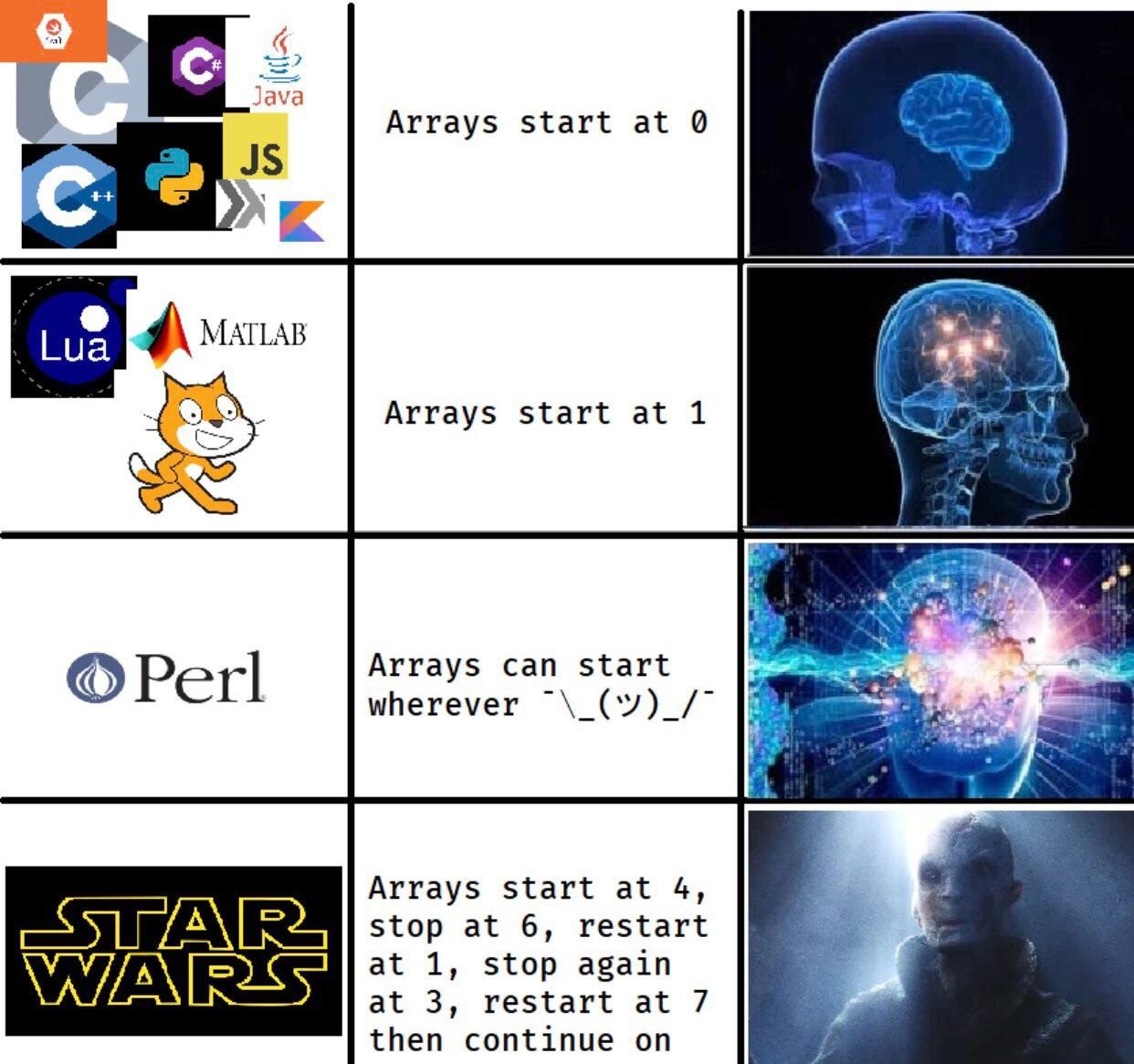
This is a four-panel 'expanding brain' meme that satirizes the different array indexing conventions in programming languages. The first panel, with a small brain, shows logos for C, C++, C#, Java, JS, Python, and Kotlin, stating 'Arrays start at 0', the most common convention. The second panel, with a more active brain, shows logos for Lua, MATLAB, and Scratch, with the text 'Arrays start at 1', a less common but still used standard. The third panel features a brightly lit, transcendent brain with the Perl logo, and the text 'Arrays can start wherever ¯\\_(ツ)_/¯', highlighting Perl's flexible (or chaotic) feature of allowing customizable array starting indices. The final panel shows the most 'enlightened' state with an image of Supreme Leader Snoke from Star Wars and the Star Wars logo, with the text, 'Arrays start at 4, stop at 6, restart at 1, stop again at 3, restart at 7 then continue on', humorously comparing the convoluted viewing order of the Star Wars films to an absurdly complex array indexing system

Comments
7Comment deleted
The final level is actually APL, where arrays can have a configurable index origin (`⎕IO`) and also a shape that looks like a UFO crash site. The Star Wars order is at least documented by fans
Architectural reality: the backend speaks 0-based JSON, finance supplies 1-based CSV, the legacy Perl ETL treats indexes as a suggestion, and the CEO’s dashboard wants them in Star Wars release order - suddenly off-by-one feels quaint
The real galaxy brain move is convincing your team that Perl's $[ variable is a feature, not a war crime, while secretly knowing you'll be retired before anyone has to debug that legacy system
The real galaxy brain move is when you realize Perl's 'arrays can start wherever' philosophy is just preparing you for the ultimate indexing chaos: maintaining a legacy codebase where someone decided to implement their own custom array class with 'business logic-driven indexing' that starts at the fiscal quarter number. At least Star Wars had George Lucas to blame for the numbering - your predecessor just left a comment saying 'trust me, this makes sense in production.'
If your service accepts 0-based offsets, returns 1-based pages, and special‑cases “Episode IV,” congrats - you’ve implemented $[ as a platform and on-call will learn the prequels in production
Zero-based is for people who’ve touched a pointer; one-based is for people who’ve touched MATLAB; Perl’s $[ proves configurable bases are how you get archaeology; and Star Wars is why product should never own semver
Zero-based bliss in C until you inherit a Perl codebase where arrays start wherever the last dev's caffeine level peaked