Minimalism Perfected: Arch Linux on a Flip Phone
Why is this EmbeddedSystems meme funny?
Level 1: Tiny Phone, Big Linux
Imagine taking a very simple old flip phone – the kind with only number buttons – and somehow squeezing a whole computer operating system into it. That’s what’s going on here! It’s like taking a toy car and putting a real car’s engine in it. The phone now thinks it’s a small computer: it can show the same kind of screen you’d see on a desktop with text and commands. This is funny because nobody needs to do this on a flip phone; it’s done just for fun. It’s a bit like doing a magic trick with technology: making an old phone do something unbelievably advanced, just to show that it’s possible and cool.
Level 2: From T9 to TTY
Let’s break down what’s happening in this meme. We have a flip phone – you know, those little phones that fold in half, with physical number buttons (0-9, * and #) and maybe no touchscreen. On old phones like this, typing letters was done with something called T9 or multi-tap. T9 stands for “Text on 9 keys.” For example, the number 2 key represents A, B, and C (press it once for A, twice for B, thrice for C, etc.), and predictive T9 mode would guess the word from key presses. It’s a very old-school way to write text messages, from back when phones didn’t have full keyboards. Now, TTY is a term from computing that originally stands for “teletypewriter,” but in modern terms it just means a text terminal or command line interface. So “when TTY meets T9” literally means we’re seeing a computer-style text terminal being used via a phone’s numeric keypad input. This is a mashup of two worlds: the retro phone interface and the geeky command line.
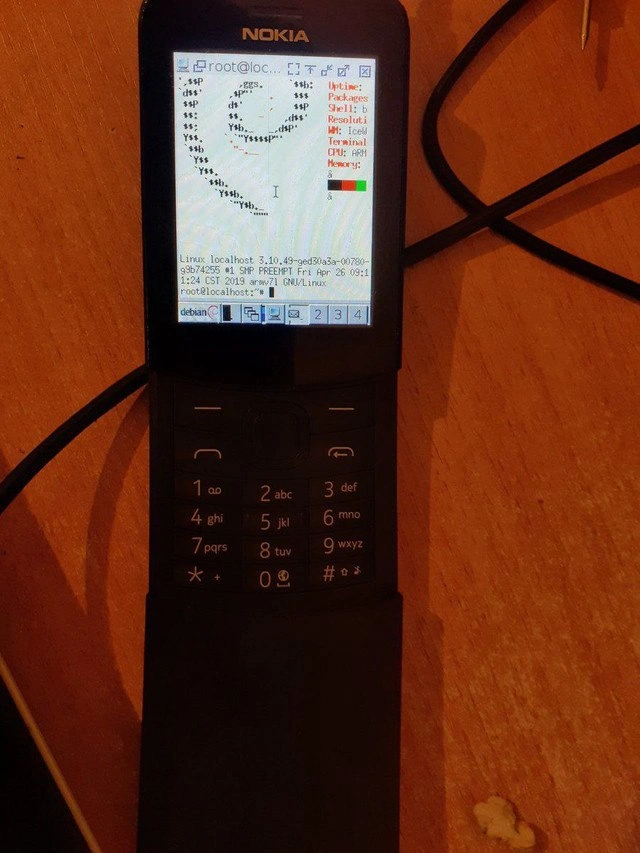
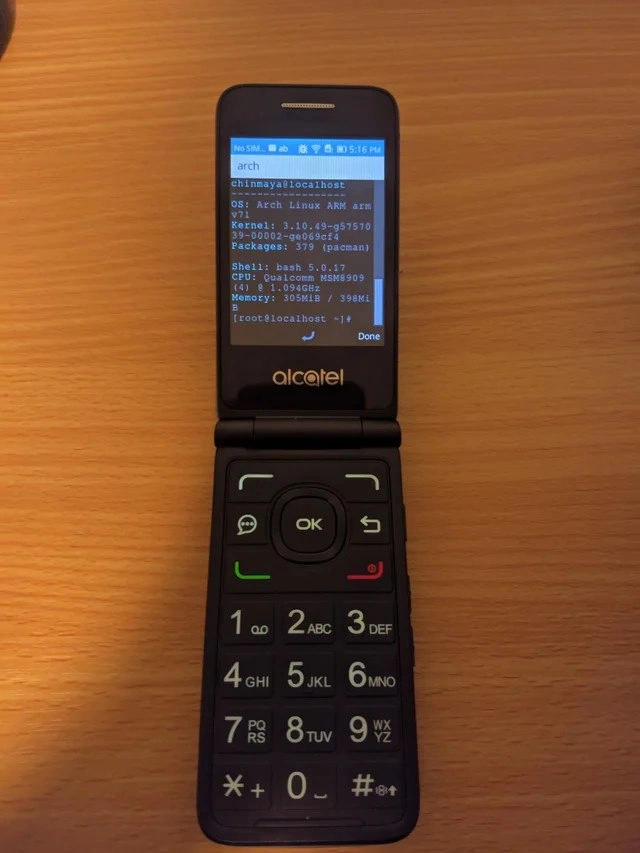
Now, the flip phone’s small screen in the image is showing what looks like a typical Linux terminal session. In fact, the text layout indicates the user ran a tool called neofetch (a program that displays system info in the terminal with a nice formatting). We can read the details:
- OS: Arch Linux ARM (armv7l) – The operating system is Arch Linux, a popular lightweight Linux distribution. “ARM armv7l” tells us it’s the version for ARM 32-bit processors (the type of CPU many phones and Raspberry Pi-like devices have). Arch Linux is something you’d normally see on PCs or hobbyist boards, not on a tiny phone, so that’s already extraordinary.
- Kernel: 3.10.49-g957570... – The kernel is the core of the operating system that talks to the hardware. Version 3.10.49 is quite old (today’s PCs run 5.x kernels), which hints that the phone’s hardware only had Linux support with that older kernel (likely the one originally used by the phone’s default firmware). The long string after it (g957570...) looks like a specific build or commit ID for that kernel, perhaps from the device’s manufacturer source.
- Packages: 379 (pacman) – This means there are 379 software packages installed via Arch’s package manager,
pacman. So this isn’t a minimal kernel-only thing; it has hundreds of utilities/programs installed! For context, pacman is like the app store for Arch but in the command line – you usepacmancommands to install or update software. 379 packages could include things like text editors, networking tools, maybe Python, etc. That’s a lot for such a small phone, indicating a pretty complete Linux environment. - Shell: bash 5.0.17 – The shell is the command line interface program; here it’s GNU Bash (Bourne Again SHell) at version 5.0.17, which was a recent version around 2020. This is the same bash you’d run on a normal Linux PC or Mac, but compiled for the phone’s ARM processor. It’s the program waiting for you to type commands at
[root@localhost ~]#. - CPU: Qualcomm MSM8909 (4) @ 1.092GHz – That’s the phone’s processor. Qualcomm MSM8909 is an entry-level quad-core ARM Cortex-A7 CPU (commonly used in budget smartphones and some feature phones). Four cores at ~1.1 GHz isn’t much horsepower by today’s standards, but it’s enough to run a basic Linux. The device likely originally ran a simple OS (or Android Go) on this chip.
- Memory: 305MiB / 398MiB – This shows the RAM usage: out of 398 MiB total (which is roughly 400 megabytes of memory), 305 MiB are currently used by the system. So about 3/4 of the RAM is already filled just running the OS and whatever services are on. This tells us the phone has very little RAM (even a cheap modern smartphone might have 2048 MiB or more). With only ~90 MiB free, you couldn’t run anything heavy. There’s definitely no graphical desktop here – just the text mode interface – because a GUI would eat far more memory.
The prompt at the bottom, [root@localhost ~]#, is the classic appearance of a Linux root user’s command line. “root” is the superuser (administrator) account on Linux, “localhost” is the machine’s hostname (default localhost here), and ~ indicates the current directory (tilde stands for the home directory). The # symbol at the end, instead of a $, is the giveaway that this is the root user. So the person has full administrative control on that phone’s OS – not surprising since they installed the OS themselves.
So how did someone get Arch Linux onto a flip phone? This usually involves several advanced steps:
- Unlocking the bootloader: Most phones come locked down to only run the original operating system. To install your own OS, you often have to go into a special boot mode and unlock the bootloader (sometimes an exploit or official unlock process is used). This allows the phone to boot unsigned or custom firmware.
- Installing a custom kernel and OS: The person likely compiled a Linux kernel that can work with the phone’s hardware. They might have started with the phone’s source code (if available) or a similar device’s Linux kernel. They then integrated that with an Arch Linux ARM file system. Arch Linux ARM is a version of Arch for ARM devices – the user could have copied an Arch system image onto the phone’s storage (like onto an SD card or internal memory) once the kernel was in place.
- Cross-compiling: Often, to set this up, you don’t compile the software on the device itself (it would be extremely slow or even impossible with low RAM). Instead, you use a more powerful computer to compile code for the phone’s ARM architecture. This is called cross-compiling – for example, using a toolchain on your PC to build an ARM-compatible kernel or binaries, then transferring them to the phone.
- Drivers and hardware support: Ensuring things like the display, keypad, and Wi-Fi work would require the right drivers. The kernel version 3.10 implies they used the original drivers meant for that phone (since newer kernels might not support the device out-of-the-box). The fact we see Wi-Fi icon and battery suggests maybe part of the original phone interface is still running (or those are just part of a minimal UI). It could be the phone’s baseband (cell modem) isn’t in use except for “No SIM” showing. Possibly the original firmware’s overlay is showing the status bar while the Linux console runs underneath – or that status bar itself might be a tiny Linux program replicating it. In any case, a lot of hardware integration effort is behind this screenshot.
For a junior developer, the key takeaway is: Linux can run on a lot of things, even devices it wasn’t originally intended for. A flip phone is essentially an EmbeddedSystem – a gadget with specific hardware and a usually fixed-purpose OS. By swapping that out with Arch Linux, the phone has been turned into a general-purpose computer (at least in theory). It’s not something you’d do for practical use, but it’s a great experiment in understanding how bootloaders, kernels, and userlands work together. It’s also a fun nod to how flexible open-source operating systems are. The meme is showing this off in a humorous way: imagine doing your programming homework or server admin tasks with the same keypad you’d use to text “hello.” It highlights both HardwareConstraints (limited memory, tiny screen, no keyboard) and the power of CLI tools (which can run even when a graphical interface would be too heavy). And of course, it’s specifically Arch Linux – a distro that’s kind of become shorthand for tech enthusiasts who like to tinker. In summary, someone modded a humble flip phone to run a full Linux OS, bridging the gap between a nostalgic device and modern software. That mix of old and new, and the sheer impracticality of it, is what makes it funny and impressive at the same time.
Level 3: But Can It Run Arch?
This meme hits experienced devs right in the nostalgic command line. It shows an Arch Linux installation on an old-school Alcatel flip phone, complete with a tiny terminal on the tiny screen. The absurdity is delightful: a full modern Linux OS jammed into a device designed for T9 text messages and Snake. Seasoned engineers recognize this as peak overengineering — the kind of ambitious weekend project you do just because you can. We’re talking about running a bleeding-edge Arch setup (famous for its “I use Arch, btw” bragging rights) on hardware with 305 MiB of RAM and a numeric keypad for input. The humor lands because it merges two eras of tech: the ancient T9 texting interface with the not-so-user-friendly CLI (Command Line Interface). It’s like watching someone control a space shuttle with a rotary phone dial – wonderfully ridiculous and technically impressive.
From a senior developer’s perspective, the image screams HardwareHacks and Linux geekery. The phone’s screen showing a neofetch summary (OS, Kernel, Packages, etc.) is a telltale sign of a proud Linux user flexing. We see “OS: Arch Linux ARM” and “Kernel: 3.10.49” — hints that this isn’t an officially supported combo but a custom port. In other words, someone unlocked the bootloader, cross-compiled a kernel for the Qualcomm MSM8909 chipset, and got Arch Linux ARM running on this little flip phone. That’s non-trivial: it likely involved digging up device tree blobs, wrestling with drivers for the display and keypad, and maybe repurposing the phone’s original Linux-based firmware (many feature phones run a slim OS like KaiOS or Android under the hood). The presence of an older 3.10 kernel suggests they had to use the vendor-provided kernel source (common in Android 5 era) to support the hardware. So this stunt required serious low-level knowledge and a lot of patience.
The comedy gold for seasoned devs lies in imagining the usability (or lack thereof). Pacman, Arch’s package manager, is shown with 379 packages installed – so this phone isn’t just running Linux, it’s running a full userspace. But managing those packages or editing config files on a T9 keypad? 😅 That’s hilariously painful. Picture typing sudo pacman -Syu on a number pad: multiple key presses per letter, like a secret cheat code just to update your system. It’s a geeky form of masochism:
# Updating Arch Linux on the flip phone (good luck typing this on T9!)
sudo pacman -Syu
Any developer who lived through the pre-smartphone era can recall tapping out texts on those 12 keys – now imagine writing Bash commands that way! TerminalHumor at its finest. This is why the meme resonates: it’s not making fun of failure or pain, but celebrating an outrageous achievement with a wink. Experienced engineers also appreciate the EmbeddedSystems angle: it demonstrates Linux’s incredible versatility. We’ve seen Linux run on fridges, routers, even toasters – and here it is on a low-spec feature phone. It’s a reminder that with enough determination (and maybe an ArchLinux User Repository script or two), you can get “$ uname -a” from almost any device with a CPU.
Finally, there’s a layer of industry inside-joke here. Arch Linux is known for its mantra of simplicity (read: you build it all yourself), and its users’ pride in that. The classic joke “btw, I use Arch” is all about unsolicited one-upmanship. What’s the ultimate one-up? Casually dropping, “Oh, this? It’s just my flip phone running Arch Linux.” It’s both ridiculous and admirable. In a world where most developers chase the latest high-performance gadget or cloud instance, some rebel goes and does the opposite: squeezes a full OperatingSystem into a retro phone for the sheer joy of it. It’s a love letter to hacking and an ode to the no device left behind philosophy. Sure, it’s impractical — a hardware constraint of 400 MB RAM means this thing probably swaps if you open vim — but practicality isn’t the point. The point is that gleeful, nerdy sense of accomplishment. Seasoned devs smile because they recognize that spark: “Look, I did a crazy thing with tech, and it actually works!”
Description
This image shows a modern Alcatel flip phone, open and resting on a wooden surface, with a terminal emulator running on its small screen. The terminal displays the output of a command, likely 'neofetch' or a similar system information tool, which reports that the device is running Arch Linux ARM v7l. The specs listed include a 3.10.49 kernel, a Qualcomm MSM8909 CPU, and a mere 398MB of memory. The sight is both absurd and impressive, embodying the 'can it run Linux?' ethos prevalent in the developer community. It represents a deep level of technical skill and dedication to minimalism, pushing the boundaries of what is considered a viable computing device. For senior engineers, it's a humorous nod to the joy of tinkering and a rejection of the bloat of modern smartphones, celebrating the power and flexibility of Linux in even the most constrained environments
Comments
7Comment deleted
I see you finally got Arch running on a flip phone. The battery life must be amazing, now that the most demanding process is just rendering the Zsh prompt
Arch boots in 305 MiB on a T9 flip phone, but our “lightweight” Electron settings screen still needs a 2 GB container - remind me who’s over-engineering again?
Finally found a device where the 26-day uptime is actually impressive instead of a sign that nobody's deployed anything in a month
When your daily driver is an Arch Linux flip phone with 394MB of RAM, you don't just use Arch BTW - you've transcended to a plane of minimalism where even systemd feels bloated. This is what happens when 'I use Arch BTW' meets 'my other computer is a Nokia 3310.' The 3-day uptime is impressive until you realize rebooting requires physically flipping the phone closed and hoping the bootloader doesn't give up on life
Proof that 'works on my machine' now includes a 398MB Alcatel running Arch via T9 - your portability story still doesn't
Newer kernel on this flip phone than half the enterprise mainframes still limping along in prod
Btw, we use Arch - on a flip phone. With 398MiB RAM, minimalism stops being a dotfiles flex and starts being the heap limit; observability is neofetch; and “works on my machine” finally means “my phone.”