The True Cost of Apple's Vision Pro
Why is this Apple meme funny?
Level 1: Kidney for a Headset
Imagine there’s a super cool new gadget – let’s say a virtual reality headset that lets you play amazing games and see 3D worlds. It’s made by a really famous company (like Apple), so everyone knows it’s fancy. Now, this headset is so expensive that if you emptied all the money from your piggy bank, your savings, and maybe all your birthday money, you still wouldn’t have enough to buy it. It’s $3499, which is a huge amount of money (think of how many toys or video games you could get for that!).
The meme is joking that the headset costs so much, you’d have to trade something really valuable for it – not just money, but even a part of your own body! It shows a picture of a kidney, which is an organ inside you that you need to live (you have two kidneys, and they keep your blood clean). Of course, nobody would actually sell their kidney to buy a toy – that’s dangerous and illegal! The idea is super silly on purpose. It’s using exaggeration to be funny.
So, the joke works like this: “This new device is so pricey, the only way I could pay for it is by giving up one of my kidneys!” It’s like saying something costs “an arm and a leg,” which people say when something is really expensive – except here they specifically chose a kidney because there’s a funny running joke about selling a “spare” kidney (since you have two). The reason it’s funny is because it’s absurd – no one would ever really do that for a gadget. It expresses how people feel about the price: shocked and a little frustrated, but in a humorous way.
In plain terms, this meme is laughing at how crazy expensive the new Apple headset is. It’s as if someone is telling a tall tale: “I found out how I can finally afford that awesome gadget – I’ll trade in my extra kidney!” You’re not meant to take it seriously; you’re meant to laugh at how over-the-top that idea is. The emotional core here is a mix of wanting something really badly (because it’s cool) and realizing it’s way out of reach (because of the cost), and responding with a joke instead of getting upset. Even if you’re not into tech, you can relate to that feeling – like wanting the newest game console or toy so much you’d do anything, then joking, “Welp, time to sell my kidney!” because it seems impossibly expensive. It’s a playful way to vent about high prices.
In the end, everyone knows their kidney isn’t actually for sale. The meme is just a funny, if slightly dark, way of saying “This new thing is awesome, but wow is it expensive!”.
Level 2: It Costs a Kidney
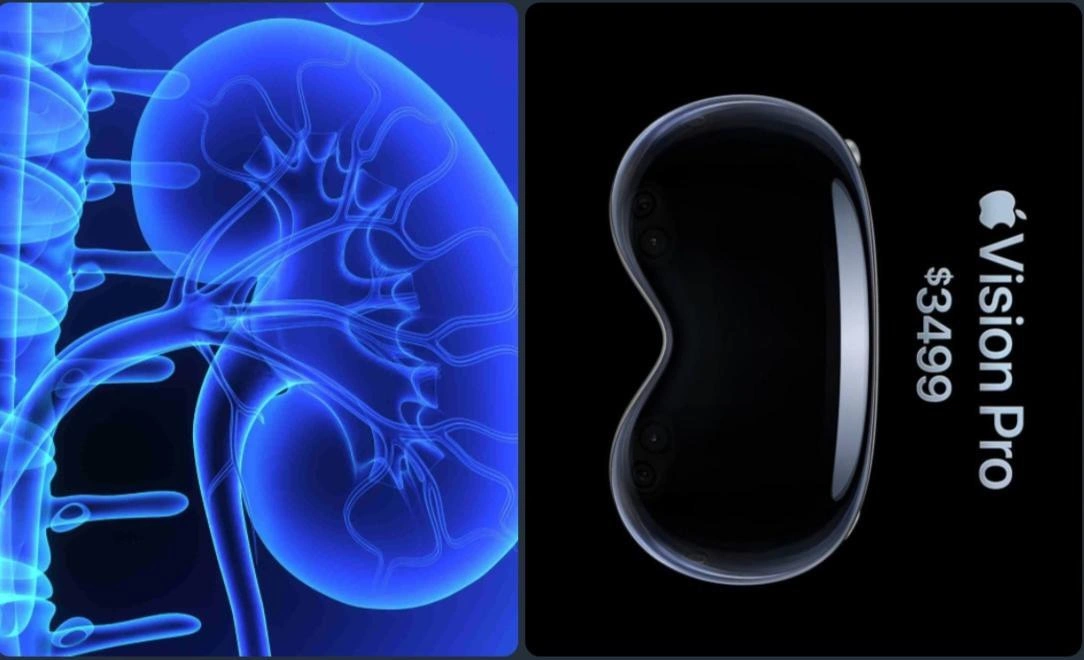
Let’s break down the joke in simpler terms. On the left side of the meme, there’s an image of a kidney – that bean-shaped organ in your body that helps filter your blood. It’s highlighted in a bright medical blue, like an X-ray from a biology textbook. On the right side is a picture of Apple’s new Vision Pro headset, along with its eye-popping price: $3499. The Apple Vision Pro is a high-end gadget for Augmented Reality (AR) and Virtual Reality (VR) experiences (Apple calls it a “mixed reality” device because it can blend digital stuff into the real world around you). This headset is basically like sci-fi glasses that let you see 3D digital things as if they’re in your living room – super cool technology, but very expensive.
Now, why is there a kidney in this meme? Well, there’s a running joke in the tech world: when something is crazy expensive, people say, “I’ll have to sell a kidney to afford it!” Of course, they don’t actually mean it – it’s illegal (and downright dangerous) to sell your organs! – but it’s an exaggerated way to complain about the high cost. We humans have two kidneys, and technically you can survive with only one, so the dark joke is that one kidney is “spare” and could be sold for money. It’s an absurd idea used for humor. Here, the meme imagines that Apple itself is accepting kidneys as payment through a hypothetical “official trade-in” program. Apple really does have a trade-in program where you can swap old iPhones or Macs for a discount on new ones, giving you a credit based on the device’s value. The meme humorously extends that concept: what if Apple lists a spare kidney as an accepted trade-in device worth $3499? It’s a tongue-in-cheek way to say “This thing is so expensive, it might as well cost me an organ.”
For a junior developer or someone new to the industry, a few points of context make this meme even clearer:
AR/VR Hype: There’s a lot of excitement around AR and VR in the tech industry (hype means everyone is talking about it like it’s the next big thing). Companies are investing in these technologies, and as a result, developers feel pressure to learn and build for these new platforms. When Apple announced the Vision Pro, it created a huge buzz. Imagine everyone around you saying “Wow, this is the future of computing!” You as a developer might think: “Should I start making apps for this? Should I get one and become an expert in Apple’s visionOS?” There’s real career FOMO (fear of missing out) here, especially when something is labeled a paradigm shift in computing.
The Price Shock: $3499 is a lot of money for a single piece of hardware. To put it in perspective, that’s about the cost of three high-end laptops or 7-8 latest iPhones (depending on the model). It might even be close to your entire monthly paycheck as a junior dev. This is why people joke about extreme measures — it feels unattainable. Most consumer gadgets, even expensive ones like game consoles or TVs, are a few hundred dollars, not a few thousand. The Vision Pro is priced more like a big industrial or professional tool. For many developers, especially those who aren’t at a big company, dropping $3499 on a new device is hard to justify unless it’s sure to pay off somehow.
Budget Constraints: In companies, buying equipment like this often falls under CAPEX (Capital Expenditure), which basically means a big purchase that has to be approved in the budget. If you’re a junior dev thinking, “I’ll ask my boss to get one for the team,” be prepared: management will likely ask, “Do we really need this? What’s the return on this $3500 spend?” They might say no, or at least not without a solid business case. This reluctance is what the meme calls “CAPEX approval hell” – it can be a nightmare to get expensive new tools approved, even if they’re the hot new thing. Opportunity cost is another term that might come up: that’s the idea of what other things you could do with the money. For example, instead of one AR headset, the company could buy 5 regular monitors, or pay for a training course, or sponsor a team outing. They’ll weigh those options and often the fun gadget loses out unless it’s critical for a project.
Organ Sale Meme: The concept of selling a kidney for tech stuff is a long-running meme in the developer and gadget-lover community. It pops up whenever a major company (especially Apple, which is known for premium pricing) releases a highly desirable but very expensive product. Older devs will recall jokes like “Kidney for a Mac Pro” or “Selling my kidney, BRB, new RTX graphics card launched”. It’s understood by everyone as pure joke – nobody is endorsing it; it’s just a dramatic way to say “This costs way more than I should logically spend, but I want it so badly.” The humor comes from that inner conflict and the hyperbole used to resolve it.
What’s at Stake for Devs: If you’re an early-career developer, you might also see seniors joking about this because they’ve been through cycles of tech hype. Many remember devices like the ones mentioned (Google Glass, HoloLens) where the company was super excited and devs were told “This is the future, get on board!” but then the device either flopped or only a few people ever used it. So, there’s a bit of sardonic wisdom being shared: “Sure, Vision Pro is awesome, but is it kidney-worthy? Probably not… we’ve been burned before.” As a junior, it’s useful to note that while learning new tech is great, you should be cautious about spending a fortune just because of hype. Often there are SDKs and simulators to experiment with AR/VR without the actual device. (In fact, Apple provides a Vision Pro simulator in Xcode for developers so you can start coding for it without owning one — perhaps precisely because they know most devs can’t get the hardware easily!)
To sum up level 2: this meme highlights, in a funny and exaggerated way, the conflict a developer might feel when a cool new technology (like Apple’s AR headset) comes out with a crazy high price. It uses the “sell a kidney” joke to communicate just how expensive and somewhat impractical that price is for the average person. It’s basically saying, “We love the tech, but c’mon, who can afford this?!” Anyone in tech who’s drooled over a new gadget’s specs but cringed at its cost can relate to that sentiment.
Level 3: Mixed Reality Check
At first glance, this meme stacks two starkly different images side by side: on the left, a glowing blue medical X-ray of a human kidney with all its arteries highlighted; on the right, Apple’s glossy promo image of the Vision Pro headset with the price tag “$3499” emblazoned in pristine white text on a black background. The juxtaposition is deliberate dark humor. It suggests that Apple’s new AR/VR device is so absurdly expensive that the only way to afford it is by trading a literal piece of yourself (one of your two kidneys). In tech circles, joking about “selling a kidney” to buy the latest Apple gadget is a time-honored bit of TechHumor. Here, the meme cranks it to eleven by implying Apple might as well have an official trade-in program for organs. The caption nails this absurdity:
“Finally discovering Apple’s official trade-in value for a spare kidney.”
For seasoned engineers, this hits a nerve because it riffs on a familiar tension: the irresistible pull of IndustryTrends_Hype versus the harsh reality of budgets and bean-counters. The Apple Vision Pro represents the cutting edge of mixed reality (Apple’s term for blending augmented and virtual reality). It’s a shiny new platform (“RealityOS” aka visionOS under the hood) promising magical experiences and new development frontiers. As developers, we feel that itch: What could we build if we had one? But then comes the gut-punch: a $3499 price tag. That’s Capital Expenditure territory – the kind of cost you need the CFO’s blessing for, not something you can just slip onto the team Amex without raising eyebrows. In a big company, getting approval to purchase a $3.5k experimental gadget can turn into CAPEX approval hell: endless justification documents, ROI projections, and procurement forms. It often feels easier to donate an organ than to get finance to green-light a cutting-edge dev kit. The meme’s dark sarcasm literally plays on that feeling.
From a senior dev’s perspective, there’s also some world-weary cynicism about hype cycles. AR/VR has been “the next big thing” multiple times in recent history, and each time it comes with a pricey hardware catch. We remember when Google Glass debuted at ~$1500 for beta testers, or when Microsoft HoloLens launched its developer edition for $3000 – both prompting similar “sell a kidney” jokes. Magic Leap One? That was another overhyped AR headset costing $2295 that fizzled out after the fanfare. Early adopters always pay a premium, often for unfinished tech. Now Apple enters the chat with a polished $3499 mixed reality headset, marketing it as a revolutionary “spatial computing” platform. Experienced developers have seen this pattern: incredible potential, but locked behind a paywall so high you question if it’s worth climbing.
Let’s be real: $3499 is sticker shock even by Apple standards. This is the company known for premium pricing, but usually an iPhone or MacBook (even a high-end Mac) doesn’t require contemplating black-market organ donation. The Vision Pro’s cost is on another level – it’s roughly equivalent to a decent month’s salary for a junior developer in many regions, or the entire yearly training budget for a small dev team. For senior engineers managing budgets, it triggers an opportunity cost analysis: spending that money on one fancy headset means not spending it on other needs. Is it better to outfit 3 developers with new laptops, or buy one single AR device for the team to share? Will investing in Vision Pro development now yield enough benefit before the hardware is outdated? These are real trade-off questions behind the humor.
The meme captures the emotional truth of this situation in a way only dark humor can. There’s the excitement about a hot new AppleProduct (the kind that has every tech blog raving and management suddenly asking “Should we build an app for this?”). But there’s also the exasperation of the engineer who knows that getting hands-on experience with this tech won’t be easy. They either have to beg the company for funds or pony up $3499 out-of-pocket. And let’s face it, most of us don’t have that kind of cash lying around for a cool experimental gadget. So the meme exaggerates: “Maybe I can trade my spare kidney… Apple’s pretty generous with trade-ins, right?” It’s a morbid joke, but it’s mocking a very real feeling of desperation.
There’s even a cheeky visual pun hidden here: the front of the Vision Pro headset, as shown in Apple’s marketing image, has a smooth curved shape almost like a giant kidney bean. Placed right next to an actual kidney X-ray, the similarity in shape makes the comparison even more on-the-nose. It’s as if the meme is saying this headset isn’t just metaphorically equivalent to a kidney in value, it even kind of looks like one! The AR_VR design meets human anatomy in a perfectly absurd alignment.
For those of us who’ve been through gadget hype cycles, the laughter this meme elicits is a knowing laugh. It’s the laugh of “Yeah, been there – new tech so cool yet so costly it hurts.” We recall pitching cutting-edge ideas to execs only to have them balk at the hardware costs. Or times when higher-ups get enamored with buzzwords (“We need a VR strategy!”) but when the invoice for dev kits lands, suddenly the enthusiasm vanishes. Senior devs also know the subtext: by the time these devices become affordable or widely approved, the hype might have moved on or a competitor might have one-upped it. Thus, there’s a cynical calculation: either you bleed (figuratively, please!) to jump in early, or you sit out the first round and risk missing the boat. This meme leans fully into the absurdity of bleeding for the tech – literally giving blood and organ – to underscore just how outlandish the situation feels.
In summary, the meme is hilariously incisive for industry veterans because it compresses multiple layers of truth into one image: Apple’s luxe pricing, the eternal AR/VR hype cycle, the struggle of devs caught between excitement and budget reality, and the age-old running gag of hawking a kidney to fund our tech obsessions. It’s a reality check wrapped in a joke about mixed reality. And if you detect a whiff of bitterness beneath the laughter, that’s because many of us have felt that exact mix of awe and frustration — “This new toy is amazing… and I might literally go broke (or need black-market surgery) to get it.” The best humor has truth at its core, and here the truth is: cutting-edge tech often comes at a price so high, it’s practically organ-scaled.
// Pseudo-code of a dev trying to get a Vision Pro
if (!companyBudget.approved(VISION_PRO_COST)) {
// Desperate times call for desperate measures... (just kidding!)
developer.sellKidney();
} else {
developer.orderDevice();
}
(Don’t worry, in reality we’ll stick to pleading with finance or waiting for that second-generation price drop. No kidneys were harmed in the making of this meme.)
Description
A two-panel comparison meme. The left panel shows a glowing blue, anatomical illustration of a human kidney against a dark background. The right panel features a product shot of the sleek, black Apple Vision Pro headset, also against a black background. To the right of the headset, white text displays the Apple logo, the product name 'Vision Pro,' and its price, '$3499.' The humor is derived from the striking visual similarity between the shape of the kidney and the headset, directly playing into the long-running joke in the tech community that one would need to sell a kidney to afford premium Apple products
Comments
7Comment deleted
Apple's new T2 security chip now includes organ donor matching to streamline the Vision Pro checkout process
At $3,499 the Vision Pro is basically Apple’s way of saying, “Sure, you can prototype in RealityKit - just shard your kidneys like you shard your databases.”
After 20 years of watching Apple's pricing strategy evolve from 'premium' to 'mortgage payment,' we've finally reached the anatomically correct pricing model where the product literally looks like the organ you'll need to sell. At least with Kubernetes complexity you only lose your sanity, not your renal function
At $3,499, the Vision Pro proves Apple has finally achieved true augmented reality: they've augmented the price of VR headsets by 5x while making your bank account disappear. The real spatial computing innovation here is calculating how many kidneys you need to sell - though given Apple's ecosystem lock-in, you'll probably need to keep one for the inevitable Vision Pro 2
When procurement asks how you’ll fund Vision Pro, “organ-level CAPEX” isn’t an approved cost center
Vision Pro: Costs a kidney, but the real eye-tracking tech is watching your dev budget hemorrhage
Finance asked how we'll fund a $3,499 Vision Pro dev kit; I said CAPEX, they said great - capitalize a kidney and amortize over two WWDCs