Anything But Learning the Language
Why is this Languages meme funny?
Level 1: Avoiding Homework
This meme is like refusing to learn a few words in another language, then deciding to build a robot translator from scratch instead. It feels like avoiding homework, but now the homework has batteries, wires, and new ways to break.
Level 2: The Bigger Shortcut
A programming language is a set of rules for writing code, like Python, JavaScript, Java, Go, Rust, or C#. Learning one means understanding its syntax, libraries, and usual ways of solving problems.
A translation layer is code that lets two different systems or languages talk to each other. It might convert data, call functions across a boundary, or make one language look easier to use from another. That can be useful, but it is rarely simple. If one side uses one kind of data structure and the other side uses another, the translation code has to decide how they match.
The joke is that the developer rejects the simpler personal task, learning, and accepts the harder technical task, building a bridge between two languages. For a junior developer, this is a common lesson: an abstraction that avoids learning can become harder than learning the thing directly. Sometimes the best shortcut is sitting down with the docs and writing small examples until the language stops looking hostile.
Level 3: Architecture As Avoidance
The meme works because it satirizes a specific developer instinct: avoiding discomfort by creating architecture. Learning a new language is direct. It requires humility, documentation, mistakes, and the temporary embarrassment of not knowing the idioms. Building a translation layer feels like engineering. It has diagrams. It has interfaces. It can be named something tasteful like BridgeCore. That makes the bottom option emotionally attractive even when it is objectively the larger problem.
This is classic OverEngineering mixed with LanguageAdoption anxiety. Teams often create interop layers for valid reasons: gradual migration, shared legacy systems, platform constraints, performance hotspots, or a need to reuse battle-tested code. Those are real engineering trade-offs. The meme is targeting the less noble version, where the translation layer exists because nobody wants to read the beginner tutorial and admit the old mental model no longer fits.
The hidden costs pile up fast:
- debugging now crosses two stack traces
- exceptions may not map cleanly
- type information can be lost or faked
- performance problems hide in conversion code
- versioning becomes a contract negotiation
- every edge case needs a policy
- both language ecosystems can break you independently
The senior-level pain is that middleware rarely stays "just a thin wrapper." It grows features, compatibility branches, logging hooks, test fixtures, and a personality. Six months later, the team has not avoided learning the new language; it has built a private dialect that must be learned before anyone can safely touch the project. Truly, a shortcut with onboarding documentation is just a maze with branding.
Level 4: Semantic Toll Booths
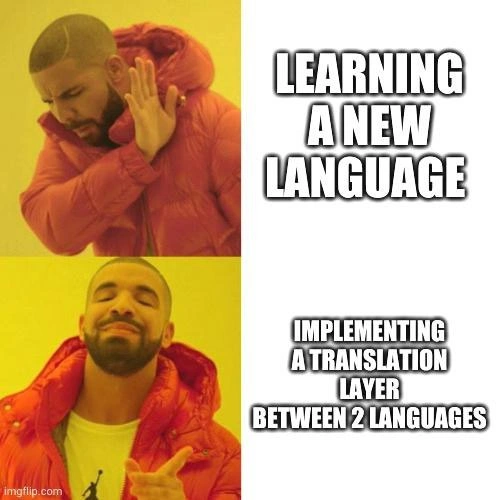
The meme uses the Drake rejection/approval format. The rejected option is:
LEARNING A NEW LANGUAGE
The approved option is:
IMPLEMENTING A TRANSLATION LAYER BETWEEN 2 LANGUAGES
The advanced joke is that a translation layer sounds like a clever way to avoid learning, but it often requires learning both languages more deeply than ordinary use would. Real interop is not just swapping keywords. Languages encode different assumptions about types, memory, errors, concurrency, module loading, object identity, numeric precision, strings, packaging, and runtime ownership. The moment you bridge two languages, you inherit the weird parts of both and then add a new weird part in the middle.
At the compiler and runtime boundary, a "translation layer" might mean a transpiler, foreign function interface, RPC boundary, adapter library, code generator, serialization protocol, or embedded interpreter. Each one has a cost. A transpiler has to preserve semantics across two syntaxes. An FFI has to deal with calling conventions, memory ownership, thread safety, and type conversion. A service boundary has to serialize data, handle failure, version contracts, and explain to someone why Date stopped meaning the same thing.
This is why the bottom panel is funny: it chooses the path that looks more abstract but is usually more technically treacherous. If "learning a language" is a hill, "building a translation layer" is constructing a funicular railway using two incompatible standards and a YAML file that nobody admits to owning.
Description
The image uses the Drake Hotline Bling meme format, with Drake rejecting the top option and approving the bottom option. The top right text says "LEARNING A NEW LANGUAGE," while the bottom right text says "IMPLEMENTING A TRANSLATION LAYER BETWEEN 2 LANGUAGES." The joke is that a developer would rather build an entire interoperability layer than invest the effort to learn the target language directly. It points at overengineering, language ecosystem friction, and the questionable elegance of solving a people problem with middleware.
Comments
3Comment deleted
Why learn a language when you can create a new failure mode between two runtimes and call it architecture?
VK devs be like Comment deleted
>between 2 layers should be >between 2 languages git push typo fix Comment deleted