Skip to content
DevMeme
6010 of 7435
Modern dev wonders how pyramids were built without ChatGPT AI assist
AI ML Post #6579, on Mar 22, 2025 in TG

Modern dev wonders how pyramids were built without ChatGPT AI assist

Why is this AI ML meme funny?

Level 1: Building Sandcastles Without the Magic Genie

Imagine you and your friends built the biggest, coolest sandcastle ever at the beach, using just shovels, buckets, and your own plans sketched in the sand. Now suppose a little kid watching says, “No fair, how did you make that without asking Siri or Alexa for help?!” – because that kid always asks a voice assistant for answers or ideas. That’s what this meme is joking about.

A long time ago, real people built a huge pyramid – like a giant sandcastle but made of stone – without any computers or smart helpers. Today, we have chatty AIs (kind of like super-smart talking genies in our phones/computers) that we ask for help with lots of things. The meme shows someone saying in a funny way, “Wait, how on earth did they build this pyramid without using ChatGPT (one of those smart genies)???” It’s funny because obviously the ancient builders didn’t have anything like that – they used their own brains, teamwork, and simple tools – and yet they succeeded.

The heart of the joke is about dependence on help. It’s like if you always use a calculator for math and then wonder how your grandparents ever did math homework without one. We find it silly and laugh because humans can actually do amazing things on their own, even if those of us living today sometimes can’t imagine doing tough jobs without our high-tech helpers. The meme playfully teases modern folks (especially developers who write computer programs) for being so used to getting instant help from AI that even the idea of building something big without that help sounds unbelievable to them. In simple terms: it’s poking fun at how spoiled and help-dependent we’ve become, in a warm, silly way.

Level 2: From Papyrus Blueprints to ChatGPT Prompts

Let’s break down the elements for a newer developer or someone not steeped in AI lingo:

  • ChatGPT: This is a chatbot powered by a Large Language Model, an AI that has been trained on vast amounts of text (like books, websites, code). When you ask it a question, it tries to generate a helpful answer by predicting likely sequences of words based on its training. Developers use it to get help with coding problems, to generate boilerplate code, or even to explain tricky concepts. Essentially, it’s like a very advanced assistant who has read everything and can draft answers or solutions in plain language. It feels almost magical: you type a question, and out comes a reasonably good answer most of the time. This has changed the developer experience (DX) quite a bit – tasks that used to require digging through documentation or Google can sometimes be answered with a single prompt to ChatGPT.
  • “How they built this without ChatGPT”: This phrase is written in a very informal, slangy way (notice the misspelling “ts” instead of “this”, and the colloquial “Naw but” meaning “No, but seriously”). It mimics how a flabbergasted person might speak on social media. The question implies genuine confusion about how something complex could be done without modern tools. It’s like a young programmer looking at the Great Pyramid of Giza (one of the Seven Wonders of the World) and asking, “Whoa, they did this without even having Google or AI?!” It’s intentionally over-the-top to be funny.
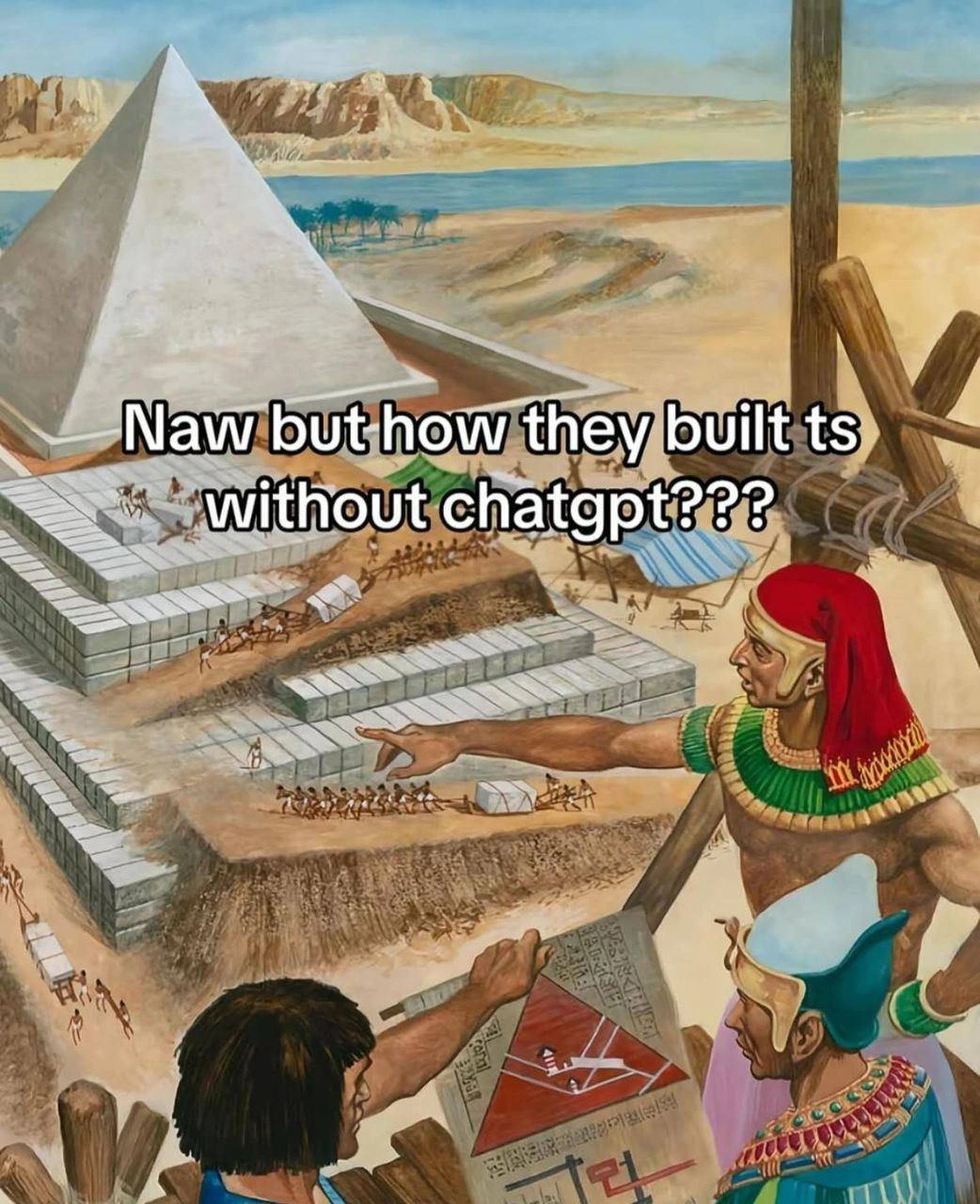
  • Ancient Egyptians and the Pyramid Construction: In the image, you see ancient Egyptian workers moving large blocks, building a pyramid using ramps and sheer manpower. Historically, building a pyramid around 4,500 years ago was an enormous task: organizing tens of thousands of workers, cutting and transporting massive stone blocks (some weighing as much as 2.5 tons each), and aligning the structure almost perfectly with the North-South-East-West directions. They had overseers (like the ones in the meme) who managed the work and made plans on papyrus (the rolled-out sheet one of them is holding, with drawings). Papyrus was an early form of paper made from a plant, and it’s how they documented plans or writing. There were no computers, no electricity, no engines – everything was done by human and animal labor, clever physics, and good planning.
  • Modern Developer Reliance on AI: Now contrast that with a modern software developer’s work. These days, if you’re coding and get stuck on a bug or need to figure out how to use a certain library, you have many aids: search engines, documentation websites, Q&A forums, and now AI chatbots like ChatGPT that can sometimes just give you the answer or example code. There’s even GitHub Copilot, an AI that integrates with coding software to auto-suggest code as you type. A lot of new developers quickly get used to this. It’s almost like always having a senior dev sitting by your side. So the meme plays on that by imagining a modern dev who just cannot fathom accomplishing something hard without such an assistant.
  • AI Dependency Humor: The phrase “generational dependency on AI” from the tags means that the newer generation of developers might depend heavily on these AI tools, whereas earlier generations did not have them and had to rely on more traditional learning (reading books, trial and error, asking colleagues, formal education). It’s a light-hearted jab; of course many new devs still learn fundamentals, but it’s true that having an AI on tap changes how you approach problems. For example, a junior dev might think to themselves, “Why spend hours reading the docs if ChatGPT can just tell me how to do this in a minute?” It’s efficient, but it can also become a crutch. The meme exaggerates this idea by joking that someone might think even ancient construction required an AI.
  • The Unspoken Reality: Obviously, the pyramids were built without any AI. The knowledge came from human brains and gradual improvements over time. In the developer world, there’s an unspoken encouragement to not rely entirely on tools – to learn the underlying concepts so you’re not completely helpless if the tool isn’t available or gives a wrong answer. (Just like an engineer should understand math, not only rely on a calculator.) This meme gets a chuckle because it’s like asking “How did people travel somewhere far before there were smartphones for navigation?!” The answer is: they used maps, memory, stars, or asked for directions. Similarly, “How did they code or build big things without AI?” Answer: they used their own problem-solving skills, pen-and-paper planning, and lots of collaboration.

If you’re a newer dev, think of it this way: Imagine you’re used to having an autocomplete for everything, and then someone shows you a piece of assembly code from the 1980s and says they wrote an entire game that way, with no AI help, no Stack Overflow (which started in 2008), and often with minimal documentation. You might jokingly react, “No way, how did you do that without Google or Stack Overflow?!” That’s precisely the reaction the meme is parodying – just projected onto something even more impressive: the pyramids of Egypt. It’s a fun way to appreciate both the power of our modern tools and the incredible achievements of the past done “the hard way.”

Level 3: Dependency Injection – Past vs Present

This meme strikes a chord with seasoned developers because it lampoons our modern developer experience (DX). Many of us have grown a tad too comfortable with instant AI assistance, treating tools like ChatGPT as a natural extension of our programming environment. The bold, slangy text “Naw but how they built ts without chatgpt???” screams with the voice of a baffled junior dev who’s never known a world without an AI in the loop. It’s a playful exaggeration, of course, but it carries a grain of truth about generational dependency on AI.

Think about it: in the last few years, AI assistants have become the new Stack Overflow. Copilot can auto-complete entire functions; ChatGPT can suggest architecture, write regex, or even draft a project plan. We’ve started treating these models like senior team members who never sleep. So when confronted with the ultimate ancient engineering project – the Great Pyramid – a modern dev jokingly wonders, how on Earth (or under the sun god Ra) did they manage without copy-pasting answers from an all-knowing AI?

The humor works on multiple levels for experienced devs:

  • Shared Insecurity: We’ve all had that moment at 3AM, staring at a code bug, and sighing “I have no idea… let’s ask the internet.” This meme just scales that up to “I have no idea how to build a pyramid… let’s ask ChatGPT.” It’s an absurd escalation that pokes fun at our reliance.
  • Imposter Syndrome, Ancient Edition: Modern devs sometimes feel like frauds without AI help; juxtapose that with the ancient master builders who invented their own algorithms (leverages, ramps, and labor management) with zero GitHub repos to consult. It’s funny because it’s humbling.
  • AI as Crutch: Senior engineers chuckle because they recall earlier in their careers (or their predecessors’) when they had to RTFM (Read The Fine Manual) or derive a solution from first principles. Seeing a meme imply that even something as fundamental as stacking blocks might be impossible without an AI is a tongue-in-cheek critique of how soft we’ve gotten. It’s the “back in my day…” sentiment dressed up in meme form.
  • Historical Irony: We live in an age where answers are a quick query away, yet ancient Egyptians coordinated tens of thousands of workers using sun-dials, rope, and sheer brainpower. There’s an implicit nod here to the fact that sometimes we overrate our modern tools. The pyramids aligned almost perfectly to cardinal points – essentially precision engineering – achieved without even basic electricity, let alone npm install pyramid-plans. The meme’s over-the-top question highlights the absurdity by implying they’d need an AI for guidance.

This is also a bit of AI humor reflecting on how quickly we normalize new tech. Large Language Models went from impressive curiosities to everyday development tools in a blink. Now some devs half-jokingly wonder aloud: How did anyone write code, or build anything, before Google or ChatGPT? It’s hyperbole, sure, but it resonates. Senior devs laugh because they remember those days, and junior devs laugh perhaps a bit nervously, wondering the same thing. The meme taps into that collective realization: we might be the most tool-assisted generation of builders ever.

Furthermore, within the AI/ML community, there’s awareness of how an AI assistant can shape your coding habits. A wry senior perspective might add: “Sure, we might accidentally trust an AI too much – like copy-pasting a code snippet that ends up being a historical bug reincarnated – but at least we’re not hauling multi-ton limestone blocks without heavy machinery!” The pyramid is a perfect symbol: an ultimate project delivered under extreme constraints (no modern tech, human/animal power only). It’s project management hell by today’s standards – and yet they delivered.

In summary, Level 3 insight identifies the core joke as dev dependency. It’s exaggerating our reliance on AI by back-projecting it onto ancient engineers. It tickles tech workers because it’s both self-deprecating and historically ironic. We laugh, but also maybe cringe a little, recognizing the kernel of truth about how our daily workflow has changed. The overseers in the image pointing at blueprints could almost be a scrum team doing a sprint review – except none of them can say “Hey ChatGPT, optimize this ramp angle.” The meme humorously reminds us that those who came before did just fine without our fancy toys, thank you very much.

Level 4: Cognitive Architecture of Ancient vs AI

In a way, the meme hints at the architecture of knowledge both ancient and modern. On one side, the Egyptians organized human brains, geometry, and physical tools to achieve an architectural marvel. On the other, modern developers lean on a Large Language Model (LLM) like ChatGPT—a product of billions of parameters and the transformer architecture—to offload cognitive work. This contrast is almost epistemological: the pyramids were built on accumulated human expertise, shared orally and on papyrus (an ancient form of documentation), whereas today’s code pyramids often rely on aggregated internet knowledge distilled by an AI.

Deep down, this also reflects the shift in how we handle complex problem-solving. Consider that ChatGPT is essentially an approximation engine over vast documentation and code repositories, performing a kind of implicit distributed computing over all the examples it's ingested. It’s akin to having an army of virtual “scribes” who have read every Stack Overflow question. Meanwhile, ancient engineers had to formalize their knowledge—geometry proofs, kinematic understanding of ramps, sledges, lubrication (wetting sand to reduce friction, a surprisingly advanced trick!)—and encode it in the workforce’s training. If we frame this in theoretical terms, the Egyptians solved a giant optimization problem (how to organize labor and materials to maximize height) using iterative refinement over generations. Modern devs might reach for an AI to optimize code or refactor architecture, essentially asking: "Given what the world knows about this, what's the best answer?"

From a machine learning perspective, one could wax poetic that each Egyptian laborer was like a processing unit in a massive parallel computer, each knowing a piece of the task, while the overseers were the “controllers” orchestrating these processes according to a blueprint algorithm. Meanwhile, ChatGPT, running on thousands of GPU cores, synthesizes human-like answers. Both systems—a human pyramid-building machine and a silicon-based reasoning engine—show how large tasks get solved by dividing knowledge and work. The humor behind “how they built this without ChatGPT” tickles at the notion of a “knowledge compiler” then versus now. The ancients compiled knowledge into stone structures; we compile knowledge into code with AI assistance.

In essence, this top complexity layer reveals a truth: technological aids change, but big challenges always require an architecture of knowledge. The meme jokingly proposes a false dependency—ancients needing an AI—highlighting just how advanced their manual cognitive system had to be. The Pharaoh’s project managers didn’t have neural networks, but they had networks of neurons (human brains) collaboratively achieving an engineering feat. The underlying comedy is that modern developers might be so entwined with AI helpers that we retroactively imagine even the ancients needed one for heavy lifting.

Description

The meme shows a detailed, painterly illustration of ancient Egyptians constructing a pyramid, complete with quarry blocks, ramps, laborers, and desert backdrop. Three overseers in colorful pharaonic garb stand on scaffolding, reviewing a papyrus blueprint while pointing at the work site. Super-imposed in bold white text with a black outline reads: “Naw but how they built ts without chatgpt???” - a deliberately misspelled, slangy question highlighting reliance on large-language-model tooling. The humor juxtaposes monumental historical engineering with modern developers’ dependence on AI assistants for even routine tasks, poking fun at the shift in developer experience and skill expectations brought by LLMs like ChatGPT

Comments

35
Anonymous ★ Top Pick The Egyptians shipped a 2.5-million-block monolith to prod using papyrus specs and a literal human CI/CD pipeline of log rollers - 4,500 years later our sprint stalls because ChatGPT rate-limited while autocompleting a Terraform variable name
  1. Anonymous ★ Top Pick

    The Egyptians shipped a 2.5-million-block monolith to prod using papyrus specs and a literal human CI/CD pipeline of log rollers - 4,500 years later our sprint stalls because ChatGPT rate-limited while autocompleting a Terraform variable name

  2. Anonymous

    The ancient Egyptians managed to solve NP-hard logistics problems, implement distributed systems with 100,000 nodes, and maintain perfect data consistency across decades of construction - all without a single Stack Overflow answer or GPT prompt. Meanwhile, we can't center a div without consulting three AI models and a Medium article

  3. Anonymous

    This meme perfectly captures the existential crisis of the modern senior engineer: we've gone from 'not invented here' syndrome to 'can't build here without GPT-4.' The irony is that ancient engineers solved NP-hard optimization problems with papyrus and geometry while we panic when the API rate limit hits during a critical refactor. They had O(n²) manual labor; we have O(1) autocomplete anxiety. Perhaps the real pyramid scheme was the AI dependencies we accumulated along the way

  4. Anonymous

    Egyptians had a deterministic build - ropes, pulleys, and documentation; we need a stochastic parrot to remind us how to appease TypeScript’s discriminated unions and moduleResolution

  5. Anonymous

    Before LLMs, they did design reviews on papyrus, ran Waterfall literally, and still shipped a monolith that’s been five‑nines for 4,500 years - try getting that SLA from your cloud

  6. Anonymous

    Egyptians aligned pyramids to true north with math and stars - no LLMs needed; our distributed systems still can't elect a leader without Raft failing over

  7. @hy60koshk 1y

    * flutter

  8. @alighislen 1y

    with DeepSeek

  9. Deleted Account 1y

    using braingpt

  10. @anatoli26 1y

    BTW, a week ago a new study was published: https://www.youtube.com/watch?v=zZjU_hioDfQ

    1. @azizhakberdiev 1y

      people will do everything but admit Egyptian people were smart

    2. @DerKnerd 1y

      https://youtube.com/shorts/TgAp_Ry6dcM?si=SAhGQyWtDjDKKFSI

      1. @RiedleroD 1y

        thank you imanuel ulbricht

      2. @anatoli26 1y

        So what does this youtube-shorts drama queen is saying on topic? That some scientists from an Italian university published another scientific paper about a topic very uncomfortable for the "mainstream" "science"? Something else? Does he publish some paper disproving the work of the mentioned scientists? But.. Writing papers?? Nah, recording shorts in youtube is much funnier! Also, no liability for the words.. just say shit and nothing happens.. Also, he is a fucking liar, he says there were no peer-reviews, but actually there are, go check it for yourself: https://www.semanticscholar.org/paper/Synthetic-Aperture-Radar-Doppler-Tomography-Reveals-Biondi-Malanga/e2ebd5e8bb230059393a1e7fb6e1570a21395387#citing-papers, then check the reviews for those papers. BTW, Kennedy was also killed by a lone gunmen.. yeah, let's trust what CIA snoops says on that 🤦‍♂️

        1. @azizhakberdiev 1y

          people make youtube content just for views, it is not that deep. I can tell just by thumbnail

  11. @DerKnerd 1y

    And let me guess, the pyramids were build by aliens? :D

    1. @anatoli26 1y

      you can guess whatever you want, put your guesses in a scientific paper, publish it and then we'll talk about it

  12. @DerKnerd 1y

    That was a question towards you, do you think that?

    1. @anatoli26 1y

      If I publish some paper on that, I'll let you know

  13. @DerKnerd 1y

    So your answer is yes?

    1. @anatoli26 1y

      Looks like too much tiktok makes text comprehension difficult

      1. @DerKnerd 1y

        I could say the same to you, you were not answering my question at all

  14. @DerKnerd 1y

    Ok, different question, since you already said that. Where is your proof, that it wasn't a lone gunman?

    1. @anatoli26 1y

      https://www.archives.gov/research/jfk/release-2025

      1. @DerKnerd 1y

        Do have a concrete document out of the 2343? Which proves your point?

        1. @anatoli26 1y

          Though a complete off-topic for the main post, you can start here, then DYOR (won't reply anything else on that): https://www.theinteldrop.org/2025/03/19/decoding-the-declassified-secret-service-memorandum-on-jfks-assassination/

  15. @DerKnerd 1y

    Oh great, the Jewish world conspiracy theory, I think there is no discussion possible

    1. @RiedleroD 1y

      I love how people are trying to find some rich people conspiracy in jews and shit when there's already one with just … no consistent racial and religious markers

      1. @RiedleroD 1y

        and it's not that devious, it's just rich people doing easy-to-think-of-and-implement actions to preserve their wealth like pushing for lower-class infighting

        1. @RiedleroD 1y

          and they're not very good at it either; the second us of lower status hold a common grudge against some rich asshole, it's joever for them. look at Elon's power in absolute freefall rn

          1. @RiedleroD 1y

            anyway sorry for the rant

  16. @callofvoid0 1y

    what does ts stand for here?

    1. @leandrofriedrich 1y

      this / this shit

      1. @callofvoid0 1y

        eh i was thinking about type script or team speak

        1. @RiedleroD 1y

          terrible sauce /j

Use J and K for navigation