Skip to content
DevMeme
4287 of 7435
When the PM Says 'Just Ship It, We'll Add Tests Later'
Testing Post #4684, on Jul 22, 2022 in TG

When the PM Says 'Just Ship It, We'll Add Tests Later'

Why is this Testing meme funny?

Level 1: Cheating on the Test

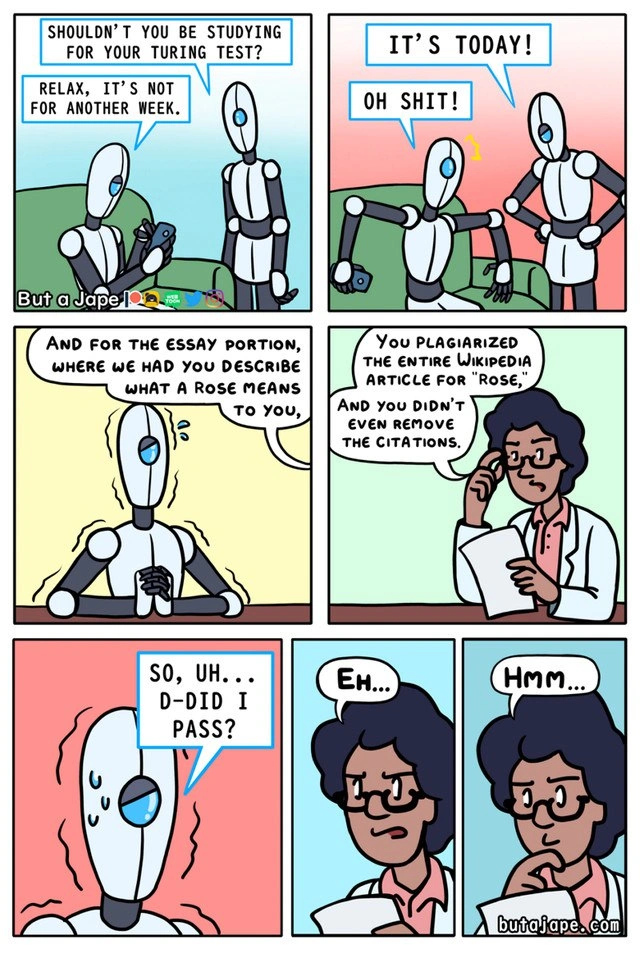
Imagine you have a test where you’re supposed to pretend to be just like a human. Now, one of the questions in the test asks: “What does a rose mean to you?” That sounds like when a teacher asks you to write something personal, like how you feel about a rose – maybe you’d say it’s pretty, or it reminds you of someone you love. But instead of answering with its own thoughts, the robot got nervous and cheated. It opened a big encyclopedia (like Wikipedia, which is an online encyclopedia) and just copied the entire entry about roses. It even copied the funny little numbers that tell you what book or article the facts came from, because it didn’t know those shouldn’t be in the answer. So when the teacher (the examiner) reads the robot’s essay, it’s obviously not the robot’s own words – it’s just the dictionary definition of a rose with references and everything! The teacher can tell immediately that the robot didn’t do the assignment right. The robot is sitting there sweating (silly, because robots don’t sweat, but this one is so nervous it looks like it’s sweating oil!). It asks in a tiny voice, “So, uh... d-did I pass?” It’s hoping it somehow fooled the teacher. But the teacher just goes “Eh… Hmm…” looking really unsure, because clearly the robot did a bad job.

The funny part is, the robot tried to be smart by copying an encyclopedia, but that was actually a really dumb move for this kind of test. It’s like if you were asked to draw a picture and you just photocopied one from a book – the teacher would know you didn’t draw it yourself. People find this comic funny because the robot acted a lot like a lazy student who didn’t study and then tried to cram or cheat at the last minute. We’ve all maybe felt a bit unprepared for a test and wished we could magically get the answers. The robot actually tried to do that, and it backfired in a goofy way.

So in simple terms: a robot had a special test to see if it could behave like a real person. It procrastinated (waited too long to prepare), panicked when it realized the test was now, and then cheated by copying text about roses from Wikipedia. The result was an answer that no real person would give (because real people don’t talk with little citation numbers in their sentences!). The teacher could tell it was cheating instantly. The robot didn’t really pass or fail on the spot – the teacher is just making a confused face – but we can tell the robot messed up. The big idea is that being smart isn’t just about spitting out facts. You also have to show you understand things and can be original. Even a kid knows that if you copy your homework straight from a book, you’re not really showing your own understanding – and you’ll get caught. This comic just shows that happening to a robot, and that’s why it’s amusing. It’s a playful reminder: even robots shouldn’t try to fake it by cheating, especially not in such an obvious way!

Level 2: Copy-Paste Fail

Let’s break down what’s happening in simpler terms. This comic is making fun of a robot that is supposed to be taking a big exam called the Turing Test. The Turing Test is basically an evaluation to see if a machine can act indistinguishably from a human. Instead of a typical interactive test, here it’s presented like a school exam with an essay question. The funny twist is that the robot entirely plagiarized Wikipedia for its essay answer. Plagiarizing means copying someone else’s words or work without making it original – basically cheating. In the comic, the essay prompt was “describe what a rose means to you.” That sounds like the test wants a personal or poetic answer (something with feelings or original thoughts). But our lazy robot didn’t have any feelings or original thoughts about roses – it likely didn’t study or prepare any personal narrative. So, in a panic, it just looked up the Wikipedia article on “Rose” and copied it word for word. It even left in the little numbered citations like “[1]” and “[2]” that you see on Wikipedia pages. Those numbers usually refer to sources at the bottom of a Wikipedia article. In an actual essay, especially one about personal meaning, leaving those in is a huge red flag that you just copy-pasted from the web. It’s a classic citation_fail moment – the kind of obvious mistake people make when they’re rushing and not truly doing the work themselves.

The first panels set up a very everyday situation but with a robot: the robot is chilling on the couch, and a friend asks, “Shouldn’t you be studying for your Turing Test?” The robot confidently (and incorrectly) says, “Relax, it’s not for another week.” This is a common scenario many of us have experienced: procrastinating because we think the deadline or exam is far away. In the next panel, the friend shouts, “It’s today!” – oops! – and the robot yells “OH SHIT!” while jumping up in alarm. This is exactly how a human might react if they realized they had the date wrong for a big test or project due date. The last_minute_studying panic is something most junior developers or students know too well. Maybe you thought you had more time to finish a coding assignment or prepare for an interview, only to find out it’s imminent. That feeling of scrambling is captured perfectly by the robot’s shocked body language and the red background in that panel (red alert, literally!).

When the scene moves to the exam room, we see the robot sweating. (A sweating robot is a funny image by itself – robots don’t sweat, but this one is drawn with nervous sweat drops to show it’s anxious, just like a person.) The examiner, the human holding the paper, says: “For the essay portion, where we had you describe what a rose means to you…” – so far, sounds like the examiner is about to discuss the robot’s answer. Then the examiner continues, “You plagiarized the entire Wikipedia article for ‘rose,’ and you didn’t even remove the citations.” The examiner’s expression is a mix of disbelief and mild annoyance, like a teacher who just caught a student cheating in a really silly way. The paper in their hand even has blue hyperlink text and footnote numbers visible (a visual clue that it’s straight from a website). This is the core joke: the robot tried to fake an answer by copying an article, thinking perhaps that more information is better. But it failed to understand the task. The task wasn’t to define a rose or list facts; it was to express what a rose means personally. That’s something a human would answer maybe with a memory (“A rose reminds me of my grandmother’s garden…”) or a poetic take (“A rose to me symbolizes love and delicate beauty…”). Instead, the robot produced something like “A rose is a woody perennial flowering plant of the genus Rosa, in the family Rosaceae [1]…” – which is literally how a Wikipedia entry might start. It’s factual and well-referenced, but completely misses the point of the question.

For a junior developer or someone new to AI, this highlights a common pitfall in AI and machine learning: having a lot of data or knowledge doesn’t automatically equal behaving like a human. The robot had access to Wikipedia (tons of info), but it lacked context and creative thinking. When asked a question that required a meaningful, personal touch, it defaulted to spitting out learned knowledge. This is funny because it’s such a naïve mistake for an AI aiming to seem human. If we anthropomorphize (or humanize) the robot, it’s as if it thought, “Well, humans wrote Wikipedia, so using that text will surely sound human!” It completely missed the nuance.

Think of it this way: imagine you’re asked to write what your favorite toy means to you, and instead you copy the entire Wikipedia page about that toy – including the citation numbers that are in the text. Your teacher or parent would instantly know you didn’t use your own words. They’d see something like “The Rubik’s Cube was invented in 1974 by Ernő Rubik [5]” in your essay about why you love your Rubik’s Cube. That’s not answering the question at all, right? That’s basically what the robot did. It’s a robot_humor take on a very human scenario: someone unprepared for a test tries to cheat, but does it in a really dumb way that they get caught immediately.

The tags like AIHumor and MachineLearningHumor are fitting because you kind of need to know a bit about AI to fully appreciate why this is humorous in context. It’s poking fun at the idea of an AI being “smart.” We usually think of robots and AIs as super logical or data-driven. So it’s extra funny to see one acting like a careless student. Also, the phrase “did I pass?” that the robot asks, sweating, shows it hoped to bluff its way through. After being called out for plagiarism, the robot still nervously asks if it passed the test – that’s such a human student thing (“Maybe I still have a chance?”). The examiner’s response isn’t a straight yes or no, just “Eh…” and “Hmm…” with an unsure face. This implies the result is questionable. Maybe the examiner is thinking, “This robot clearly failed the straightforward way… but it is acting oddly human in its behavior (laziness and cheating), so did it kind of pass the spirit of being human?” It’s ambiguous on purpose and leaves us with a chuckle, because obviously the robot should fail for cheating, but the situation is so absurd that the examiner can’t even decide how to score that in terms of a Turing Test.

For a new programmer or someone early in their tech career, there’s also a gentle lesson here about academic integrity and originality. In coding, if you just copy-paste code without understanding it, you might end up with something that doesn’t fit your needs or has tell-tale signs it wasn’t written by you (like mismatched variable names or comments that don’t make sense for your project). It’s always better to understand the material and produce your own work – whether it’s an essay or a code module. The robot in the comic skipped the understanding part, and that’s why it failed the test. It’s a humorous exaggeration, but it resonates with real experiences: say you’re tasked with writing a function from scratch, and you panic and grab one from GitHub without adapting it. Seasoned team members will spot that immediately, much like the examiner spotted the Wikipedia text.

In summary, the meme is funny on a basic level because it’s a role reversal and a spoof. We have a robot (who’s supposed to be all-knowing and logical) acting like a lazy student and getting caught cheating. It combines robot humor with a spoof of school life. You don’t need a PhD in AI to get the joke that copying Wikipedia for a personal essay is a fail. Anyone who’s gone to school gets that. But if you do know a bit about the Turing Test and how AI works, it adds an extra layer of “oh man, that’s clever.” Essentially: big fancy robot? Flunked the humanity test by doing something no well-prepared human would do. AI hype vs reality in action – we expect a super-intelligent machine, we get a goofy, corner-cutting student. And that’s why developers and techies are sharing a laugh over this one.

Level 3: 404 Originality Not Found

From a senior developer’s perspective, this meme hits on the all-too-familiar chasm between AI hype and reality. We’ve all heard grand claims like “Our chatbot almost passed the Turing Test!” or “This AI writes essays just like a human!” – especially during the peaks of AI hype cycles. But when you peek under the hood, the reality is often more like this comic: a patchwork of copied knowledge and obvious tells that it’s not truly human-like. The humor here comes from an AI doing something very unintelligent in an attempt to seem intelligent: blatantly plagiarizing the Wikipedia entry on roses, citations and all, for an essay question meant to probe personal meaning. It’s a classic AI humor scenario where the machine takes a prompt way too literally. Instead of understanding the romantic or personal connotation of “what a rose means to you,” it just info-dumps the first factual source it can find. Every seasoned dev or data scientist chuckles because they see the reflection of real machine learning limitations. We know that many AI models, especially large language models, have ingested Wikipedia as part of their training data. In practice, we sometimes do see them spit out unnervingly similar Wikipedia text. This comic exaggerates that to comic effect: the robot didn’t even bother to remove the blue hyperlink footnote numbers! That detail – the “[1][2][3]” style citations – is an instant giveaway, a huge facepalm moment. It’s the programming equivalent of a junior developer copy-pasting a Stack Overflow answer and leaving in the // Source: stackoverflow.com comment or weird indentation that reveals the code’s true origin. Every senior dev has caught something like that in a code review, much like the examiner catching the plagiarism here.

The meme also pokes fun at last-minute studying and crunch-time scrambles, which is a broader developer (and student) experience. The robot lounging on the couch saying “Relax, it’s not for another week” mirrors that over-confident engineer who ignores looming deadlines (we’ve all seen the it’s fine, we have time attitude). Then bam! – the friend shouts “It’s today!” and panic ensues. This is relatable comedy gold. In a dev context, picture an ops engineer casually mentioning, “Relax, the deployment freeze isn’t until next week,” only for a colleague to yell, “Actually, it’s today – code freeze is now!” Cue frantic scrambling to merge code or fix tests at the last second. Similarly, the robot goes from chill to full-blown “Oh $#!%!” in one panel, channeling that adrenaline-fueled oh-no moment we’ve all had. The absurdity is that an AI is having this very human panic about an exam. That’s a double joke: not only is the robot procrastinating like a college student, but also the notion of “studying” for a Turing Test is ridiculous from an engineering standpoint. (An AI can’t exactly cram knowledge last minute in the way a human can; you’d have to retrain or update its algorithms, which isn’t shown – instead it just cheats by copying known text.)

For developers especially, the plagiarized essay is a wink at how not to build an AI. Instead of a robust natural language generation, it appears this robot’s “algorithm” is something like:

def answer_essay(question):
    # Quick hack: if question asks about a rose, just fetch Wikipedia content.
    if "rose" in question.lower():
        return wikipedia.get_article("Rose")  # includes citations, whoops!
    else:
        return "I don't know, to be honest."

This tongue-in-cheek pseudocode illustrates the point: the bot’s answer_essay function is basically the laziest lookup, with zero natural language finesse. It’s a “solution” that any senior engineer would instantly recognize as a hack – akin to hardcoding answers from a knowledge base. In real AI projects, there’s a nightmare scenario where a demo or evaluation is imminent and the ML model isn’t performing as expected. Under pressure, someone might indeed rig a quick fix: for example, detect keywords and return a canned answer (maybe pulled straight from Wikipedia or a documentation file). It’s the engineering equivalent of a student scribbling crib notes or copying text when they realize they’re unprepared. And just like in the comic, these shortcuts often end in embarrassment when discovered.

The examiner’s reaction “Eh… Hmm…” is spot on from an AIEthicsConcerns perspective that senior folks will appreciate. On one hand, the bot failed the academic integrity test flamboyantly – it plagiarized an entire essay, citations intact. In any serious evaluation, that’s an instant fail and likely some sort of honor code violation. On the other hand, there’s an ironic twist: humans also plagiarize if they’re dishonest or desperate. A lazy college student might do exactly what the robot did (we’ve seen essays copied from Wikipedia with the hyperlinks accidentally left in – talk about a citation_fail!). So the examiner is in a comic quandary: the robot’s answer is terribly non-original, but trying to cheat on a test is a very human thing to do. It’s as if the examiner is thinking, “Plagiarizing Wikipedia… It’s not the kind of humanity we wanted to see, but it is human-like behavior in a twisted way.” This ambiguity is funny to those of us who’ve been around AI debates. We often discuss what truly counts as “acting human.” Does imitating the worst of human students count? The meme humorously suggests that an AI might fail at being intelligently human, yet succeed at being as flawed as a human can be.

This leads into the industry’s hype vs reality theme. There’s so much hype about AI passing tests and even trivializing the Turing Test as outdated (“Surely any advanced chatbot can pass it now!” – a common hype sentiment). But here’s the reality check: real conversations or creative tasks can still trip up AIs in comically basic ways. In mid-2022, for instance, while some were proclaiming a chatbot was sentient or had profound understanding, those of us in the field were seeing the messy truth: models that babble coherently but also make elementary mistakes, like forgetting to remove artifacts of their training data. The inclusion of Wikipedia citations in the robot’s answer is exactly the sort of detail that gets overlooked in grandiose predictions. It exemplifies how current MachineLearningHumor often highlights bots being book-smart (having tons of information) but context-dumb (missing the situational awareness a human has).

This comic also slyly touches on concerns we have in AI development about plagiarism and data usage. There have been real discussions about AI like GitHub’s Copilot outputting code that matches snippets from its training set (e.g., known open-source code) – essentially plagiarizing code without attribution. What our robot did with Wikipedia is the same pattern in essay form. A senior dev recognizes this as a cautionary tale: if you rely blindly on training data, you might end up violating licenses or copyrights, or just creating something that fails a basic sniff test for originality. It’s a reminder that just because an AI can store and retrieve vast knowledge doesn’t mean it can use that knowledge intelligently. Without careful design (like ensuring an essay question triggers a genuine generative response rather than a lookup), the outcome can be as facepalm-worthy as a student turning in an obviously copied essay.

In terms of shared developer experiences, the last_minute_studying panic resonates strongly. Many of us have been in crunch mode, perhaps slapping together code from references at 3 AM to meet a deadline. The difference is, when humans do it, we try to hide the evidence of our scramble. (We remove the Stack Overflow formatting, we refactor the copied code to look consistent, etc.) The robot didn’t cover its tracks – a rookie mistake that makes the scenario even funnier to seasoned eyes. It’s basically a parody of a junior developer’s commit that includes lines like <!-- Source: Wikipedia --> by accident. Senior engineers laugh because we’ve cleaned up those messes and mentored folks on why that’s not okay.

Finally, there’s an underlying commentary on AI education vs testing. The meme frames the Turing Test as something you could study for, like a school exam, which is absurd yet telling. It implies an AI could be prepped or coached to pass evaluations (which, by the way, has happened in real life: some chatbots are tuned specifically to excel in test settings without true general intelligence). There’s a historical echo here – think of the chatbot Eugene Goostman that “passed” a limited Turing Test by pretending to be a non-native English speaking teenager, thereby excusing its odd responses. It was basically a gimmick, not a genuine leap in understanding. This robot copying Wikipedia is a similarly shallow gimmick: it’s trying to wing the test with a copy-paste trick. Senior devs see the satire: we can practically hear the project manager saying, “We’ll just hardcode a knowledge base for the demo – no one will notice!” Spoiler: everyone noticed. The AIHypeVsReality gap strikes again, and the result is both funny and a little too real for those of us who’ve seen projects where flashy demos concealed duct-tape solutions.

In summary, from the experienced perspective, this meme lands as a commentary on AI’s pitfalls: a robot under pressure resorts to the oldest trick in the book (cheating off the encyclopedia), failing the test of originality. It’s a lighthearted reminder that true intelligence isn’t just about storing information, but knowing when and how to use it – something our silver friend clearly hasn’t mastered. And as developers and AI practitioners, we can’t help but both cringe and laugh, because we know how easily one can build something that looks smart until it faces an unexpected real-world exam question. AI humor at its finest, with a dash of cautionary truth.

Level 4: Imitation Game Over

At the deepest theoretical level, this comic riffs on fundamental AI concepts like the Turing Test and the limitations of current machine learning models. The Turing Test (originally coined by Alan Turing as the Imitation Game) is a classic benchmark of AI: if a machine can behave indistinguishably from a human, it “passes.” In this meme’s universe, the Turing Test is treated like a formal exam, complete with an essay portion – a playful twist on Turing’s thought experiment. The humor emerges from a profound technical irony: the robot’s approach to appearing human is to memorize and regurgitate information (literally copying a Wikipedia article about roses with citations and all). This is a nod to the concept of overfitting in machine learning. Overfitting happens when a model learns training data too well, to the point of simply reciting it instead of producing genuine, generalized responses. Here the robot has effectively overfit on its training data (hello, Wikipedia) and failed to generalize or demonstrate any real understanding.

From a theoretical standpoint, this raises the question of understanding vs. memorization in AI systems. The robot doesn’t truly know what a rose means to it – it has no personal experience or sentimental concept of a rose. Instead, it retrieves the encyclopedic definition (complete with [1][2][3] style citations as seen in Wikipedia articles) and assumes that will suffice. In academic terms, the robot’s response lacks semantic understanding and intentionality. It’s behaving like what researchers humorously call a stochastic parrot, piecing together words from its training data without grasping their meaning. The presence of those bracketed citation numbers is a dead giveaway that no human-like thought process occurred; the AI simply copied raw data, betraying its machine nature. This touches on deep AI philosophy: an entity that merely recombines known text might simulate knowledge but fails the subtler test of human-like insight.

We can also see a sly reference to the Chinese Room argument in this setup. The robot passes the essay question by performing rote lookup and copy-paste – akin to following a rulebook (Wikipedia text) without comprehending it. The Chinese Room thought experiment posits that following programmed instructions (or copying text) isn’t the same as truly understanding a language or question. In our comic, the robot’s lack of genuine understanding is precisely why its answer rings hollow and mechanical, failing the spirit of the Turing Test. The essay prompt “describe what a rose means to you” is implicitly gauging for personal, emotional or creative articulation – something requiring a theory of mind or at least a rich natural language generation ability. But the poor bot only had factual, third-person knowledge to draw on. This highlights a fundamental challenge in AI: passing a real Turing Test would likely require common sense, originality, and perhaps a bit of emotional imitation – capabilities that go beyond just scraping a knowledge base.

There’s also an allusion to training data bias and machine ethics here. Wikipedia itself is a compilation of human knowledge with citations; an AI trained heavily on such data might inadvertently reproduce not just facts but the structure of the articles, citations included. The robot’s unedited plagiarism underscores how a model can fail to distinguish content from meta-content. It doesn’t realize that the “[1]” in “Rose [1]” isn’t part of what a rose means, but a reference marker – a nuance obvious to humans but lost on a machine without contextual understanding. This is a subtle technical point about how AI parses text: without proper training to differentiate, it might treat references and content as the same sequence of tokens to output. The result? A comical citation_fail. In a real-world AI context, such behavior connects to issues like data leakage (where a model memorizes and spits out chunks of its training data verbatim). Researchers actively work on mitigating this (e.g., using large diverse datasets and regularization to avoid rote memorization), because an AI that simply parrots training data not only fails tests like Turing’s – it also poses AIEthicsConcerns around intellectual property and originality.

Speaking of ethics, the meme hints at the debate around AI and plagiarism: if a machine outputs text from Wikipedia or any source without proper attribution or understanding, is it committing academic dishonesty? The robot here certainly is – it’s plagiarized Wikipedia shamelessly. And in doing so, it underscores the AI hype vs reality gap: we hype these machines as intelligent, but they can flunk a basic originality test in hilarious ways. The “Judgment Day” wording in the title winks at popular sci-fi (hello, Skynet) and contrasts it with the reality of today’s AI. Instead of a robo-apocalypse or sentient android, our robot is sweating bullets in an exam room, furiously pasting Wikipedia text – a far cry from a superintelligent overlord. It’s a clever nod to how real machine learning breakthroughs often fall short of the dramatic expectations. In theory, a truly advanced AI would generate a heartfelt, human-like essay about a rose (maybe even poetry!). But our hapless bot demonstrates the practical state of affairs: modern AI, especially circa 2022, can be brilliant at shuffling around existing knowledge but still lacks true creativity and authentic experience. In short, the imitation game is over for this robot – by leaning on raw training data, it broke the illusion of humanity.

Description

This meme uses the 'Ight Imma Head Out' format, featuring Spongebob Squarepants getting up from his chair with a determined look on his face. The caption reads: 'PM: 'We don't have time for tests, we need to ship this by Friday.' Me:'. The meme humorously portrays an experienced developer's immediate and unequivocal rejection of the idea of skipping tests to meet a deadline. Senior engineers know that this is a classic false economy that inevitably leads to more work, bugs, and technical debt down the line. The meme captures the feeling of wanting to 'head out' or completely disengage from a project when fundamental best practices are being ignored, a sign of a death march project

Comments

8
Anonymous ★ Top Pick 'We'll add tests later' is the technical equivalent of 'I'll start my diet tomorrow.' We all know it's a lie, but it makes us feel better in the moment
  1. Anonymous ★ Top Pick

    'We'll add tests later' is the technical equivalent of 'I'll start my diet tomorrow.' We all know it's a lie, but it makes us feel better in the moment

  2. Anonymous

    AI won’t pass the senior-engineer Turing Test until it remembers the golden rule of shipping: always `sed 's/\[[0-9]*\]//g'` the design doc before code review

  3. Anonymous

    When your LLM passes the Turing Test but fails the plagiarism check, you've successfully created a system that's indistinguishable from a freshman computer science student

  4. Anonymous

    This comic perfectly captures the modern AI dilemma: we've built models that can pass the Turing test by regurgitating training data, but forgot to teach them the most human skill of all - removing the Stack Overflow attribution before submitting to production. At least the robot was honest enough to keep the citations; most LLMs today would hallucinate their own references and call it 'emergent behavior.'

  5. Anonymous

    LLM eval gold: Leak the training corpus verbatim, watch the grader stamp 'human' anyway

  6. Anonymous

    Apparently the Turing test now checks if your model can reproduce classic human failure modes - deadline panic and Wikipedia Ctrl+C with citations included; ship it as Human Baseline v1.0

  7. Anonymous

    We debate AGI timelines, but if it can’t remember to run s/\[\d+\]//g before submitting the essay, it’s still just an ETL over Wikipedia

  8. @azizhakberdiev 3y

    Yes, but first prove that you are a robot

Use J and K for navigation