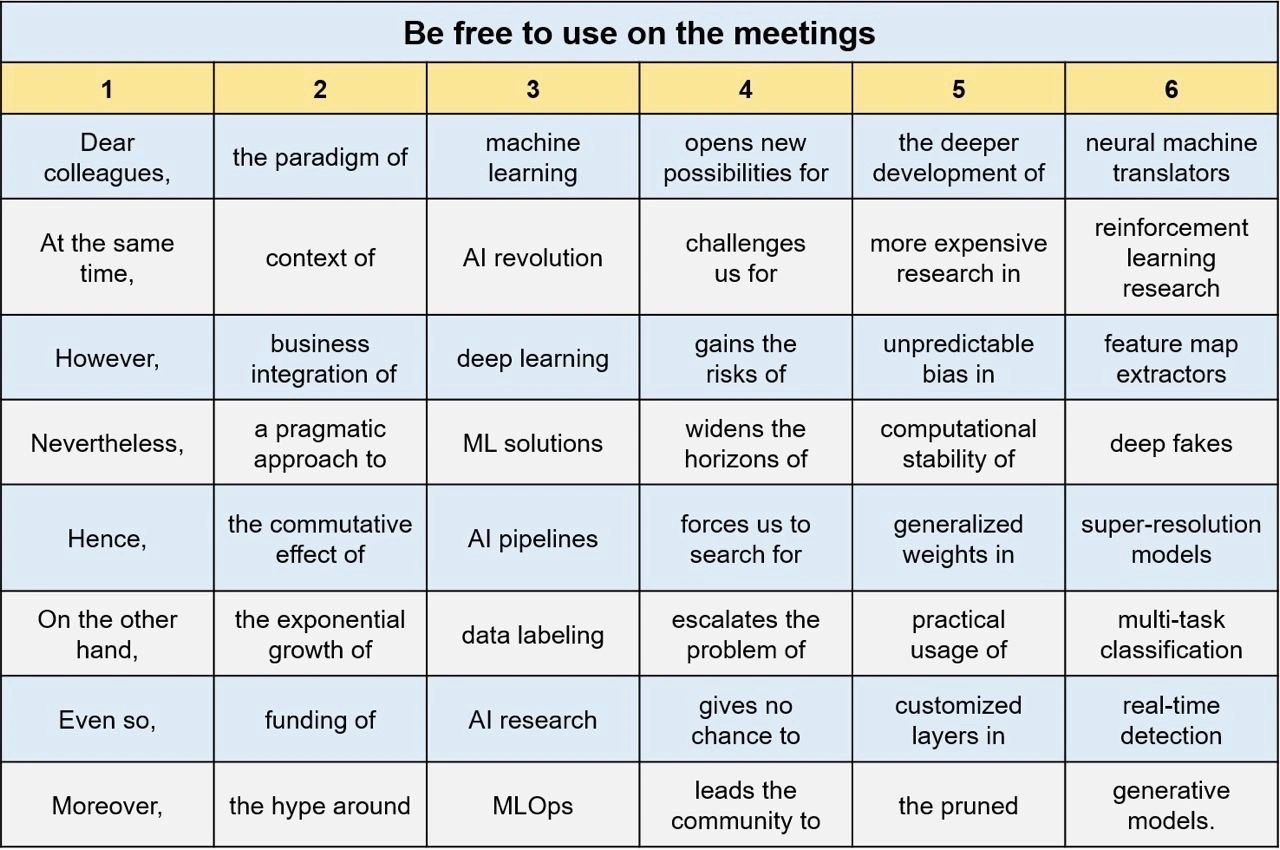
Spin the AI meeting buzzword bingo grid for instant machine learning jargon
Why is this AI ML meme funny?
Level 1: Big Words, No Meaning
Imagine you have a friend who wants to sound super smart. When the teacher asks a simple question, instead of answering in a normal way, your friend strings together every big word they know: “Well, in the context of our educational paradigm, the exponential growth of knowledge trajectory opens new possibilities for pedagogical synergy.” Huh? 🙃 Everyone listening might nod or clap, but secretly they’re a bit confused because that sentence didn’t actually explain anything – it just sounded fancy.
This meme is making fun of that exact thing, but with AI buzzwords. It’s like having a box full of impressive-sounding tech words (machine learning! neural networks! deep fakes!) and randomly pulling them out to build a sentence. The result is a sentence that’s grammatically correct and full of fancy terms, but when you try to understand it, it’s basically nonsense. It’s funny because we’ve all heard someone talk like this in real life – using big words to try to impress everyone, without really saying much. The meme is a playful reminder: just because a sentence has lots of big smart words, doesn’t mean it’s actually smart! It’s as silly as mixing all your favorite foods in a blender – you think you’ll get something amazing, but you just end up with a weird mush. 🥤
Level 2: Real Terms, Random Talk
If you’re newer to the tech scene or just starting out in AI/ML, this meme might look like a wall of confusing terms. Don’t worry – that confusion is exactly the point! These buzzwords are real technologies and concepts, but when jammed together they become meaningless jargon. Let’s break down some of the key terms and ideas flying around here, and what they actually mean in real life:
Machine Learning (ML): Think of this as teaching computers by example. Instead of programming explicit rules, we feed the computer lots of data so it can learn patterns by itself. For instance, show an ML model thousands of cat photos and non-cat photos, and it can learn to tell cats apart from dogs. It’s the broad field that includes many approaches, like neural networks, decision trees, etc.
Deep Learning: This is a subset of machine learning that uses multi-layered neural networks (vaguely inspired by the brain) to learn from data. Deep refers to having many layers in the network. Deep learning has driven much of the recent AI boom – it’s behind things like voice assistants understanding speech, or an image AI recognizing your face in a photo. It’s powerful, but mentioning it without context (like “business integration of deep learning”) is often just name-dropping to sound advanced.
AI Revolution: A grand term to describe how AI is rapidly changing industries and society. People talk about an AI revolution the way they talk about the industrial revolution or the internet revolution – it’s the idea that AI will transform everything. In reality, AI is indeed bringing big changes, but if someone just says “context of AI revolution” in a meeting, they might be hand-waving – referencing a big trend without specifics.
Neural Machine Translators: This refers to AI models that translate text from one language to another (like how Google Translate works under the hood nowadays). The term “neural” indicates it uses neural network models. They were a huge leap over old rule-based translation systems. Saying “the deeper development of neural machine translators” sounds fancy, but it’s just talking about making better language translation AIs.
Reinforcement Learning: A type of machine learning where an agent (like a game-playing AI or a robot) learns by trial and error, getting rewards or penalties. Think of training a dog: good behavior gets a treat, bad behavior gets nothing or a timeout. In AI terms, algorithms like Q-learning or Deep Q Networks learned to play Atari games this way, and famously AlphaGo used reinforcement learning to master the game of Go. It’s genuinely a complex, cutting-edge domain of AI. But phrase it as “more expensive research in reinforcement learning research”, and it starts to sound suspiciously redundant – and that’s exactly what the meme does to poke fun.
Feature Map Extractors: This one’s pretty technical. In deep learning, especially in image recognition, layers of a neural network create what are called feature maps – basically, representations of the input image that highlight important features (edges, shapes, textures). A feature extractor is a part of the network that pulls out those useful features from raw data. So, feature map extractors might refer to layers in something like a convolutional neural network (CNN) identifying patterns in an image. Used in an everyday meeting sentence (“unpredictable bias in feature map extractors”), it’s almost comical – that’s an extremely specific issue to discuss without context, and most non-specialists in the meeting would be completely lost.
ML Solutions: A very buzzword-y way to say “machine learning applications” or “AI projects.” When someone says “pragmatic approach to ML solutions,” they likely mean “let’s be practical in how we apply AI.” But it sounds so much fancier their way, doesn’t it? As a junior developer, you’ll learn that whenever you hear “solution” in tech, it often just means “thing that we built or use.” It’s a favorite buzzword in marketing and management circles.
Deep Fakes: These are synthetic media (images, videos, audio) created by AI that look and sound real, but aren’t. For example, an AI can generate a video of someone saying something they never actually said. It’s like high-tech photoshop on steroids. Deep fakes use generative models (often Generative Adversarial Networks - GANs) to fabricate content. So talking about the “computational stability of deep fakes” in a serious tone is weird; it’s stringing together terms that individually relate to real concerns (like computational cost or stability of algorithms, and deep fakes being a thing) but combined, it’s not a known issue or phrase. It’s there to sound urgent and technical.
AI Pipelines: This just means the end-to-end process of an AI project – from data collection to data preprocessing, model training, evaluation, and deployment. It’s the assembly line for building an AI solution. Everyone has to figure out their pipeline to get models from the lab to production. If someone mentions “the commutative effect of AI pipelines,” a newbie (heck, even an expert) would scratch their head. Pipelines are sequential processes (commutativity isn’t a thing there). This part of the meme is signaling, “Look, we can even toss in math-y words like commutative to really crank up the pseudo-intellectual vibe.” As a junior dev, know that if it sounds off, trust your instinct – it probably is nonsense in context.
Generalized Weights: In machine learning, weights are the parameters the model learns – basically numbers that get tuned during training to make the model perform well. When we say a model generalizes, we mean it works on new, unseen data (not just the data it was trained on). So “generalized weights” isn’t a standard phrase, but it hints at the concept of having a model whose weights are general enough to work well beyond the training examples. In plain terms, “search for generalized weights” could mean trying to train a model that isn’t overfitting. It’s dressed-up lingo; most practitioners would simply say “we need to improve the model’s generalization.”
Super-Resolution Models: These are AI models that take a low-resolution image and produce a high-resolution version – essentially enhancing image detail. If you’ve ever seen those sci-fi “Enhance that image!” moments, super-resolution is the real-life algorithm trying to do that. It’s a legit area in computer vision. The meme’s phrase “super-resolution models” is real, but pairing it with “generalized weights” as above, or any unrelated prefix, makes it nonsensical.
Data Labeling: This is the unglamorous but vital task of preparing training data for supervised learning. It means assigning the correct tags or categories to data (like drawing boxes around cars vs. pedestrians in thousands of images, or transcribing hours of audio recordings). It’s often a huge bottleneck in ML projects because models need lots of labeled examples to learn well. So, “the exponential growth of data labeling” might refer to how data labeling needs skyrocket as projects expand. That’s actually a fair point in real life – labeling is hard to scale. But saying it alone without context (“escalates the problem of practical usage of multi-task classification”??) ends up as bafflegab. A junior engineer might rightfully think, “If labeling is growing exponentially, wouldn’t that help multi-task models by giving more data?” The meme’s combo doesn’t have to make sense – it just sounds weighty and problematic to someone not really listening.
Multi-Task Classification: This is when a single AI model tries to solve multiple classification tasks at the same time. For example, one model could simultaneously identify the type of animal in a picture (dog vs cat) and determine the animal’s color (brown, black, white, etc.). It’s a challenging but active area of research – the model has to juggle learning different but related tasks. In practice, multi-task models can save computation by sharing some knowledge across tasks, but they also risk not being as specialized for each task. The phrase “practical usage of multi-task classification” on its own is fine – lots of people discuss how to use multi-task learning in real applications. The funny part is preceding it with something like “escalates the problem of” – making it sound ominous without explaining why. It’s like they’re saying “multi-task learning has issues in practice” but in the most convoluted way imaginable.
Funding of AI Research: Pretty straightforward – money that goes into AI R&D. The meme uses “Even so, funding of AI research gives no chance to customized layers in real-time detection.” Huh? Okay, customized layers likely means tweaking the architecture of neural networks for specific needs, and real-time detection means AI that can detect things on-the-fly (for example, identifying objects in video instantly). The whole phrase is off. Maybe they’re implying budget constraints kill fancy tailored neural nets for real-time systems? It’s honestly hard to tell – and that’s the joke. As a junior dev, you might be breaking your head trying to catch the meaning, but there isn’t a coherent one. It’s important to realize sometimes people string together cause and effect in ways that don’t really hold up, hoping no one will question it.
MLOps: This stands for Machine Learning Operations. It’s a relatively new but very important concept: how to manage and deploy machine learning models in production reliably and efficiently. It’s about applying DevOps practices to ML – automated pipelines, continuous integration/deployment, monitoring models for performance drift, etc. Companies are hyping MLOps because many discovered that building a model in a notebook is one thing, but maintaining it in a real product is a whole other challenge. So MLOps became a buzzword around 2020-2022 as an essential part of the AI pipeline. When the meme says “the hype around MLOps leads the community to the pruned generative models,” it’s mashing two separate ideas: hype about MLOps, and pruned generative models. Pruning in ML means removing unnecessary parts of a model (to make it smaller/faster). Generative models are AIs that create data (like image generators or text generators). In reality, there is work on pruning large generative models to make them run on smaller devices. But phrasing it as “leads the community to the pruned generative models” is oddly theatrical. It’s the kind of vagueness you might hear in a dull conference keynote: “And moreover, the hype around MLOps leads the community to... (something something)”. You expect a grand insight but you get a half-baked phrase.
Phew! That’s a lot of terminology. 😅 The key takeaway for a newcomer is: each of these buzzwords does have a real meaning (and you’ll encounter them as you study AI), but meaning can evaporate when they’re used just to impress rather than to explain. The meme is funny because it shows that anyone can generate an authoritative-sounding sentence with a handful of trendy terms. If you ever sat in a meeting as a junior developer and felt lost because someone was going on about “paradigms” and “horizons” and “pipelines” all in one breath – this meme assures you, you’re not the only one thinking “What does that even mean?” Sometimes the answer is: it means very little, and it’s okay to chuckle about it.
Level 3: Deep Learning Lorem Ipsum
At first glance, this meme looks like a cheat-sheet for sounding AI-smart in meetings. It's basically a machine learning version of Buzzword Bingo, where you string together jargon from each column to form a grandiose sentence. The humor is that these impressive-sounding sentences are pure gibberish – they're technically grammatical, but they don’t actually say anything concrete. It’s like a Mad Libs for the AI hype era. Every phrase in the table is a real term from the world of AI/ML, but thrown together randomly they become absurd.
In corporate culture, especially during the peak of the AI hype cycle, people often pepper their presentations with fancy terms to sound cutting-edge. This meme skewers that habit. Each column in the table provides a piece of a six-part Frankenstein sentence:
- Column 1 gives a serious-sounding opener (“Dear colleagues,”, “However,”, “Moreover,” ...), mimicking how execs or managers transition between slides.
- Column 2 adds a vague context phrase (“the paradigm of”, “the exponential growth of”) – classic corporate speak that sounds insightful but is mostly filler.
- Column 3 throws in a hot-topic AI noun (“deep learning”, “AI revolution”, “MLOps”). These are buzzwords everyone has heard of; dropping them signals “Hey, we’re talking advanced stuff here.”
- Column 4 injects an action or impact (“opens new possibilities for”, “challenges us for”, “forces us to search for”), implying something important is happening (without actually explaining how or why).
- Column 5 tacks on an extra technical twist (“unpredictable bias in”, “computational stability of”, “generalized weights in”) to deepen the mystique. Often this is where the jargon level goes to 11 – it hints at serious technical depth but is mostly smoke.
- Column 6 finally drops a specific high-tech term (“neural machine translators”, “feature map extractors”, “deep fakes”, “generative models”). This is the big finish, like “Ta-da! We said the fancy thing!”
Put one item from each column together, and you get a full-blown AI buzz-phrase. For example:
“Hence, the commutative effect of AI pipelines forces us to search for generalized weights in super-resolution models.”
On the surface, that sounds extremely deep and intelligent – it’s packed with academic flair. But if you try to parse it, it's mostly nonsense. “Commutative effect of AI pipelines” doesn’t correspond to any real concept (pipelines aren’t commutative – that term belongs to math, like saying A + B = B + A). And “search for generalized weights” is just a convoluted way to say “find more generalizable parameters,” which any ML engineer would phrase way more simply, if they meant it at all. The whole sentence is a word salad: lots of flavor, no nutrition.
This meme resonates with developers and data scientists who’ve sat through puffed-up meetings where someone speaks in what we jokingly call “AI-glish” – English peppered with AI jargon. Everyone in the room has heard these terms (neural networks, reinforcement learning, MLOps), but often they're used by people who only vaguely understand them or want to impress stakeholders. The result is a stream of high-level fluff that sounds impressive yet conveys nothing actionable. It’s a corporate magic show: distract the audience with buzzwords so they don’t notice the lack of real substance or results.
Why is this funny to us? Because it’s too real. Many of us have played “meeting bingo,” secretly crossing off jargon like “paradigm shift,” “synergy,” or “leverage AI” each time the boss utters them. By the end of a long update meeting, your bingo card (or this meme’s table) might be completely filled. The table in the image even encourages you: “Be free to use on the meetings.” It’s poking fun at how routine and formulaic these lofty AI statements have become.
From an insider perspective, the meme also hints at how trivial it is to generate such jargon. You could write a simple script to spit out sentences like these, and it would pass for some companies’ quarterly innovation report. In fact, let's pseudo-code the Buzzword Generator:
import random
columns = [
["Dear colleagues,", "At the same time,", "However,", "Nevertheless,",
"Hence,", "On the other hand,", "Even so,", "Moreover,"],
["the paradigm of", "context of", "business integration of",
"a pragmatic approach to", "the commutative effect of",
"the exponential growth of", "funding of", "the hype around"],
["machine learning", "AI revolution", "deep learning", "ML solutions",
"AI pipelines", "data labeling", "AI research", "MLOps"],
["opens new possibilities for", "challenges us to", "gains the risks of",
"widens the horizons of", "forces us to search for",
"escalates the problem of", "gives no chance to", "leads the community to"],
["the deeper development of", "more expensive research in",
"unpredictable bias in", "computational stability of",
"generalized weights in", "practical usage of",
"customized layers in", "the pruned"],
["neural machine translators.", "reinforcement learning research.",
"feature map extractors.", "deep fakes.", "super-resolution models.",
"multi-task classification.", "real-time detection.", "generative models."]
]
sentence = " ".join(random.choice(col) for col in columns)
print(sentence)
# Example output: "Nevertheless, the exponential growth of deep learning challenges us to practical usage of super-resolution models."
// (Yes, it’s that easy to auto-generate profound-sounding nonsense.)
This highlights a truth: throwing buzzwords together is cheap, but delivering actual AI solutions is hard. The meme implicitly mocks how some organizations operate – big talk, modest walk. It reflects a bit of frustration from developers who know that real machine learning work involves painstaking data cleaning, rigorous experiments, and careful validation, none of which sound as sexy in a meeting as “opens new possibilities for the deeper development of neural machine translators.”
There’s also commentary here on the AI hype cycle. Terms like “AI revolution” and “deep fakes” were extremely hot around the time this meme was posted (early 2022). We were (and still are) in a period where AI is often portrayed as magical pixie dust that will revolutionize everything. Companies felt pressure to sprinkle phrases like “deep learning” and “MLOps” into every discussion to seem relevant and forward-thinking. The result? A lot of meetings and press releases filled with grand statements that sound cutting-edge but are painfully light on details. This table lampoons that phenomenon perfectly.
In essence, the meme is saying: “See how easy it is to spout impressive-sounding AI jargon? You don’t even need an actual plan or insight – just pick one item from each column and you’re good to go!” It’s a comedic reminder to cut through the fluff. For seasoned tech folks (the cynical veterans in the back of the room), it’s a chance to nod knowingly and maybe crack a smile next time someone in a suit says “the paradigm of AI revolution opens new possibilities for our business integration of deep learning.” We’ve all been there, holding back an eyeroll and thinking, “Sure, boss, whatever that means.”
Description
A rectangular meme shows a six-column table titled “Be free to use on the meetings.” The header row has pale-yellow cells numbered “1”, “2”, “3”, “4”, “5”, and “6”. Eight subsequent rows alternate pale-blue and white cells, each containing phrase fragments: 1) “Dear colleagues, | the paradigm of | machine learning | opens new possibilities for | the deeper development of | neural machine translators”; 2) “At the same time, | context of | AI revolution | challenges us for | more expensive research in | reinforcement learning research”; 3) “However, | business integration of | deep learning | gains the risks of | unpredictable bias in | feature map extractors”; 4) “Nevertheless, | a pragmatic approach to | ML solutions | widens the horizons of | computational stability of | deep fakes”; 5) “Hence, | the commutative effect of | AI pipelines | forces us to search for | generalized weights in | super-resolution models”; 6) “On the other hand, | the exponential growth of | data labeling | escalates the problem of | practical usage of | multi-task classification”; 7) “Even so, | funding of | AI research | gives no chance to | customized layers in | real-time detection”; 8) “Moreover, | the hype around | MLOps | leads the community to | the pruned | generative models.” By selecting one cell from each column, anyone can fabricate a grandiose sentence packed with AI/ML jargon, lampooning corporate meeting culture, communication fluff, and the relentless hype cycle around data science initiatives

Comments
27Comment deleted
Spent months shaving milliseconds off inference; PM waved this bingo grid, declared “the commutative effect of AI pipelines forces us to search for generalized weights in super-resolution models,” and walked out with three years of funding - turns out latency is measured in syllable count
The real deep learning here is figuring out which combination of these phrases will make your stakeholders nod knowingly while having absolutely no idea what computational stability of generalized weights means - but hey, at least it widens the horizons of funding opportunities
Proof that meeting-grade AI commentary was a lookup table all along - six columns, zero parameters, indistinguishable from a VP
This bingo card perfectly captures the modern ML engineering meeting: where 'the paradigm of deep learning opens new possibilities' translates to 'we're throwing GPUs at the problem until something works,' and 'the exponential growth of AI research' really means 'we have 47 tabs open to different transformer papers we'll never finish reading.' The real challenge isn't the unpredictable bias in your models - it's staying awake while someone explains how their neural machine translators will revolutionize the business integration of our ML solutions. Bonus points if you can complete a full row before someone mentions 'synergy' or asks if we've considered just using ChatGPT
Our “AI strategy” is basically this six‑column Markov chain - roll a d8 six times and you’ve generated a quarter’s OKRs, a board deck, and exactly zero working ML pipelines
The perfect LLM fine-tune: earnings calls, yielding infinite hype with zero perplexity on reality
Our QBR generator is just beam search over this buzzword grid - minimize stakeholder perplexity, maximize engineering loss, and make sure the output only compiles in PowerPoint
I feel like the numbers are on the wrong axis Comment deleted
It's supposed to work like this Numbers are the steps Comment deleted
Right, but I thought I was supposed to choose the next option with a dice Comment deleted
Apparently, not Comment deleted
why Comment deleted
Take a good look at the pic again, pal Comment deleted
d8 is a dice too Comment deleted
You don’t make any sense Comment deleted
There are 9 sided dice. They look like this and are heavily used in ttrpgs. Comment deleted
Gimme a break, I wasn’t talking about the dices for fuck’s sake I was talking that the dude was completely missing the point that you have to go horizontally to get a sentence, not vertically Shove these dices up your ass please and have a great day. Thank you Comment deleted
don't be rude please Comment deleted
👌 Comment deleted
seethe Comment deleted
8 Comment deleted
Fucking oboes, hate them. Comment deleted
I mean, you would need 8 sided dice to choose one element from the column Comment deleted
I have many 8 sided die Comment deleted
d&d player much? Comment deleted
Much Comment deleted
Nice Comment deleted