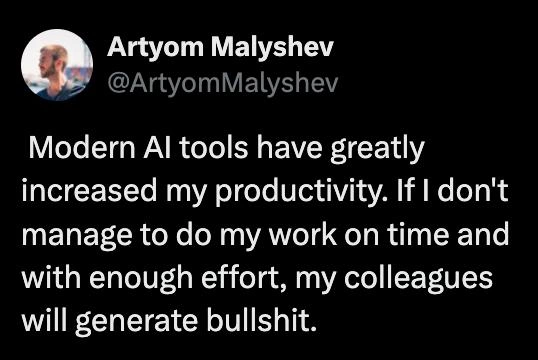
AI Tools Increased Productivity Through Fear of AI-Generated Bullshit
Why is this AI ML meme funny?
Level 1: The Magic Excuse Machine
Imagine you’re in a group where everyone has a job to do, like a school project. Now, think of one kid who didn’t do their part. Normally, that kid might say, “Uh, my dog ate my homework,” or some excuse to not look bad. That’s already kind of funny because it’s obviously not true. Now picture if the group had a magic machine that could instantly create super convincing stories or explanations whenever someone didn’t do their work. The lazy kid could press a button and the machine would spit out a perfectly worded reason that sounds really fancy and believable – basically a fancy lie that’s hard to question.
This meme joke is saying: nowadays, we have a bit of that magic in real life, called AI (like smart computer programs that can write stuff for you). The person in the meme is joking, “These new AI tools make me work harder. Because if I don’t do my work, my teammates will just use the AI to make up nonsense to cover it up!” In simple terms: I have to do my chores, or my friends will ask a robot to invent an excuse for me. The funny part is thinking about a robot making excuses. It’s like having a friend who’s an expert fibber always on standby. It motivates you to just do the darn thing, because who wants a robot to take over even your excuses?
So the meme is playing on that silly idea. It’s saying we’ve gotten to a point where technology is so advanced that it can even automate excuses. That’s both hilarious and a bit ridiculous, right? It’s like if you didn’t clean your room and instead of you telling your mom a reason, a little AI box on your desk instantly yells out, “The room is messy due to unprecedented toy distribution challenges!” Sounds official, but it’s basically nonsense. You’d probably rather just clean your room than deal with that silliness.
In the end, the big laugh is about not getting shown up by a machine. We usually think of robots helping with chores or homework; here the robot is helping with laziness in a sneaky way. So our hard-working meme author jokes that because such a machine exists, he’s more productive — he’d rather do real work than let coworkers unleash the “magic excuse machine” on his behalf. It’s a fun reminder that doing the real work beats relying on a fancy-sounding fake any day, and it exaggerates the situation to make us smile. After all, it’s pretty goofy to imagine excuses generated at the push of a button!
Level 2: AI-Powered Excuses
For a junior developer or someone new to these concepts, let’s break down what’s happening in this meme. It starts with the idea of modern AI tools in a workplace setting. In recent years (especially by 2024-2025), many developers and teams have started using AI-powered assistants like ChatGPT or GitHub Copilot. These tools can help with tasks such as writing code, generating documentation, or answering questions. They’re called generative AI because they can generate new content (text, images, etc.) based on the patterns they learned from tons of training data.
Now, the tweet in the meme is by a developer joking about their productivity. Normally, saying “AI tools have greatly increased my productivity” would mean the AI helped them get more work done faster (which is the promise of these AI assistants). But here comes the plot twist: he says why he’s more productive — “If I don’t manage to do my work on time and with enough effort, my colleagues will generate bullshit.” In plainer terms, “If I slack off and miss my deadline, my co-workers are just going to use an AI to spit out some nonsense as a substitute for my real work.”
Let’s clarify a couple of terms:
- “Bullshit” in this context means content that sounds legitimate or technical but is actually nonsense or meaningless. It’s the kind of thing you say or write to cover your butt when something isn’t done — an excuse, basically. In a work meeting, bullshit might be a fancy explanation that avoids admitting “I didn’t do it.”
- “Generate bullshit” implies using an AI tool to automatically create that excuse or filler. Instead of a person manually coming up with a convoluted reason for a delay, they can click a button (or prompt an AI) and get a ready-made paragraph of jibber-jabber that looks official.
- Deadline pressure is the stress everyone feels when a due date is approaching and the work isn’t finished. A workaround is a clever (sometimes not entirely proper) way to deal with a problem. In this case, the workaround for missing a deadline might be making something up to buy time or shift blame.
So the humor here is that the developer is essentially saying: “Because AI can automate making excuses, I have to work harder to not need those excuses!” It’s a cheeky way to highlight how AI might be misused in a team. Instead of just using these tools to produce actual work (like writing code or testing), colleagues might use them to create the appearance of work or explanations for lack of progress.
Picture a team meeting where everyone has to share an update. There’s always that temptation to embellish (make things sound better) if you haven’t made much progress. Now imagine you have a tool on your computer that can instantly write a very polished update for you. You could type in: “Explain why module ABC wasn’t completed this week,” and the AI might output something like:
“We faced unanticipated challenges integrating module ABC due to legacy system constraints. The team is implementing optimizations and conducting additional testing to ensure stability.”
To a manager or a client, that sounds pretty legit — it uses technical terms (“legacy system constraints”, “additional testing”, “ensure stability”) and definitely sounds better than “I haven’t done it yet.” This is what we mean by AI-powered excuses or generative_ai_excuses. The AI is essentially being used to automate the creation of excuses or status updates that don’t have real substance behind them.
For a newer developer, this meme might also be poking at a fear or anxiety: “Will I be replaced by AI?” Usually we think of that in terms of coding or actual tasks. But here it’s almost worse — it’s saying you could be replaced in making excuses! Even the soft skill of coming up with reasons for delays can be taken over by a robot with a silver tongue. It’s a funny exaggeration, of course. In reality, if you don’t do your work, eventually it becomes clear no matter how fancy your update sounds. But in the short term, an AI assistant could help someone appear to be working when they really aren’t contributing much.
This relates to AI hype vs reality. The hype is that AI will do our mundane work and free us up to be more productive. The reality, as joked here, is that AI might just enable new kinds of nonsense. Instead of truly boosting productivity, it might just boost the production of fancy-smelling nothingness (if people choose to use it that way). The category “DeveloperProductivity” is at play because we measure productivity by output. If AI can generate fake output, then measuring productivity gets tricky. Are you productive because you delivered a thorough design doc, or was that just the AI spewing words? The meme jokingly suggests that knowing this can happen lights a fire under the honest developer to make sure authentic work is done — otherwise someone might cover the gap with AI-generated fluff.
And note, the meme is shown as a tweet screenshot (black background, profile name “Artyom Malyshev” etc.), which is a common format for sharing jokes in developer and tech circles. It’s basically one developer broadcasting this witty observation to others: that in today’s AI-infused environment, even your team’s excuses might be automated. If you’re a junior dev reading that on your Twitter (X) feed, you’d chuckle but also get a little reminder: doing the actual work is important, because AI can only pretend for so long. Plus, nobody wants to be upstaged by a robot when it comes to writing excuses! The humor comes from the relatable situation (we’ve all seen or given excuses for delays) combined with this newfangled twist (now there’s an app for that!). It’s both a joke and a gentle jab: don’t let your colleagues’ AI outshine your real efforts.
Level 3: Bullshit as a Service
Seasoned developers will smirk at this because it captures a too-real trend in modern teams. The joke is essentially that with today’s AI assistants, if you drop the ball on a task, someone won’t just cover for you in the traditional way (e.g., quietly fixing your bug at 2 AM or making a generic excuse to the PM). Instead, they’ll fire up a bullshit generator – an AI tool – and conjure a perfectly-crafted explanation or even a phantom deliverable. It’s like BS-as-a-Service (BSaaS) has entered the chat. The tweet’s author quips that “Modern AI tools have greatly increased my productivity” not because the AI is helping him do the work, but because the fear of being outshined by AI-generated malarkey motivates him to actually get stuff done. In other words: “I better finish this feature properly, or Bob from QA will ask ChatGPT to spit out a ten-paragraph status update that makes it look like we’re done when we’re not.” It’s a cynical nod to how AI hype vs reality plays out on dev teams.
Think of those long email updates or Jira comments filled with grandiose buzzwords and no real content – we used to assume a human was winging it. Now, the suspicion is your colleague ran GPT-Assistant on a prompt like “Explain why the project is delayed in a convincing way”. Suddenly, you have a wall of text about “unforeseen infrastructural bottlenecks due to legacy integration complexities” hitting everyone’s inbox. It sounds legit, uses all the right jargon, and technically says nothing. The project still isn’t done, but hey, the update looks comprehensive! This is bullshit generation on a whole new level: faster, more articulate, and available on demand. For a senior developer who’s seen their share of smoke-and-mirrors in standups, the meme nails the absurdity: AI has essentially automated the art of sounding productive.
Let’s break down a real-world scenario that this humor is pointing to. Say a critical feature is behind schedule. In the past, a team member might mumble something about “needing to refactor some modules” as a half-baked excuse. Now it’s 2025, and the team has an AI tool at hand. A colleague can ask the AI to generate a plausible excuse or even a dummy report. In pseudo-code, the new workflow might look like:
if task_status == "incomplete" and approaching_deadline:
excuse = AI.generate("convincing technical excuse for not finishing the task on time")
team_meeting.post_update(excuse) # Share the auto-generated BS in the stand-up
Instead of just saying “Sorry, I didn’t get to it,” the colleague provides a multi-sentence update about “complex edge cases encountered in the data pipeline and the need for additional optimization passes”. It’s the kind of explanation that sounds plausible to non-experts, possibly bamboozles management, and might even deflect blame (“who could argue, it was those pesky edge cases!”).
The senior perspective recognizes a couple of biting truths here. First, AI tools like ChatGPT, Bing Chat, or GitHub Copilot are double-edged swords. Yes, they can write boilerplate code or summarize documentation, ostensibly boosting developer productivity. But they can just as easily be turned to less noble uses – like padding out a progress report or generating a last-minute slide deck of fluff when actual work is lacking. The phrase “generate bullshit” in the tweet is deliberately blunt and comedic, but it points to what many have already seen: AI makes it trivial to create the illusion of progress.
Second, there’s an underlying commentary on team dynamics and pressure. If one developer isn’t pulling their weight, others might previously have had to either pick up the slack or confront the issue. Now they have a third option: use AI to paper over the issue. In a dysfunctional environment, instead of raising a flag (“Alice didn’t finish her part”), someone might quietly run an AI to produce Alice’s “results” or a lofty excuse to present to stakeholders. It’s a form of deadline_pressure_workaround. Rather than solving the problem (i.e., doing the work or negotiating a new deadline), the team can present something — even if it’s just well-formatted hot air.
This is hilarious in a dark way because it amplifies a long-standing tech industry joke: If you can’t make it, fake it. We’ve all encountered that slick co-worker who manages up with fancy talk. Now that colleague has a futurist tool at their disposal, cranking the BS to 11. The meme captures that escalation: your team’s excuses can now be auto-generated with AI precision. The stakes for genuine contributors are raised. It’s developer humor with an edge — laughing at the idea that your value on the team might be measured against how quickly someone else’s AI can produce sounding-like-work output. Seasoned devs find it funny because it rings true: in countless sprint retrospectives and project post-mortems, there’s always that beautiful PowerPoint or exhaustive report that, in retrospect, was complete fluff. The difference now is that a Generative AI assistant can whip up that fluff in seconds, threatening to make the old-school human bullshitter obsolete (or supercharged).
In summary, Level 3 perspective sees this meme as a commentary on AI in the workplace turning into a bullshit amplifier. It’s poking fun at how easily we might be seduced by AI-generated artifacts of productivity. And it wryly observes that for those of us who take pride in real work, the only option to stay ahead is to out-produce the BS — basically, do your job well and on time, so nobody feels the need to summon the AI excuse generator on your behalf!
Level 4: Hallucinated Productivity Paradox
At the theoretical extreme, this meme highlights a paradox of generative AI in the workplace: advanced language models can produce output that looks impressively thorough and competent, yet may be fundamentally content-free. Large Language Models (LLMs) like GPT-4 are essentially sophisticated pattern-recognition systems. They’ve been trained on vast amounts of text (from code repositories to wiki articles to forum rants) and generate new text by predicting likely word sequences. Crucially, they have no intrinsic understanding of truth or context – they merely emulate it. This leads to what AI researchers politely call hallucinations: the model will confidently invent nonexistent library functions, fabricate plausible-sounding project updates, or propose architectural diagrams that sound right but say nothing real. In academic terms, an LLM can be seen as a stochastic parrot, echoing patterns it has seen without grasping the meaning. It’s a bit like a high-powered Markov chain that swallowed the internet: given a prompt (“Why is the project delayed?”), it can regurgitate a statistically probable excuse that reads like something a human might say.
From an information theory perspective, generating bullshit (to use the meme’s own term) is often algorithmically easier than generating correct, meaningful work. Why? Because there are countless ways to compose a vague explanation or filler text (high entropy, many degrees of freedom) but far fewer ways to produce a specific, correct solution (constrained by reality and logical consistency). It’s reminiscent of a computational asymmetry: verifying a solution or truth is hard, but generating plausible-sounding noise is cheap. An LLM doesn’t check its output against a knowledge base of ground truth; it doesn’t “know” if a task was actually done or if the excuse is valid – it just strings together an excuse that statistically fits the scenario. In formal terms, if we consider the space of all possible project reports, the subset that is accurate is minuscule compared to the vast sea of fluent gibberish that sounds like a status update.
This dynamic creates a modern “hallucinated productivity” paradox. Advanced AI tools can flood the zone with seemingly polished deliverables or updates that aren’t backed by actual progress. In the meme tweet, Artyom quips that this raises his productivity: in other words, the presence of AI-driven nonsense forces him to step up his game. It’s a bit of gallows humor about an arms race between real output and AI-generated smoke and mirrors. We can even frame it tongue-in-cheek as an equation:
$$ \text{Perceived Output} = \text{Actual Work} + \text{AI-generated Bullshit} $$
In an ideal world, $\text{AI-generated Bullshit}$ would be zero. But in the real world, as AI tools proliferate, that term can grow — sometimes masking lack of substance with sheer volume of verbiage. The meme exposes this fundamental quirk of modern AI: it can automate not just tasks, but the appearance of work. It’s a scenario foreseen in philosophical terms by the essay “On Bullshit” (Frankfurt, 1986), which notes that bullshit is defined by indifference to truth. LLMs epitomize this indifference technologically: they’ll as happily output correct code as they will an utterly fake but confident-sounding explanation for missing a deadline. The result is a high-tech appearance of productivity that can fool managers and team metrics, at least temporarily. Thus, at the deepest level, this meme is winking at a serious concept in AI ethics and software engineering: when AI hype meets reality, we must grapple with distinguishing genuine contributions from algorithmically generated fluff. It’s a 21st-century take on the Turing Test—except here the challenge is discerning meaningful progress from meaningless generated prose.
Description
A screenshot of a tweet by Artyom Malyshev (@ArtyomMalyshev) on a black background. Text reads: 'Modern AI tools have greatly increased my productivity. If I don't manage to do my work on time and with enough effort, my colleagues will generate bullshit.' The joke subverts the typical AI productivity praise by revealing the real motivation: not that AI helps you work, but that if you don't work fast enough, AI will produce garbage in your place that you'll then have to deal with
Comments
8Comment deleted
AI hasn't replaced developers -- it's just given management a faster way to generate the tech debt that developers will spend the next decade maintaining
My new productivity metric is 'Bullshit PRs Averted.' It's a lagging indicator that spikes every time a junior discovers a new 'instant refactor' AI plugin
LLMs now scale the team’s capacity for status-update lorem ipsum - finally, infinite ‘looks-good-to-me’ throughput at the cost of zero actual throughput
The real 10x developer is the one who can fix 10x the amount of hallucinated code their colleagues committed straight from ChatGPT without reading the output - because nothing says 'senior engineer' like being the human linter for an AI's fever dreams
The real productivity gain from AI tools isn't in what you can build - it's in how quickly your team can generate plausible-sounding excuses and documentation for what they didn't build. We've finally automated the most critical enterprise skill: producing convincing bullshit at scale. Who needs working code when you can ship a 50-page AI-generated technical specification that says absolutely nothing?
Our org’s newest KPI is time-to-BS; since LLM adoption the p99 is under 30 seconds, so I deploy before a hallucinated Confluence spec becomes canonical
My sprint velocity doubled after we set policy: if I miss the PR, someone will 'leverage AI' to write it, so I ship before the hallucinations become architecture
AI made me ship 10x faster; now I herd cats through teammates' hallucinated PRs