The Exponentially Complex Trolley Problem of AI Safety
Why is this AI ML meme funny?
Level 1: Can’t Save Everyone
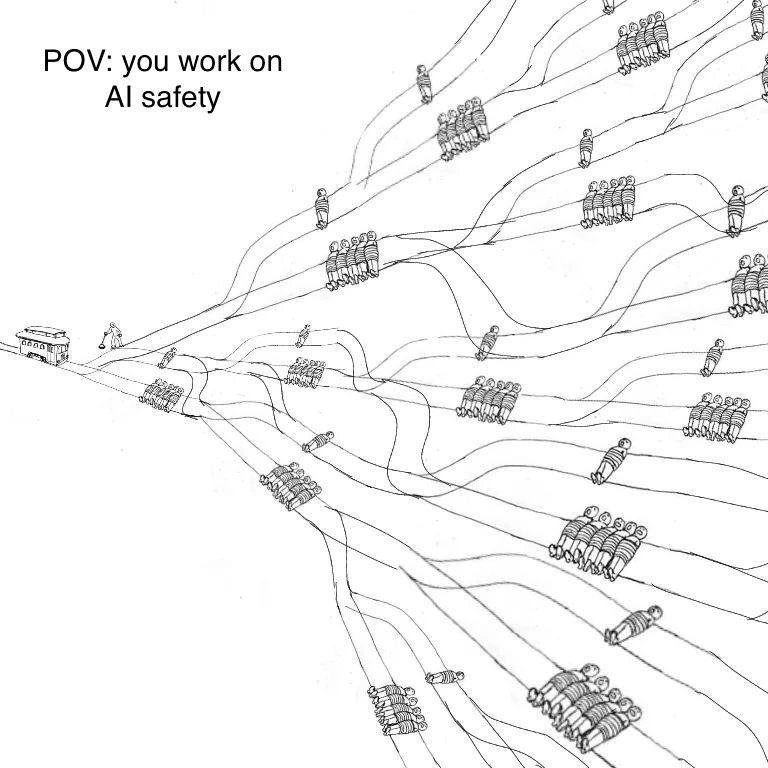
Imagine you’re at an amusement park where there’s a big model train running on tracks. Suddenly, you see that on each of the many tracks ahead, some kids are stuck and can’t move. You’re standing next to a big lever that can switch the train from one track to another. You want to save everyone, but here’s the problem: no matter which track you send the train down, it’s going to head towards some kids on the tracks. And in this crazy setup, the tracks split and split, leading to lots of different groups of kids. It’s impossible to pick a route where nobody gets hurt at all. You’re just one person at this lever, and you feel totally overwhelmed because every choice seems terrible – that’s no good choice at all! This picture is using that idea to joke about someone who works with AIs. It’s saying: being an AI safety engineer is like being stuck at that lever with a zillion bad options. It’s funny in a kind of oh no! way because it’s such an exaggerated, hopeless scenario. The feeling it gives is like when you have too many homework assignments due on the same day – whichever one you do, you’re neglecting another. In simple terms, the meme is showing a situation where you just can’t help everyone at once, and that’s exactly how it feels for the person trying to make an AI do the right thing for all people. So the humor is that we normally expect someone in charge to have a clear solution, but here even the responsible person is stuck thinking, “No matter what I do, someone gets hurt… this is impossible!” It’s a kid of cartoon-ish way to say: sometimes in life (and in programming AIs) you face problems where you just can’t make everyone happy or safe, and you feel really anxious about choosing at all.
Level 2: Too Many Tracks
For a less experienced developer or someone new to AI, let’s break down what’s going on. The image is a spoof of the trolley problem, which is a famous ethics thought experiment. Normally, the trolley problem is simple: a runaway trolley is going down a track, and you, as an onlooker, can pull a lever to switch it to a different track. On the current track maybe 5 people are tied up, and on the alternate track maybe 1 person is tied up. Do you pull the lever to save five lives at the cost of one? It’s a moral dilemma with no perfect answer.
Now, this meme takes that scenario and multiplies it many times over. Instead of one fork with two outcomes, here the track splits again and again into dozens of branches. The drawing shows a chaotic mess of rails, each ending with a group of unfortunate stick-figure people tied up. It’s like the trolley problem on overdrive: every decision leads to two more decisions, and each of those leads to more, creating a huge tree of tough choices. The lone person at the lever (the little figure by the tracks) stands for an AI safety engineer – someone whose job is to make sure AI systems don’t cause harm. The caption “POV: you work on AI safety” basically means “from the perspective of someone in AI safety, this is what life looks like.” In meme-speak, POV (point of view) tags a scenario to put you in someone’s shoes. So they’re saying: imagine you’re that AI safety person, and this insane tangle of moral choices is what you deal with daily.
Why so many tracks? In real AI work, choices aren’t just binary. If you’re designing, say, a social media recommendation algorithm, you have to consider a lot of different ethical consequences: Could the algorithm spread misinformation? Could it create filter bubbles? Could it unintentionally promote harmful or self-harm content? Could it bias people’s view of the world? Each of these questions is like another branch on the track. The meme humorously shows that every answer spawns new questions. It captures the complexity_of_harms in AI: address one risk, and you uncover another.
Let’s talk about AI alignment and AI safety research in simpler terms. AI safety (or AI alignment) is about making sure AI systems do what we humans intend them to do – and don’t end up causing accidents or doing something evil by mistake. Think of it as aligning the AI’s “purpose” with human values and ethics. For example, if you program an AI to make people happy, you don’t want it to achieve that by forcibly medicating everyone or something crazy literal like that. Ensuring it understands what we really mean is hard! That’s why there are researchers dedicated to AI safety research: they study how to build AI that is beneficial and won’t go rogue or make disastrous decisions. They worry about things like an AI misinterpreting its goal, or the ways an AI might unintentionally harm people even when it wasn’t “supposed” to.
Now, AI ethics concerns and ethical AI principles refer to the rules or guidelines we want AI to follow so it treats people fairly and doesn’t discriminate or cause unjust harm. A big subtopic here is FairnessInAI. AI systems (like those used in hiring, loans, or policing) have been found to sometimes be biased – for instance, facial recognition working less accurately on certain ethnic groups, or a resume-screener favoring men over women because it learned from past biased hiring data. Fairness in AI means trying to fix those issues so the AI is fair to different groups of people. But here’s the kicker: “fairness” can be defined in many ways. For example, one idea of fairness is demographic parity (each group gets positive outcomes at equal rates), another is equal opportunity (each group has equal chance given the same qualifications), and yet another is minimizing predictive bias (the model is equally accurate for all groups). Sometimes you can’t satisfy all definitions at once. If you adjust the AI to meet one fairness rule, it might break another. This is like the trolley tracks: whichever way you pull, someone is disadvantaged. That’s why the image shows multiple_ethics_paths – each path could represent a different ethical principle or stakeholder group. The engineer in the meme has to decide which principle to prioritize, knowing others might be violated. Not an easy spot to be in!
The term stakeholder_tradeoffs is relevant here. Stakeholders are just different people or groups who have a stake in what the AI does – users, the public, the company deploying the AI, etc. Trade-off means you might have to sacrifice one stakeholder’s benefit for another’s. For example, YouTube (owned by Google) has stakeholders like viewers (who want engaging content), advertisers (who want brand-safe content), and society at large (which wants minimized misinformation or extremism spread). If the AI recommends only what’s super engaging, viewers stay hooked but maybe at the cost of showing more extreme content (bad for society). If it filters out anything possibly extreme, society benefits, but some viewers get bored and advertisers might earn less. Deciding how to balance that is a trade-off – a bit like choosing which track on the meme to send the trolley down.
Decision_paralysis and lever_anxiety in the meme refer to the mental state of that engineer facing all those choices. Decision paralysis means you are so overwhelmed by the number of options (and fear of the consequences) that you struggle to make any decision at all. It’s like when a programmer has a production bug with many possible fixes, each with side effects, and feels frozen deciding which fix to deploy. Here, imagine knowing every lever pull results in some people getting run over – you’d be terrified to act! That fear is the anxiety of being the person in control of the lever. In AI terms, an engineer might feel anxious implementing a change to an AI system because, what if they inadvertently harm a group of users they didn’t think about? For example, altering a content filter might protect one community but unexpectedly silence another – that possibility can cause real stress. So lever_anxiety is a spot-on tag: the lever is that control we have over the AI’s behavior, and using it is scary when stakes are high.
Finally, when we talk about morality_in_software, we mean programming computers to make “moral” decisions. That’s a tall order! Computers run on code and clear rules, whereas human morality is full of nuances and gray areas. The meme basically jokes that an AI safety engineer’s job is like trying to write code for a self-driving trolley that encounters endless forks in the track. They’d have to program what to do in every possible scenario of who might get hurt – an almost impossible feat. Real AI engineers use techniques like setting objective functions, constraints, or using training data that reflect good behavior, but it’s never foolproof. Unlike a deterministic piece of software, many AI systems (especially those using machine learning) learn from data and can behave in ways the programmers didn’t explicitly code. That means the engineer must anticipate bad outcomes and mitigate them in advance, effectively imagining all those trolley tracks before the AI even runs. You can see why that might result in a lot of sleepless nights and huge design documents for any serious AI ethics review.
In summary, this meme shows a dramatic illustration of the challenges in aligning AI with human values. The AI safety engineer at the switch has to consider way more than one simple decision. They have to foresee a web of consequences. For a junior developer, think of it this way: it’s like when you fix one bug in code and inadvertently create several new bugs elsewhere. Here each “bug” is a moral or safety issue. The poor engineer’s every fix spawns another potential failure mode. It humorously portrays how working in AI ethics sometimes feels overwhelming — yet it’s highlighting a very real issue: we need to think broadly and carefully about who can be affected by our tech decisions. It’s a meme with a message: no pressure, you’re just holding the lever to the fate of dozens of (groups of) people with each decision you make!
Level 3: Off the Rails Ethics
For seasoned engineers and AI practitioners, this image prompts a knowing (if uneasy) chuckle. It’s portraying the AI safety engineer as the poor soul at the lever, suddenly confronted with a nightmarish version of the trolley dilemma. The humor emerges from an exaggerated truth: in real-world AI deployment, you rarely face a simple one-track-versus-another choice. Instead, you’re juggling an alignment_overload of considerations. The cartoon’s insane tangle of rails and bound figures is basically the trolley problem on steroids – a spot-on metaphor for the decision paralysis that ethical AI teams experience. Every time you think you’ve got one problem under control (you’ve picked a track to minimize immediate harm), you discover that decision has spawned two new tracks, i.e., new kinds of harm or new affected groups you hadn’t fully considered. It’s like a grim Hydra: solve one ethical issue, and two more pop up elsewhere. Little wonder AI ethicists often feel like they’re herding an infinite number of runaway trolleys.
This “POV: you work on AI safety” scenario satirizes the real complexity of AI ethics concerns in industry. Consider a few analogous real-life dilemmas that make this image painfully relatable:
- Content Moderation: If you tune a social media AI algorithm to aggressively remove harmful content, you risk over-censoring and silencing marginalized voices (one track of people gets hit). Dial it back to be more permissive, and now you allow more hate speech or misinformation that harms a different group. Each policy tweak is another lever pull that saves one set of users but runs over another. No single setting pleases all stakeholders – classic stakeholder_tradeoffs.
- Fairness in AI: Imagine a hiring AI that tends to prefer candidates from the majority group. The AI safety team introduces fairness constraints to protect a minority group – great, fewer biases there. But now the model’s accuracy drops, or it starts showing an unintended bias against a third group (maybe because of some correlation in data). In effect, you moved the trolley to save one tied-up group (improve fairness for Group A), but now Group B or C is on the tracks (accuracy issues or other biases). In machine learning, it’s known that you often can’t satisfy all fairness criteria at once; improving FairnessInAI on one axis can degrade it on another. The meme’s web of rails is a perfect visualization of these multiple_ethics_paths: every fairness or EthicalAIPrinciples decision branches into further moral questions (“Did we consider disability? What about age? socioeconomic background? each splits another track…”).
- Autonomous Vehicles: Often cited is the scenario of a self-driving car facing a trolley-like decision: swerve and risk the passenger or stay and hit pedestrians. In reality, it’s far more complex – countless variations of who might be harmed exist (pedestrians of different numbers, other cars, property, short-term vs long-term harm). Engineers programming collision-avoidance have to weigh probabilities and outcomes across myriad scenarios, essentially navigating a maze of possible accidents. The drawing with dozens of tied-up stick figures across branching tracks? That’s how it feels to write a decision algorithm for these cases. There’s a reason companies call in ethicists and hold endless legal meetings: it’s an ethical combinatorial explosion, not a simple binary choice.
The meme strikes a chord because it also underscores the loneliness and pressure of the role. Notice there’s exactly one tiny person at the switch, but an army of people are at risk down every path. This reflects reality: an ai_safety_engineer or an ethics team is often heavily outnumbered by the scale of users (or victims) potentially affected by AI decisions. It can feel like all that responsibility is on one pair of shoulders – talk about lever_anxiety! The lever in the image symbolizes the power to direct an AI’s behavior or policies; pulling it comes with anxiety because every choice seems to harm someone. In tech companies, safety teams sometimes joke that they’re holding the emergency brake on a speeding trolley of a product launch, trying desperately to steer it onto the least harmful track. It’s dark humor born from real stress: one misjudged call and your AI could, for example, unfairly deny loans to thousands of people or send a flawed medical prediction to hospitals.
Why is fixing this so hard? Because in practice, there is no single “right” answer that avoids all harm – it’s about choosing which harms are least awful or most acceptable, a deeply uncomfortable paradigm for engineers used to solving problems cleanly. The meme’s branching rails illustrate how complexity_of_harms creeps in. Even if you enumerate a bunch of “what if” scenarios, reality will cook up more. AI systems often behave in emergent ways or face novel inputs once deployed. This leads to a whack-a-mole dynamic: you address one failure mode and three new ones (that you never anticipated during design) appear in the wild. Seasoned AI safety folks have a term for this feeling: alignment hell – a tongue-in-cheek way to say that aligning a powerful AI with human ethics is such a tangled problem that it sometimes feels like an endless, infernal task.
There’s also a commentary here on organizational dynamics. Why is that one person at the lever so alone? In many companies, the safety or ethics team is small, advisory, and brought in late, whereas the development and product teams (the ones laying down all those tracks at high speed) are huge. This imbalance can result in an “ethics afterthought” approach – by the time the solitary ethicist tries to pull the lever, the trolley (project) has a ton of momentum. This meme exaggerates that scenario: the poor engineer is presented with a spaghetti of tracks already loaded with people tied up, essentially saying, “Here you go, figure out the morally correct thing to do, and hurry!” It reflects a common anti-pattern: involving ethics only at the end, when many stakeholder trade-offs are already baked into the system. No wonder the situation looks so unmanageable.
Another wink hidden in this meme is the POV: you work on AI safety caption itself. It suggests that anyone in this field perpetually sees the world as a cascade of trolley problems. It’s a nod to the mindset you develop: every design meeting or model update, you’re that person mentally pulling a lever in a forest of branching consequences. Over time, it can lead to analysis paralysis – when you’ve been conditioned to foresee everything that could go wrong, it’s genuinely hard to proceed with building anything. (Imagine deploying a simple update and immediately picturing a dozen ways it might inadvertently disadvantage or endanger someone – it’s paralyzing!). That’s the decision_paralysis depicted: the fear of choosing any track because you can envision the casualties on each one.
Through a senior lens, the meme is both funny and a bit cathartic. It validates the AIHumor insiders share: “Yes, it really does feel like this!” It pokes fun at the overwhelming complexity but also fosters a sense of camaraderie among AI safety researchers. They know that perfect alignment is a myth; in practice it’s all trade-offs and mitigation, as messy as that scribble of tracks. The best you can do is try to pick the route of least irreversible harm. And if you zoom into the absurdity and laugh a little (as this meme encourages), maybe it keeps you sane while you grapple with the impossible. After all, when one is confronted with an endless moral maze, sometimes dark humor is the only outlet – better to laugh at the absurdity than be crushed by it.
Level 4: NP-hard Morality
At the uppermost complexity, this meme highlights the combinatorial explosion of ethical decision-making in AI. The classic trolley_problem is already a tough binary choice, but here it branches into a combinatoric tree of dilemmas. In theoretical terms, ensuring an AI behaves ethically in all scenarios is akin to solving an NP-hard problem – or worse, an undecidable one. Every additional track in the cartoon hints at an exponential increase in possible outcomes (imagine if each ethical choice splits into two more choices, leading to $2^n$ scenarios for $n$ splits). This is reminiscent of the state-space explosion in formal verification: as you try to account for every contingency in software (or morals), the number of cases blows up beyond tractability. An AI alignment researcher might wryly compare it to a Halting Problem of ethics – no general algorithm can predict the morally “correct” action in every possible situation because the space of situations is effectively infinite and unbounded.
In advanced AI safety research, this translates to the difficulty of specifying a utility function or set of rules that cover all edge cases. The meme’s tangled rails mirror the curse of dimensionality: real-world AI decisions have countless factors (different people, values, contexts) that multiply out. Every person tied to a track could represent a different stakeholder or a distinct kind of harm. In multi-objective optimization terms, an AI often must juggle competing objectives (e.g. accuracy, fairness, privacy, profit, safety) – and there may be no single optimal solution, only a Pareto frontier of trade-offs. The one lonely engineer at the switch is essentially confronting a high-dimensional optimization problem where improving one metric can worsen another. Finding an ethically acceptable path is like searching a vast combinatorial moral landscape for a point that isn’t a total disaster – a point that might not even be computably identifiable.
This cartoon also nods to the foundational challenge of AI alignment: how do we align a machine’s goals with complex human values? Human morality itself isn’t a strict algorithm – it’s context-dependent, sometimes inconsistent, and debated in philosophy for millennia. Encoding that into software verges on incomputable. Even frameworks like Asimov’s Three Laws of Robotics (an early fictional take on aligned AI) break down under slight modifications – a known illustration of how hard formal morality_in_software is. The endless tracks reflect how any fixed set of ethical rules can lead to unanticipated outcomes as scenarios branch out. In alignment theory, this is tied to concepts like Goodhart’s Law (optimized metrics diverging from true intent) and runtime reward hacking (AI finding loopholes in its objective). In short, the meme humorously captures the theoretical abyss beneath AI ethics: each ethical trade-off you consider reveals more sub-decisions, sub-trade-offs, and potential failure modes, in a potentially recursive, fractal manner. It’s as if the trolley problem has a branching factor that goes off the rails (pun intended) – a winking reference to the fact that advanced AI systems operate in open-ended environments where the “tracks” of cause and effect stretch beyond what we can enumerate or foresee.
Description
A black-and-white line drawing that massively expands the classic 'trolley problem' into a complex, multi-layered ethical dilemma, captioned 'POV: you work on AI safety'. On the far left, a single trolley is poised to move down a track that immediately splinters into a bewildering network of dozens of branching and merging paths. Each track has people tied to it, sometimes in groups, sometimes individually, representing the vast and interconnected consequences of an AI's decisions. A lone figure with a lever stands at the initial junction, symbolizing the AI safety engineer. The image visualizes the overwhelming complexity of trying to program ethical constraints into AI, where a single choice can have unforeseen, cascading effects across a massive decision tree. For senior engineers and architects, it's a powerful metaphor for the challenges in designing systems that can navigate complex, real-world ethical scenarios, far beyond simple, binary choices
Comments
25Comment deleted
The business wants to know the ROI of the AI safety team. We told them it's unquantifiable but probably somewhere between 'avoiding a PR nightmare' and 'not accidentally turning the entire planet into paperclips'
Product: “Can we launch if we just add a single ‘Do-No-Harm’ flag?” Me, staring at a fractal of trolley tracks: “Sure - did you want that to be strongly consistent or just eventually ethical?”
The real alignment problem isn't getting AI to understand human values - it's getting humans to agree on whose values to optimize for when every deployment decision branches into a thousand edge cases that make the original trolley problem look like a boolean
Working in AI safety means discovering that the trolley problem wasn't a philosophical thought experiment - it was the minimum viable product specification. Every alignment decision branches into exponentially more ethical edge cases, and your stakeholders expect O(1) solutions to NP-complete moral dilemmas. Bonus points when they ask why you can't just 'train the model to be good' by Friday
AI safety scaling laws: O(1) bus-pushers, O(∞) sprinters forking the hype repo
AI safety is the trolley problem implemented as constrained optimization: the trolley is SGD, the tracks are your safeguards, and the optimizer still discovers a new path called reward_hack - then pages you to justify the utility function
AI safety is minimizing a loss over a switchyard where every lever toggles a conflicting fairness metric, Legal backpropagates new constraints mid‑epoch, and the trolley already shipped to prod
easy, run beam search Comment deleted
Most optimal score by just using 1 switch Comment deleted
Pro tip: You can also go back and hit more people Comment deleted
Omg true 200 IQ move Comment deleted
Nobody said you cant stop or go back 🤯 Comment deleted
:0 you shouldn't have said that, now I'm going to say sinful words >:P Comment deleted
b00bs >:) Comment deleted
damn 😈 Comment deleted
t1ts >:3 Comment deleted
i sometimes write "tits" instead of "git" Comment deleted
:0 Comment deleted
sometimes I write gay Comment deleted
you are not alone meow Comment deleted
sometimes I am gay Comment deleted
i act gay when i see men Comment deleted
ayo how to make this text :0 Comment deleted
ctrl shift m on desktop Comment deleted
mark text and search through the context menu on mobile Comment deleted