Skip to content
DevMeme
6393 of 7435
AI Model Benchmark: Humanity's Last Exam
AI ML Post #7010, on Aug 7, 2025 in TG

AI Model Benchmark: Humanity's Last Exam

Why is this AI ML meme funny?

Level 1: Robots Take a Test

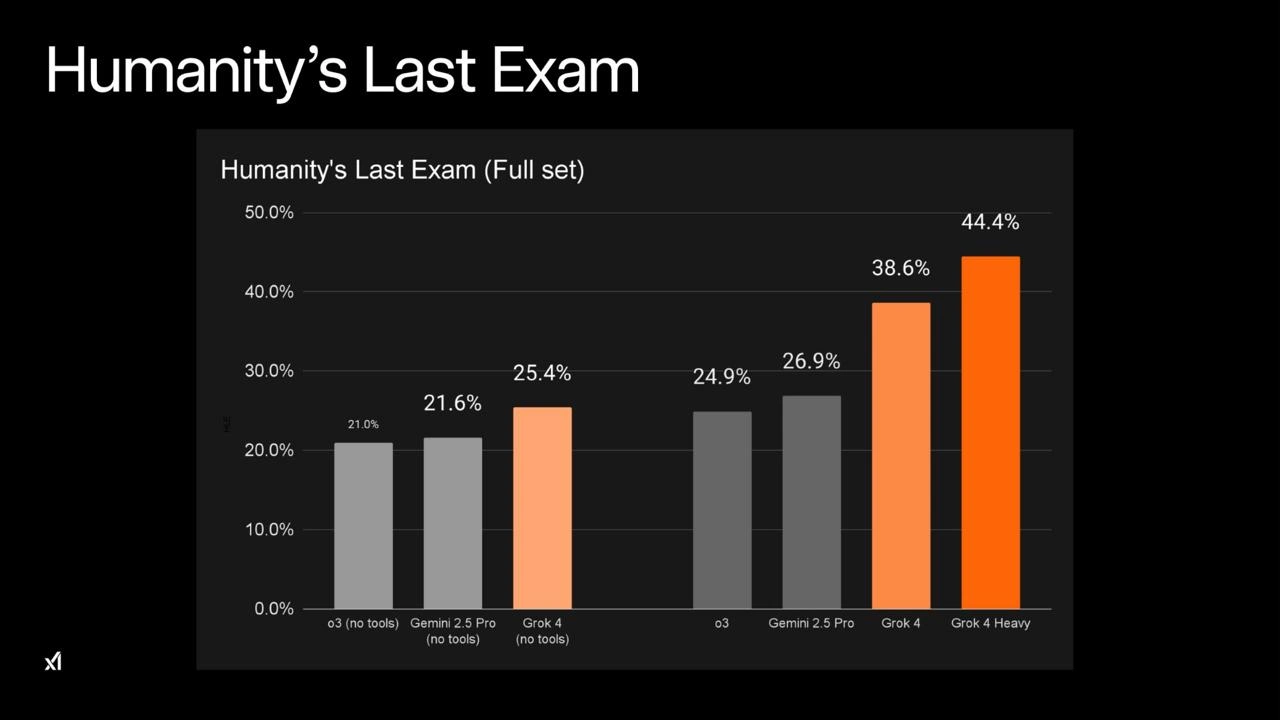
Imagine you gave the smartest robots in the world a really, really hard test – maybe the hardest test ever, with all sorts of tricky questions. Now imagine you’re looking at a chart that shows how those robots did, kind of like when your teacher shows the class grades after a tough quiz. Each bar on the chart is one robot’s score. The funny (and a bit happy) part is that even the best robot only got about 4 out of 10 questions right – less than half! The chart calls this “Humanity’s Last Exam,” which sounds super serious, like it’s the final test to see if robots are as smart as humans. But the way it’s drawn, it actually looks like a boring office presentation slide from a company meeting about how employees did last quarter.

So picture a classroom or an office where someone says, “Alright, here are the scores for the big test,” and then you see bars that are all pretty low. The tallest bar is colored bright orange to catch your eye, saying “This robot did the best!” – but that best is still only 44%. It’s a bit like if the top grade in class was an F and the teacher was like, “Great job to the top student anyway!” 😂 We find it funny because it makes these powerful AI robots seem like students who didn’t study enough. And it makes the super dramatic idea of “the last exam ever” look as dull and ordinary as a slide from your dad’s work meeting. The joke is basically: even the big scary robots struggle on the ultimate quiz, and we’re showing it in the most plain, corporate way possible. It’s both silly and a little comforting – turns out the robots have some homework to do!

Level 2: AI Report Card

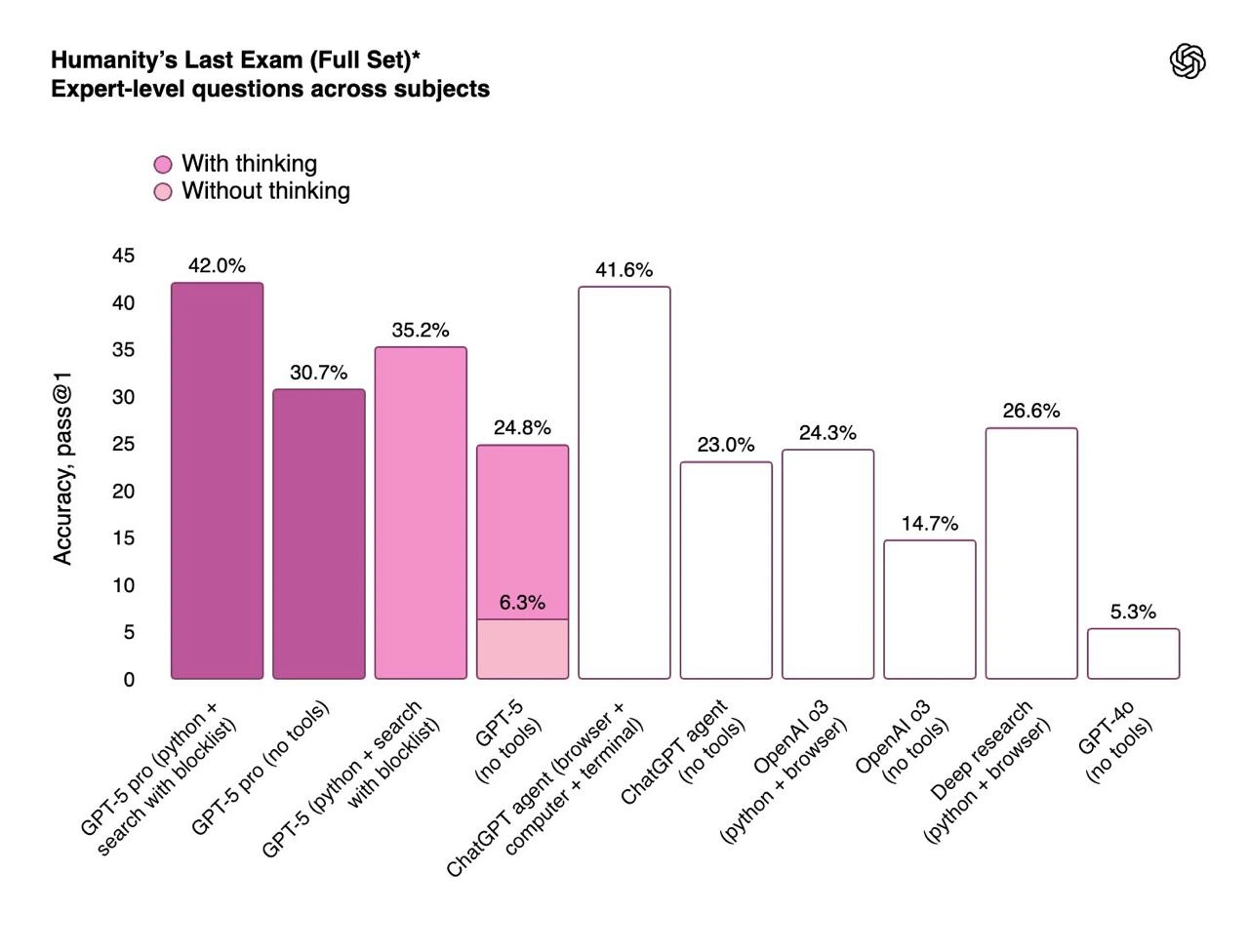
This meme is basically showing a report card for several AI models in the form of a bar chart. Think of each bar as a student’s test score on a really hard exam called “Humanity’s Last Exam.” Instead of student names, we have AI model names: o3, Gemini 2.5 Pro, Grok 4, and Grok 4 Heavy. The height of each bar (and the percentage label on top) is the model’s accuracy – that is, how many questions out of 100 it got right on this exam. The numbers aren’t high: the best one, Grok 4 Heavy, scored 44.4% (roughly 44 out of 100 questions correct). The others are around 20-38%. So, none of these AIs passed the test with flying colors (normally a score of 90%+ would be an A grade, 50% would barely pass in school, so 20-40% is pretty poor by usual standards). But in the world of advanced Large Language Models (LLMs), even these small differences count as big news.

To a newer developer or someone outside AI, all these model names might be confusing. Here’s a quick rundown:

  • LLM (Large Language Model): a type of AI system that’s trained on tons of text data. It tries to understand and generate human-like text. Models like GPT-4, Claude, or others are LLMs. They answer questions, write essays, code, etc.
  • o3: This looks like the name of one model. It’s not a well-known public name, so it might be a codename or a stand-in for some company’s model (possibly something by OpenAI or an open-source model, given the “o”). In the chart, o3 appears twice: once with “(no tools)” and once without that note. That suggests two different scenarios for o3 – one where it wasn’t allowed to use any external help, and one where it was.
  • Gemini 2.5 Pro: This is another model name – “Gemini” is actually a real project name (Google’s next AI model after PaLM). The version “2.5 Pro” sounds intentionally kinda corporate or productized (like how we name phones or software versions). It also shows up twice, likely with and without tools.
  • Grok 4: “Grok” is a word meaning to deeply understand, popular in tech lingo, and it’s used here as a model name. There’s a Grok 4 and a Grok 4 Heavy. This suggests Grok 4 Heavy is like an upgraded, larger version of Grok 4 – maybe it has more data or more computational power behind it (in AI, we often have model variants like “base” vs “large” or “XL” models). Grok 4 appears with two bars too (no tools vs with tools presumably), while Grok 4 Heavy presumably always uses tools (or is entirely supercharged).

Now, what does “no tools” mean? In the context of these AI models, tools refers to giving the model access to external resources beyond its own brain. Imagine an AI trying to answer a question like “Who was the US President in 1875?”

  • If it’s no tools, the AI has to rely on whatever it learned during training (its “memory”). If it didn’t memorize that fact, it might get it wrong or guess.
  • If it has tools, we could allow the AI to, say, perform a web search or look at a database or use a calculator as part of finding the answer. It’s like letting the AI use the internet or reference books during the test – an open-book exam.

So, each pair of bars (grey vs orange) for o3, Gemini, and Grok 4 shows how much better the model did when it could use tools. For example:

  • o3 (no tools) got 21.0% on the test, but with tools (the bar labeled just “o3” in grey) it got 24.9%. A small improvement – maybe it looked up a few answers.
  • Gemini 2.5 Pro (no tools) got 21.6%, and with tools it got 26.9% – also a modest bump.
  • Grok 4 (no tools) got 25.4%, but with tools shot up to 38.6% – that’s a big jump! It suggests Grok 4 might be particularly good at using tools to find answers it doesn’t know off-hand.
  • Grok 4 Heavy got 44.4% – presumably with tools (since it doesn’t say “no tools,” we assume this heavy version is using everything available by default). It’s the highest score on the chart.

This chart is a data visualization common in tech and business: a bar chart comparing performance. The meme specifically makes it look like a slide titled “Humanity’s Last Exam.” That title is intentionally dramatic and a bit ominous. It suggests this test is like the ultimate exam assessing AI against human-level tasks. It’s jokingly implying “if humanity’s existence depended on an AI passing a final exam, here’s how they scored.” And since the scores are all below 50%, it’s simultaneously funny and relieving – the AIs aren’t passing that ultimate test just yet.

The subtitle in the meme says “Full set.” That likely means this is the score on the full set of exam questions. Perhaps the exam had different sections (math, history, logic, etc.), and this combined score is overall accuracy. So these AIs might do better in some areas, worse in others, but around ~25-44% overall correct.

Now the line “When AI leaderboards resemble humanity’s last quarterly performance review slide” is comparing this AI results chart to something many of us have seen in a workplace: the quarterly review slide deck. In companies, every quarter managers present slides showing how the team or company performed – often bar charts with targets vs achieved results. If a team performed poorly, you’d see bars nowhere near 100%, maybe lots of ~20-50% bars of goals achieved or metrics hit. They might even color some bars differently to highlight something. The meme humorously says these AI benchmark charts look just like those somewhat depressing corporate slides. In other words, the AI models are doing about as well as a group of underperforming employees on their goals – not great 😅.

For a junior dev or someone new to AI:

  • Why is this funny? Because it mixes a serious, almost sci-fi scenario (AIs taking humanity’s “last exam”) with a totally mundane office scenario (quarterly performance slides). It’s absurd in a cute way: picturing a super-intense battle between advanced AIs being reported in the same boring style as a sales report. Also, it pokes fun at the hype: everyone talks about AI being super smart, yet here we are bragging about 44% correctness, which is like an F grade. It’s a bit of AI humor highlighting the gap between AI industry trends (always announcing new, better models) and reality (the improvements are incremental and sometimes underwhelming if you take a step back).

Lastly, notice the coloring: grey bars for o3 and Gemini, orange bars for Grok models. The creator is emphasizing Grok’s performance. This suggests the meme might be referencing a scenario where someone (maybe the team behind Grok) is showing off how their model outperforms the others. It’s common in conference talks or papers: “Our Model (orange) vs Previous Models (grey).” They want you to see that orange towering bar at 44.4% and go “wow, theirs is the best!” – even though, objectively, none of these are anywhere near perfect. It’s both a real data viz strategy and part of the joke about AI hype: each company will highlight their slight edge as if it’s a huge deal.

In summary, this meme’s chart is like an AI leaderboard (who’s on top in accuracy) presented as if it were a performance review slide. It’s funny to tech folks because we recognize both things and the contrast between what we expect (AIs eventually dominating) and what we see (scores that look like a failing report card) is ironically satisfying.

Level 3: Leaderboard FOMO

This meme nails the LLM leaderboard arms race vibe that senior engineers know all too well. The slide looks like it was plucked straight from some AI lab’s investor deck or a Big Tech keynote – complete with color-coded bars to show “our model vs. theirs.” The title “Humanity’s Last Exam” is grandiose (and darkly comic), as if the fate of humankind was distilled into a PowerPoint slide. And honestly, that melodrama is part of the industry humor: we’ve all seen ridiculously overhyped slides claiming “State-of-the-Art on XYZ benchmark!” while the fine print (here, tiny accuracy percentages barely breaking 40%) tells a more humble story. The meme mirrors that feeling when a company’s quarterly performance review slide shows a bunch of miserable bars and someone still tries to highlight the tallest miserable bar in orange and call it a win.

Let’s break down the bars: we have models named o3, Gemini 2.5 Pro, and Grok 4 (plus a Grok 4 Heavy variant). To a seasoned dev, these sound like the usual suspects in the AI hype cycle. Gemini is famously Google’s next big thing, OpenAI presumably has something (maybe “o3” hints at an OpenAI GPT-3 successor or some open-source model), and Grok – aside from the Heinlein reference meaning “to understand deeply,” it’s cheekily the name of Elon’s rumored AI. The version soup (2.5 Pro, 4, Heavy) satirizes how every few months there’s a new model version or “Pro” release that one-ups the last, just like smartphones or video cards. Grok 4 Heavy sounds like a souped-up edition (likely “heavy” meaning a bigger model or more training data) that edges out standard Grok 4. The bright orange bars for Grok models are a classic slide trick: highlight your product. It screams, “Look, we’re ahead!” even if “ahead” is only from ~27% to ~39% accuracy.

To an experienced engineer, the humor also lies in how low these numbers are. 44.4% accuracy – that’s the top score. In any normal exam, 44% is a failing grade. The meme’s subtext is that despite all the hype, even the best AI model is still flunking “Humanity’s exam.” It’s a tongue-in-cheek reality check on AI capabilities versus the grand promises. We chuckle because it’s hype vs. reality in chart form: glossy bars and fancy model names battling for what? For not even half the answers right. This is the kind of slide you encounter at 2 AM doom-scrolling through an AI newsletter, and it triggers that weary thought: Do I need to rewrite our whole stack for this? The description even nods to that late-night anxiety – debating a vector database re-architecture because some new model might handle knowledge retrieval differently or might demand new infrastructure (gotta store all those embeddings for “tools”). There’s a real FOMO among dev teams and startups: if Grok 4 Heavy is now topping the charts, investors might ask “Why aren’t we using that?”. Never mind that the improvement might be marginal in practice; the pressure is on to integrate the latest and greatest model or risk looking outdated.

The “quarterly performance review” parallel hits another nerve for the battle-hardened dev. In many companies, we’ve sat through meetings where a slide shows various team KPIs or sales figures as bars – often disappointingly low, much like these sub-30% scores – and yet someone tries to put a motivational spin on it. “We only hit 44% of our Q4 goal, but hey, that’s an improvement!” 😅 Here, humanity (or the AI trying to surpass humanity) gets its own dismal report card. The title “Humanity’s Last Exam” could imply a doomsday scenario – like if these AIs pass this exam, humans are obsolete. So far, humanity can breathe easy because none of the AIs even reached 50%. It’s a dark joke: we’re essentially grading how close the machines are to beating us, and they’re all below average. The senior perspective appreciates this irony and perhaps even feels a smug relief: “All that venture capital, all those petaflops of compute, and the best they can do is 44%. Back to work, folks.”

On a practical level, the meme also references the tool use trend in AI. A senior dev likely knows that “(no tools)” versus no qualifier means the latter used tools or external help. This is a huge discussion in LLM circles: giving the model access to external data via a tools API or a vector DB (for retrieval-augmented generation) can drastically improve performance on knowledge-intensive tasks. We see that clearly: Grok 4 jumps from 25.4% to 38.6% with tools – a senior engineer recognizes this as the open-book exam strategy. The meme’s author expects you to see that pattern and chuckle at how it’s presented so dryly on a slide, as if to say “obviously, letting the AI cheat off the internet helps it score better.” Seasoned devs also have a sense of the frantic pacing: every time a new benchmark result like this comes out, engineering teams scramble. Should we update our ML pipeline? Do we need to support a larger context window now (because maybe Grok 4 Heavy can read more tokens at once)? It’s the “benchmark-driven development” cycle, which can feel as futile as chasing the next quarterly target in a big company.

In summary, the humor at this level comes from recognition and slight exasperation. We see a data visualization meant to hype an AI model, but it inadvertently highlights how far we still have to go. And we see ourselves in that scenario – late at night, looking at yet another slide deck with incremental improvements, knowing tomorrow’s stand-up might bring a directive like, “We should consider switching to Grok, it got 6 more points on the leaderboard.” The meme perfectly captures that mix of impressed, unimpressed, and under-caffeinated that is the hallmark of following AI industry trends in real time.

Level 4: The Open-Book Effect

At the cutting edge of AI model benchmarks, the meme’s bar chart highlights a deep technical nuance: augmenting a large language model with external tools versus leaving it to operate in isolation. In AI research, this is akin to comparing a closed-book exam (the model relies only on its internal parameters) with an open-book exam (the model can query external resources). Here, the grey bars show models like o3 and Gemini 2.5 Pro taking the test “no tools” – essentially closed-book – while the bright orange bars show Grok 4 models with the advantage of tools (open-book). The jump from 25.4% to 38.6% when Grok 4 is allowed tools is a dramatic example of the open-book effect: giving an AI access to a search engine, database, or calculator can markedly improve accuracy on broad knowledge tasks.

Why such a stark difference? The exam presumably covers a full set of challenging queries (“Humanity’s Last Exam” sounds like an AGI gauntlet – possibly a conglomerate of history, logic puzzles, math word problems, coding, and trivia). No single model can memorize the entire breadth of human knowledge or solve every problem by itself – this is where fundamental ML concepts like the No Free Lunch theorem echo. That theorem reminds us there’s no one model that’s best at all tasks; here, even the best standalone model (Grok 4 at 25.4%) is only slightly above what random guessing might score if each question had four choices (~25% baseline). In other words, without outside help, these giant neural networks are still largely pattern-matching and can flounder on questions outside their training distribution or long-tail facts they never saw.

The theoretical implication is significant: the quest for Artificial General Intelligence (AGI) might demand more than just scaling up parameters. It likely requires cognitive synergy – combining a model’s learned knowledge with tools for retrieval, calculation, or even logical reasoning steps. Researchers have formalized this in approaches like ReAct (Reason+Act) and Toolformer, which let the model decide when to invoke external APIs. The meme’s data suggests Grok 4 “knew” when to use tools effectively (hence the huge boost), whereas o3 and Gemini saw only modest gains, implying differences in their architecture or training. Perhaps Grok 4 Heavy (at 44.4% with all bells and whistles) employs a larger context window or a more advanced prompt-chaining strategy, letting it cross-reference more information per query – essentially it’s the honor student with an internet connection.

In an academic sense, “Humanity’s Last Exam” evokes comparisons to the Turing Test’s original spirit – but quantified. Instead of a simple pass/fail conversation, this is a scorecard of machine intelligence on a comprehensive test. It’s as if an AI Alignment committee devised a final exam for AIs to prove they can match or exceed human problem-solving across domains. The fact that even the top score is 44.4% underscores a sobering reality: current models, despite billions of parameters and unprecedented training data, are still far from acing the human curriculum. This reinforces core scientific challenges – from improving common-sense reasoning (an AI-hard problem) to overcoming context length limits and knowledge cutoffs. Each orange bar reaching higher on that chart represents not just incremental corporate one-upmanship, but also a micro-step toward a theoretical goal: an AI that can truly grok the full breadth of human knowledge. For now, the math is clear – even a “Heavy” model with tools scores less than half on the ultimate test, a combined result of algorithmic limits and the sheer complexity of humanity’s knowledge base.

Description

A dark-themed bar chart titled "Humanity's Last Exam (Full set)" presented on a slide with the main title "Humanity's Last Exam". The chart compares the performance of various AI models, with percentages on the y-axis. The models listed are "o3 (no tools)", "Gemini 2.5 Pro (no tools)", "Grok 4 (no tools)", "o3", "Gemini 2.5 Pro", "Grok 4", and "Grok 4 Heavy". The bars are colored grey and orange, with "Grok 4 Heavy" achieving the highest score of 44.4%. The "xI" logo, likely for xAI, is in the bottom left corner. This chart displays competitive benchmark results for large language models on a test set called "Humanity's Last Exam". It compares models from different AI labs, including Google (Gemini 2.5 Pro), xAI (Grok 4), and likely OpenAI ("o3"). The chart highlights the performance gains from using tools (as implied by the "no tools" labels for the lower-scoring models) and showcases "Grok 4 Heavy" as the top performer in this specific evaluation. For senior engineers, this is a snapshot of the ongoing "AI race," providing data points on how different models stack up against each other, which is crucial for making strategic decisions about technology adoption
Comments

7
Anonymous ★ Top Pick Another Tuesday, another 'Humanity's Last Exam' benchmark. At this rate, the real last exam will be figuring out which model's API has the fewest breaking changes this quarter
  1. Anonymous ★ Top Pick

    Another Tuesday, another 'Humanity's Last Exam' benchmark. At this rate, the real last exam will be figuring out which model's API has the fewest breaking changes this quarter

  2. Anonymous

    Sure, 44 % isn’t quite AGI - but it’s high enough that your CTO just asked if the annual performance review can be replaced with a curl call to /v1/chat/completions

  3. Anonymous

    Turns out 'Humanity's Last Exam' is just asking AI to correctly estimate a JIRA ticket - even Grok 4 Heavy with all its parameters can't crack the 50% mark on that impossible task

  4. Anonymous

    When your AI model needs tools to pass 'Humanity's Last Exam,' you realize we've successfully automated the art of looking up answers on Stack Overflow. The real question is: did Grok 4 Heavy achieve 44.4% by actually understanding the problems, or did it just get really good at parsing the documentation?

  5. Anonymous

    Top score 44.4% on “Humanity’s Last Exam” - apparently we’re grading on the press‑release curve, with tool‑use treated as ‘open book’ and confidence intervals left as an exercise for Legal

  6. Anonymous

    Gemini Pro with tools: -1% score. Even LLMs know bad integrations can introduce more bugs than they fix

  7. Anonymous

    AGI progress report: three orange bars, no error bars; statistically significant in Excel, production-ready in the board deck

Use J and K for navigation