The Never-Ending AI 'Most Powerful Model' Hype Cycle
Why is this AI ML meme funny?
Level 1: Everyone Says They’re Best
Imagine you have a group of friends who all love building sandcastles. Each friend takes a turn building the biggest sandcastle they can. The first friend finishes a huge tower and proudly shouts, “This is the world’s most powerful sandcastle!” All the other kids ooh and ahh… until the next friend builds an even taller, more decorated sandcastle. Now that friend declares, “No, this is the world’s most powerful sandcastle!” Not to be outdone, a third friend quickly piles up an even bigger one and claims the exact same thing: “Behold, the world’s most powerful sandcastle!” Then the fourth friend goes, builds theirs even higher, and again yells the same line. But here’s the funny part: by the time the fourth friend is bragging, the first friend is already reshaping the sand and getting ready to make an even larger castle than all the rest. You can see where this is going – it’s going to loop right back to the first friend claiming the title again with a new sandcastle. They could keep doing this forever, each one always saying the same big boast: that their creation is the best in the world, at least until the next person tops it.
This meme is like that sandbox story, but instead of kids it’s big companies, and instead of sandcastles it’s super-smart computer programs called AI models. Each company takes a turn announcing “We have the most powerful AI!” very proudly, much like those kids bragging about their sandcastles. It’s funny because they all use the exact same words. It’s as if none of them realized the others are saying it too – or more likely, they do realize but just hope we’ll be impressed each time anyway. The joke is that it’s a never-ending circle: there will always be a next company ready to say “Nope, now we are the best!” Imagine if every new superhero movie that came out had a poster claiming “Introducing the world’s greatest superhero!” Eventually you’d smile and think, “You guys say this every time.” In the same way, these AI companies keep declaring their new model is the strongest, and it just keeps going round in circles.
The feeling behind this meme is a mix of amusement and a little eye-rolling. It’s pointing out how everyone likes to boast that they’re number one, to the point where the words don’t feel special anymore. Kind of like hearing “This is the best cake ever!” from every single bakery on the block – can they all really be the best? Probably not, and each new “best cake” claim makes you a bit less excited than the last, right? People who follow tech closely have heard “most powerful AI” so many times that it’s become a bit of a running gag. The meme simply shows that gag in picture form. Even if you don’t know the companies, you can understand the silliness: it’s just a bunch of folks taking turns to say the exact same boastful thing. It makes us laugh because it’s a playful way of saying, “Here we go again!”
Level 2: Buzzword Carousel
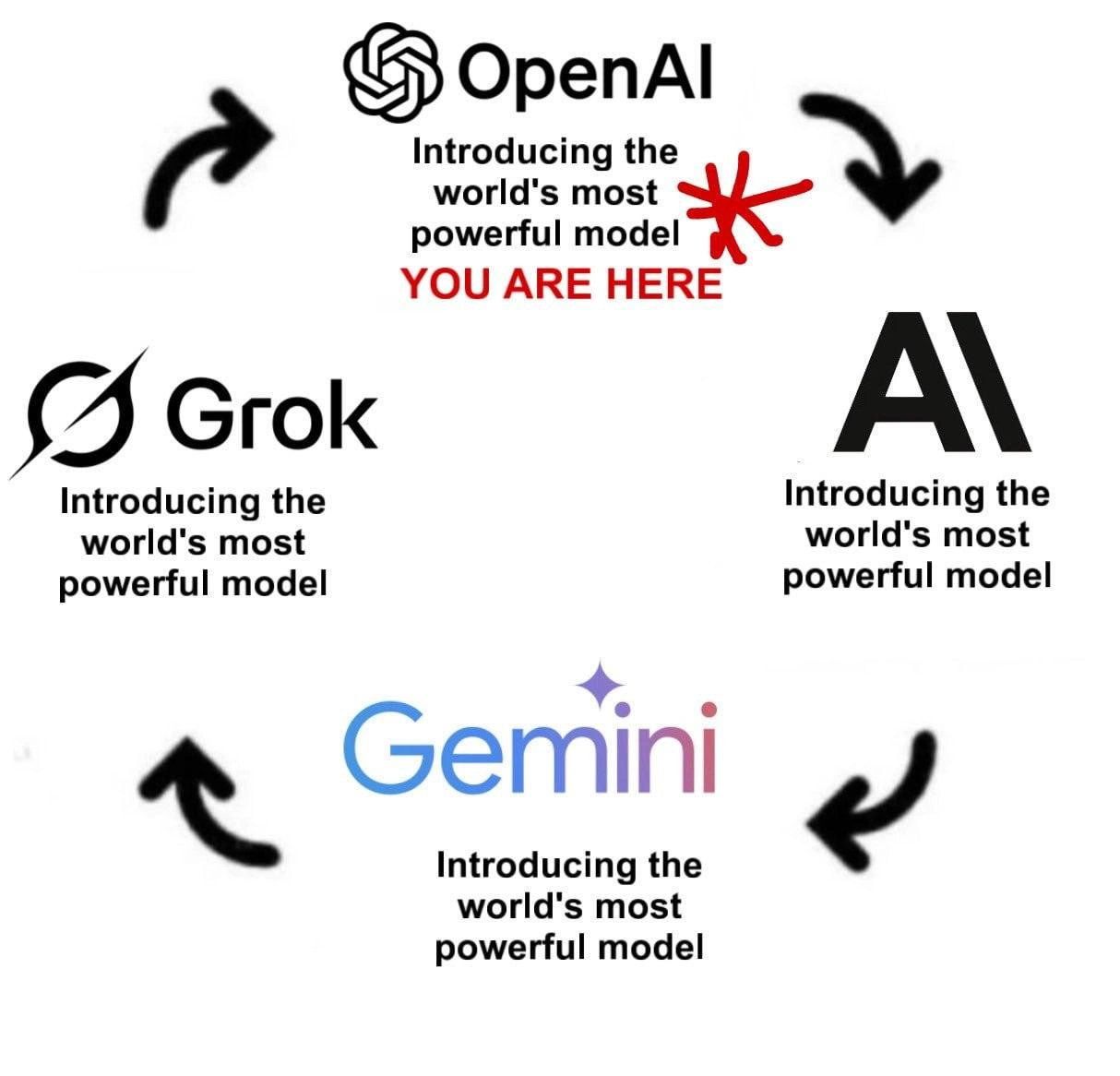
Let’s break down what’s happening in this meme in simpler terms. We have a loop of arrows going in a circle, connecting a series of company logos (OpenAI, a generic “AI” logo, Google’s Gemini, and Musk’s Grok). By looping around, it implies an ongoing cycle. Next to each logo is the caption “Introducing the world's most powerful model.” It’s literally the same sentence copy-pasted for each company’s part of the loop. At the very top, with the OpenAI logo, there’s a red asterisk and the words “YOU ARE HERE,” indicating that at this moment, OpenAI is the one making this claim. But the arrow points from OpenAI to the next logo, meaning another company will soon also say “We have the world’s most powerful model,” then another, and eventually back to OpenAI with some new model – on and on. This visual joke conveys that every player in the AI game takes turns claiming their AI is the mightiest. It’s an infinite hype cycle: a carousel of buzzwords where “world’s most powerful” is the buzz-phrase of choice.
Now, why is this funny to developers, especially those tuned into AI/ML and industry trends? Because it’s a bit of truth served with humor. In recent years, there’s been a race among companies to build bigger and better large language models (LLMs) – think of those AI models that can chat with you (like ChatGPT), write code, or generate text. Every time a new model comes out, the company behind it often markets it as a huge breakthrough. You’ll see announcements or keynotes along the lines of, “We’re introducing [Model Name], the world’s most powerful AI model yet.” It’s meant to grab headlines. For example, OpenAI (the company that made ChatGPT) might release GPT-5 and call it the most powerful. Then maybe Google unveils Gemini, their next model, also branded as the most powerful. Elon Musk, not to be left out, has a venture (xAI) working on a model named Grok, and of course he’ll claim it’s the most powerful as well when it’s announced. Even smaller startups or research labs (represented by that generic “AI” logo in the meme) will often use similar wording to get attention. Essentially, each is saying “our AI is number one!”
For someone new to the concept, it helps to know that “most powerful model” isn’t an official title like in a record book – it’s more of a marketing phrase. There’s no single universal test that declares one AI model to rule them all. Instead, there are many different benchmarks (standard tests for AI, like answering trivia questions, passing exams, coding challenges, etc.). When a new model comes out, companies run it through these tests. If it scores higher than previous models on many of them, they’ll tout it as the new state-of-the-art (meaning the best so far) and hence “most powerful.” The hitch is, this field is moving really fast. So fast that what’s state-of-the-art today might get outperformed just a few months later by a rival model. So the meme jokes that the exact same boast – “world’s most powerful AI” – just keeps getting recycled. It’s like if every new smartphone released claimed “World’s fastest phone!” Every company wants that bragging right, even if it will only be true until the next competitor one-ups it.
Let’s talk about those logos to make sure it’s clear:
OpenAI – This is one of the leading AI companies, known for the GPT series (such as GPT-4 powering ChatGPT). They often set the bar with very large and capable models. In the meme, OpenAI’s name is at the top, suggesting they’re the current brag-holders of the “most powerful model” (imagine this came out when GPT-4 or GPT-5 was the hot thing). The red text “YOU ARE HERE” next to it is cheekily telling us “currently, we’re at this point in the cycle – watching OpenAI’s claim.”
Generic “AI” logo – Below OpenAI in the loop, there’s just a bold “AI” in black. This likely represents any other company or startup jumping into the fray. It could be a stand-in for others like Anthropic (who made the Claude model), or Meta AI (Facebook’s AI arm, which created the LLaMA models), or really any new player that comes along. The meme uses a generic icon to say “insert your favorite AI company here” – because they too will say “we have the world’s most powerful model.”
Gemini – This is Google’s code name for a next-gen AI model they have been developing. In the meme, the Gemini logo is shown (with that star-like sparkle on the “G”), and of course the same caption. So it’s highlighting that Google will also announce Gemini as the world’s most powerful. (In reality, companies often use wording like “our most powerful model yet” or “the most advanced AI to date.” The meme simplifies it to one stock phrase for comic effect.)
Grok – This is referencing the AI initiative by Elon Musk (often associated with a company he created called xAI). “Grok” is the name he’s given to his model. Musk co-founded OpenAI originally, then left, and later decided to build a rival AI — so it’s almost certain he’d market his as the best thing since sliced bread. The Grok logo in the meme looks like a stylized ‘G’ with an orbit around it (kind of space-themed). And yes, it has the same caption below: “Introducing the world’s most powerful model.”
All these are arranged in a circle with arrows, meaning after Grok, the arrow goes back to OpenAI. That suggests once Musk’s model is out, perhaps OpenAI (or another company) will come with an even newer model, again claiming the top spot. Round and round it goes.
For a junior developer or someone early in their tech career, this might all sound a bit confusing – like, aren’t these companies actually making progress? (They are!) So why the joke? The heart of it is that the marketing language is over-the-top and repetitive. If you’ve followed tech news even for a year or two, you’ve likely seen big announcements. The first couple of times, you think “Wow, the world’s most powerful model? That’s amazing!” But by the fifth time you hear the same phrase from a different company, you start to grin or roll your eyes. It starts to sound like a broken record or a catchphrase. The meme is basically saying: “Look, they ALL say this. It’s become a cliché.”
Think of it this way: imagine four different video game console makers, each releasing a new console in the same year, and every single one advertises it as “the world’s most powerful gaming console.” By the last one, you’d probably chuckle and say, “Haven’t I heard this before?” You realize they can’t all be the most powerful simultaneously – it’s just that each is the most powerful at the moment of its own release, or in the specific way they measured it. In AI, because things move so quickly, those moments of being on top are very fleeting. The meme captures that fleetingness and the almost comical repetition of words.
Another concept here is the AI hype vs reality. “Hype” means lots of excitement and exaggeration about something. In the AI industry, hype can be very high – companies sometimes over-promise what their AI can do (or at least use grand phrases like “most powerful” which make it sound almost omnipotent). The reality usually is that each new model is an improvement, but not a magic jump to true intelligence or anything. So engineers often keep a bit of skepticism. This meme is an example of that skeptical humor: it’s implicitly saying, “we’ve heard these big claims before; we know another one is coming, so let’s not get carried away.”
So the buzzword carousel here is “world’s most powerful model” – a buzzwordy claim that keeps going round and round among all the competitors. It’s a playful reminder not to take every grand proclamation at face value, and it definitely gives those who know the context a good chuckle. If you’re new to this, don’t worry – it’s basically teasing the marketing fluff that accumulates in a fast-moving field like AI. Once you’ve seen a few cycles of it, you’ll be in on the joke too!
Level 3: Crowned Today, Dethroned Tomorrow
For seasoned engineers and industry watchers, this meme hits right in the hype feels. It’s poking fun at how every few months there’s a press release from some AI lab bragging about the “world’s most powerful model”. The humor comes from that déjà vu factor: we’ve heard this exact phrase before – many times – from different players, all in a short span. Today it’s OpenAI claiming supremacy (hence the red “YOU ARE HERE” in the meme). Give it a moment, and an announcer from “Generic AI Startup Inc.” will be on stage proclaiming their model is now the most powerful. Next, Google will drop news about Gemini (their next-gen model) with the identical claim in bold letters. Then Elon Musk’s new Grok AI will make waves on social media, again with “Introducing the world’s most powerful model” in the announcement. And then… back to OpenAI or another contender. It’s a never-ending victory lap where everyone takes turns wearing the same “Most Powerful” sash.
This resonates with senior devs because we’ve lived through similar tech hype cycles. It’s like the cloud providers constantly leapfrogging (“Now with the world’s fastest GPU instances!”), or the browser makers in the 2000s each claiming to be the speediest. The meme’s loop of arrows is basically the Tech Hype Carousel in graphic form. We chuckle because it’s so true: as soon as you finish reading one “breakthrough” blog post or adjusting your project to use the latest model, boom – another model claims the crown and everyone on Twitter is aflutter about benchmarks and leaderboards again. It’s exhausting and comical at the same time. The phrase “world’s most powerful” has become a buzzword that vendors throw around like confetti, often with an implied asterisk. (Who decided this model is the most powerful? Oh, the company’s own benchmark tests… how convenient.) It reminds us of the old Gartner hype cycle graph – except here we skip the “trough of disillusionment” because there’s always a new peak of inflated expectations right away.
On a practical level, this endless one-upmanship creates a kind of AI FOMO in engineering teams. We’ve joked that keeping up with AI model releases feels like chasing your own tail. One month you’re integrating OpenAI’s latest API, the next quarter your product manager asks “Should we switch to Gemini? I hear it’s the most powerful now.” By the time that’s scoped, another contender appears. It’s a bit of a running gag in ML engineering circles – the moment you boast “we use the best model out there,” you’ve practically summoned the next announcement that makes your statement outdated. The meme essentially says: “Don’t get too cozy, the throne is a rental, not a permanent title.” There’s also a hint of cynicism about marketing: every company uses the same pompous wording. It’s as if there’s a template titled “Press Release for Most Powerful AI” that just gets copy-pasted with the company name filled in. In fact, the meme’s repetitive caption feels like copy-paste incarnate. Senior folks find that hilarious because we see through the PR-speak. We know it’s partially about bragging rights in the AI vendor wars – these grand claims are meant as much to dazzle investors and the press as to inform us techies. The red asterisk next to OpenAI’s claim (“YOU ARE HERE”) is a witty addition implying this is the current hype spot – tune in next week to see it move. It’s basically the meme equivalent of saying “At this point, even OpenAI knows their top spot is temporary.”
The shared laugh here also comes from a bit of battle-weariness. Those who have chased every new LLM or diligently read each SOTA benchmark report feel like we’re on a treadmill. There’s always a new model supposedly so much better than the last, and we’re skeptical until we see real evidence. We remember times like when GPT-3 came out – it was revolutionary, sure – but then a dozen others followed suit. Or when every framework was labeled “AI-powered” during the frenzy, stretching the term “powerful” beyond recognition. The AI_hype vs. reality gap becomes apparent: often the improvements are incremental or specialized, not a universal jump in “power” like the marketing implies. The meme’s infinite loop arrow graphic nails that sense of déjà vu as a visual. It’s the Groundhog Day of AI announcements.
To illustrate the pattern in code (because why not mix humor with pseudocode for the senior crowd):
vendors = ["OpenAI", "Generic AI Co.", "Google Gemini", "Musk's Grok"]
while True:
for vendor in vendors:
print(f"{vendor}: Introducing the world's most powerful model!")
# ...wait a bit (e.g., one quarter) before the next big announcement
Every iteration of that loop, one of those vendors prints the exact same line. 😅 This snippet lampoons how the model_release_cycle feels from the outside: an infinite while True loop of bragging rights. The irony is that for all the innovation happening under the hood (and there is genuine innovation!), the outward message is indistinguishable each time. That’s why experienced observers nod and smirk at this meme – it’s capturing an industry trend that’s both exciting and absurd. We’re essentially watching a game of hot-potato with the title “World’s Most Powerful AI” being passed around. AI Industry Trends have turned into a spectacle where every player claims supremacy by hitting a slightly higher score on some leaderboard or by training a model with even more billions of parameters (and presumably burning through a proportional amount of GPU fuel). The meme throws a bit of shade on this hype treadmill, resonating with anyone who’s grown a tad cynical about grandiose claims. After all, if everyone is always the most powerful, one starts to wonder if that phrase has lost its meaning – and that’s exactly the wink-and-nudge this meme delivers to those in the know.
Level 4: SOTA Ouroboros
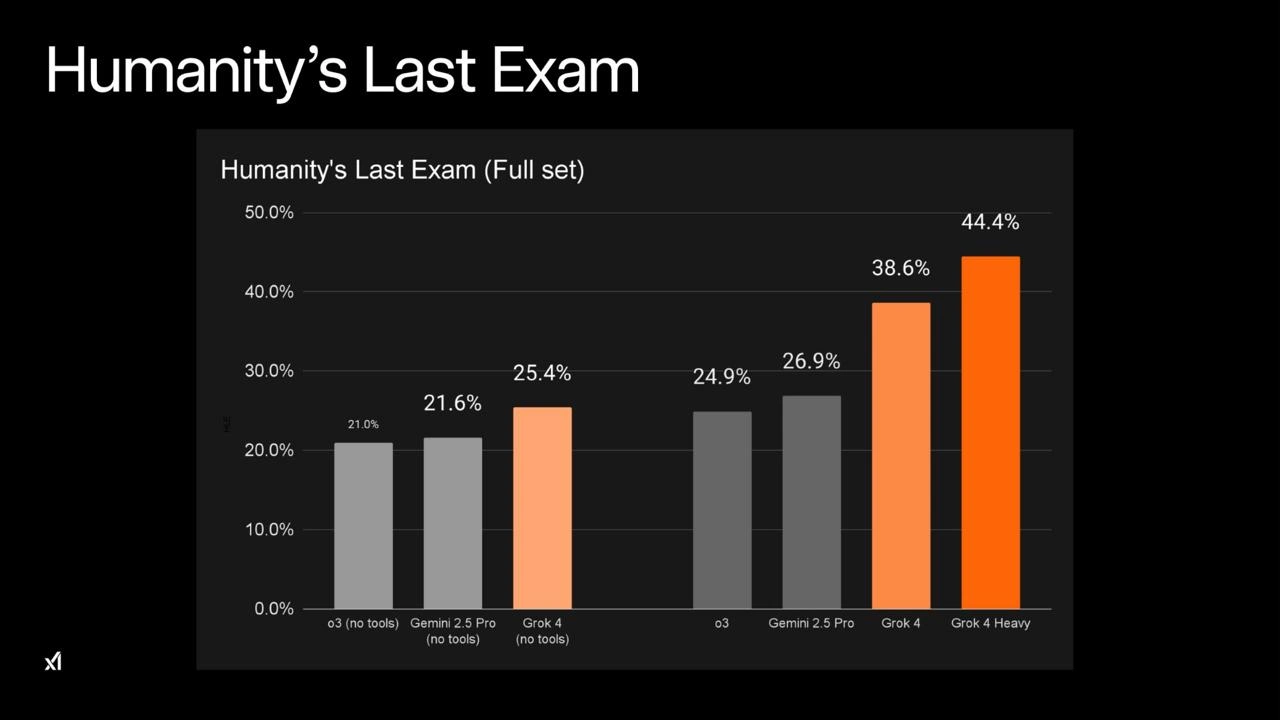
In the machine learning world, the chase for state-of-the-art (SOTA) performance is an endless loop – much like an Ouroboros (a snake eating its tail). Each new AI model claims to be the “world’s most powerful”, but fundamental theory reminds us why this crown never stays put. The no free lunch theorem in ML states that no single model is best at every task – there’s always some trade-off or niche where another approach can win. Today’s record-smashing model might dominate on popular benchmarks, but introduce a new challenge domain or slightly tweaked metric and suddenly it’s not supreme anymore. This meme’s circular arrangement of logos captures that idea: as soon as one company’s model reaches the top of a leaderboard, another competitor is right behind ready to dethrone it, creating a self-perpetuating cycle.
From a research perspective, this cycle is driven by ever-shifting goalposts. One year it’s about bigger parameter counts (billions turning to trillions), the next it’s about novel architectures or training on multimodal data. Each “world’s most powerful model” excels by optimizing for the current favored benchmarks – say, the highest score on MMLU or the lowest perplexity on language tasks. But optimizing too hard for specific metrics triggers Goodhart’s Law: when a metric becomes a target, it can lose its value as a good measure. Companies might fine-tune models specifically to ace certain tests (to claim SOTA), which yields diminishing real-world returns. Meanwhile, the definition of “powerful” is itself slippery – does it mean the highest accuracy on academic tasks? The most diverse capabilities (coding, reasoning, vision)? The longest context window or the ability to handle complex prompts? Depending on how you measure “power,” different models could claim the title. In multi-objective terms, these models sit on a Pareto frontier of various skills and efficiencies. One model might be the best at code generation, another at common-sense QA, and yet another at real-time performance. Declaring an absolute “most powerful” glosses over this multidimensional reality for the sake of a flashy headline.
The meme’s red asterisk and “YOU ARE HERE” marker next to OpenAI’s logo is a tongue-in-cheek you-are-currently-at-this-point-in-the-cycle indicator. It implies that today we’re listening to OpenAI’s announcement, but soon we’ll move on. Indeed, in a few months, the arrow will curve on and we’ll be at the next logo – maybe a new Google Gemini model boasting superior multi-modal reasoning, or Musk’s Grok touting some edgy innovation – with each claiming the exact same superlative tagline. It’s a commentary on the model_release_cycle in cutting-edge AI: no achievement holds the top spot for long because the field is advancing in a competitive, almost feed-forward loop manner. The result is an AI vendor arms race where research progress and marketing bravado are tightly intertwined. On a technical level, it’s impressive how quickly these models leapfrog one another by exploiting scaling laws and novel training techniques. But the meme highlights the almost absurd uniformity of their claims. Every iteration is “the biggest leap forward yet” – a hyperbole arms race that, when visualized as an infinite loop, exposes its own futility. In short, the meme hints that “world’s most powerful” is less of a factual designation and more of a transient PR badge, one destined to be swapped out when the next giant model arrives.
Description
A diagram on a white background illustrates the cyclical nature of AI model releases. It features the logos of four major AI players arranged in a circle: OpenAI, a generic 'AI' logo (representing competitors like Anthropic), Google's Gemini, and xAI's Grok. Curved black arrows connect them, indicating a continuous loop. Each logo is accompanied by the exact same marketing claim: 'Introducing the world's most powerful model.' A red asterisk and the text 'YOU ARE HERE' are placed next to the OpenAI logo, humorously indicating the current point in this relentless cycle. The meme satirizes the predictable and repetitive marketing hype in the AI industry, where each new model is launched with superlative claims, only to be quickly challenged by the next competitor in the ongoing 'AI arms race.' For senior developers, this reflects the exhausting reality of trying to keep up with a field where groundbreaking announcements are a near-quarterly event, and 'the world's most powerful' is a title that changes hands faster than a JavaScript framework
Comments
7Comment deleted
This isn't a hype cycle, it's a load balancer. Each vendor gets a turn at the 'world's most powerful model' endpoint until the next health check fails
LLM product roadmap, Q1-Q4: 1) add 5B params, 2) rename to ‘Omega’, 3) update press release to ‘world’s most powerful’, 4) merge marketing branch back into hype-cycle main
Remember when we measured model performance in actual benchmarks instead of press release superlatives? Now every model is simultaneously 'the most powerful' until you check the fine print about which cherry-picked metric they're using this week
Every AI company's product roadmap is just a circular linked list where each node points to 'world's most powerful model' and the only way to break the cycle is a stack overflow of marketing claims. The real innovation isn't in the models - it's in finding new superlatives that haven't been SEO-optimized yet
AI's SOTA cycle: today's 'world's most powerful' is tomorrow's baseline for someone else's RAG pipeline
It’s DNS round-robin for SOTA: a new CNAME every quarter, same latency - only the cherry‑picked MMLU/GSM8K bars rotate
If “world’s most powerful model” were a database, it’d be eventually consistent - every press release does a last‑write‑wins update to our vendor list